
|
Lot: 126 ♡
|
|||||||||||
|
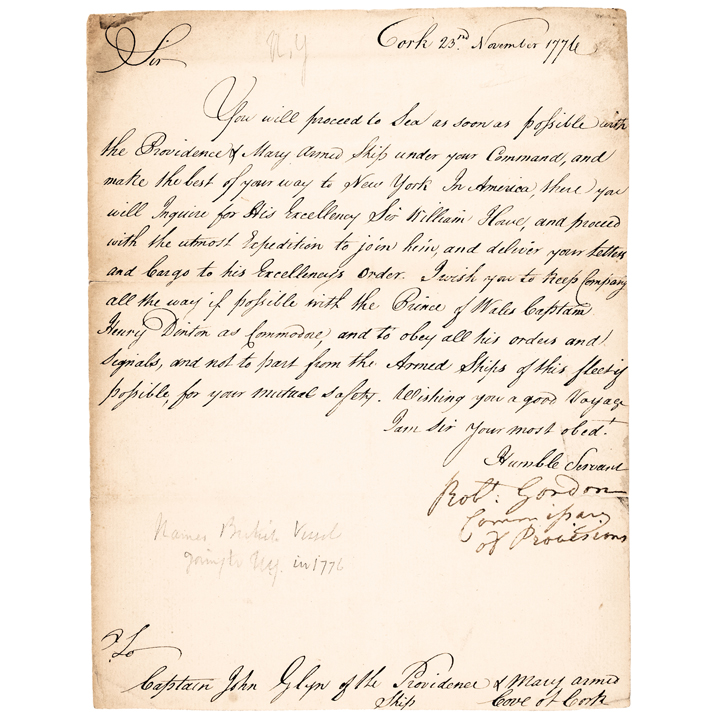
1776 Armed Ship “Providence and Mary” Ordered to New York in America, ... there you will inquire for his Excellency Sir William Howe...” to Assist in Naval War against the rebel Americans
|
|||||||||||
|
|||||||||||
 |
|
||||||||||
|
Lot 126:
1776 Armed Ship “Providence and Mary” Ordered to New York in America, ... there you will inquire for his Excellency Sir William Howe...” to Assist in Naval War against the rebel Americans
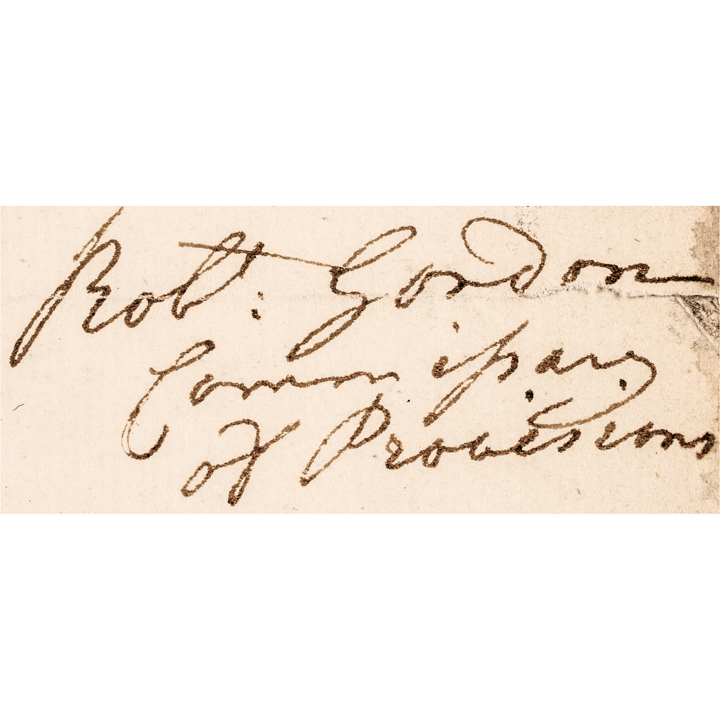
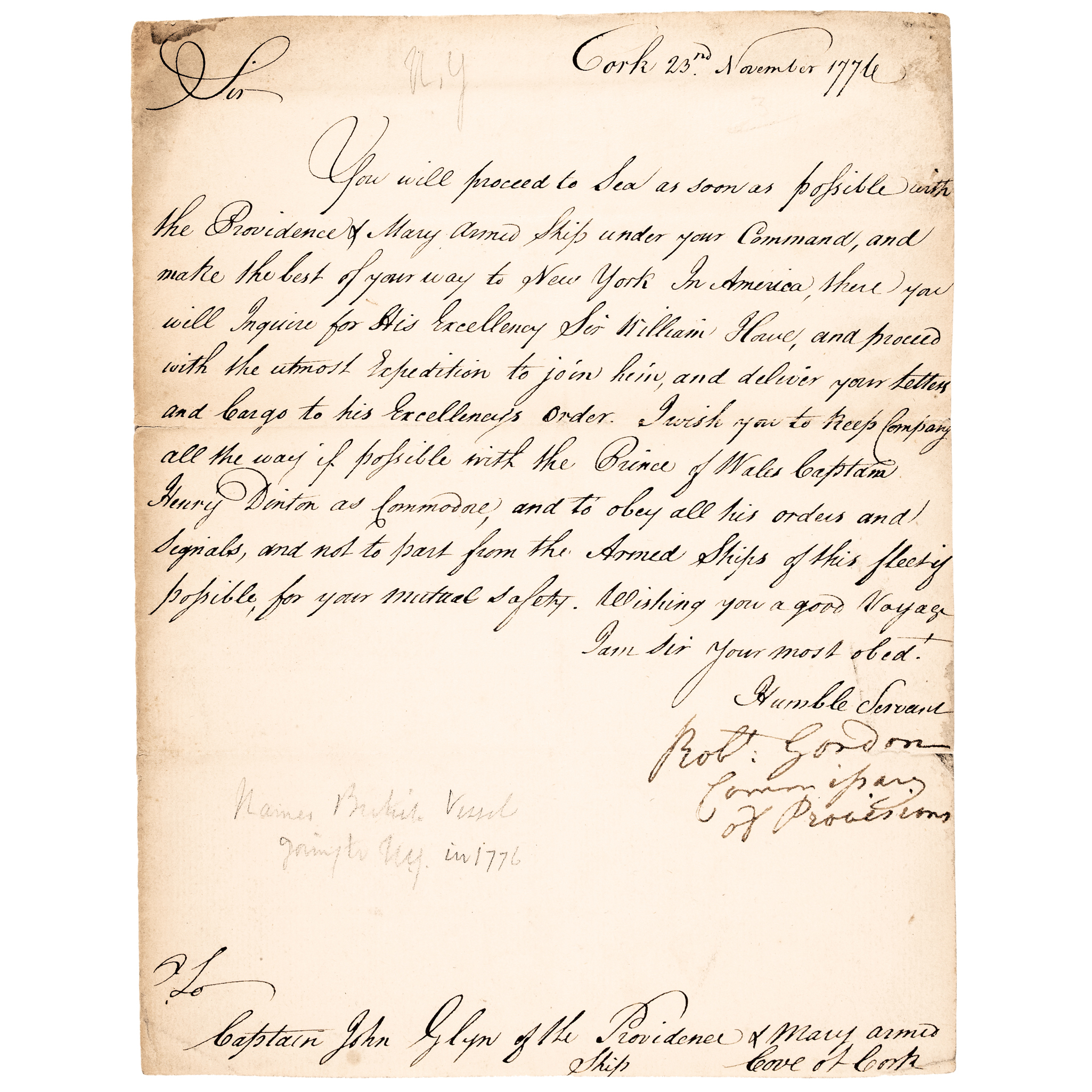
November 23, 1776-Dated Revolutionary War, Important Content Manuscript Document Signed, “Robert Gordon” as British Navy Commissary of Provisions, from Cork (England), directing the Armed Ship “Providence & Mary” to leave for New York in America as soon as possible to meet with Sir William Howe, Choice Fine. This exceptional content November 23, 1776 dated document is 1 page, measuring 9.5” x 7”, completely penned by “Robert Gordon” the British Commissary of Provisions. Here, Gordon expressly orders Captain John Glyn of the Providence & Mary armed Ship to sail immediately, to meet with Sir William Howe in New York, and to assist in the Blockade and Naval War against the rebel Americans. Boldly written in rich brown ink and easily readable on laid period paper, having just some modest tone at upper corners, being addressed: “To - Captain John Glyn of the Providence & Mary armed Ship - Cove of Cork”. This letter reads, in full: “Cork - 23rd November 1776 --- Sir - You will proceed to Sea as soon as possible with the Providence and Mary Armed Ship under your Command, and make the best of your way to New York in America, there you will inquire for his Excellency Sir William Howe, and proceed with the utmost Expedition to join him, and deliver your letters and Cargo to his Excellency's order. I wish you to keep Company all the way if possible with the Prince of Wales Captain Henry Dinton as Commodore and to obey all his orders and signals, and not to part from the Armed Ships of this fleet if possible, for your mutual safety. Wishing you a good Voyage - I am Sir your most obedt. Humble Servant - (Signed) Robert Gordon Commissary of Provisions.” The British Armed Ship “Providence & Mary” (not be be confused with the myriad “Providence” ships of America and other nations) was an armed sloop that saw service in America before being captured on February 2, 1777 by the Maryland Privateer Brigantine “Sturdy Beggar.” Ironically, the “Sturdy Beggar” had joined the Continental Navy on November 19, 1776, just a few days before Robert Gordon wrote this letter. General William Howe, 5th Viscount Howe (1729-1814), was a British Army officer and politician who rose to become Commander-in-Chief in America, during the American War of Independence. Howe was one of three brothers who had distinguished military careers. In the American War, he is usually referred to as “Sir William Howe.” Provenance: Collection of Ambassador J. William Middendorf II. The Armed ship "Providence and Mary" was also a vessel involved in the transportation of formerly Enslaved Blacks during the British evacuation of Loyalists and others at the end of the American Revolution. More specifically, the ship "Providence and Mary" was one of eleven vessels that transported formerly Enslaved Blacks for Port Roseway, Nova Scotia, as part of the April 1783 evacuation fleets organized by the British Commander-in-Chief, Sir Guy Carleton. Carleton had stayed true to the various proclamations that the British had issued to Emancipate Patriot Slaves during the American Revolution, and rather than turning his back on Black Loyalists, the Commander in chief ignored the Virginian Slave Masters instead. As the frustrated Slave owners had learned to their dismay, eleven ships of the April evacuation fleets (Polly, London, Ann, Esther, Apollo, Kingston, Blacket, Elizabeth, Montague, Providence and Mary) were transporting “their” Slaves for Port Roseway, Nova Scotia. In the months that followed, no less than 292 other Black Loyalists who had once been Enslaved in Norfolk, and Princess Anne Counties, would find sanctuary in the West Indies, Nova Scotia, New Brunswick, England, and Belgium. General William Howe, 5th Viscount Howe (10 August 1729 - 12 July 1814), was a British Army officer and politician who rose to become Commander-in-Chief, America, during the American War of Independence. Howe was one of three brothers who had distinguished military careers. In historiography of the American war, he is usually referred to as Sir William Howe. Howe joined the army in 1746 and saw extensive service in the War of the Austrian Succession and Seven Years' War. He became known for his role in the capture of Quebec in 1759 when he led a British force to capture the cliffs at Anse-au-Foulon, allowing James Wolfe to land his army and engage the French in the Battle of the Plains of Abraham. Howe also participated in the British offensive campaigns of Louisbourg, Belle PROBLEM: Île and Havana. He was appointed Lieutenant-Governor of the Isle of Wight, a post he held until 1795. Howe was sent to North America in March 1775, arriving in May after the American War of Independence broke out. After leading British troops to a costly victory in the Battle of Bunker Hill, Howe took command of all British forces in America from Thomas Gage in September of that year. Howe's record in North America was marked by the successful capture of both New York City and Philadelphia. However, poor campaign planning for 1777 contributed to the failure of John Burgoyne's Saratoga campaign, which played a major role in the entry of France into the war. Howe's role in developing those plans and the degree to which he was responsible for British failures that year (despite his personal success at Philadelphia) have both been subjects of contemporary and historic debate. He was knighted after his successes in 1776. He resigned his post as Commander-in-Chief, British land forces in America, in 1777, and the next year returned to England, where he was at times active in the defence of the British Isles. He sat in the House of Commons from 1758 to 1780 for Nottingham. He inherited the Howe viscountcy upon the death of his brother Richard in 1799. He married, but had no children, and the viscountcy became extinct with his death in 1814. |
|||||||||||
|
Auction Closing: Saturday, April 18th
at Noon Eastern Time • 9:00 AM Pacific Time |
|||||||||||