
|
Lot: 135 ♡
|
|||||||||||
|
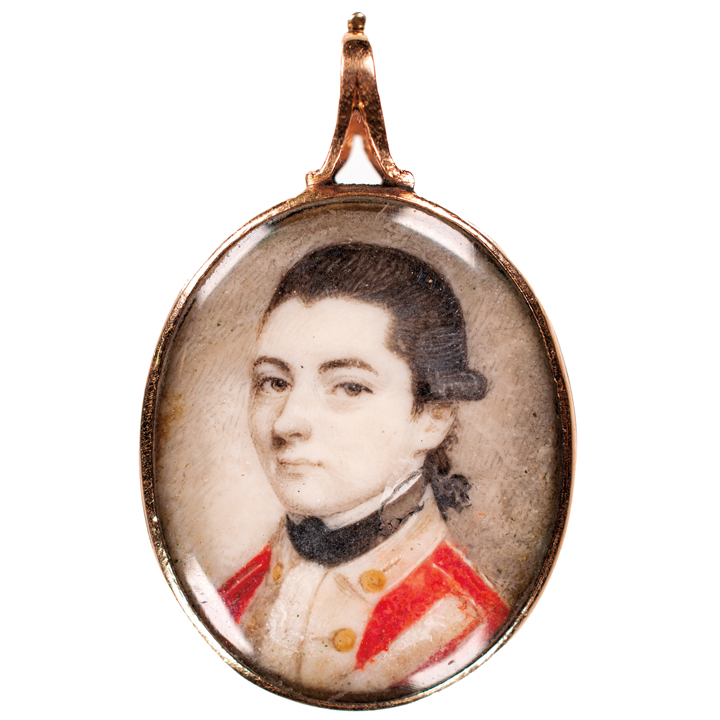
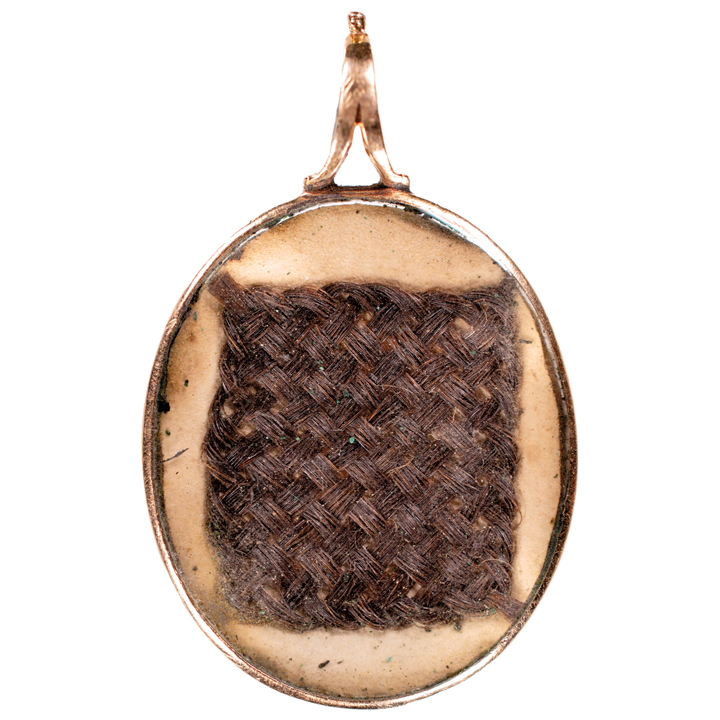
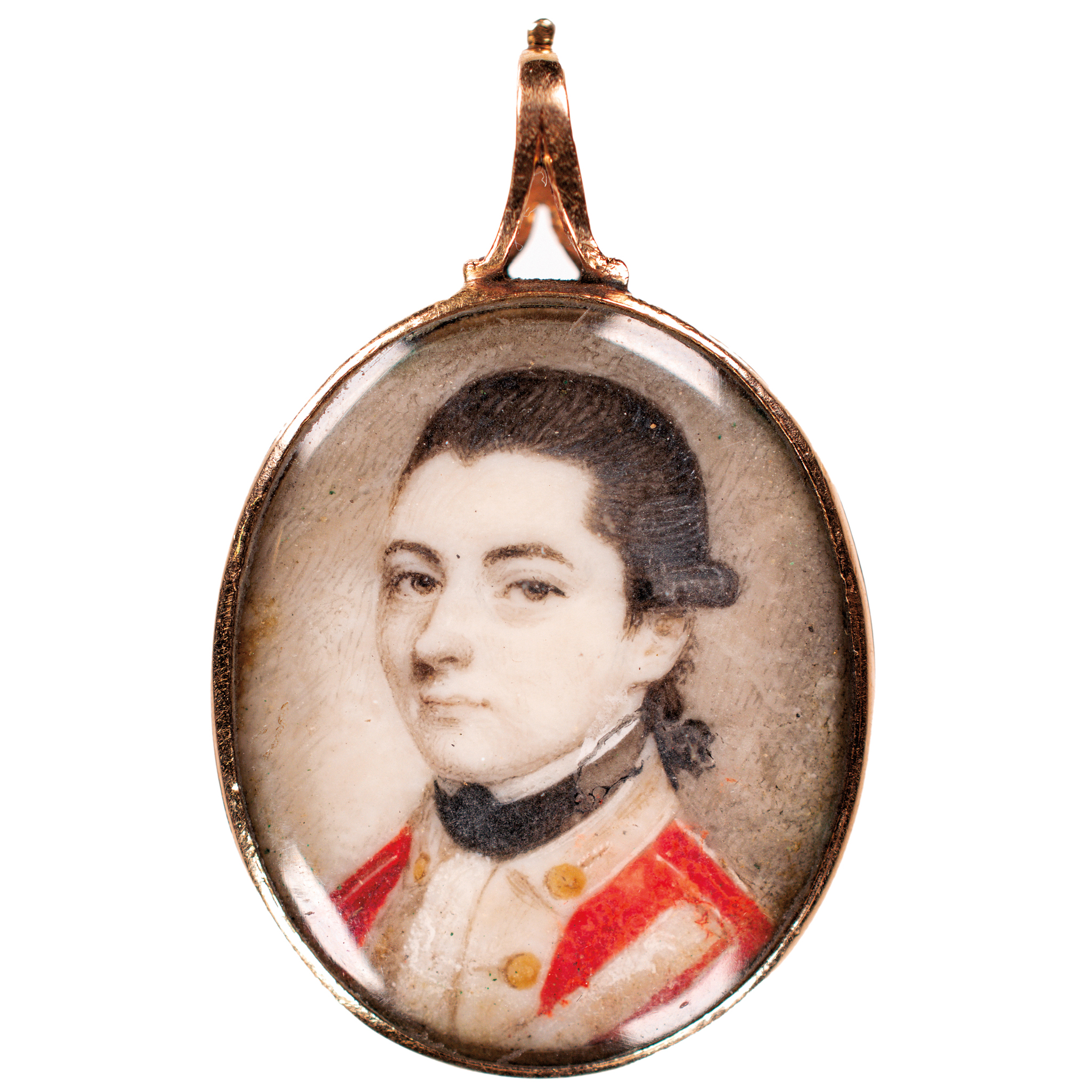
c. 1774 Rare George Engleheart Miniature Portrait of a Young English 40th Regiment of Foot Officer, the Officer’s Hair Woven tightly into a decorative square pattern, England
|
|||||||||||
|
|||||||||||
 |
|
||||||||||
|
Lot 135:
c. 1774 Rare George Engleheart Miniature Portrait of a Young English 40th Regiment of Foot Officer, the Officer’s Hair Woven tightly into a decorative square pattern, England
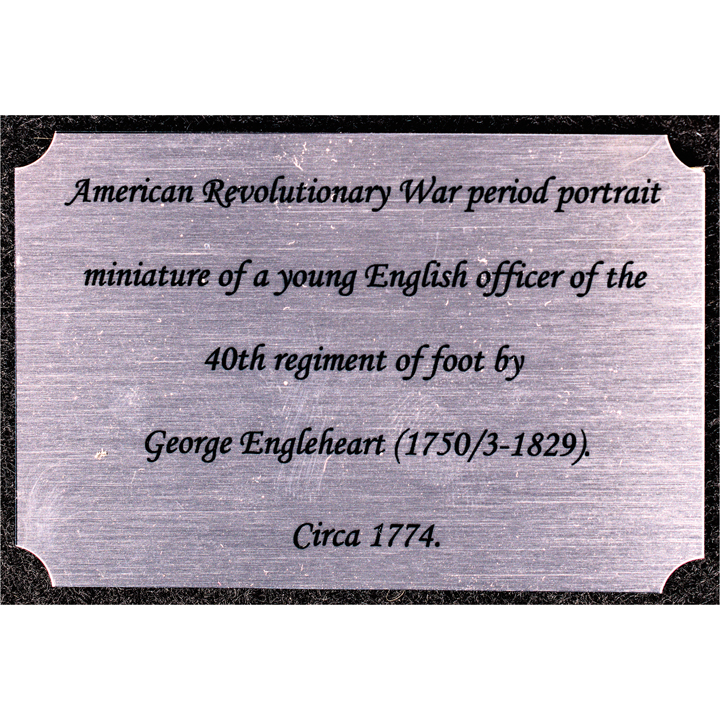
c. 1774 George Engleheart (1750/3-1829) American Revolutionary War period Portrait Miniature of a young English Officer of the 40th Regiment of foot (2nd Somersetshire) a unit which saw extensive active American service (1775-1783), in a Gold Bezel, his Hair Woven tightly into a decorative square pattern sealed on the back, with engraved plaque, Choice Extremely Fine. This beautifully detailed American Revolutionary War period Portrait Miniature is attributed to the accomplished English miniaturist George Engleheart (1750-1829.) This pendant measures about 1.25 x 0.75 inches, presenting an attractive and historically evocative example of Revolutionary War period military related miniature. This artwork portrays a young British officer of the 40th Regiment of Foot wearing the Regiment’s distinctive uniform of a scarlet frock coat with pale blue buff facings, gilt buttons, a white ruffled shirt, and a red shoulder wing trimmed with white lace, according the 1768 regulations. A black neck cloth completes the officer’s dress, accurately reflecting the appearance of a junior officer of the regiment during the early Revolutionary period. On the reverse of this pendant is the young Officer’s hair woven into a fine decorative square pattern. Not examined out of its frame. This fine portrait is delicately executed apparently on the white natural material typically used during the period. Despite its small scale, demonstrating the precision and refined brushwork characteristic of late 18th century English portrait miniatures. It is housed within a gold pendant style locket featuring a fluted rose-gold mount with an applied suspension loop, allowing it to be worn or displayed. This pendant itself remains intact and well preserved. Condition is choice for its age. There are minor signs of use to the pendant consistent with normal wear over time. **Please read about the American Revolutionary War history and actions by the British 40th Regiment of foot outlined in our online version of this catalog at: www.EarlyAmerican.com George Engleheart (1750/3-1829) ranks alongside John Smart, Richard Cosway and Ozias Humphry as one of the most talented portrait miniaturists active in Georgian England. Engleheart began his professional training in 1769 when he was admitted into the Royal Academy Schools in London, starting as a pupil of the Irish landscape artist George Barret. Perhaps owing to Barret’s bankruptcy, Engleheart found himself under the supervision of the celebrated portrait painter Sir Joshua Reynolds from 1773 until 1776. He meticulously studied Reynolds’s creative approach, carefully copying his full-scale oil paintings in miniature, observing his master’s technique, style and compositional devices which would later emerge in Engleheart’s subsequent work. On completion of this apprenticeship, Engleheart established his own practice initially being based on Shepherd Street, Mayfair, then moving to a studio on Princes Street, near Hanover Square in 1776, and finally settling at 4 Hertford Street in 1783. He quickly attracted an impressive client base for his regency portrait miniatures, with rapid success undoubtedly bolstered by his association with Reynolds, and became a central figure in a thriving market for watercolours on ivory. According to his fee-book, now in private ownership, Engleheart produced over four thousand eight hundred portrait miniatures throughout his forty-year career, demonstrating the huge demand for his work among notable members of London’s elite. His clients appreciated the characteristic poise and sobriety evidenced in his portraiture and valued his keen observation to detail and excellent draughtsmanship. From 1773 to 1822, Engleheart exhibited a selection of his miniatures from a growing portfolio at the Royal Academy. His early miniatures (c. 1773-1780) are smaller in scale, for example A Young Girl, wearing white dress, with more muted tones in comparison with his more confident handling and fluent brushwork evident in his middle period between c.1780 to 1795, A Lady Wearing a White Dress. The skill and virtuosity apparent in his work enlisted the patronage of military men like Lieutenant-Colonel George Collier, aristocratic intelligentsia, society sweethearts and even King George III, who in 1789 employed Engleheart as his Pictor Primus, producing around twenty five portraits of the monarch and other members of the royal family. His decorative style and skill in flattery favoured the royal aesthetic and in return for his favour King George helped to raise the artist’s reputation. Such regal associations induced even more commissions and high demand for his portrait miniatures, but Engleheart worked rapidly, painting straight from life without preliminary sketches, allowing him to meet this growing demand. https://philipmould.com/artists/107-george-engleheart/ ___ May 8, 1775, under the command of Major James Grant, departed the British Isles for Boston. The 40th was composed of eight companies. There were twenty seven officers and four hundred and forty rank and file. They arrived in Boston on June 25th, a week after the Battle of Bunker Hill, and put under the direct command of General Thomas Gage. It was in August of 1775 that chief command of British forces in America changed hands from General Gage to Lieutenant General William Howe. The 40th, along with the British army, wintered in Boston. Cut off from food and supplies from the mainland, they faced malnutrition and suffered from lack of heating fuel. When the Americans fortified the high grounds on Dorchester Heights, Gage ordered an evacuation of the city. The 40th boarded the ships Spry and Success as the rest of the British army, numbering 8,906 men, were transported to Halifax departing March 17th, 1776. On August 22, 1776, the 40th, part of the 4th Brigade under the command of Major General James Grant, invaded Long Island. The 40th remained before the American defenses along Harlem Heights under the command of Lord Percy. On October 28th, Howe attacked the American forces dug in along White Plains. On November 18th, General Cornwallis crossed the Hudson above Fort Lee on the New Jersey side. The Americans retreated before his force. General Grant’s 4th Brigade, with the 40th, joined Cornwallis on November 24th. The pursuit of the Americans across New Jersey was carried on for three weeks until the Americans crossed the Delaware into Pennsylvania. After Washington’s victory at Trenton, General Cornwallis rushed his forces across New Jersey. While passing through Princeton on January 2nd , he left the 17th, 55th, and 40th before proceeding on to Trenton. The 40th soon found themselves embroiled in what became known as the Battle of Princeton. Washington was able to position his forces at Brandywine Creek, south of Philadelphia in Maryland. Howe advanced and attacked on September 11th, 1777. For this engagement, the 40th were back in Major General Grants Brigade. At the Battle of Brandywine, the Rangers performed well under the command of Captain Wemyss of the 40th. Battle or Massacre of Paoli ... Major General Grey with the 2nd Battalion Light Infantry, to which the 40th Light Infantry was now attached, and the 42nd and 44th Regiments to make a night attack against the American camp. They killed fifty three and wounded over a hundred more, capturing over seventy. Of the 40th Light Infantry, Captain Wolfe, along with three rank and file, were killed. This became known as the Paoli Massacre. The Battle of Germantown would shed fame upon the 40th and laurels upon its commander, Colonel Thomas Musgrave who fought at the Chew House. On October 10th, Howe moved his army from Germantown towards Philadelphia. The 40th went into camp and wintered near the city while George Washington moved his army to Valley Forge. British General Clinton left Philadelphia on June 10th and gradually made his way across New Jersey towards Sandy Hook, NY, arriving Monmouth on June 27th. The next day, June 28th, the army was put in motion. The 40th were in the lead under Hessian General Knyphausen. At the Battle of Monmouth, June 27th & 28th, the 40th flank companies sustained heavy casualties. During the battle, the 40th battalion companies, serving as pickets to guard the baggage, were attacked by an American light infantry. In early Winter 1778 General Clinton assembled five thousand troops under Major General Grant which included the 40th. They departed Staten Island in November and arrived at Barbados on December 10th, 1778. Here the 40th were involved in several actions against the French over the next two years. The 40th remained in the West Indies until June of 1781, when they returned to their old quarters at Staten Island. Soon after, Clinton organized a small expedition under American turncoat General Benedict Arnold to destroy privateers and collect Naval stores at New London, Connecticut. The 40th, now commanded by Major William Montgomery, sailed with the expedition on September 4th and passed through the sound arriving Groton, Conn. on the 6th. commanded by Arnold, was to capture Fort Trumbull on the New London side of the harbor and gain possession of the town. The other, under the command of Lieutenant Colonel Eyre which consisted of the 40th, 54th, some artillery, and some loyalist volunteer from New Jersey were to attack Fort Griswold on the Groton side. Fort Trumbull was abandoned. Fort Griswold was another matter. ommand of the assault was turned over to Major Stephen Bromfield of the 40th. As the British swarmed into the fort, its commander, Colonel Ledyard offered surrender. Many of the British soldiers continued to fire upon the Americans as they tried to surrender, killing and wounding many. It was reported by eyewitnesses that Colonel Ledyard offered his sword to Major Bromfield. The officer accepted it then immediately thrust it thought Ledyard, killing him instantly. Eighty five Americans were killed, most of them after having surrendered. Sixty were wounded and seventy made prisoner. Major Bromfield was given command of the 40th on September 7th, 1781. Fort Griswold was to be the last action the 40th saw in America. After Connecticut, the regiment sailed back to Flag Staff, Staten Island, and their old camp. There they remained until New York City was nearly abandoned by British forces. The 40th was one of the last units to set sail on November 25th, 1783. |
|||||||||||
|
Auction Closing: Saturday, April 18th
at Noon Eastern Time • 9:00 AM Pacific Time |
|||||||||||