
|
Lot: 144 ♡
|
|||||||||||
|
1791 JOHN HANCOCK & SAMUEL ADAMS Tally Sheet Document Recording Massachusetts State Election Results 2nd Election held under the New United States Constitution
|
|||||||||||
|
|||||||||||
 |
|
||||||||||
|
Lot 144:
1791 JOHN HANCOCK & SAMUEL ADAMS Tally Sheet Document Recording Massachusetts State Election Results 2nd Election held under the New United States Constitution
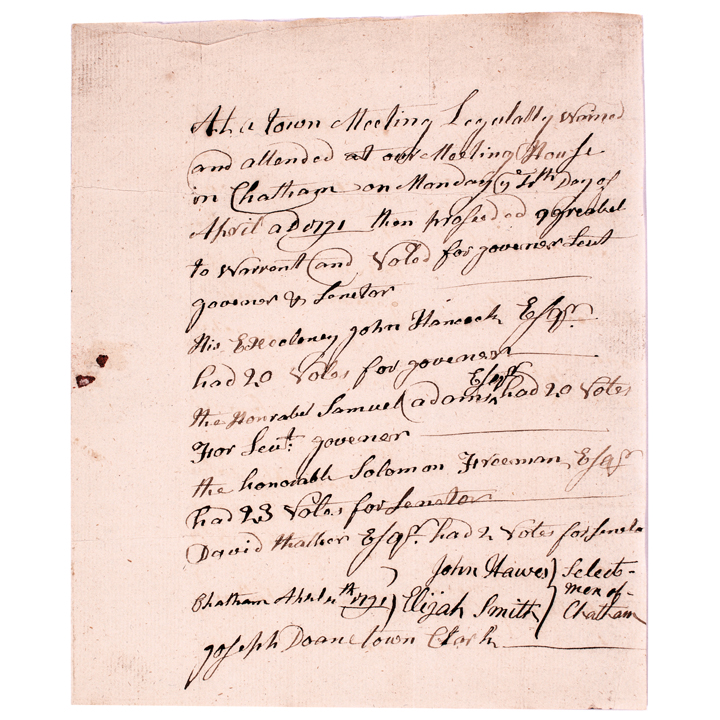
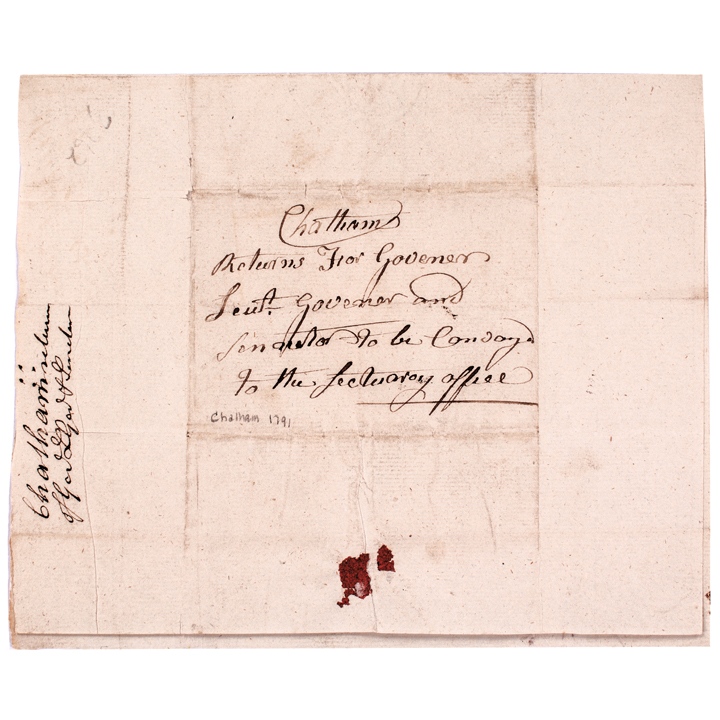
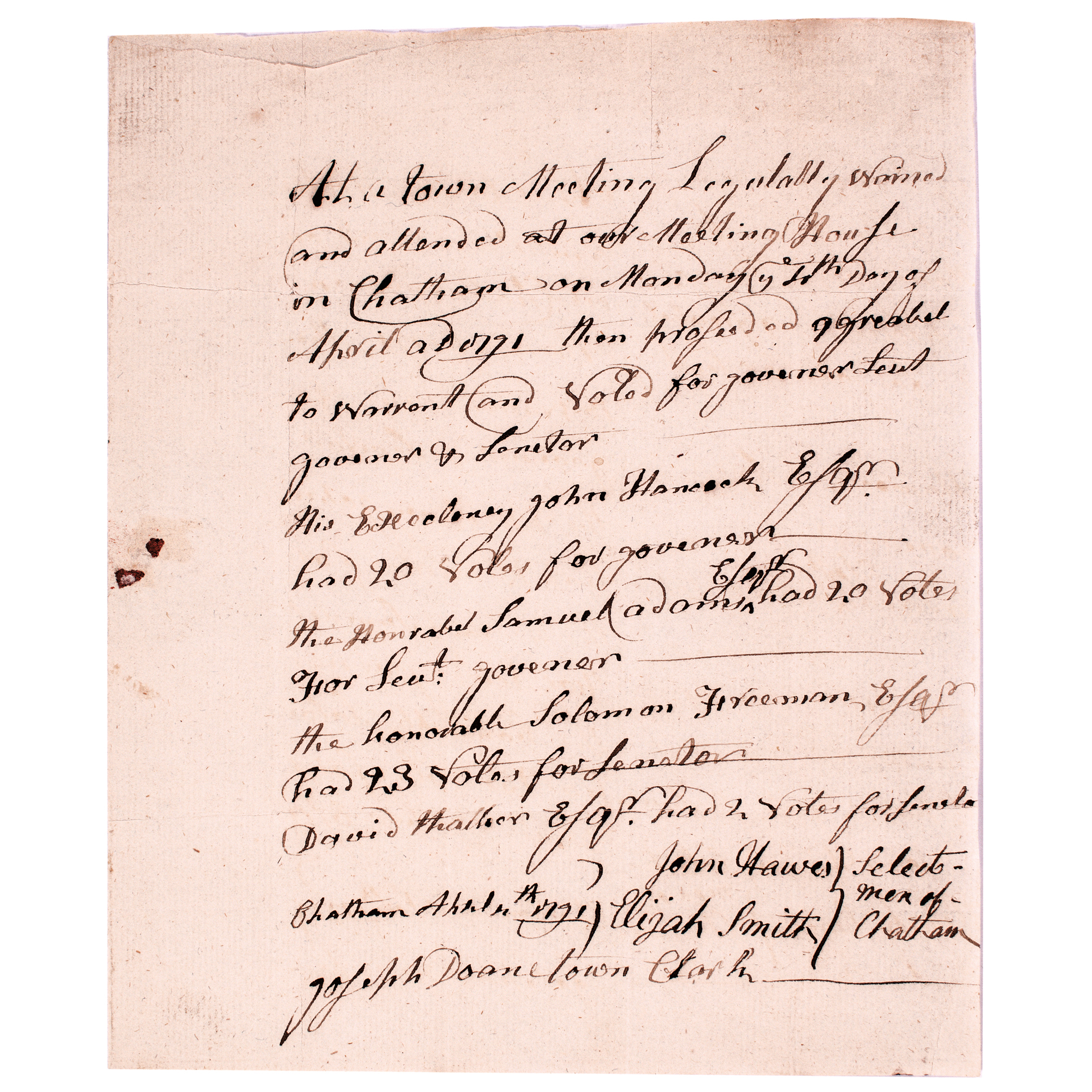
April 4th, 1791-Dated Federal Period, JOHN HANCOCK, SAMUEL ADAMS State of Massachusetts Election Tally Sheet Results for GOVERNOR & SENATOR, Manuscript Document as reported from the town of Chatham (on Cape Cod), being the Second Election held under the United States Constitution, with its Integral Transmittal Cover, Choice Extremely Fine. April 4th, 1791 very rare and historic, important early Federal Period Political Election Tally Sheet Results for GOVERNOR & SENATOR, listing (JOHN HANCOCK & SAMUEL ADAMS Related) where Hancock & Adams tie with 20 Votes each for Governor. In the 1791 Massachusetts gubernatorial election held on April 4, 1791, incumbent John Hancock was reelected in a landslide victory with 16,055 being 94% of the Votes, Chatham provided 20 or the 37 Votes for Adams. This Manuscript Document reports results for the Second Massachusetts election held under the new United States Constitution, 1 page, measuring about 7.5” tall x 6” wide, with its Integral Transmittal Cover with traces of its original red wax seal, well written in rich brown ink on clean laid period paper, reading, in full: “Chathams Returns For Governor / Leut. Governor and Senator to be Conveyed to the Secretary office” and the Docket reads: “Chatham return of Gov Lt Gov & Senator”. This Tally Sheet Return reads, in full: “At a town meeting Legally Called and attended at our Meeting House in Chatham on Monday the 4th Day of April AD 1791 - then proceeded agreabel, to Warrent and Voted for governor Leut governor & Senator --- His Excellency John Hancock Esqr. had 20 Votes for governor --- the Honorable Samuel Adams Esqr. had 20 Votes, for Leut: governor --- the Honorable Solomon Freeman, Esqr. had 23 Votes for Senator --- David Theatre Esqr. had 2 Votes for Senator --- (Signed) Selectmen of Chatham - Chatham April 4th, 1791 (by committee members & Clerk). The 1791 Massachusetts gubernatorial election was held on April 4th and resulted in the re-election of incumbent John Hancock. Hancock, a wealthy merchant, president of the Continental Congress from 1775 to 1777, and signer of the Declaration of Independence, had resumed the governorship in 1787 after an earlier stint from 1780 to 1785 and a period in the state senate. The election encountered no organized opposition of note, with Hancock securing victory amid scattered votes for minor candidates, underscoring his enduring appeal in a state dominated by Federalist sentiments following ratification of the U.S. Constitution. This outcome aligned with Massachusetts' tradition of annual gubernatorial contests under its 1780 constitution, which emphasized direct voter input in executive selection during the formative years of the republic. Hancock's tenure emphasized fiscal prudence and support for federal authority, though his health declined in his final years; Lieutenant Governor Samuel Adams served as acting governor after Hancock's death in 1793. The absence of partisan strife in this contest highlighted the relative political consensus in Massachusetts at a time when national divisions over issues like the Bank of the United States were emerging but had yet to deeply fracture state-level races. The ratification debates over the U.S. Constitution in 1788 further defined the landscape, with Massachusetts' convention of 355 delegates-the largest of any state-divided between Federalists advocating centralized authority to address interstate weaknesses exposed by events like Shays' Rebellion, and Anti-Federalists wary of elite consolidation eroding Revolutionary War era democratic gains. Ratification passed narrowly on February 6, 1788, by 187 to 168, after Governor Hancock proposed amendments including a Bill of Rights to assuage opponents like Elbridge Gerry and Samuel Adams, who initially resisted but shifted under pressure for national union. This outcome aligned Massachusetts with Federalist priorities, diminishing overt Anti-Federalist influence by 1791, though underlying sectional tensions over representation and fiscal policy persisted in a pre-partisan system strained by economic legacies rather than formalized factions. By the early 1790s, with the federal government operational since 1789, state politics emphasized stability under Hancock's popular leadership, setting the stage for gubernatorial contests focused on continuity amid recovering commerce and manufacturing. |
|||||||||||
|
Auction Closing: Saturday, April 18th
at Noon Eastern Time • 9:00 AM Pacific Time |
|||||||||||