
|
Lot: 213 ♡
|
|||||||||||
|
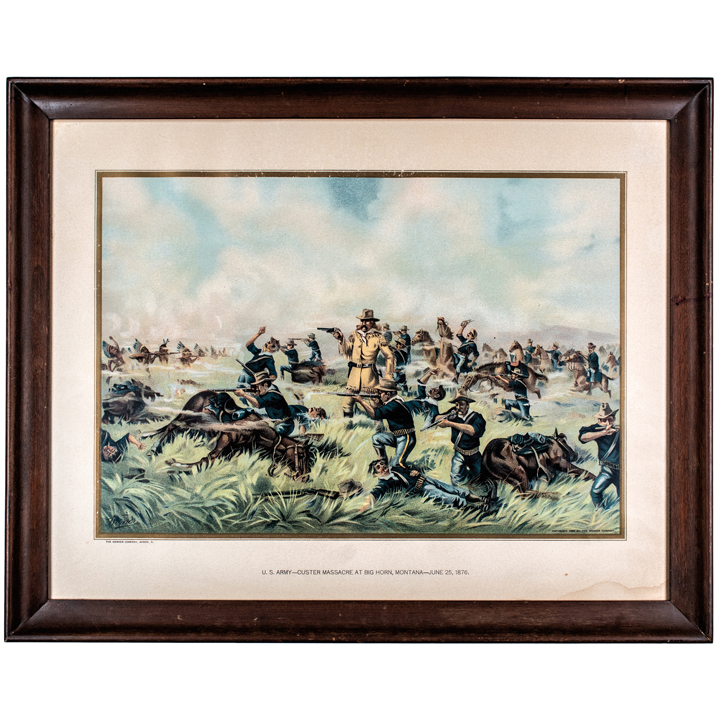
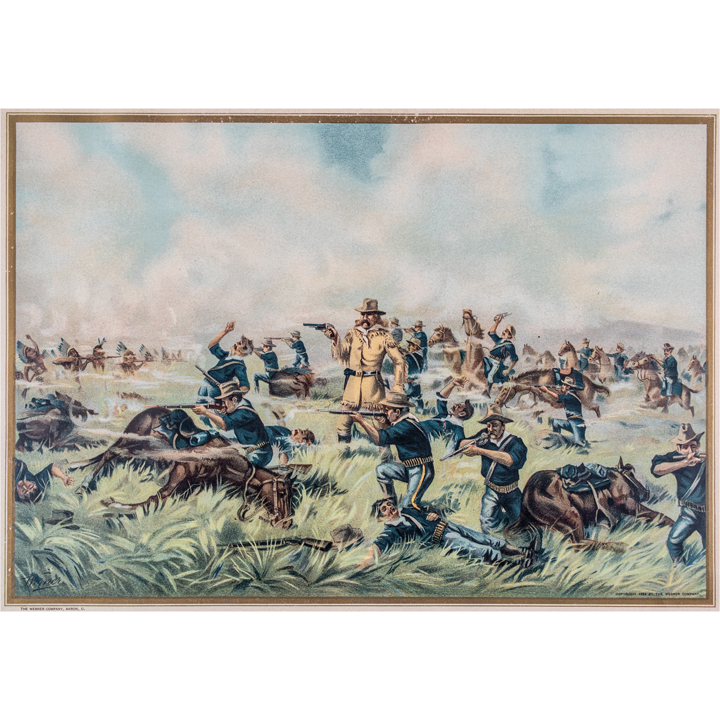
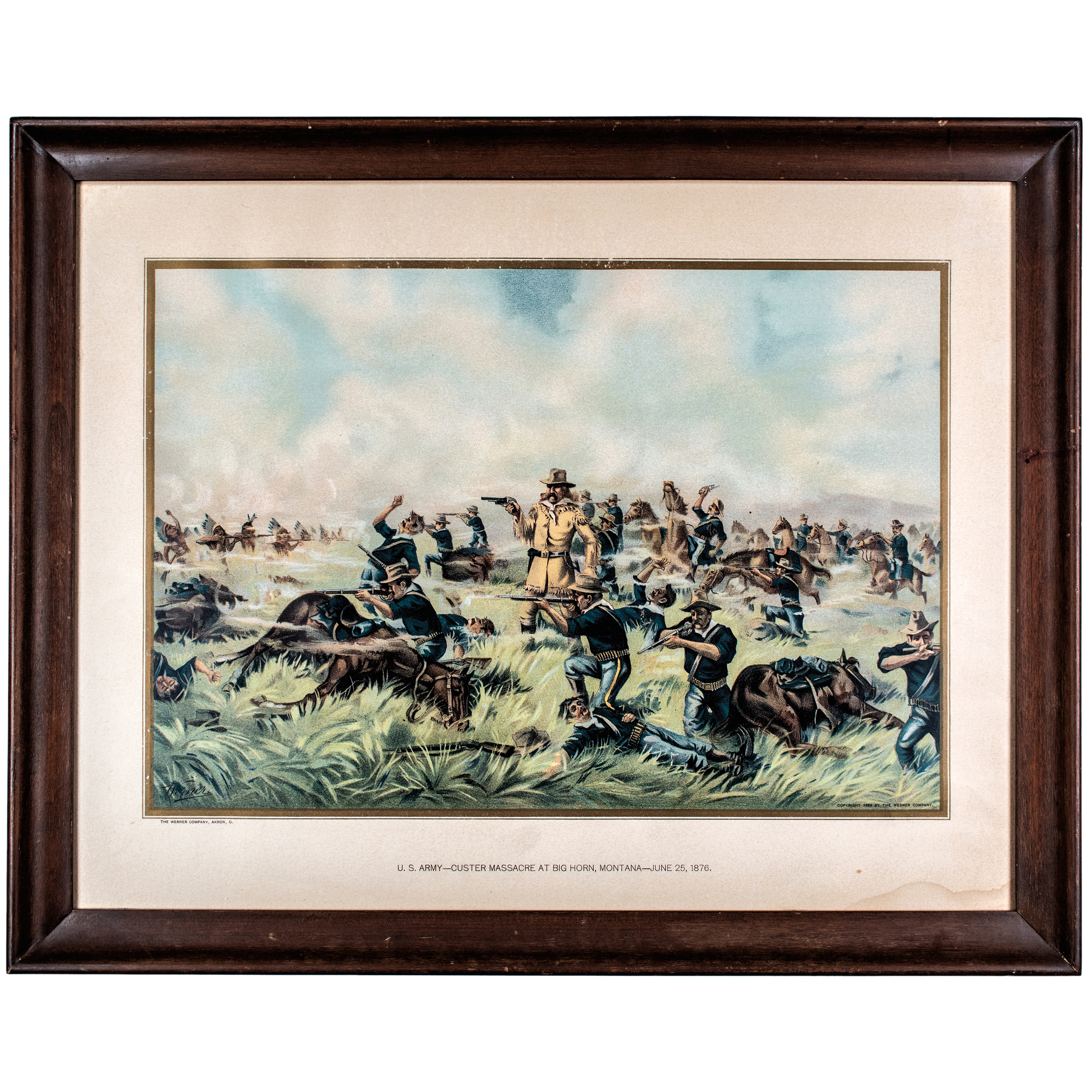
1899 “U.S. ARMY - CUSTER MASSACRE AT BIG HORN, MONTANA - JUNE 25, 1876.” Chromolithograph
|
|||||||||||
|
|||||||||||
 |
|
||||||||||
|
Lot 213:
1899 “U.S. ARMY - CUSTER MASSACRE AT BIG HORN, MONTANA - JUNE 25, 1876.” Chromolithograph
1899-Dated Copyright, Color Chromolithograph titled, “U.S. ARMY - CUSTER MASSACRE AT BIG HORN, MONTANA - JUNE 25, 1876.” by “Werner”, The Werner Company, Akron, Ohio, Wood Frame, Choice Extremely Fine. A scarce original 1899 issued Chromolithograph with printed signature of artist “Werner” printed by the Werner Company of Akron, Ohio titled, “U.S. Army - Custer Massacre at Big Horn, Montana - June 25, 1876.” This action Chromolithograph print remains bright and clean with strong colors having only a some very slight humidity tone at the bottom right corner frame edge far from printing. It has nice eye-appeal displaying a classic rendition with General George Armstrong Custer shown standing at center, his 7th cavalry troopers all about, firing his pistol at the attacking Indians of which four are shown wearing their Chief’s Eagle Feather War Bonnets. Modern reproductions are found online of this historic Chromolithograph. While this is the authentic “original” from 1899 and ready to hang on display. Custer's "Last Stand" also marked the Plains Indians' last stand. The shocking news of Custer's defeat arrived in the east two days after the nation's Centennial, and encouraged a thirst for revenge. The Plains Indians suffered a series of defeats following the battle. The Indian alliance was shattered and Sitting Bull and some of his people fled to Canada. Buffalo Bill Cody would advertise himself as the first soldier to scalp an Indian in retaliation for Custer's defeat. Within a year, nearly all the Plains Indians had been confined on reservations. Historic Note - Document from: The Custer Massacre - Harper's Weekly - 5 August 1876: The fate of the brave and gallant Custer has deeply touched the public heart, which sees only a fearless soldier leading a charge against an ambushed foe, and falling at the head of his men and in the thick of the fray. A monument is proposed, and subscriptions have been made. But a truer monument, more enduring than brass or marble, would be an Indian policy intelligent, moral, and efficient. Custer would not have fallen in vain if such a policy should be the result of his death. It is a permanent accusation against our humanity and ability that over the Canadian line the relations between the Indians and whites are so tranquil, while upon our side they are summed up in perpetual treachery, waste, and war. When he was a young lieutenant on the frontier, General Grant saw this, and watching attentively, he came to the conclusion that the reason of the difference was that the English respected the rights of the Indians and kept faith with them, while we make solemn treaties with them as if they were civilized and powerful nations, and then practically regard them as vermin to be exterminated. The folly of making treaties with the Indian tribes may be as great as treating with a herd of buffalo. But the infamy of violating treaties when we have made them is undeniable, and we are guilty both of the folly and the infamy. We make treaties-that is, we pledge our faith-and then leave swindlers and knaves of all kinds to execute them. We maintain and breed pauper colonies. The savages who know us and who will neither be pauperized nor trust our word we pursue and slay if we can at an incredible expense. The flower of our young officers is lost in inglorious forays, and one of the intelligent students of the whole subject rises in Congress and says, "The fact is that these Indians, with whom we have made a solemn treaty that their territory should not be invaded. That they should receive supplies upon their reservations, have seen from one thousand to fifteen hundred miners during the present season entering and occupying their territory, while the Indians, owing to the failure of this and the last Congress to make adequate appropriations for their subsistence, instead of being fattened, as the gentleman says, by the support of the government, have simply been starved." The Red Cloud investigation of last year, however inadequate, sufficed to show the practice under our Indian policy, and we regretted then that ex-Governor Bullock of Massachusetts declined the appointment upon the commission, because there was evidently the opportunity of an exhaustive report upon the whole subject, which should have commanded the attention of the country, and would sooner or later have led to some decisive action. It is plain that so long as we undertake to support the Indians as paupers, and then fail to supply the food; to respect their rights to reservations, and then permit the reservations to be overrun; to give them the best weapons and ammunition, and then furnish the pretext of their using them against us; to treat with them as men, and then hunt them like skunks-so long we shall have the most costly and bloody Indian wars, and the most tragical ambuscades, slaughters, and assassinations. The Indian is undoubtedly a savage, and a savage greatly spoiled by the kind of contact with civilization which he gets at the West. There is generally no interest whatever in him or his fate. But there should be some interest in our own good faith and humanity, in the lives of our soldiers and frontier settlers, and in the taxation to support our Indian policy. All this should certainly be enough to arouse a public demand for a thorough consideration of the subject, and the adoption of a system which should neither be puerile nor disgraceful, and which would tend to spare us the constant repetition of such sorrowful events as the slaughter of Custer and his brave men. |
|||||||||||
|
Auction Closing: Saturday, April 18th
at Noon Eastern Time • 9:00 AM Pacific Time |
|||||||||||