
|
Lot: 223 ♡
|
|||||||||||
|
Important 1868 Andrew Johnson Impeachment Trial Archive with Senator Yates Owned Rare Broadside containing the Senate Votes “Guilty & Not Guilty” Johnson’s Impeachment
|
|||||||||||


|
|||||||||||
 |
|
||||||||||
|
Lot 223:
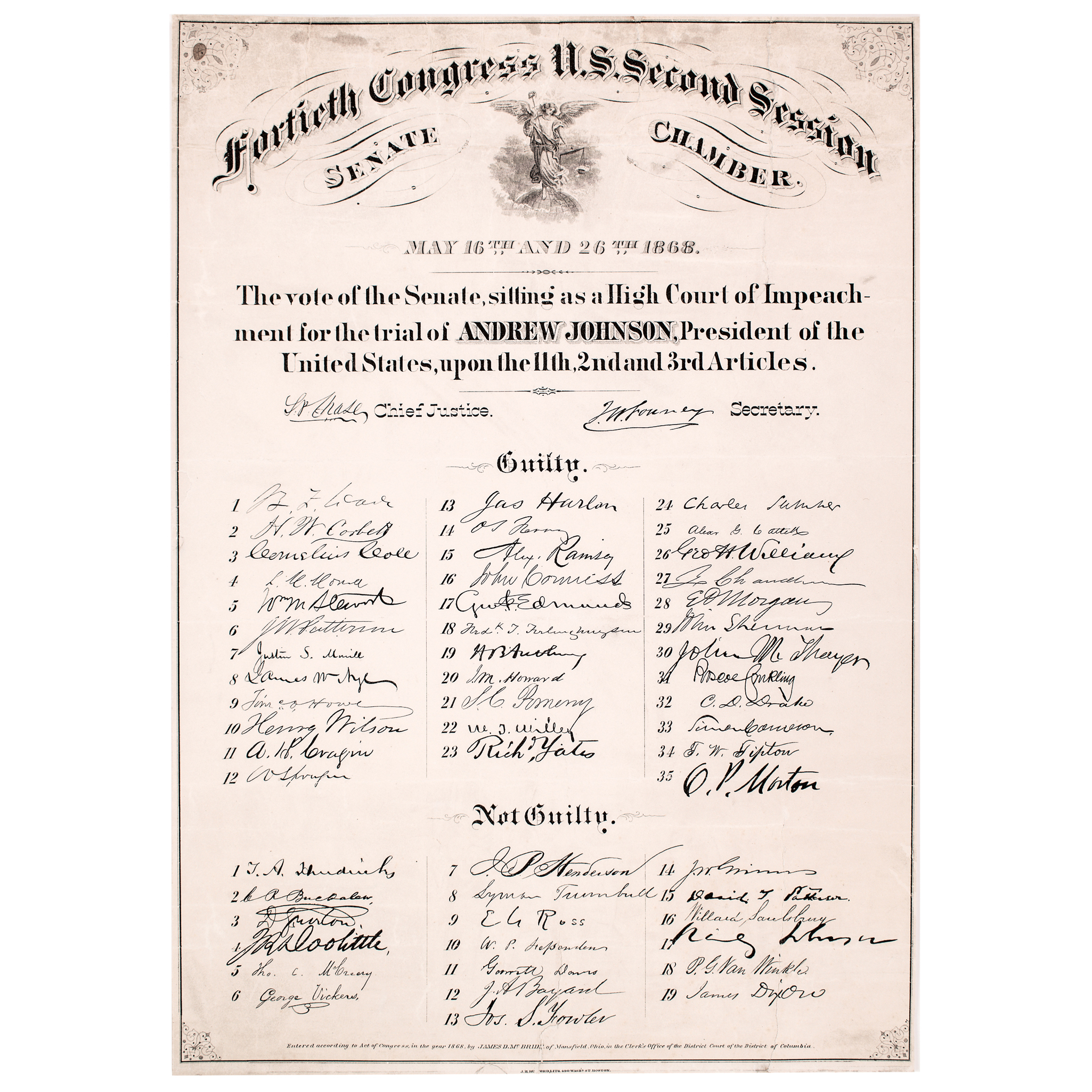
Important 1868 Andrew Johnson Impeachment Trial Archive with Senator Yates Owned Rare Broadside containing the Senate Votes “Guilty & Not Guilty” Johnson’s Impeachment
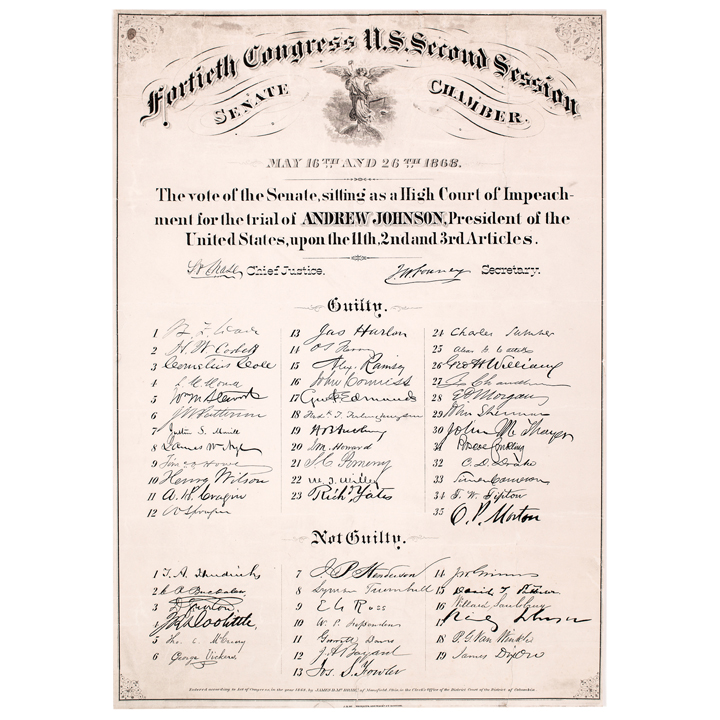
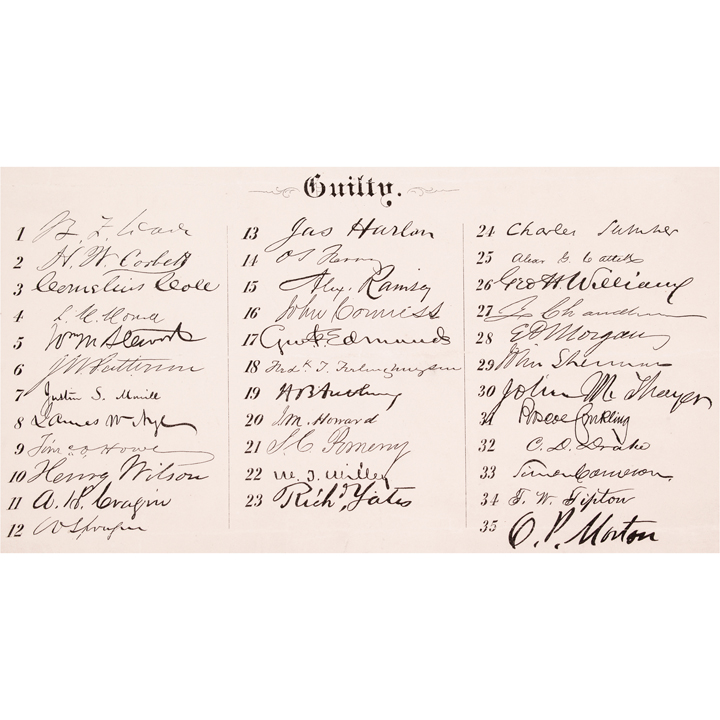
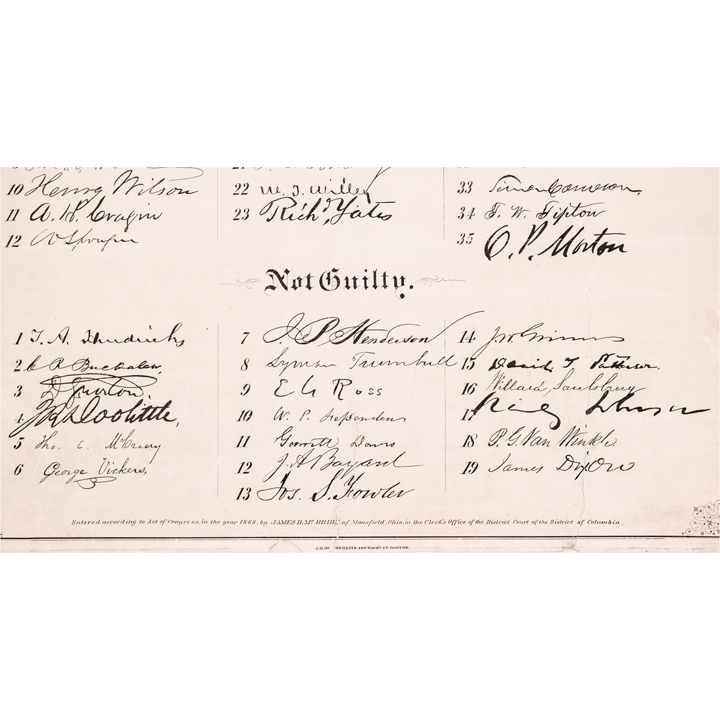
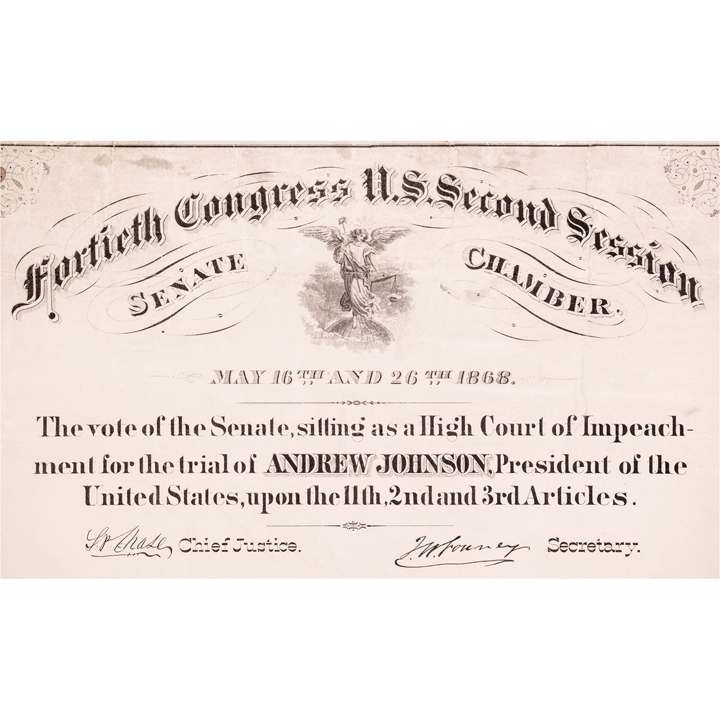
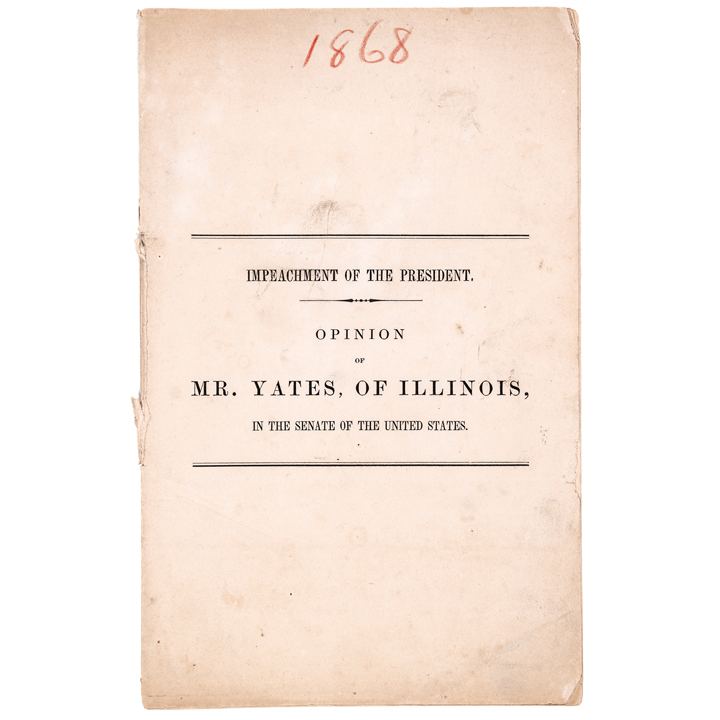
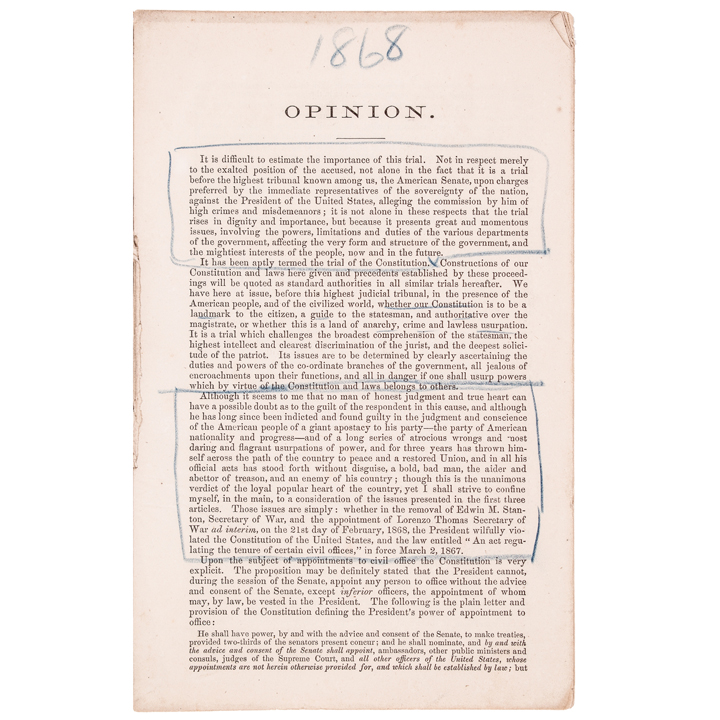
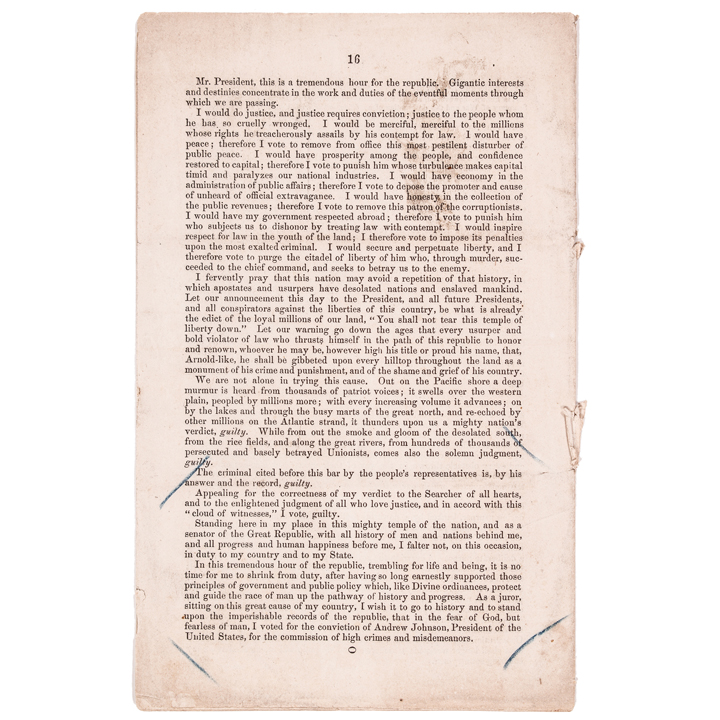
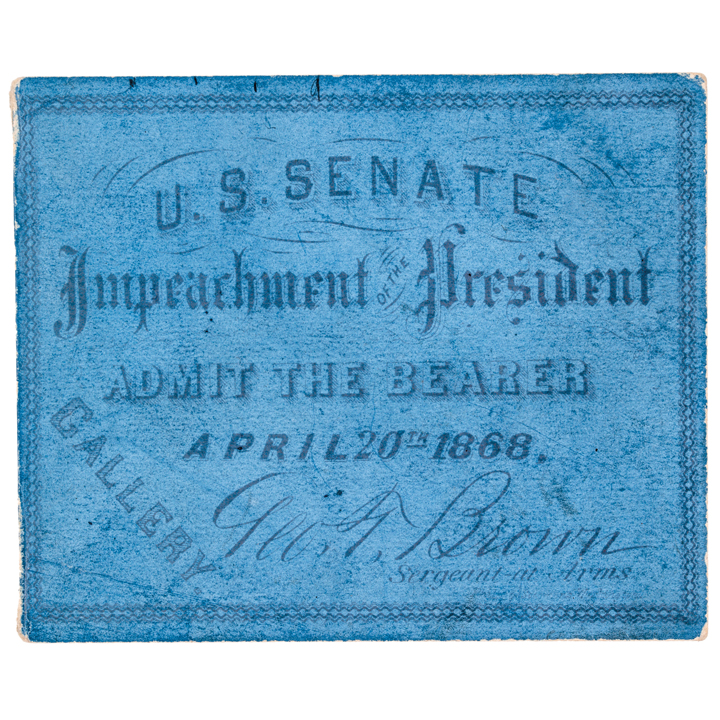
1868-Dated, Important Historical Lot of (3) Items each relating to President Andrew Johnson’s Impeachment Trial in 1868, including Senator Richard Yates of Illinois Broadside displaying the facsimile signatures of the United States Senators who Voted “Guilty” and “Not Guilty,” for or against Johnson’s Conviction, plus two lesser items of Senator Yates, Choice Very Fine or better. 1. Broadside Headed: “Fortieth Congress U.S. Second Session - Senate Chamber. - May 16th AND 26th 1868. / The vote of the Senate, sitting as a High Court of Impeachment for the trial of ANDREW JOHNSON, President of the United States, upon the 11th, 2nd and 3rd Articles.”, Very Fine. The highlight of this small archive is this large vivid, exceedingly rare Political Broadside containing the United States Senate’s Votes for and against President Johnson’s Impeachment, said to have been issued to the participants, this being Senator Richard Yates of Illinois personal copy, which came together with the other two items. It was engraved by James D. McBride of Mansfield, Ohio and printed by “J.H. BUFORD, Lith. 490 Washington St., BOSTON” printed at the bottom edge. This Broadside measures 13.75” x 19.5” printed on bold black ink on heavy cardstock. The individual Votes are organized by “Guilty” and “Not Guilty,” with each accompanied by the voting Senator’s facsimile signature. Senator Yates’s signature is number 23 having Voted in the “Guilty” section. The Senate held a roll call vote on only 3 of the 11 articles before adjourning as a Court. An exceptional rarity which displays clean and boldly printed engraved text with just a few trivial sealed splits at the extreme bottom edge from prior use or display, sealed split at top right and professionally conserved and deacidified for longevity. Overall, with significant impressive eye appeal. Extremely rare as we have not been able to locate another example of this Broadside. The original signed original is housed in the Library of Congress. 2. An Impeachment Trial Admission Ticket is printed on blue card measuring 3.5” x 3” its stub removed when actually used. Its text reads; “U.S. Senate -- Impeachment of the President -- Admit the Bearer -- April 20th, 1868.” The ticket’s bottom bears the printed signature of George T. Brown, Sergeant-at-Arms for the U.S. Senate during the proceedings. 3. A Booklet containing the transcript of Senator Yates’s Opinion on the Impeachment which measures 5.75” x 9” with 16 pages complete. The first and final pages are annotated with what appears to be colored pencil, marking sections where Senator Yates presents his argument for impeaching President Johnson. His reasons include the damage Johnson did to the Southern Reconstruction projects in the wake of the Civil War, and the positive necessity of holding him to account for his bad conduct as President. On May 16, The vote on the article was one vote short (35 to 19) of the two thirds majority needed for conviction. The trial was then recessed for ten days. On May 26 the Senate also failed by the same margin (35 to 19) to convict Johnson on articles two and three. At this point the Senate voted to adjourn the trial sine die without considering the remaining articles. An opinion that Senator Ross was mercilessly persecuted for his courageous vote to sustain the independence of the presidency as a branch of the federal government is the subject of an entire chapter in President John F. Kennedy's book, “Profiles in Courage”. Provenance: Stated to be from the estate of Richard Yates, Senator for Illinois. The Impeachment of President Andrew Johnson for "high crimes and misdemeanors" was initiated by the United States House of Representatives on February 24, 1868. The alleged high crimes and misdemeanors were afterwards specified in eleven articles of impeachment adopted by the House on March 2 and 3, 1868. The primary charge against Johnson was that he had violated the Tenure of Office Act. Specifically, that he had acted to remove Edwin Stanton from the position of Secretary of War and to replace him with Brevet Major General Lorenzo Thomas as Secretary of War ad interim. The Tenure of Office Act had been passed by Congress in March 1867 over Johnson's veto with the primary intent of protecting Stanton from being fired without the Senate's consent. Stanton often sided with the Radical Republican faction and had a good relationship with Johnson. Johnson was the first United States President to be Impeached. After the House formally adopted the articles of impeachment, they forwarded them to the United States Senate for adjudication. The trial in the Senate began on March 5, with Chief Justice Salmon P. Chase presiding. On May 16, the Senate voted against convicting Johnson on one of the articles, with its 35-19 Vote in favor of conviction, falling just one vote short of the necessary two-thirds majority. A 10-day recess of the Senate trial was called to before reconvening to convict him on additional articles. On May 26th, the Senate voted against convicting the president on two more articles by margins identical to the first vote. After this, the trial was adjourned without votes being held on the remaining eight articles of impeachment. The impeachment and trial of Andrew Johnson had important political implications for the balance of federal legislative-executive power. It maintained the principle that Congress should not remove the president from office simply because its members disagreed with him over policy, style, and administration of the office. It also resulted in diminished presidential influence on public policy and overall governing power, fostering a system of governance which future-President Woodrow Wilson referred to in the 1880s as "Congressional Government". From the Opinion of HON. RICHARD YATES, OF ILLINOIS: Opinions of Senators in the Impeachment Trial of Andrew Johnson “It is difficult to estimate the importance of this trial. Not in respect merely to the exalted position of the accused, not alone in the fact that it is a trial before the highest tribunal known among us, the American Senate, upon charges preferred by the immediate Representatives of the sovereignty of the nation, against the President of the United States, alleging the commission by him of high crimes and misdemeanors; it is not alone in these respects that the trial rises in dignity and importance, but because it presents great and momentous issues, involving the powers, limitations, and duties of the various Departments of the Government, affecting the very form and structure of the Government, and the mightiest interests of the people, now and in the future. It has been aptly termed the “Trial of the Constitution.” Constructions of our Constitution and laws here given and precedents established by these proceedings will be quoted as standard authorities in all similar trials hereafter. We have here at issue, before this highest judicial tribunal, in the presence of the American people and of the civilized world, whether our Constitution is to be a landmark to the citizen, a guide to the statesman, and authoritative over the magistrate, or whether this is a land if anarchy, crime, and lawless usurpation. It is a trial which challenges the broadest comprehension of the statesman, the highest intellect and clearest discrimination of the jurist, and the deepest solicitude of the patriot. Its issues are to be determined by clearly ascertaining the duties and powers of the coordinate branches of the Government, all jealous of encroachment upon their functions, and all in danger if one shall usurp powers which by virtue of the constitution and laws belong to others. Although it seems to me that no man of honest judgment and true heart can have a possible doubt as to the guilt of the respondent in this cause, and although he has long since been indicted and found guilty in the judgment and conscience of the American people of a giant apostasy to his party--the party of American nationality and progress--and of a long series of atrocious wrongs and most daring and flagrant usurpations of power, and for three years has thrown himself across the path of the country to peace and a restored Union, and in all his official acts has stood forth without disguise, a bold, bad man, he aided and abettor of treason, and an enemy of his country; though this is the unanimous verdict of the loyal popular heart of the country, yet I shall strive to confine myself, in the main, to a consideration of the issues presented in the first three articles. Those issues are simply: whether the removal of Edwin M. Stanton, Secretary of War, and the appointment of Lorenzo Thomas Secretary of War, ad interim on the 21st day of February, 1868, the President willfully violated the Constitution of the United States, and the law entitled, "An act regulating the tenure of certain civil offices," in force March 2, 1867 ... The conclusion of the whole matter is, that if the President issued an order for the removal of Mr. Stanton and the appointment of Thomas without advice and consent of the Senate, it being then in session, then he acted in palpable violation of the plain letter of the Constitution, and is chargeable with a high misdemeanor in office. The production of his own order removing Stanton, and of his letter of authority to Thomas, commanding him to take possession of the War Office, are all the proofs necessary to establish his guilt. And when it appears, as it does most conclusively in the evidence before use, that he not only did not have the concurrence of the Senate, but its absolute, unqualified dissent, and that he was notified of that dissent by a certified copy of a resolution to that effect, passed by the Senate, under all the forms of parliamentary deliberation, and that he still willfully and defiantly persisted, and does still persist in the removal of Mr. Stanton, and to this day stubbornly retains Thomas as a member of his Cabinet, then who shall say that he has not wickedly trampled the Constitution under his feet, and that he does not justly deserve the punishment due to his great offense? ...” |
|||||||||||
|
Auction Closing: Saturday, April 18th
at Noon Eastern Time • 9:00 AM Pacific Time |
|||||||||||