
|
Lot: 23 ♡
|
|||||||||||
|
1768 William Heath Later Continental Army Major General Signed Military Content Document as the Militia Captain
|
|||||||||||
|
|||||||||||
 |
|
||||||||||
|
Lot 23:
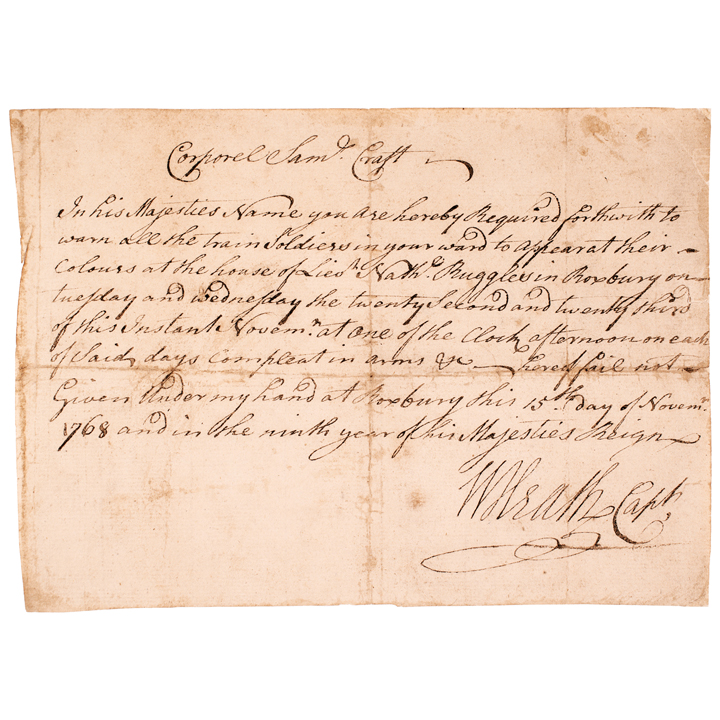
1768 William Heath Later Continental Army Major General Signed Military Content Document as the Militia Captain
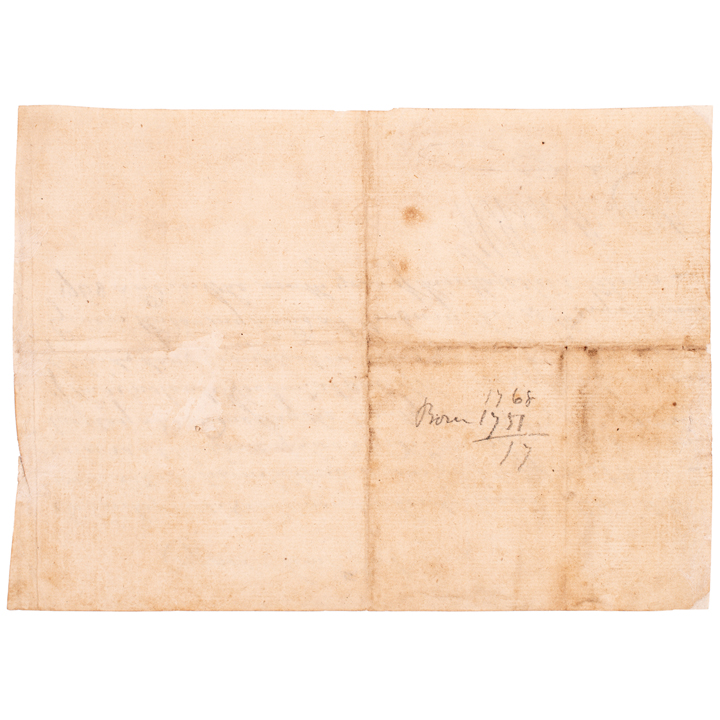
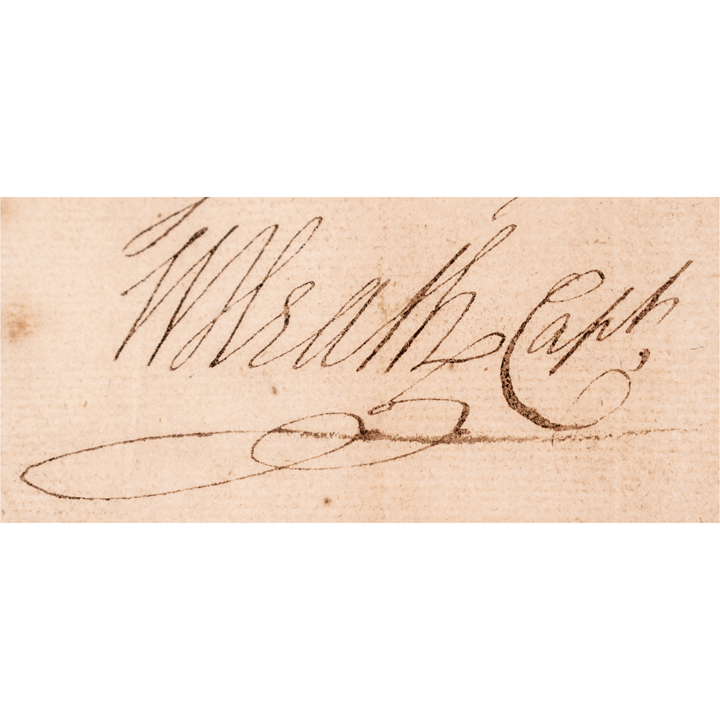
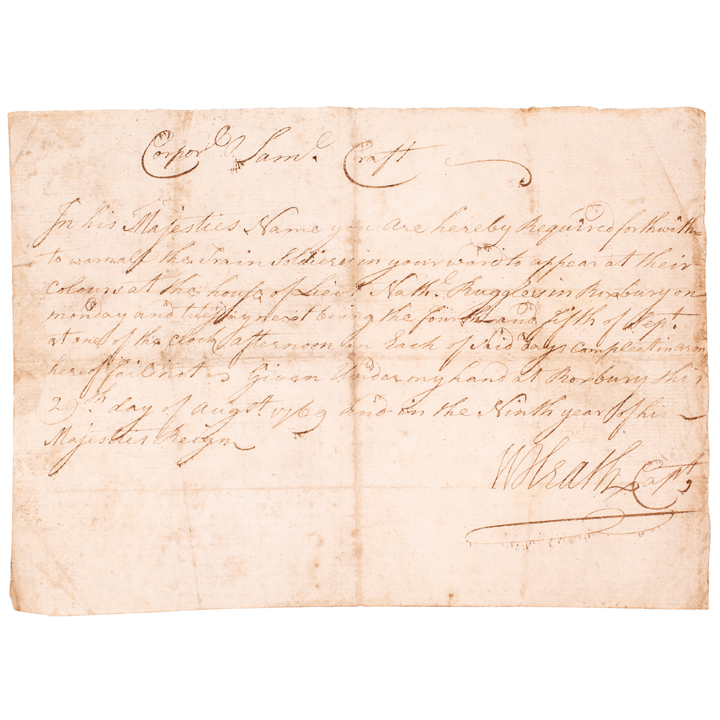
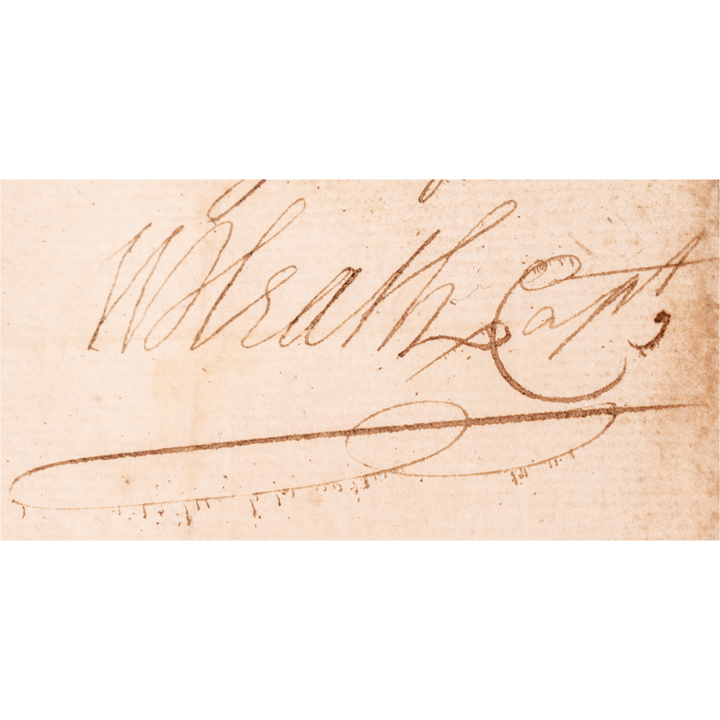
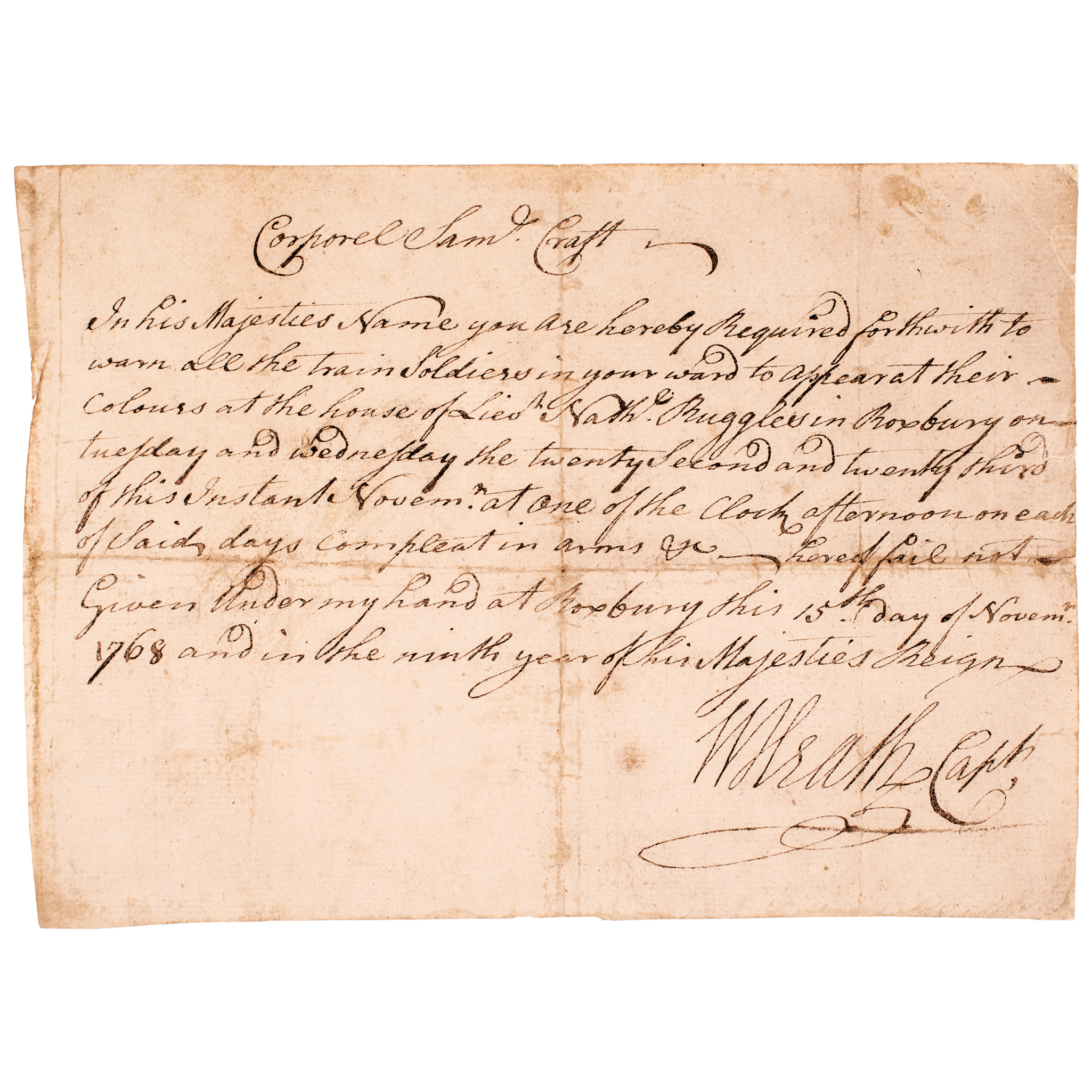
WILLIAM HEATH (1737-1814). Continental Army Major General in the American Revolutionary War on August 9th, 1776, Trained troops at Cambridge before the Battle of Bunker Hill, Commanding during the attack on Fort Independence, and later the Eastern Department, and in the Hudson Valley; Mass. State Convention Member that ratified the Constitution, served as a State Senator (1791-1792), Probate Judge, the Last Surviving Major General of the American Revolutionary War. November 15th, 1768-Dated Colonial Pre Revolutionary War America, Military Content Manuscript Militia Document Signed, “W Heath, Capt.”, 1 page, measuring about 7.25” x 5.25”, Very Fine. This well handwritten easily readable brown ink document, is to: “Corporal Saml. Craft”. Samuel Craft (Born Newton, Mass. 1729 - Died Jay, Maine 1803), also served in the American Revolution in Capt. Amaziah Fuller’s company, present at the battle of Lexington, April 19, 1775. He and his brother Lieut. Joseph Craft were later both chosen to adjust pay allowances for the local militiamen’s service since April 19, 1775, and he was a town of Newton selectman for 1773-1776, moved to Jay, Me. c. 1793. This document reads, in full: “Corporal Saml. Craft --- In his Majesties Name you are hereby Required forthwith to warn all the train Soldiers in your ward to Appear at their Colors at the house of Lieut. Nath. Ruggles in Roxbury on Tuesday and Wednesday the twenty second and twenty third of this Instant Novemr. at One of the Clock afternoon on each of Said days Compleat in arms etc. -- hereof fail not -- Given Under my hand at Roxbury the 15th Day of Novembr. 1768 and in the ninth year of his Majesties Reign. --- (Signed) W Heath, Capt.” William Heath’s signature measures a large 2.5” long with his flourish below. WILLIAM HEATH (1737-1814) was a Continental Army Major General from Massachusetts. He was born at Roxbury, Mass. on 13 March 1737. Heath was a farmer, militiaman, and politician before the American Revolution. Heath joined Boston's Ancient and Honorable Artillery Company in 1765, and later became Captain of his local Militia company, and as Revolutionary War approached he was active in rousing the Militia. He also represented Roxbury in the Massachusetts General Court in 1761 and again from 1771 until its dissolution in 1774 by Thomas Gage, Commanding British General in Boston. Then he became a Member of the Provincial Congress of Massachusetts and of the Committees of Correspondence and Safety. Promoted to Major General of Massachusetts troops on 20 June, he was appointed a Continental Army Brigadier General two days later. On 13 March 1776 he led the first detachment of troops from Boston to New York City and became Israel Putnam's second in command when the latter arrived on 3 April 1776. Heath was the last surviving Major General of the American Revolutiony War when he died on January 24th, 1814. He represented Roxbury in the Massachusetts General Court in 1761 and again from 1771 until its dissolution by Commanding General in Boston, Thomas Gage in 1774. Then he became a Member of the Provincial Congress of Massachusetts and of the Committees of Correspondence and Safety. He described himself candidly as, "of middling stature, light complexion, very corpulent, and bald-headed" (Heath, page 15). Interested in soldiering from an early age, he read every military work he could get his hands on. He saw no action during the final French and Indian War but joined Boston's Ancient and Honorable Artillery Company in 1765 and later became Captain of his local militia company; as war approached he was active in rousing the militia. On 9 February 1775 the Massachusetts Provincial Congress appointed him one of its five Brigadier Generals. The first American General on the scene as the British retreated to Boston from Lexington and Concord, he ordered the initial dispositions for what became the Siege of Boston. Promoted to Major General of Massachusetts troops on 20 June, he was appointed a Continental Army Brigadier General two days later. On 13 March 1776 he led the first detachment of troops from Boston to New York City and became Israel Putnam's second in command when the latter arrived on 3 April 1776. Heath was elevated to Major General on August 9th, 1776 and a month later was one of three senior officers who voted in a council of war to defend New York City. Commanding George Washington recognized Heath's limitations and during the New York and New Jersey campaigns posted him where no major threat was expected. On November 12th Heath was placed in command of troops defending the Hudson Highlands. His best chance for distinction as a field commander resulted in the mismanaged diversion against Fort Independence, New York, on 17-18 January 1777. George Washington wrote him privately that: "your conduct is censured... as being fraught with too much caution by which the Army has been disappointed, and in some degree disgraced" (Twohig, page 240). On 11 February 1777 Heath left Peekskill for a short leave. He reached Roxbury on 19 February and on 14 March had started back toward his headquarters when he received orders to succeed Artemas Ward as commander of the Eastern Department. The highlight of this tour of duty was his temporary custody of Burgoyne and the Convention army. He remained in Boston until 11 June 1779, when he left to join the main army on the Hudson. On 23 June he took command of troops on the east side of the river, the advance posts of which were then at Peekskill. He remained in the Highlands for the rest of the war except for the period from 16 June to 1 October 1780, when he was in Providence to handle the reception of the Comte de Rochambeau's French expeditionary force. On July 1st, 1783 he returned to his farm at Roxbury, Mass. He was a member of the State convention that ratified the Constitution, served as a State Senator in 1791-1792, and then became a probate judge. He published his valuable Memoirs in 1798. Heath was the last surviving Major General of the American Revolutiony War when he died on January 24th, 1814, in the very house where he had been born. |
|||||||||||
|
Auction Closing: Saturday, April 18th
at Noon Eastern Time • 9:00 AM Pacific Time |
|||||||||||