
|
Lot: 35 ♡
|
|||||||||||
|
1706/7 Colonial Oyster Bay New York Town Meeting Copy Record Signed Samuel Townsend Regarding Land Measures
|
|||||||||||
|
|||||||||||
 |
|
||||||||||
|
Lot 35:
1706/7 Colonial Oyster Bay New York Town Meeting Copy Record Signed Samuel Townsend Regarding Land Measures
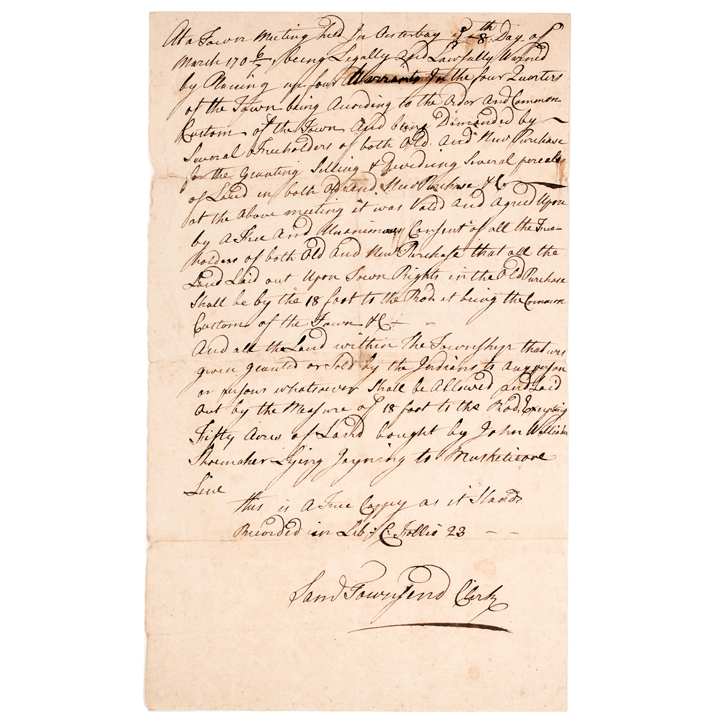
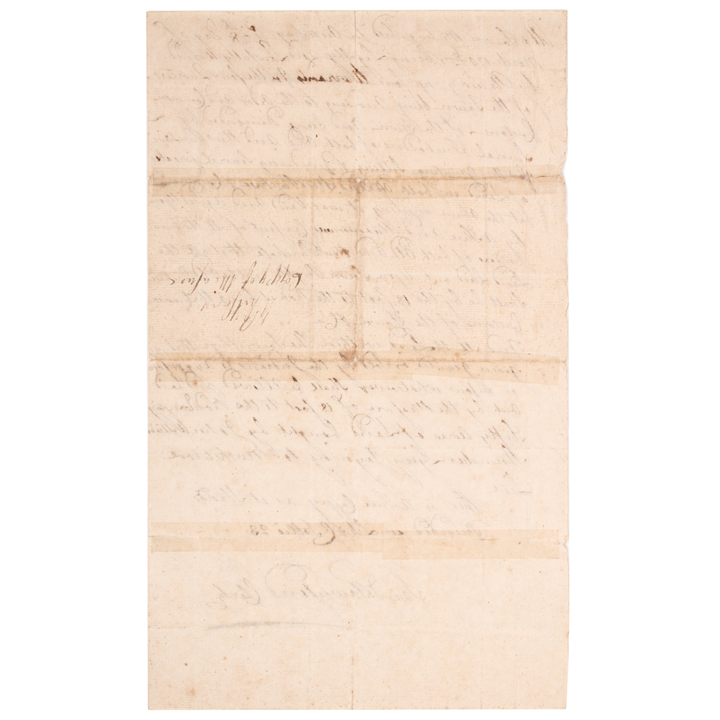
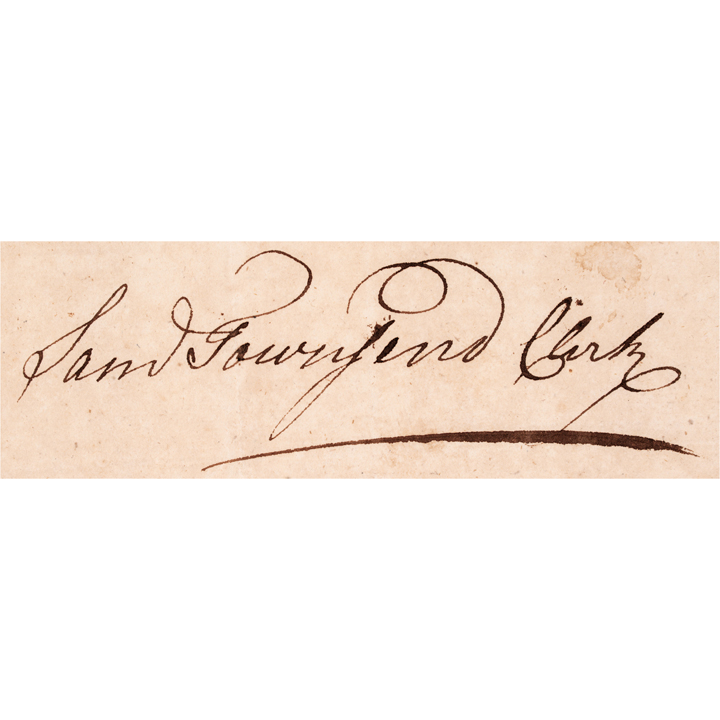
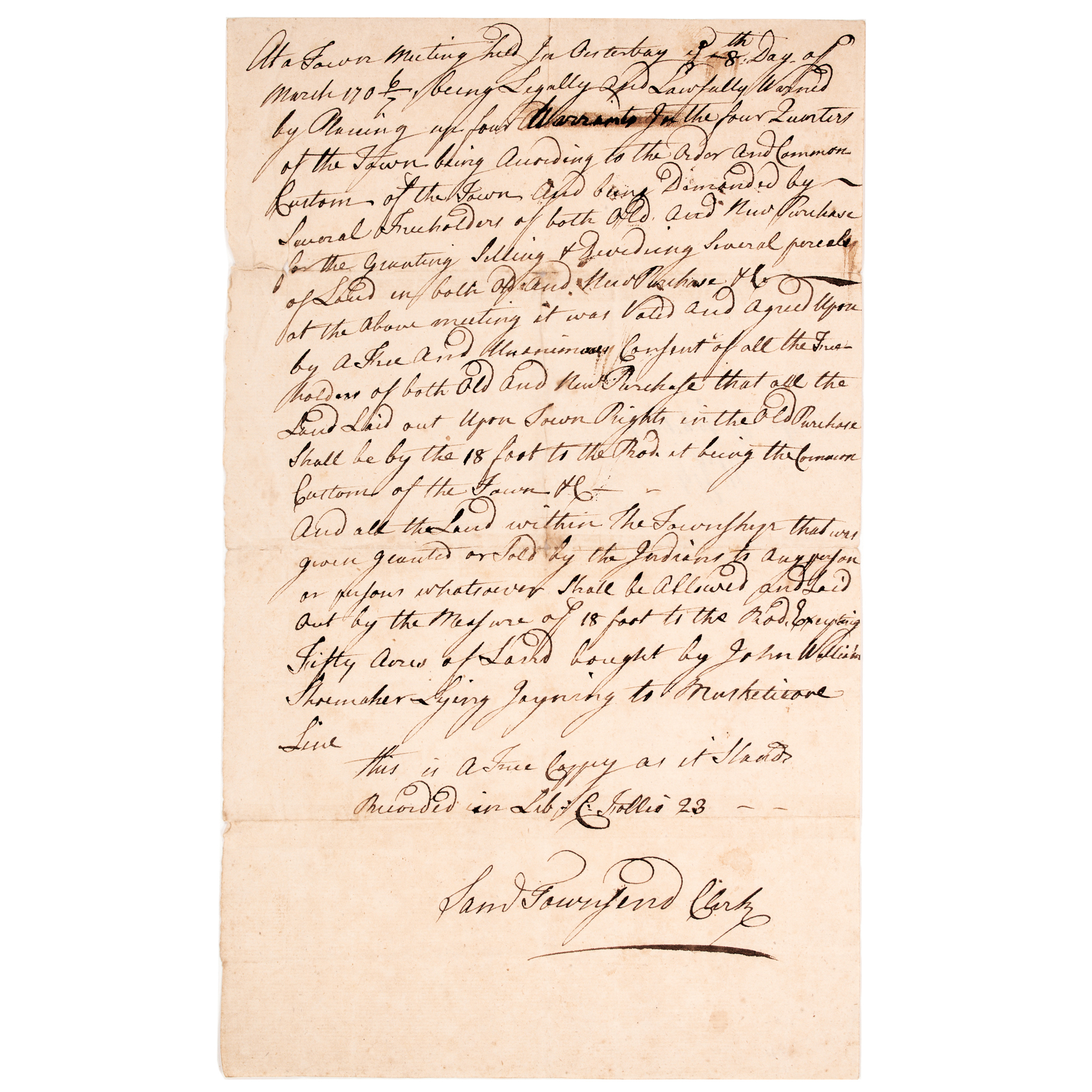
SAMUEL TOWNSEND (1717-1790). Prominent member of the Oyster Bay, New York Townsend family and was the father of Robert Townsend (1753-1838), who would later be a key member of George Washington’s “Culper Spy Ring” during the American Revolution; local and state government member as Oyster Bay’s Justice of the Peace and Town Clerk, Member of the New York Provincial Congress from 1774-1777; Post Revolution, a New York State Senator from 1786-1790. This Manuscript Document Signed (Saml Townsend” as Clerk, is a true copy of a early colonial town meeting record from Oyster Bay, dated March 8, 1706/7, Fine. It is documenting a formal vote by the town’s freeholders regarding the surveying and division of land within the township. This document is 1 page, measures about 12” tall x 7 inches wide, boldly written and signed in rich brown ink that is clearly readable on laid period paper with a large central watermark of the maker, three thin tape reinforcements on the centerfolds on its blank reverse side. It records the unanimous vote by the town’s freeholders establishing an official standard for land surverying measurement, being 18 feet to the rod for lands in the Old and New Purchase areas of the township. This official copy is certified and signed by Samuel Townsend likely to inform surveyors in the town of Oyster Bay of the proper means for precise measurement. The documented exception of this new measurement, being the land purchased by John Williams, which adjoined the Masketicove line, being the boundary line then used in the area around Oyster Bay. This document reads as written, in full: “At a Town Meeting held in Oysterbay on ye 8th Day of March 1706/7, beeing Legally and Lawfully Warned by placeing up four Warrants in the four Quarters of the Town being according to the Order and Common Custom of ye Town and being Demanded by several Freeholders of both old and new Purchase For the Granting setling and Dividing Several parcels Of Land in both old and new purchase. Att the above meeting it was Voted and agreed upon by a Free and unanimous consent of all the freeholders of both old and new Purchase That all the Land laid out upon Town Rights in ye old purchase shall be by ye 18 foot to ye rod it being the Common Custom of the Town. And all the Land Within the Township that was Given Granted or Sold by the Indians to any person or persons whatsoEver shall be allowed and Laid out by ye measure of 18 foot to ye Rod Excepting fifty Acrees of Land bought by John Williams shomaker Lying Joyning to Masketicove Line ” --- This is a True Coppey as it Stands Recorded in Lib of C. Jollies '23 --- (Signed) - Sam Townsend Clerk” In 1740, 23-year-old Samuel Townsend purchased the property now known as Raynham Hall, moving from his father’s place in nearby Jericho. His move to Oyster Bay, New York allowed him easier access to the waterfront and benefited his growing shipping business, co-owned with his brother, Jacob, who moved in next door on Main Street. Samuel’s property consisted originally of a four-room frame house on a sizable plot of land, with an apple orchard across the street, hundreds of acres of nearby pasture and woodlands for his livestock, and a meadow leading down to the harbor, where he and Jacob kept their ships. In short order, Samuel had enlarged the house to eight rooms by building a lean-to addition on the north side, creating a saltbox-style house. This property, then known simply as “The Homestead,” would have been a hub of activity during the years leading up to the American Revolutionary War, and was home to Samuel, his wife Sarah Stoddard Townsend, their eight children, and their 20 Enslaved Black people. By 1769, Samuel and his brother Jacob owned five ships, which sailed to Europe, Central America, and the West Indies. They traded in an impressive range of goods, including most importantly logwood (which was and continues today to be a crucial ingredient in the dyeing of textiles), tea, lumber, molasses, sugar, china, wine, textiles, dye and rum. In addition to the shipping business, Samuel operated a general store, providing local access to a wide variety of imported wares. He was an active member of local and state government, as Oyster Bay’s Justice of the Peace and Town Clerk, a Member of the New York Provincial Congress from 1774 to 1777, and after the Revolutionary War, a New York State Senator from 1786 to 1790. Although most of Oyster Bay sided with the British during the American Revolution, Samuel’s sympathies were with the Patriots, despite the far greater risks those sympathies posed to his position, family and fortune. Following the Patriots’ decisive defeat in 1776 at the Battle of Long Island, British forces occupied all of New York City and Long Island, often brutally. Many people in the area who ran afoul of British authorities were confined to prison ships on which more than 12,000 people would die of illness or starvation by the end of the war in 1783, at a time when Manhattan’s entire population was around 20,000. The Townsend family, unlike many Patriots who fled, decided to stay in their home throughout the occupation. See: https://raynhamhallmuseum.org/1740-1776-before-the-revolution/ |
|||||||||||
|
Auction Closing: Saturday, April 18th
at Noon Eastern Time • 9:00 AM Pacific Time |
|||||||||||