
|
Lot: 36 ♡
|
|||||||||||
|
Bounty Payment for Twenty Men as Volunteers Authorized and Signed by Meshech Weare as President of the State of New Hampshire, Committee of Safety March 19th, 1779
|
|||||||||||
|
|||||||||||
 |
|
||||||||||
|
Lot 36:
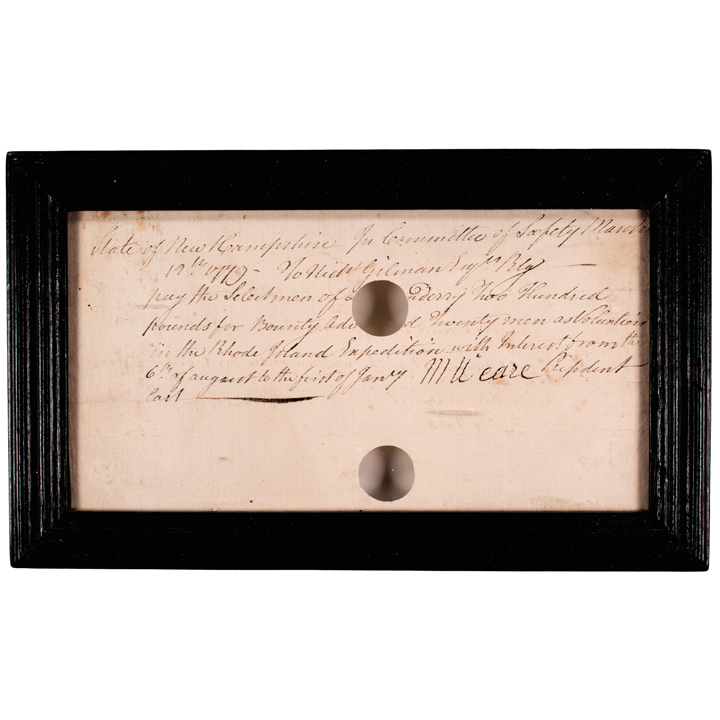
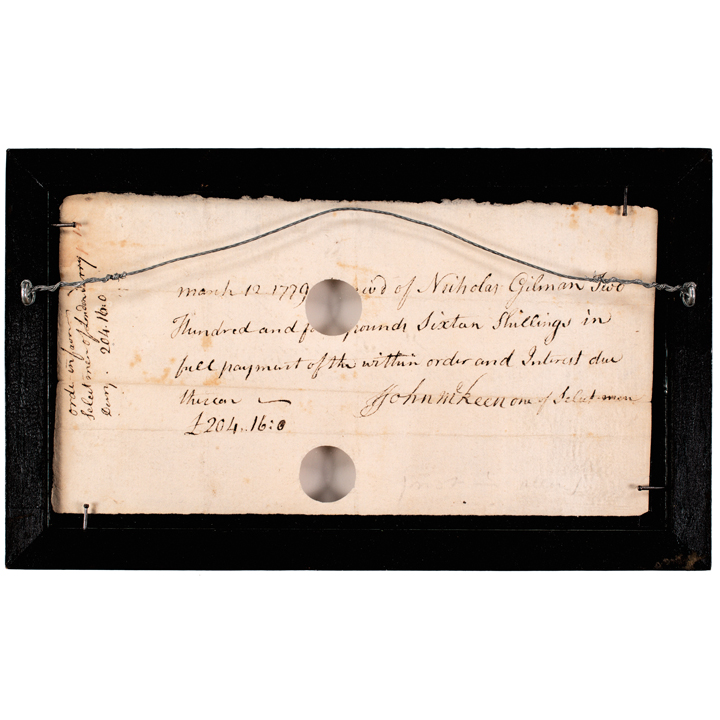
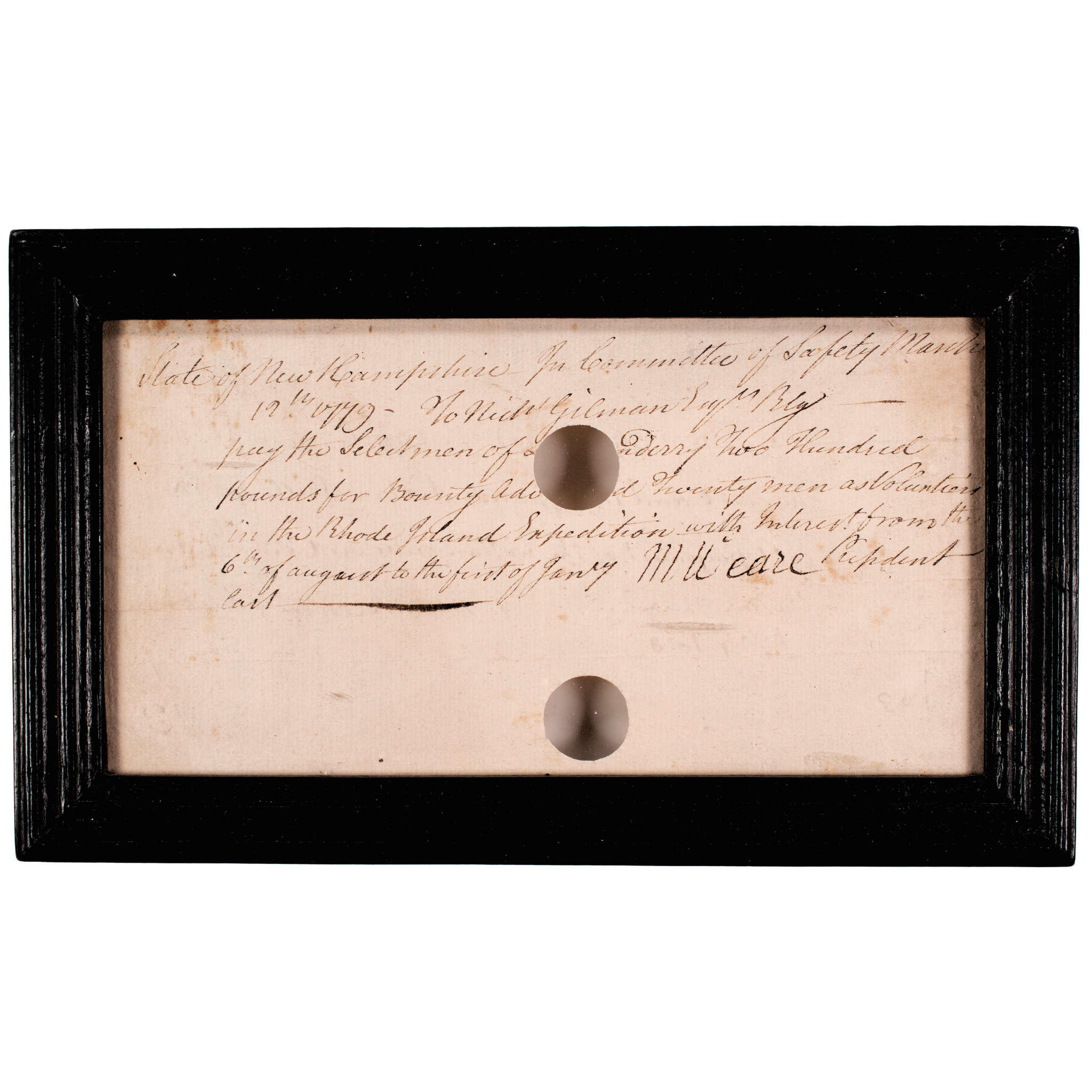
Bounty Payment for Twenty Men as Volunteers Authorized and Signed by Meshech Weare as President of the State of New Hampshire, Committee of Safety March 19th, 1779
MESHECH WEARE (1713-1786). First President of New Hampshire (1784-1785), Revolutionary Patriot, Councilman and Chairman of the Committee of Safety, (Before 1784 the position of governor was referred to as “president of New Hampshire.” He is also called “The father of New Hampshire.”); 1st Chief Justice of the New Hampshire Superior Court of Judicature in office (1776-1782); also called “The father of New Hampshire.” March 19th, 1779-Dated Rare Revolutionary War Period, “State of New Hampshire for Committee of Safety” Manuscript Autograph Document Signed, “M(eshech) Weare” as President, Payment order c/o Nicholas Gilman (NH. Treasurer) directed to the Selectmen of Londonderry, hole punch canceled when paid, Framed, Very Fine. This laid period paper sheet measures about 4” tall x 8” wide (by sight), written on both sides having two 3/4” hole cancellations as shown. Framed under glass so that both sides are fully readable measuring fully to 5.5” tall x 9.5” wide. All written text is easily readable written in brown ink with “M Weare” signature bold rich brown. This Revolutionary War document reads, in full: “State of New Hampshire for Committee of Safety - March 19th, 1779 - To Nichs. Gilman Esqr -- pay the Selectmen of (London)derry Two Hundred pounds for Bounty Adv(ance)d Twenty men as Volunteers in the Rhode Island Expedition with Interest from the 6th of August to the first of Janry last ---- (Signed) “M Weare President”. The reverse side reads, in full: March 12 1779 (rece)ivd of Nicholas Gilman Two Hundred and f(our) pounds Sixteen Shillings in full payment of the within order and Interest due thereon -- (Signed) John McKeen one of Selectmen L204..16: 0”. Docket at the left edge reads: “Order in favor Selectmen of Londonderry. 204. 16 : 0” The Battle of Newport, Rhode Island-also known as the Battle of Quaker Hill-was fought on August 29, 1778 and stands out as one of the earliest joint American-French operations of the Revolutionary War. While the campaign fell short of its ultimate goal, it highlighted both the challenges of international coordination and the resilience of the American forces. Most notably, it marked a historic moment for the 1st Rhode Island Regiment, one of the first racially integrated military units in American history, composed of European Americans, Native Americans, and African Americans who fought with distinction on the field. New Hampshire’s presence was led by Colonel Stephen Peabody’s State Regiment, raised in early 1778 specifically for the defense of New England. Alongside them were Hale’s Regiment of Militia and Evans’ Regiment of Militia, both of which had gained experience at Saratoga before joining Sullivan’s army. These units fought with determination on the front lines, holding their ground during the fierce clashes that allowed the Continental Army to withdraw in good order. The battle also highlighted the leadership of men like General Moses Nichols of Amherst, who commanded New Hampshire militia, and drew upon the experience of veterans of Stark’s brigade from earlier campaigns. Though the attempt to expel the British from Newport fell short, New Hampshire troops left their mark through discipline, endurance, and their willingness to answer the call. The Battle of Newport is often overlooked in the annals of the American Revolution, but it is important, if not only for the role of the 1st Rhode Island infantry. _____ Meshech Weare's political career began in 1739 when he became a town moderator. For the next 35 years, he served in various political positions, including selectman and representative of Hampton Falls in the Assembly. He was also the Speaker of the House of Representatives three times, and its clerk for eight years. In 1754, he was one of New Hampshire's delegates to the Albany Congress. In September 1772, Weare served as one of the four judges in the trial of the participants in the “Pine Tree Riot,” an early act of rebellion against British authority in the Colonies. Although the defendants were found guilty (of assaulting a sheriff who had been enforcing laws against harvesting white pine reserved to the Crown), the light fines assessed by the court were seen as encouraging other such militant acts, including the Boston Tea Party. On January 5, 1776, New Hampshire became the first American state to adopt a formal Constitution. Weare was a leader in the drafting of this document, which served as the basic instrument of government for the ensuing eight years or until the adoption of a second and more permanent constitution in 1784. Under this Constitution, there was no established executive, and the legislature was supreme. In practice, executive power was delegated to a Committee of Safety consisting of eight or ten legislative leaders. This committee had full power to act on behalf of the government while the legislature was not in session. After a brief interval, Weare was elected Chairman of the Committee of Safety and served in this capacity throughout the Revolution. In addition to being New Hampshire's first "Governor”, Weare was Chief Justice of the state's highest court the "Superior Court of Judicature" from 1776 to 1782. He also served as presiding officer of the Council, then part of the upper house of the legislature. He managed to hold that position throughout the American Revolution. He was elected a Foreign Honorary Member of the American Academy of Arts and Sciences in 1782. The Committee of Safety, over which Weare presided, was a most interesting governmental institution. It operated both at the state and (through a network of town committees of safety) at the local level, and was virtually a law unto itself while the legislature was not in session. Its duties included supervision and coordination of military affairs within the state, raising of recruits and supplies, regulation of the state militia, custody of prisoners of war, supervision of the entrance and clearance of vessels from Portsmouth Harbor, regulation of privateers and captured prizes, surveillance of the Loyalists, regulation of trade and currency (including prevention of counterfeiting), and supervision of price controls. The house in which Weare lived was built in 1737 by Samuel Shaw, and is now listed on the National Register of Historic Places. It was later to be visited by George Washington, Marquis de Lafayette, and James Monroe. The back half of the house burnt many years after Weare's death, although the front half was saved. It still stands in Hampton Falls, next to the park named after Weare and across from the town school, Lincoln Akerman School. |
|||||||||||
|
Auction Closing: Saturday, April 18th
at Noon Eastern Time • 9:00 AM Pacific Time |
|||||||||||