
|
Lot: 40 ♡
|
|||||||||||
|
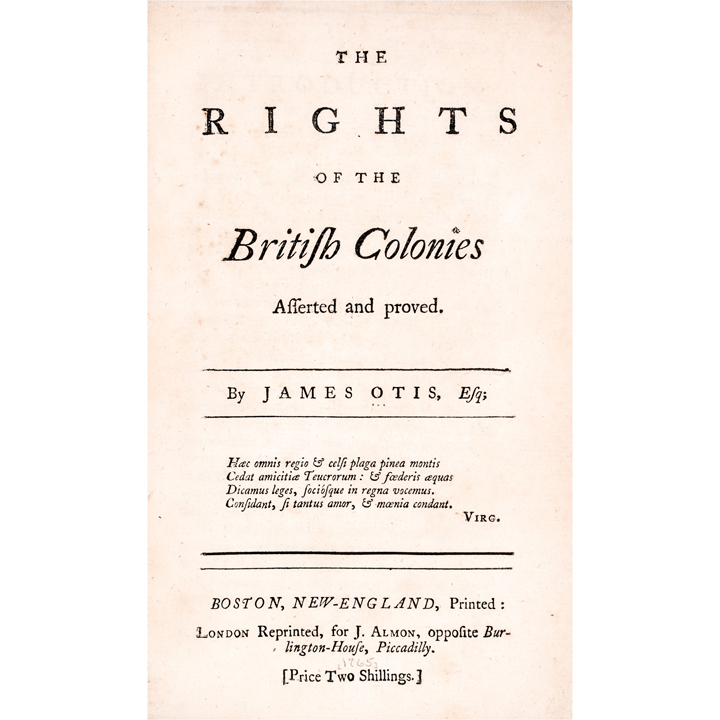
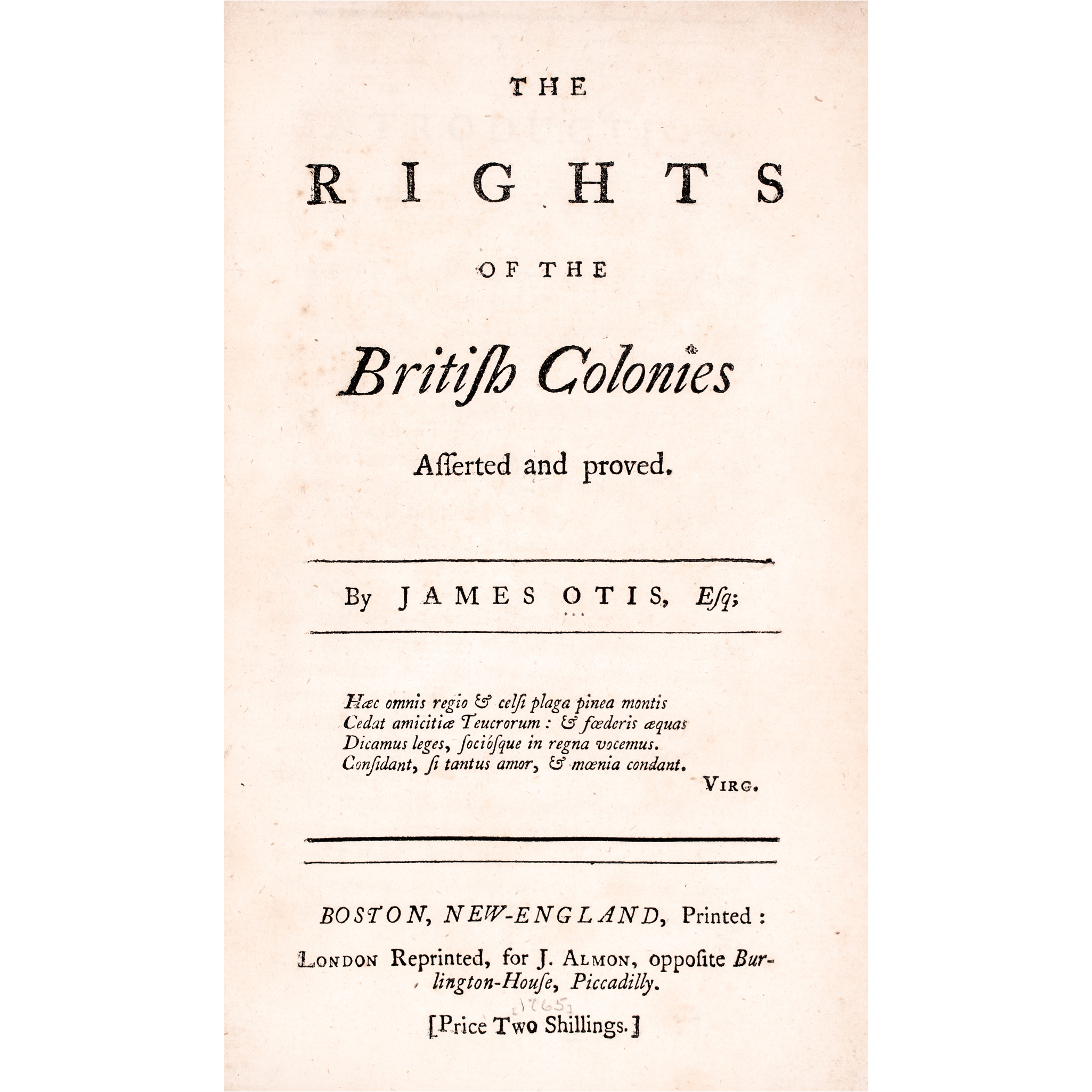
1765 “THE RIGHTS OF THE BRITISH COLONIES Asserted and proved. by JAMES OTIS, Esq; BOSTON, New-England, Printed” (London, J. Almon, 1765) One of the Truly Important Seminal Revolutionary War Pamphlets
|
|||||||||||

|
|||||||||||
 |
|
||||||||||
|
Lot 40:
1765 “THE RIGHTS OF THE BRITISH COLONIES Asserted and proved. by JAMES OTIS, Esq; BOSTON, New-England, Printed” (London, J. Almon, 1765) One of the Truly Important Seminal Revolutionary War Pamphlets
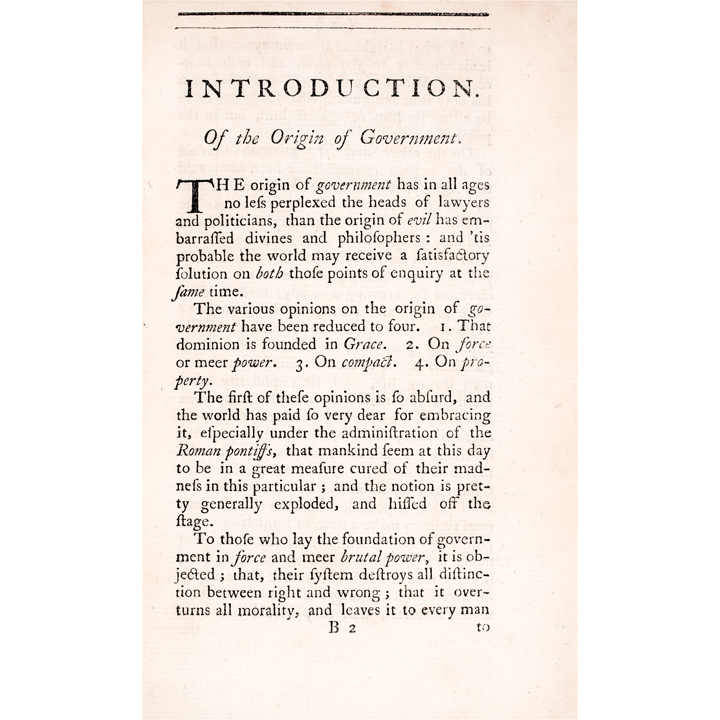
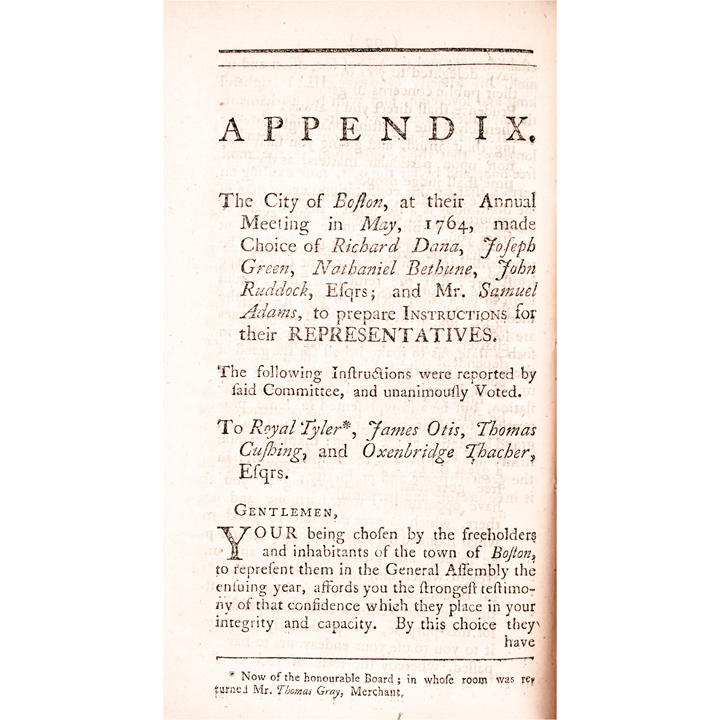
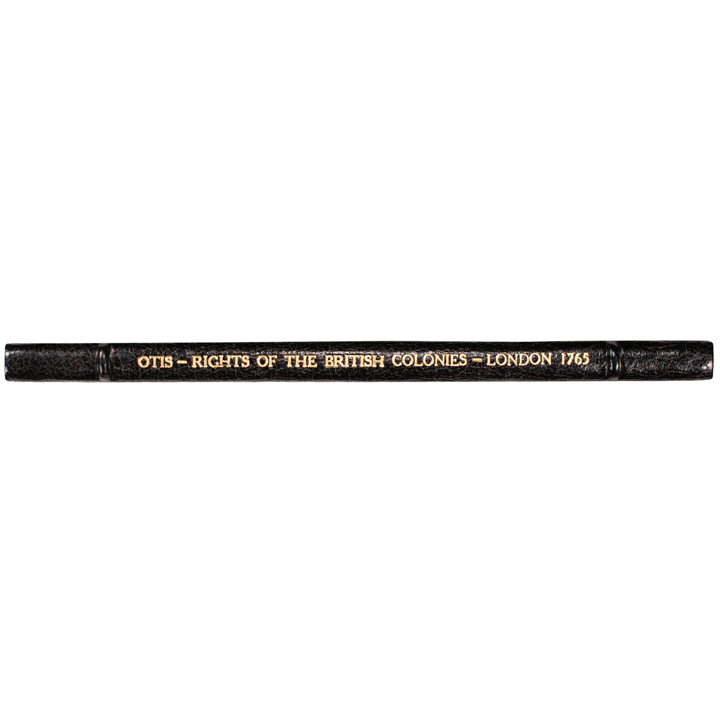
(James Otis), 1765 Pamphlet, “The Rights of the British Colonies Asserted and Proved, published in London in 1765 by J. Almon.” Otis argues that the supreme legislative power (Parliament) cannot justly take away the property or rights of colonists without their consent and that Taxation without Representation amounted to tyranny, being unjust and a violation of the rights of the American colonists. This pamphlet provided the legal and philosophical framework for opposing the Stamp Act of 1765, 120 pages, Complete with Appendix, Choice Very Fine. A very rare clean and complete historic Pamphlet including the Appendix, 120 pages, professionally bound in modern 3/4 leather boards with gilt spine with title, measuring 5” x 8” in overall choice condition. This work was foundational in shaping the American perspective on Constitutional Rights before the Declaration of Independence. James Otis's 1764 Rights Asserted tract and his 1765 pamphlet, “The Rights of the British Colonies Asserted and Proved, published in London in 1765 by J. Almon”, is a key pre-Revolutionary document arguing against "taxation without representation". It asserts that colonists possess natural rights, that Parliament cannot take away their property without consent, and that they are entitled to representation. This 1765 London edition, offered here, by J. Almon helped spread these radical ideas throughout the British Empire. Boston lawyer James Otis was one of the foremost colonial American critics of British policies during the leadup to the Revolutionary War. In this pamphlet, he argued that Taxation without Representation was unjust and a violation of the rights of the colonists. It was written in response to the tightening of British Colonial policy (Sugar Act). Otis presents that every British subject born on the continent of America, or in any other of the British dominions, is by the law of God and nature, by the common law, and by act of Parliament (exclusive of all charters from the crown), entitled to all the natural, essential, inherent, and inseparable rights of our fellow subjects in Great Britain. Among those rights are the following, which it is humbly conceived no man or body of men, not excepting the Parliament-justly, equitably, and consistently with their own rights and the constitution-can take away. These are their bounds, which by God and nature are fixed, hitherto have they a right to come, and no further. James Otis is often credited by John Adams as the "first and foremost" of the founding fathers for his role in sparking the intellectual movement for American Independence. References See: ADAMS, Amer. Independence, no. 4b; ADAMS, 64-15b. Otis’s 1764 interpretation of the Glorious Revolution differs sharply from what was generally accepted by his English brethren across the Atlantic in London. According to Otis in Rights Asserted, the Glorious Revolution both dissolved and “reestablished” the system of government in England and the entire imperial system. It created a new imperial constitution that was consented to by all imperial subjects. He states that the English government of his time was created “by the convention, with a professed and real view, in all parts of the British empire, to put the liberties of the people out of the reach of arbitrary power in all times to come”. The Convention Parliament therefore represented the whole of the empire when it passed the Declaration of Rights, not merely the nobles or the Commons of England. By reestablishing government, reinstating charters, confirming and protecting rights, and professing to secure all Englishmen from arbitrary government, the Declaration of Rights was seen by the colonial mind as extending the effects of the Glorious Revolution to colonial emigrants. Otis’s assertions seem to suggest that the Glorious Revolution not only established or reestablished a fundamental right within the colonies to maintain their own colonial legislatures, which he admits to be formally subordinate to Parliament, but also firmly placed the local powers of government such as taxation in those assemblies. The fundamental right of the colonists to representation, in either a subordinate or supreme legislature, as derived from the events of the Glorious Revolution, is essential to Otis’s argument against the imposition of the 1764 Sugar Act. He asserts that the peace and prosperity so long enjoyed, as well as the continued loyalty of the colonies, depend on the “continuation” of the same political and civil liberties that were guaranteed to the colonists “since the Revolution, and the same moderation of government exercised towards them”. American Revolution, Ames, Nathaniel, Edes, Benjamin and John Gill (printers), Locke, John, marketing, pamphlets, politics, print culture, George Washington, Taxation without Representation, Stamp Act, Intolerable Acts, Revolutionary War, Declaration of Independence |
|||||||||||
|
Auction Closing: Saturday, April 18th
at Noon Eastern Time • 9:00 AM Pacific Time |
|||||||||||