
|
Lot: 42 ♡
|
|||||||||||
|
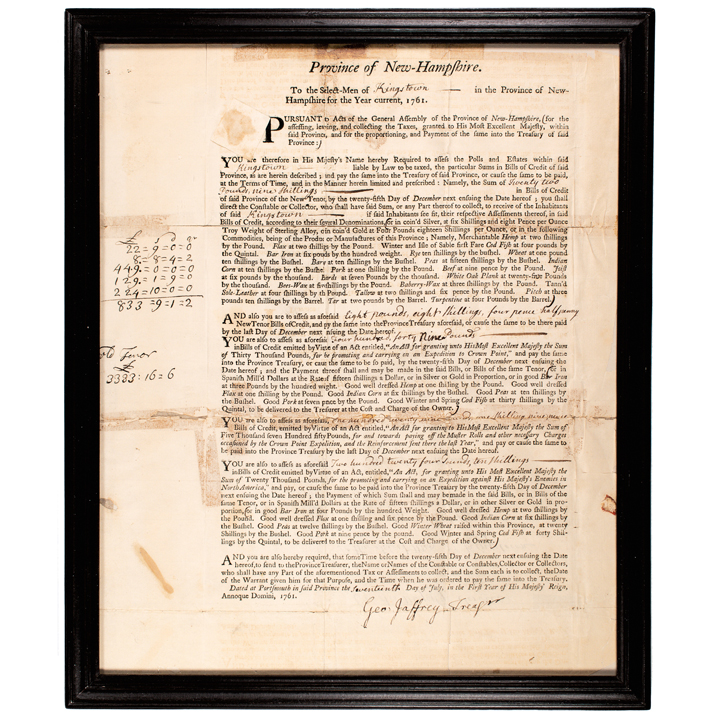
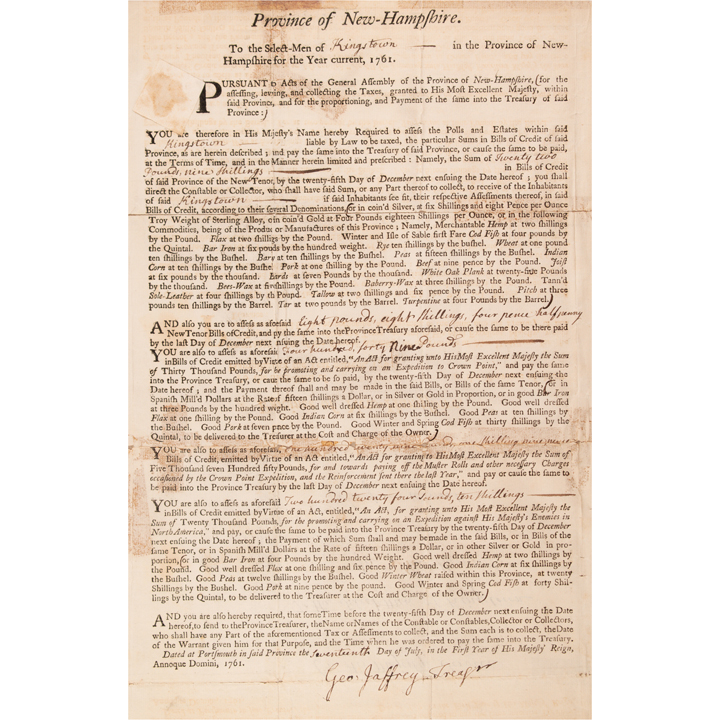
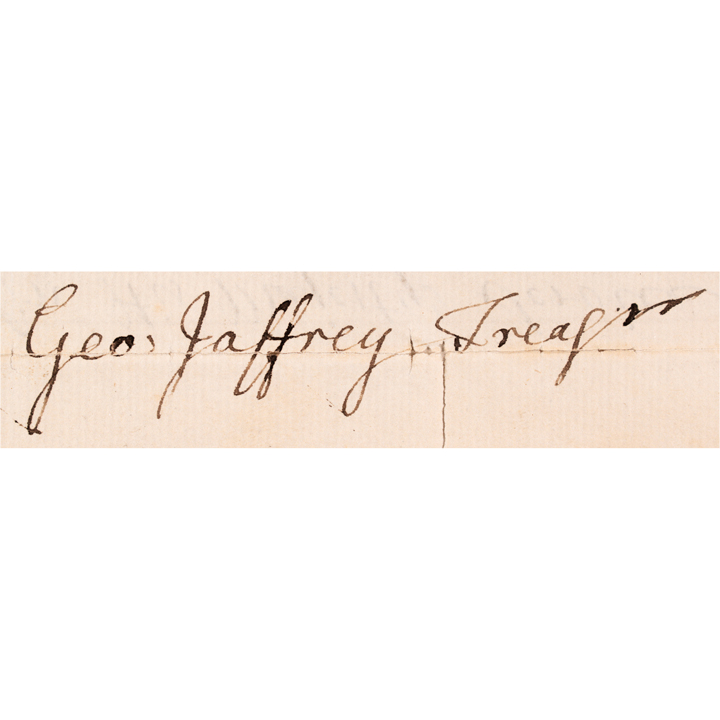
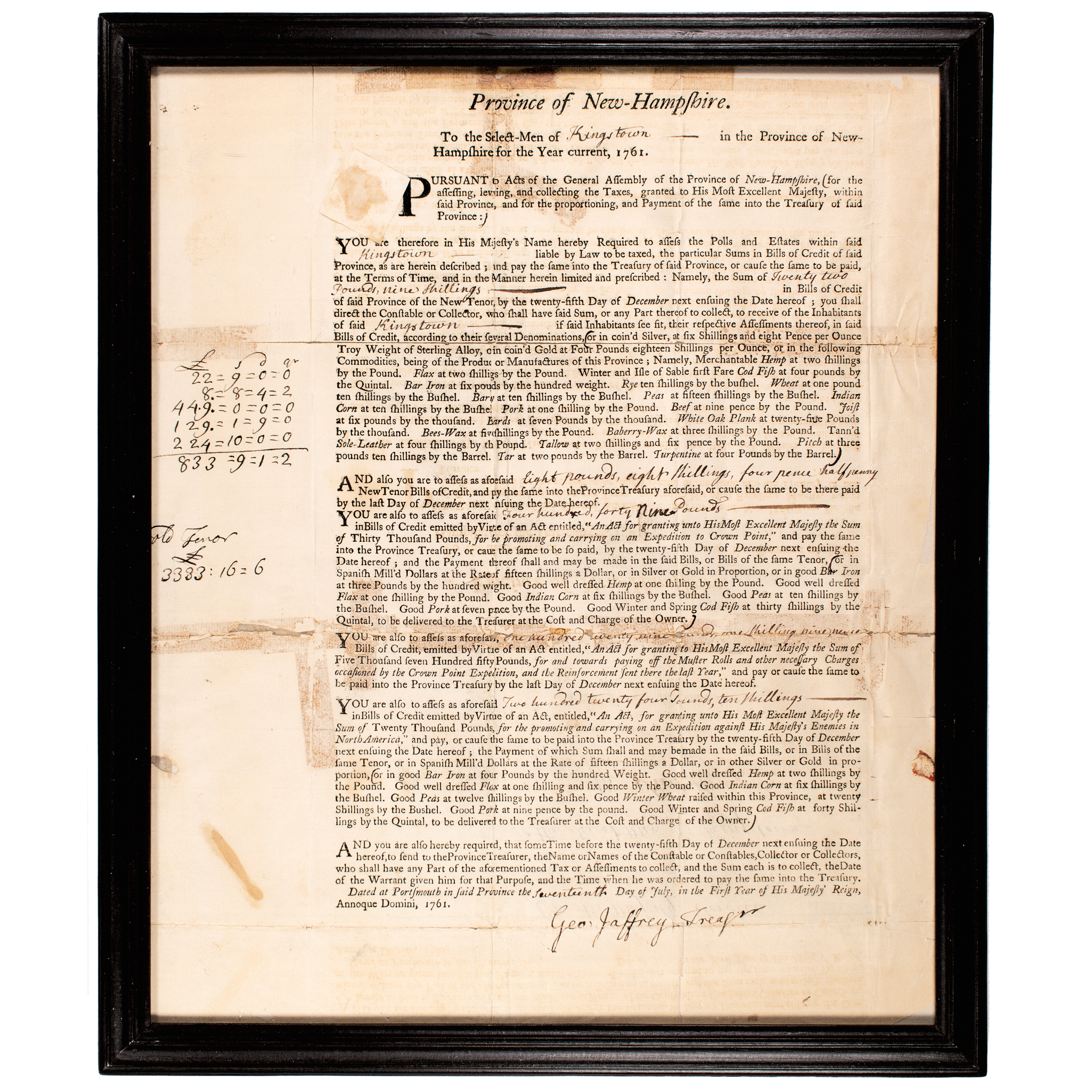
Boldly Signed 1761 Portsmouth, New Hampshire Broadside Signed “Geo(rge) Jaffrey” French and Indian War Town Tax Assessment in Bills of Credit or Commodities “for the promoting and carrying on an Expedition to Crown Point.”
|
|||||||||||
|
|||||||||||
 |
|
||||||||||
|
Lot 42:
Boldly Signed 1761 Portsmouth, New Hampshire Broadside Signed “Geo(rge) Jaffrey” French and Indian War Town Tax Assessment in Bills of Credit or Commodities “for the promoting and carrying on an Expedition to Crown Point.”
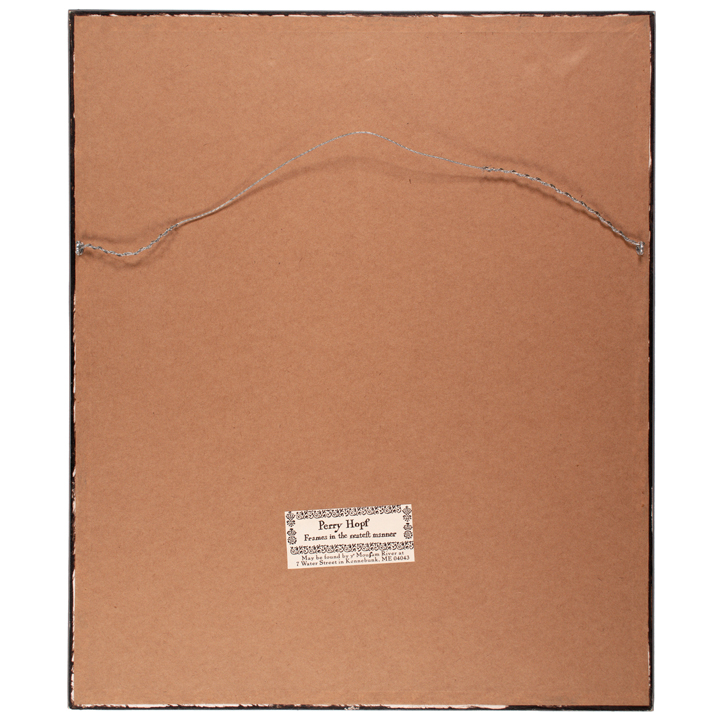
July 17th, 1761-Dated Colonial French and Indian War Period, Portsmouth, New Hampshire Partially-Printed Broadside Signed, “Geo(rge) Jaffrey”, a Tax Warrant or Assessment Notice issued to the Select-Men Town of Kingston. George Jaffrey (1717-1801) served as the Treasurer of the Province of New Hampshire and was a member of a powerful merchant family that influenced the province's separation from Massachusetts. This extremely rare original Broadside is a formal document command for town officials of Kingston to assess and collect specific tax sums for the British Crown's Provincial government. It is signed by George Jaffrey in his capacity as Treasurer, still bearing a small remnant of a red wax seal at lower right. This Broadside calls for various sums of tax for various assessments to reimburse the Crown and Taxes various named specific commodities at exact differing rates. Though it calls for payment in Gold and Silver, also accepted are “New Tenor Bills of Credit”. Significant taxes are levied for several stated reasons towards the costs of the Crown’s “for the promoting and carrying on an Expedition to Crown Point.” Commodities are accepted at certain rates but they are “to be delivered to the Treasurer at the Cost and Charge of the Owner.” Payment is to be received by the twenty-fifth Day of December next...”. Jaffrey held the office of Treasurer for decades, often transacting all Provincial business without assistants until 1763. He was a staunch Loyalist who remained in Portsmouth throughout the American Revolutionary War. This is the only example of this specific Broadside we have been able to locate. The Dartmouth College Archives holds a similar 1773 dated notice from Jaffrey to the Selectmen of Kingston regarding Tax sums to be collected. Displayed framed under UV plexiglas, printed in black on laid period paper, some financial notations in the margins, minor fold splitting reinforced on the verso with tape, its original paper and was seal intact at the upper left. Not examined out of the frame with its “Perry Hopf” Kennebunk, ME framer’s tag on the verso. Ready to hang on display. George Jaffrey is the only place in the world named Jaffrey but few persons in Jaffrey know much about the man for whom the town was named. Homer J. Belletete of the Jaffrey History Committee developed a genuine curiosity about wha:t manner of man the town was named for. Belletete contacted the Massachusetts Historical Society in Boston from which he received a courteous reply and the following sketch of Hon. George Jaffrey. In further correspondence with the Society he received its permission for the use of the sketch in this volume, dependent, of course, on the author's consent. The author of the sketch, Clifford K. Shipton, of Shirley Center, Massachusetts, graciously permitted the use of his sketch, which follows on these pages. A likeness of Hon. George Jaffrey from a portrait by John Singleton Copley appears opposite page 112 of Volume I. The Honorable George Jaffrey of Portsmouth, New Hampshire, was a son of Chief Justice George (A.B. 1702) and Sarah (Jeffries) Jaffrey of New Castle and Portsmouth He was born on February 8, I717/8, and baptized at the North Church two weeks later, when his father owned the covenant. The only unusual thing about his college record is the fact that he was fined and twice publicly admonished for playing cards and dice. In the college Hall on March 19, I 735 /6, he pronounced the valedictory oration of his class. Thence he went straightway to his father's warehouse, where he so busied himself that it is not surprising that when he emerged in I 739 to take his M.A. he was prepared to hold against all challengers at the Commencement exercise the affirmative of "An Postestori facultatum copiae, Mercaturas facere expediat?" Judge Jaffrey had long been a leader of the New Hampshire oligarchy which was battling Governor Jonathan Belcher (A.B. 1699) and trying to dissolve the union of their province with Massachusetts. The Judge made the breach wider by joining Queen's Chapel (the Governor disliked Episcopalians) and by taking his second wife Sarah, widow of Archibald MacPhedris, and daughter of Lieutenant Governor John Wentworth. George, in spite of the problems surrounding the settlement of his father's estate, plunged willingly into the pressing task of issuing the tax warrants. For fourteen years he transacted the business of the treasury without an assistant, but in 1763 the House instructed him to hire an assistant to carry the tax warrants to the Selectmen of the towns and parishes. Three years later he was appointed to the Province Council, a comfortable family circle. When the Revolution broke, Jaffrey would neither participate nor go into exile with his cousin, Governor John Wentworth (A.B. 1755). An uncompromising Loyalist, he was several times molested by the mobs, but he refused to run. When the local shooting began he told a friend that he could not think of leaving Portsmouth because of the "great Confusion owing to some rash fellows, the other day firing on the Man of War's barge." Whigs who might have used violence against him were deterred by his fearlessness, and by his reputation for correctness, punctuality, and strictest integrity in business, public affairs, and social life. The problem of separating Jaffrey from his public offices was solved when he declined to follow the Assembly to Exeter, a removal which to the old oligarchy was in itself a revolution. Early in June, 1775, he surrendered £150 of the Province money to a committee of the Committee of Safety: but that was as far as he was willing to go. On August 25, 1775, the Provincial Congress ordered him to lay the treasurer accounts before it on the following Tuesday. He replied, giving as an excuse for his failure to comply the fact that he was for safety moving from Portsmouth to North Hampton and could not readily get at his accounts; but then he proceeded to question the authority of the revolutionary Congress: As a Provincial Officer, constant and invariable Custom necessarily obliges me, to render my Treasury Accounts to the General Assembly, who with the Other Branch of the Legislature Settle those Accounts by which Method the Settling the Treasurer's Accounts they only, with consent of the third Branch of the Legislature can give the Treasurer a Discharge - So that any Settlement by the Congress, would not prevent the Requisition of a Settlement by the general Assembly and the other Branches of the Legislature - it would be a Case very Singular and unknown, that the Treasurer should be accountable, to two Seperate and different Authorities in the Same Province ... I hope the Congress will candidly consider the Situation of the Province Treasurer, and be Satisfycd with the Settlement of his Accounts by the general Assembly. The Congress, which was beginning to get the idea that Jaffrey was a Tory, on November 15, 1775, ordered that he should remove himself to a place at least ten miles from Portsmouth, and that he should not leave the bounds of the town or parish in which he settled. He had friends among the rebels, however, for two weeks later General John Sullivan (A.M. 1780) wrote from the camp on Winter Hill to the New Hampshire Committee of Safety: Gentlemen Since I Saw you Last I find that George Jaffrey Esq. has assisted much in fixing the works to Defend our Harbour - That being the Case I am Clearly of opinion that he ought not in Justice to be Deemed an Enemy to his Country or treated as such. I therefore Consent that he remain at his own House in Portsmouth if agreeable to you. |
|||||||||||
|
Auction Closing: Saturday, April 18th
at Noon Eastern Time • 9:00 AM Pacific Time |
|||||||||||