
|
Lot: 54 ♡
|
|||||||||||
|
Choice April 11th, 1778 YORKTOWN Issue Five Dollars
|
|||||||||||
|
|||||||||||
 |
|
||||||||||
|
Lot 54:
Choice April 11th, 1778 YORKTOWN Issue Five Dollars
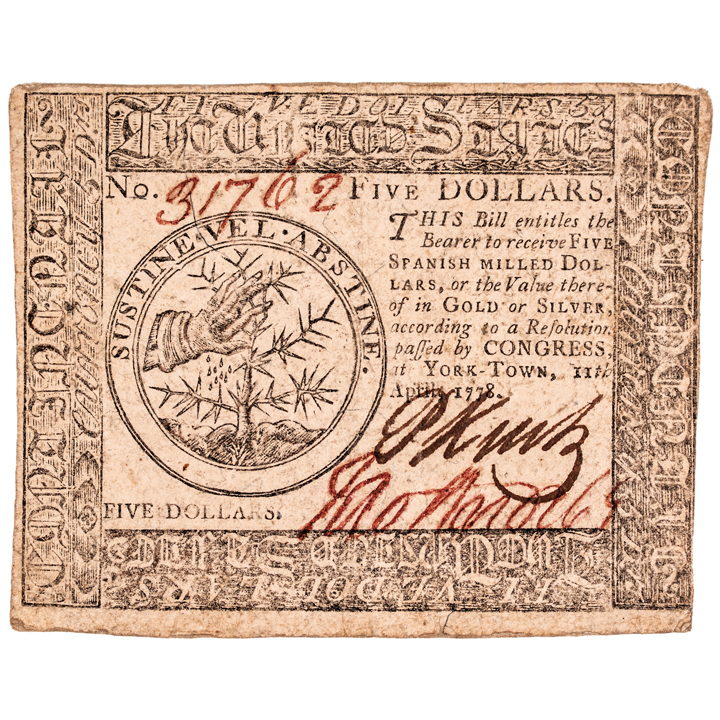
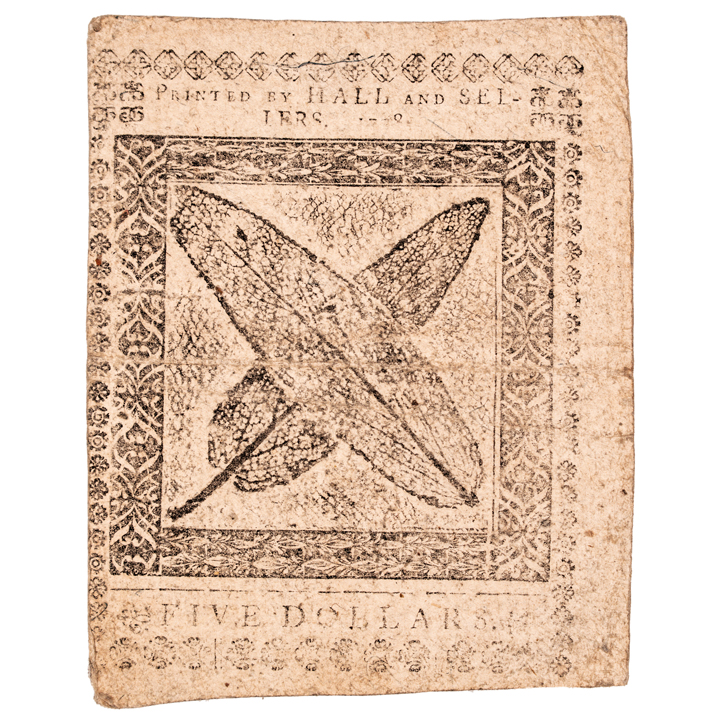
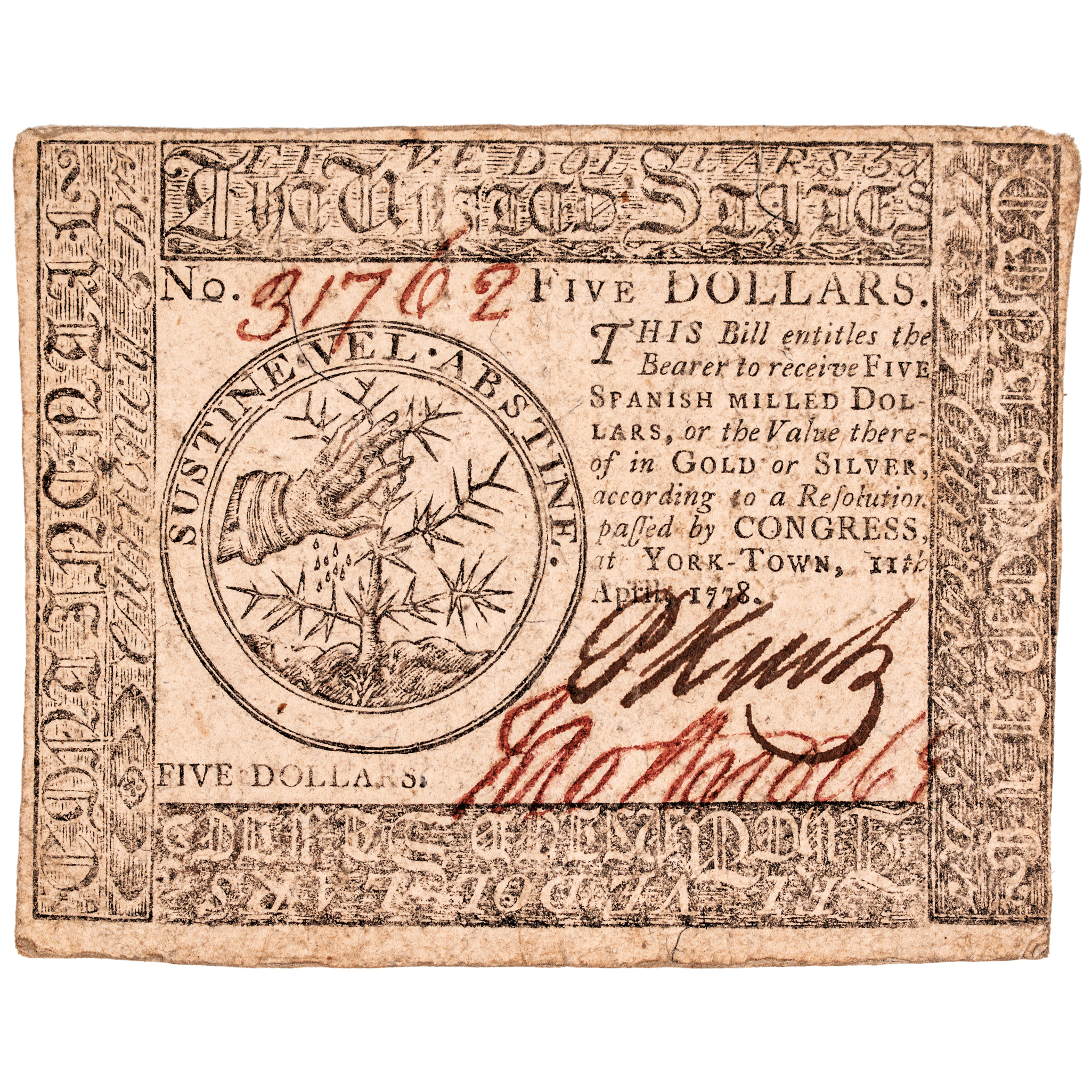
April 11th, 1778 YORKTOWN Issue, Five Dollars, Continental Currency, Genuine, Fr. CC-72, Design: A bleeding hand reaching for a thorny bush; motto “Sustine Vel Abstine” ("Either Support or Leave Me"), Reverse: Two crossed willow leaves, Choice Very Fine. Fr. CC-72. An impressive well printed Revolutionary War period YORKTOWN Issue note with bold red and brown signatures and serial number. Singers include Peter Kurtz and J Rothrock (both Appointed by Michael Hillegas). This note is clean and even in circulation having a particularly bold appearance on its face. The April 11, 1778, Yorktown issue of Continental Currency is considered the "Holy Grail" for collectors because it is the rarest overall series of paper money issued by the Continental Congress. It was authorized while Congress was meeting in York, Pennsylvania (having fled the British occupation of Philadelphia), the issue totaled approximately $5 million in value but was quickly recalled due to immense British counterfeiting. Because the British produced so many fake versions of this specific emission, the Continental Congress issued a resolution in January 1779 to recall and exchange and destroy the entire April 11, 1778, issue for newer notes. Most original notes were indeed destroyed during this process, making surviving genuine examples highly valuable. Per Early Paper Money of America / Continental Currency / April 11th, 1778 YORKTOWN Issue: An aggregate of $25,000,000 in Continental Currency was authorized by Resolutions passed at Yorktown (York, Pennsylvania) on April 11, May 22, and June 20, 1778 for $15,000,000 and at Philadelphia on July 30 and Sept. 5, 1778 for $10,000,000. Known as the Yorktown issue. Newly engraved border cuts are on the face. Newly prepared nature prints are on the back of each denomination and decorative cuts were introduced to frame those nature prints. Type and typeset ornaments on the back were modified. Denominations below $4 were eliminated, the $20 reinstated, and a $40 denomination added because of inflation. A 13-star patriotic design featuring CONFEDERATION was created by Francis Hopkinson for the emblem on the $40 denomination. The Continental Congress met at York from Sept. 30, 1777 to June 27, 1778 during which period Hall and Sellers conducted their printing business there. Due to extensive British sponsored counterfeiting the entire issue was called for exchange prior to June 1, 1779 by the Jan. 2, 1779 Resolution, but the exchange was extended to Jan. 1, 1781 by which time the bills were virtually worthless. Counterfeit detector sheets are printed on blue paper. Notes were printed by Hall and Sellers, who moved their operation from Philadelphia to York during the war. Each note was hand-numbered and required two hand-signed autographs, typically in red and brown/black ink. |
|||||||||||
|
Auction Closing: Saturday, April 18th
at Noon Eastern Time • 9:00 AM Pacific Time |
|||||||||||