
|
Lot: 66 ♡
|
|||||||||||
|
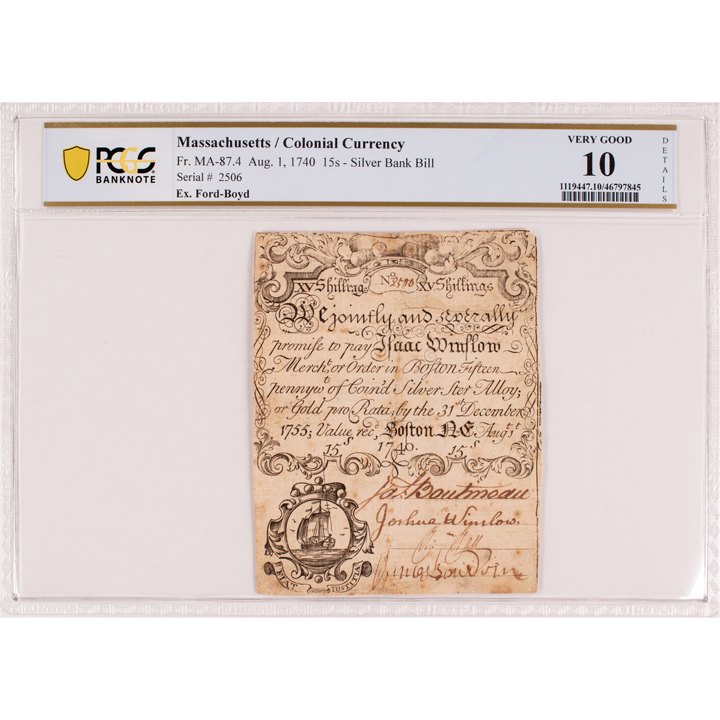
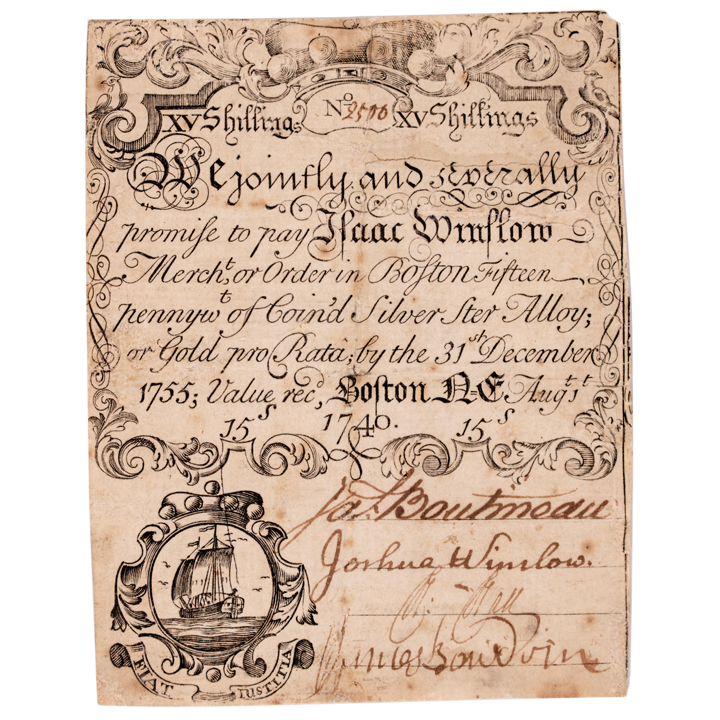
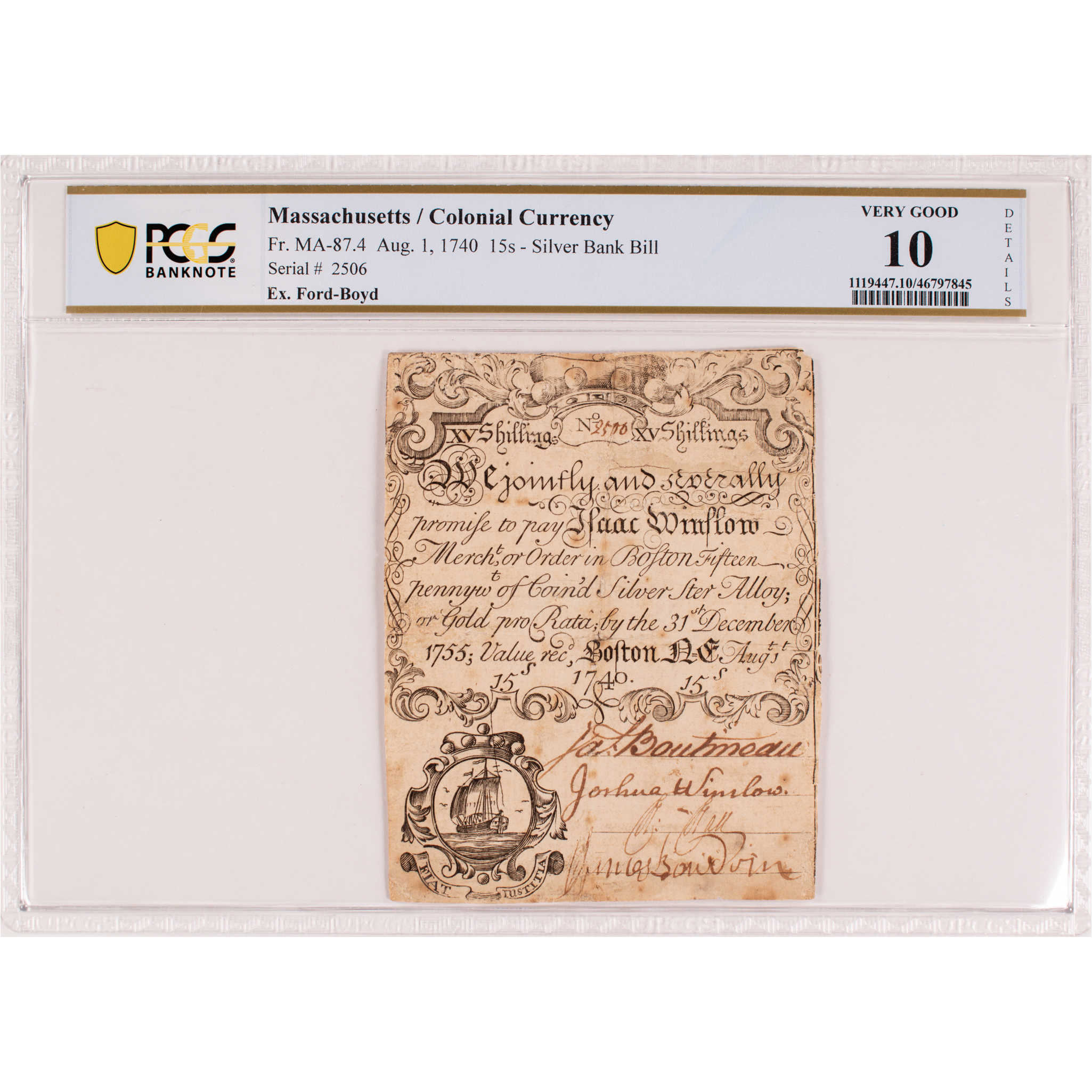
August 1, 1740 (Massachusetts) “Silver Bank” or “Specie Bank” Stating: “We jointly and severally promise to pay Isaac Winslow.”
|
|||||||||||
|
|||||||||||
 |
|
||||||||||
|
Lot 66:
August 1, 1740 (Massachusetts) “Silver Bank” or “Specie Bank” Stating: “We jointly and severally promise to pay Isaac Winslow.”
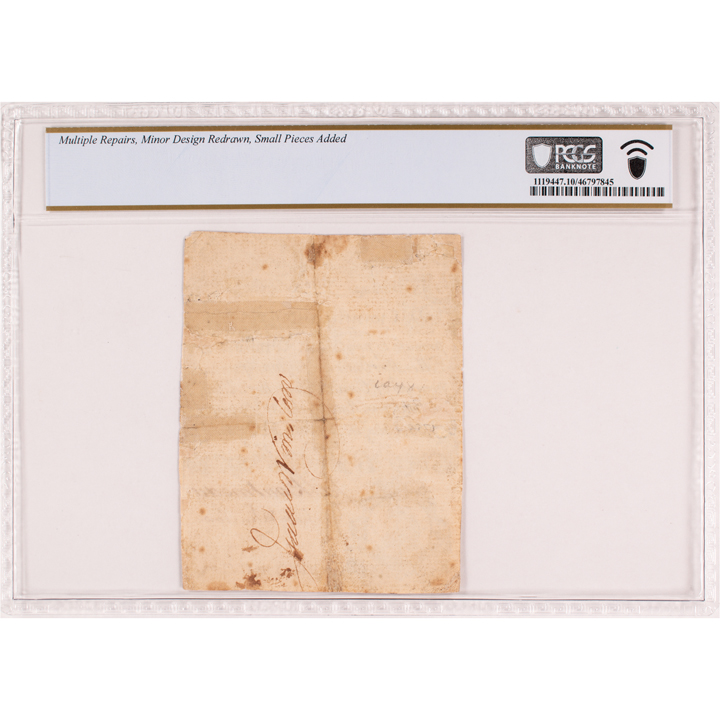
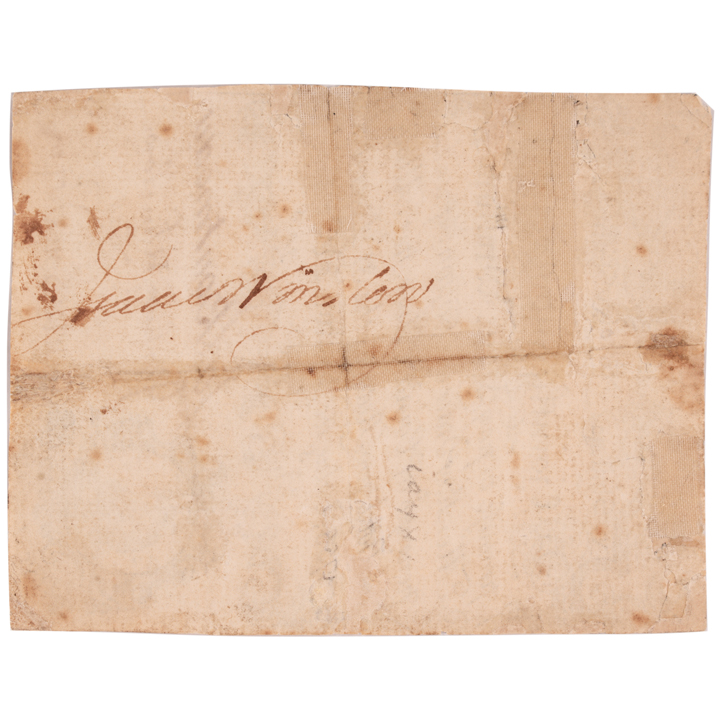
August 1, 1740, (Massachusetts) The Silver or Specie Bank, “We jointly and severally promise to pay Isaac Winslow.”, Fifteen Shillings, Ex. Ford-Boyd Collections, PCGS Banknote graded Very Good-10 (Finest Certified), however, it was graded raw Fine by noted cataloger Bruce Hagen when sold by Stack’s in May 2004. Fr. MA-87.4. This Engraved Copper-Plate note’s black inking is bold and well-impressed, and the brown ink signatures are strong, well defined and readable on this well centered Uniface rarity. This exceedingly rare 1740 “Tall Note” is consigned in its original PCGS Banknote holder, which we find to be nonsensically graded Very Good-10. Called a “pleasing, bright and vivid note from a very rare series” in the 2004 Ford sale; that description still rings true today. In fact, many would consider this note to have the eye appeal of Very Fine. There are some old silk reinforcements on the blank reverse as the holder states; multiple repairs, minor design redrawn, small pieces added. It is printed on early handmade laid period paper. Serial No. 2506. Measuring 85mm x 110mm. The shipping scene vignette at lower left is sharply detailed and vivid. It’s legend reads, “FIAT JUSTITIA” (Let there be Justice). This engraved Merchant Bills issue was to be loaned out with land promised as security. The directors formed the Silver Bank as a conservative "hard money" response to the Land Bank of 1740, which they viewed as inflationary and dangerous. While the Land Bank was popular with farmers and small traders (including Samuel Adams' father), the Silver Bank directors represented the wealthy elite who favored a stable currency pegged to precious metals. This Uniface note is fully Signed by James Boutineau, Joshua Winslow, H. Hall, and James Bowdoin (whose son was the namesake of Bowdoin College in Maine). The blank back is ink Signed “Isaac Winslow” (1709-1777), small penciled “iayx” cost code also present. Other than two small chip repairs at upper left edge, and another small pair of like repairs at lower right edge, the visual impact of this rare and important note has not changed when compared to the photo in the Ford sale catalog. Pedigree: Ex F.C.C. Boyd Estate; Stack’s sale of the John J. Ford, Jr. Collection, Part III, May, 2004, Lot 521. The Isaac Winslow associated with the 1740 Silver Bank was a prominent Boston merchant born in 1709. He should not be confused with his ancestor, Colonel Isaac Winslow (1671-1738) of Marshfield, who died before the bank was established. This younger Isaac was a member of the Sandemanian religious sect and a Loyalist during the American Revolution. Joshua Winslow (January 23, 1726 - June 1801) was an American-born military officer, judge and politician. He represented Cumberland County in the Nova Scotia House of Assembly from 1770 to 1772. He was the father of Anna Green Winslow. He was born in Portsmouth, New Hampshire, the son of John Winslow and Sarah Peirce. Winslow was a lieutenant in William Pepperrell's regiment which attacked Louisbourg in 1745. After the fall of Louisbourg, he was named commissary general for British troops in Nova Scotia. During Father Le Loutre's War, he fought in the Battle at Chignecto. In 1758, he married his cousin Anna Green. With others, he petitioned for representative government in Nova Scotia. Winslow was justice of the peace and a lieutenant in the militia. In 1764, he was named a judge in the Inferior Court of Common Pleas. Winslow had considered returning to a residence in Massachusetts but decided to remain in Nova Scotia once the American Revolution had begun. He moved to Quebec City after he was named deputy paymaster for the British forces at Quebec City in 1782. Winslow served as receiver general for Lower Canada from 1791 to 1794. He died at Quebec at the age of 75 following an extended illness. James Boutineau (1710-1778) was a prominent merchant and lawyer based in Boston, Massachusetts, with documented legal and financial ties to New Hampshire. He was the son-in-law of Peter Faneuil (having married Susanna Faneuil) and acted as an attorney in significant New England legal cases, such as representing John Robinson in a high-profile assault suit brought by James Otis. Boutineau was part of the colonial elite; he was a vestryman at King's Chapel in Boston during this period (records 1740-1753) and was closely associated with other influential New England families like the Sewalls and Apthorps. Although active in New England through the mid-18th century, Boutineau remained a staunch Loyalist. Following the outbreak of the American Revolution, his estate was confiscated under the Conspiracy Act of 1779, and he went into exile in England, where he died in 1778. James Bowdoin II (1726-1790) transitioned from a wealthy Boston merchant into a prominent political and intellectual figure in colonial Massachusetts. This decade marked the beginning of his lifelong public service and scientific collaboration with Benjamin Franklin. Bowdoin maintained a lifelong interest in the sciences. In 1780 he was one of the founders of the American Academy of Arts and Sciences. He served as its first president until his death and left the society his library. Bowdoin was first elected to the Massachusetts House of Representatives in 1753. He was elevated to the prestigious Governor’s Council in 1756, serving as a "king's man" and generally supporting the royal governor during this period before his later radicalization. During the mid-1750s, he negotiated treaties with the Wabanaki tribe in Maine. These negotiations were often criticized for favoring his personal land interests, as they allowed for the construction of forts that restricted indigenous hunting grounds. Bowdoin met Benjamin Franklin in 1750 and became a key correspondent on electricity and physics. Franklin frequently solicited Bowdoin's advice on papers submitted to the Royal Society of London. Having married Elizabeth Erving in 1748, Bowdoin expanded his family during this decade. His son, James Bowdoin III, the future benefactor of Bowdoin College, was born in 1752. Bowdoin inheriting a massive fortune from his father in 1747, Bowdoin spent the 1750s managing vast tracts of land in Maine and the Elizabeth Islands. In later years he served as the first president of the Massachusetts Bank in 1784, and was also the first president of the Massachusetts Humane Society (an organization initially devoted to rescuing survivors from shipwrecks and other water-based disasters.) |
|||||||||||
|
Auction Closing: Saturday, April 18th
at Noon Eastern Time • 9:00 AM Pacific Time |
|||||||||||