
|
Lot: 9 ♡
|
|||||||||||
|
1757 Important Indian Treaty Dispatch from Colonel George Croghan one of the most Influential Figures on the American Frontier, Adversary well known to Col. George Washington
|
|||||||||||
|
|||||||||||
 |
|
||||||||||
|
Lot 9:
1757 Important Indian Treaty Dispatch from Colonel George Croghan one of the most Influential Figures on the American Frontier, Adversary well known to Col. George Washington
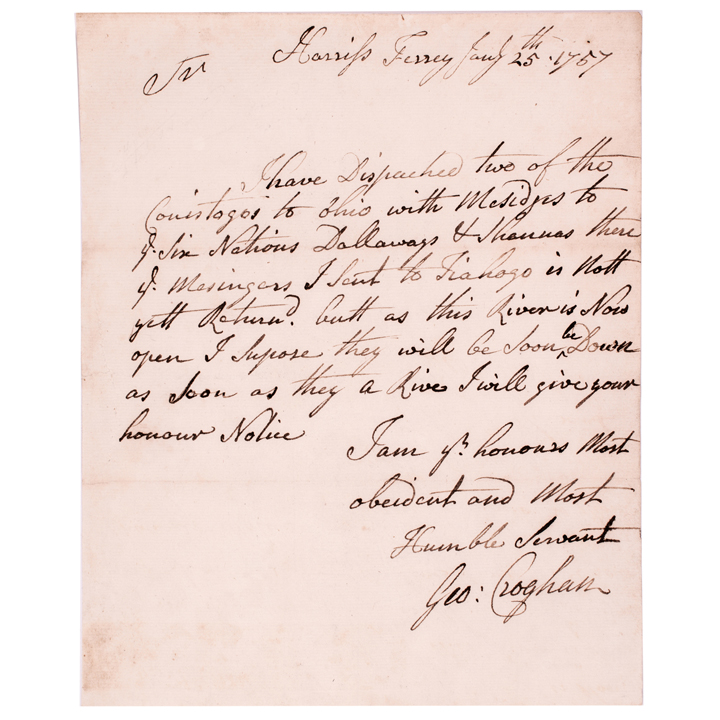
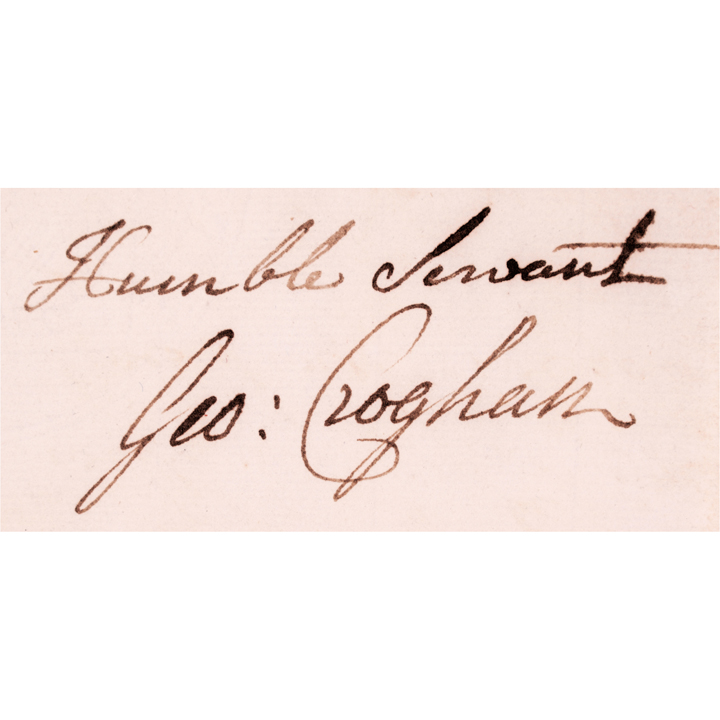
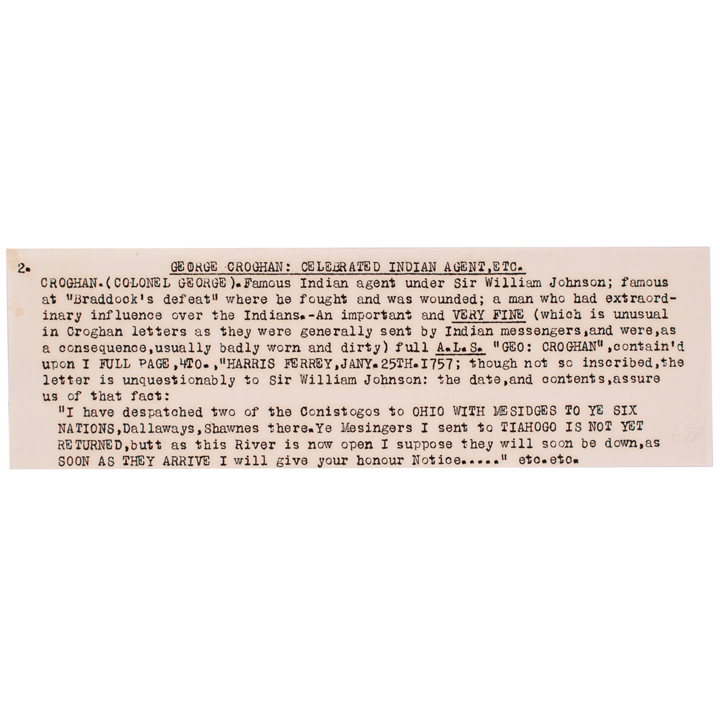
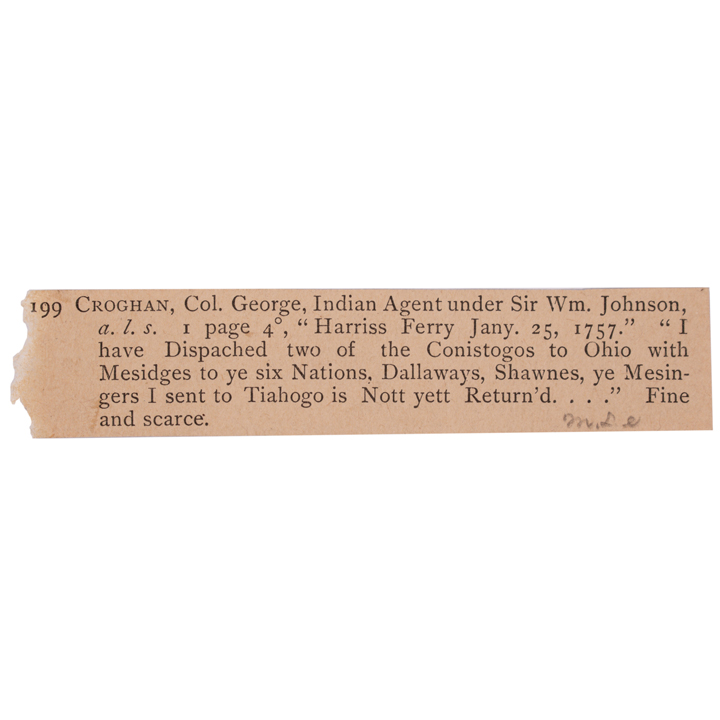
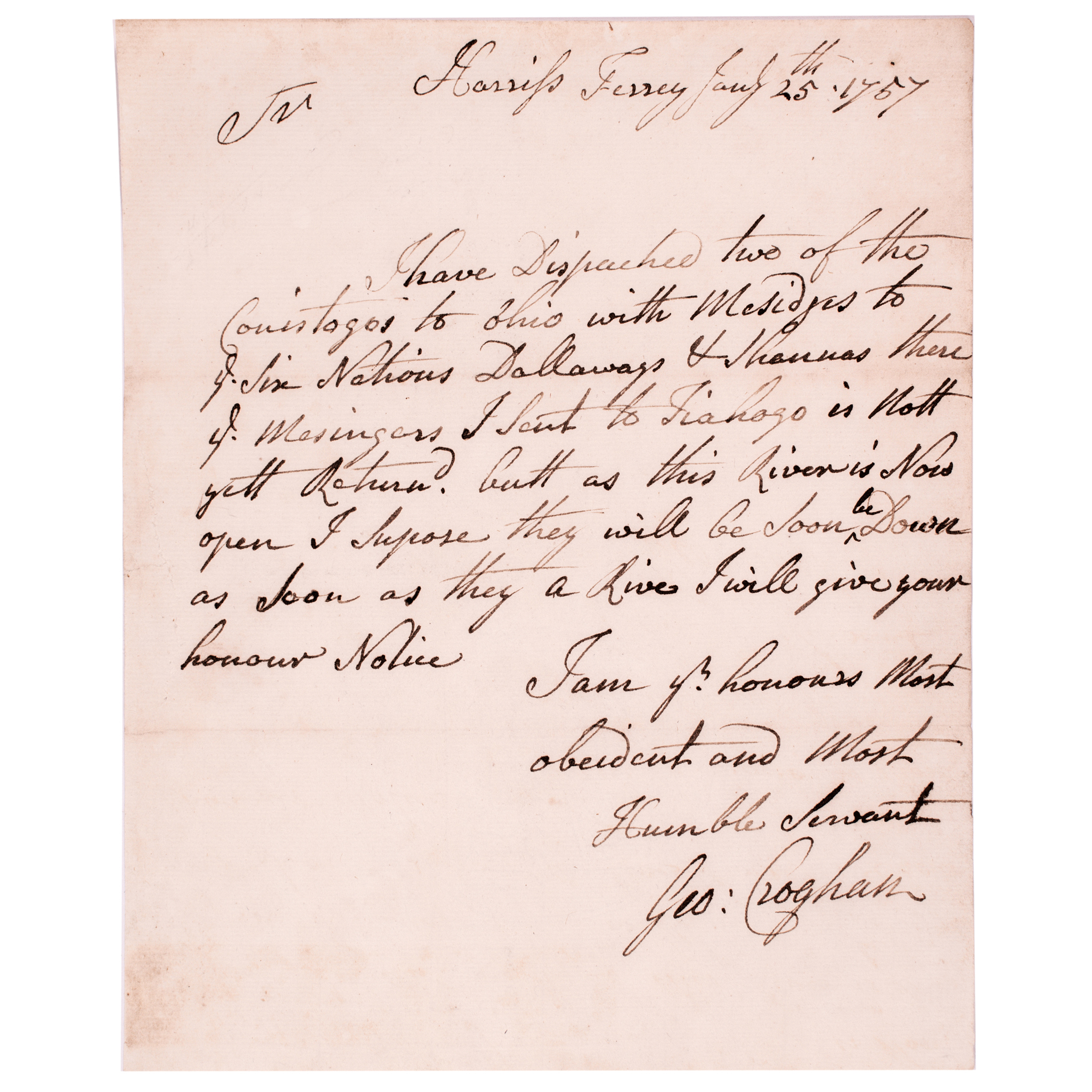
COLONEL GEORGE CROGHAN (c. 1718-1782). Irish-born fur trader in the Ohio Country of North America who became one of the most influential figures on the early American frontier who during and after King George's War of the 1740s, he helped negotiate new treaties and alliances for the British with the Native Americans, Indian Agent under Sir William Johnson. While working to keep the Ohio Indians neutral during the Revolutionary War, Croghan served as Pittsburgh's President Judge for Virginia and chairman of its Committee of Safety. Croghan was celebrated as a “National Hero” for negotiating with Chief Pontiac and ending the Indian war. July 25th, 1757-Dated French & Indian War Period, Indian Treaty Dispatch Autograph Letter Signed, “Geo:(rge) Croghan”, Choice Extremely Fine. This letter, as were most sent by Colonel Croghan were sent by native Indian couriers. Though not specifically inscribed, this letter is unquestionably meant to reach his superior Sir William Johnson who was the British Superintendent of Indian Affairs for the Northern District, who was based in New York and had strong alliances with the Iroquois. Overall, an exceptionally clean, easily readable and boldly written important dispatch by Croghan on fine quality Crown watermarked laid period paper. Certainly one of the cleanest best preserved letters written by this historic celebrated Indian Agent. It reads, in full (his spelling errors included): “Harriss Ferrey - Jany. 25th, 1757 --- I have dispached two of the Conistogos to Ohio with Mesidges to the Six Nations Dallaways & Shawnes there the Mesingers I Sent to Tiahogo is Nott yett Return’d... butt as this River is now open I suppose they will soon be down as Soon as they a Rive I will give your honour Notice --- I am yr. honours Most obeidiant and Most Humble Servant - (Signed) Geo: Croghan”. Of special note: Croghan and George Washington were associated on multiple occassions. By the end of May 1754, Croghan and Montour were in Winchester, Virginia, where Governor Dinwiddie commissioned them as Captains under Colonel George Washington, then stationed at Fort Loudoun in Winchester, the largest fort on the fronteer. Croghan was to supply flour for an expedition and was to advise Washington on Indian affairs. Washington had alienated his Indian allies during a crucial conference at Gist's plantation and he blamed Croghan for the subsequent defeat at Fort Necessity. The signature “Geo: Croghan” is boldy signed in vivid rich brown ink that measures about 2.75 inches long and rates an outstanding “10 out of 10” in its quality. Whereas Col. Croghan Autograph Letters are very rare, most known are in badly worn and dirty condition. This current example would rank as one of the finest known to exist penned by his hand. Extremely rare. In 2008, the Sons of the American Revolution added a new marker to Croghan's grave. In 2012 a historical marker commemorating Croghan was dedicated at the veteran's memorial near Rostraver Township's borough building in Westmoreland County, Pennsylvania. In 2020, a historical marker, commemorating Croghan was placed at the site of his original trading post, in Mechanicsburg (Cumberland County), Pennsylvania. ____ Early in the spring of 1753, Canada's Governor Duquesne "opened his campaign to drive the English out of the Ohio Valley." That October during a conference held at Carlisle, Pennsylvania, Scarouady officially appointed Croghan as the representative of the Ohio Confederation in communications to and from Pennsylvania, and authorized him to receive its gifts for the tribes. His biographer, Wainwright, says this suggests that he organized his own appointment. When the year ended in 1753, 21-year-old George Washington making his diplomatic journey to the French at Fort Le Boeuf. Croghan, then about 35, had been operating in Ohio Country for twelve years, and was the leading figure among its British traders, the Native American tribes, and bands, and Colonial agents. Soon after George Washington returned from delivering Virginia Governor Dinwiddie's summons to the French, Croghan was in the Ohio Country gathering intelligence for Pennsylvania, helping to build the Ohio Company stockade commanded by William Trent, and supplying the Indians with food, rum, and weapons. When the French reached the Forks of the Ohio early that spring of 1754, Croghan's half-brother Ensign Edward Ward was in charge of the garrison and was forced to surrender. The Seven Years' War (1756-1763) in North America, or French and Indian War as this front was known in the colonies, unofficially began in 1754 with the Battle of Jumonville Glen, and effectively ended in 1760 with the British capture of Montreal. French forces occupied the Ohio Country and expelled or arrested British fur traders. By the end of May 1754, Croghan and Montour were in Winchester, Virginia, where Governor Dinwiddie commissioned them as Captains under Colonel George Washington. Croghan was to supply flour for the expedition and advise Washington on Indian affairs. Washington had previously alienated his Indian allies during a crucial conference at Gist's plantation, and he blamed Croghan for his subsequent defeat at Fort Necessity. During the disastrous Braddock Expedition in 1755, Croghan, assisted by Montour, led eight Indian scouts, the same group who had been with the Half King at Jumonville Glen a year earlier. General Braddock alienated the other friendly Indians, yet Montour and the handful with Croghan, attended the gravely wounded general. Teamsters Daniel Boone and Daniel Morgan fled on horseback as Croghan pressed Braddock to relinquish command and, despite the general's refusal, apparently he took charge. He got Braddock off the battlefield with the help of Braddock's aide, the 23-year-old Washington. Washington's account differs and his biographer James Flexner does not even mention Croghan as being present. Captains Croghan and Montour were there, outranked the General's aide, and worked together to save Braddock, with Croghan the more likely leader in the emergency. It was a familiar role, one Croghan assumed on the Pennsylvania frontier a year earlier, and during the almost continuous crises in Ohio Country before and after until 1777. In 1755, friendly Indians again sought refuge at Augwick. Croghan fortified it as Fort Shirley, one of four forts he built on the frontier. In 1756, he relocated to the western edge of the New York frontier, beginning a 15-year career as Deputy Superintendent of Indian Affairs under Sir William Johnson. Johnson appointed him to deal with the Susquehanna and Allegheny Indians. With Montour at his side and in command of 100 Indians on an overlooking hilltop, Croghan witnessed in July 1758 General James Abercrombie's calamitous frontal assault on Fort Ticonderoga. Afterward Croghan wrote Sir William Johnson that he feared a similar "thrashing" for General John Forbes’ advance forces nearing Fort Duquesne, unaware that Major James Grant had been defeated five days earlier. Claiming to be one himself, Croghan used his influence on the Indians at Easton, Pennsylvania, where the treaty that stripped the French of their local allies was negotiated, assuring Forbes' success. He then joined Forbes on November 20th with fifteen Indian scouts in his usual role at the head of the military column, likely the first to see that the French had burned Fort Duquesne to prevent it being used by the British. General Forbes assigned Croghan and Montour to bring in the regional Delaware warriors for a peace treaty with the British. Still under Col. Henry Bouquet's command early in 1759, Croghan gathered intelligence about the French force at Venango, "700 troops and about 950 Indians." About to overwhelm Pittsburgh in July, these French forces were ordered to relieve Fort Niagara, where they were ambushed and defeated by Sir William Johnson. The following year Croghan took part in the Montreal Campaign which resulted with the French capitulation to the British. Soon after Croghan accompanied Major Robert Rogers on an expedition to Detroit which was also captured. During 1761 and 1762, Croghan negotiated preliminary treaties with thirteen western tribes on behalf of the British Crown, gaining their acceptance of its assumption of rule in areas ceded by the French. These treaties were formalized in the September 1761 conference at Detroit, which was presided over by Sir William Johnson. Croghan countered Seneca efforts to enlist the western Indians in an anti-British alliance; as he had done in 1748, he organized the western groups into a confederacy, independent of the Six Nations. From 1764 onward, despite continual provocations, the tribes were kept at peace on the frontier, largely due to the herculean efforts of Croghan. The exceptions were isolated incidents and Dunmore's War in 1774 on the Shawnee, when the former Indian agent worked to keep the Delaware and other Indian nations neutral. Seen as a 1765 prelude to the American Revolutionary War, Croghan's first shipment of Indian presents and trade goods to Pittsburgh provoked an armed rebellion by frontiersmen led by James Smith. (*Played by John Wayne in Hollywood's 1939 version of the incident, “Allegheny Uprising.”) Smith's hatred of Indians was long standing. At nineteen, as a captive in Fort Duquesne, Smith was traumatized by the screams of Braddock's captured soldiers being slowly tortured to death by Indian allies of the French. There were two justifications for leading the Black Boys in the attack on the British convoy, burning most of Croghan's gifts, and threatening his life if he ever returned to Cumberland County. Despite Black Boy opposition, Croghan accumulated enough goods to open trade with the Ohio Indians in Pittsburgh; he set off for Illinois Country. His party was attacked near the mouth of the Wabash River by eighty Kickapoo and Mascouten warriors. Two of Croghan's men and three Indians were killed, Croghan tomahawked, the camp plundered and the survivors marched to Vincennes and eventually Ouiatenon. In a conference on July 13, Croghan reconciled the Ottawa, Piankashaw, Miami, Ouiatenon, Mascouten, and Kickapoo Indians to British rule, a peace confirmed shortly afterward in a grand council that included Chief Pontiac. The principals journeyed to Detroit, where Croghan conducted an even larger conference that brought the Potawatomi, Ojibway, Wyandot, and Wea tribes into the British economic orbit, with Pontiac "playing an important part in the proceedings." At the time, Croghan was celebrated as a “national hero” for negotiating with Pontiac and ending the Indian war. Croghan led a group of speculators, including Benjamin Franklin and his son William Franklin, in pursuing land in the Ohio Country, the Illinois Country, and New York. On September 6, 1765, Croghan was awarded a grant of 10,000 acres. Pennsylvania had proscribed trade with the Ohio Indians before a peace was established under a new treaty and as a Crown Indian agent, Croghan was prohibited from engaging in Indian trade. Without the trade and gifts, no peace treaty was possible and Croghan was quick to point out the threat to British rule. Later in 1771 needing funds, among those buying land from Croghan's 1749 Indian grant was Colonel George Washington through his agent William Crawford. "I am likely to sell another tract to Coll. Washington and his friends," Croghan wrote to Joseph Wharton, Jr. and to Michael Gratz, "I have sold a parcel of lands to Coll Washington," but there were no further sales to him beyond 1,500 acres (6.1 km2) in today's Perryopolis, Pennsylvania. Crawford surveyed land near Chartiers Creek for Washington that Croghan claimed when his survey of an Indian deed fell far short of the 100,000 acres (400 km2) called for and he had it redone. More than twenty years later, in 1784, George Washington won a court case against Chartiers Creek families who had bought their land from Croghan. Washington's document was dated July 5, 1775, two years after his land dispute with Croghan began. It was made out by Lord Dunmore aboard a British warship on the James River, signed a few days after Washington had assumed command of the Continental army besieging Boston.[16] |
|||||||||||
|
Auction Closing: Saturday, April 18th
at Noon Eastern Time • 9:00 AM Pacific Time |
|||||||||||