
|
Lot: 1 ♡
|
|||||||||||
|
D. F. Barry Autograph Letter Signed on Photographic Advertisement Discussing 1881 Fort Buford Image of “Rain in the Face”
|
|||||||||||
|
|||||||||||
 |
|
||||||||||
|
Lot 1:
D. F. Barry Autograph Letter Signed on Photographic Advertisement Discussing 1881 Fort Buford Image of “Rain in the Face”
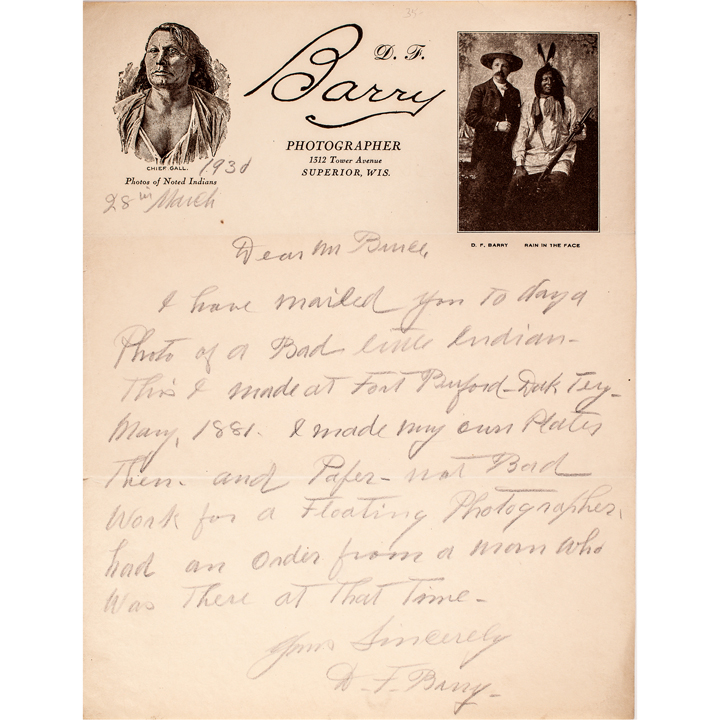
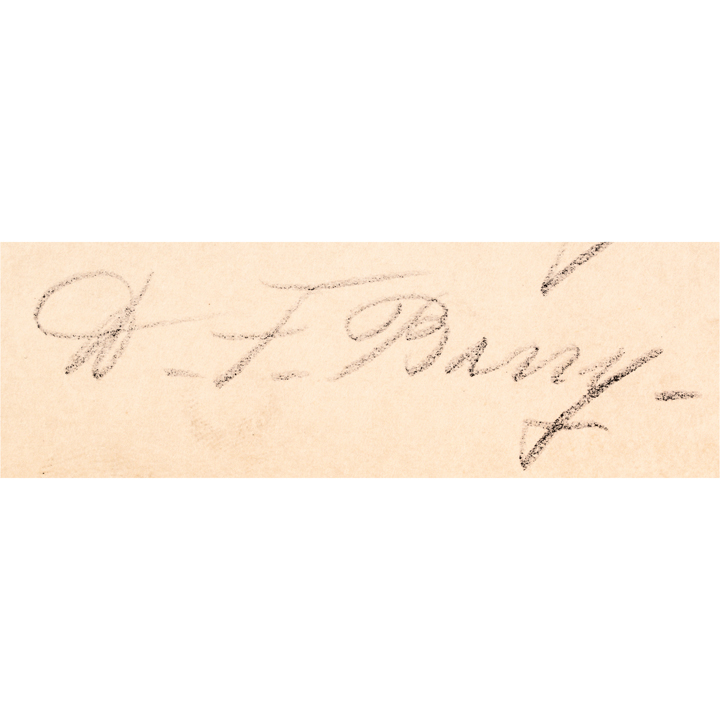
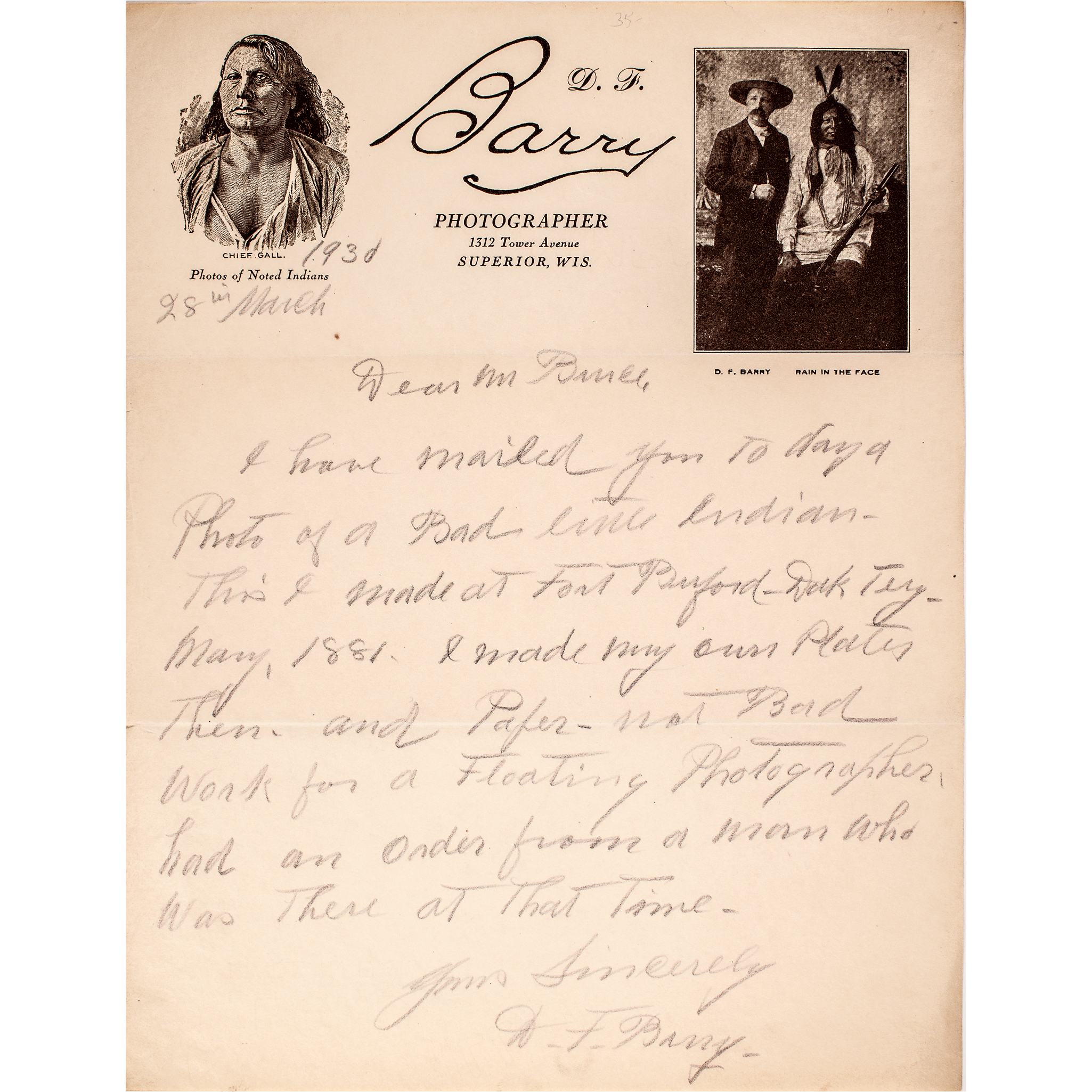
DAVID FRANCIS BARRY (1854-1934) The Lakota nicknamed him "The Little Shadow Catcher"; one of the most noted Photographers of the American Indian and U.S. Army participants in the Sioux War of 1876, attributed with some of the most recognizable surviving images from this period in the history of the American West. March 28, 1930-Dated, D. F. Barry (1854-1934), noted Frontier Photographer, Autograph Letter Signed, “D. F. Barry”, all written in pencil on his decorative printed Studio Advertising Sheet, at Superior, Wisconsin, Choice Very Fine. A scarce and evocative letter signed by one of the most important photographers of the American frontier. The printed letterhead measures about 11” x 8.5” and features Barry’s name and business address (“1312 Tower Avenue”), along with photographic images identified as “Chief Gall” and “Rain in the Face,” two prominent Lakota Native American Indian Chiefs, being figures associated with the Northern Plains and the era surrounding the Battle of the Little Bighorn. This letter is easily readable, the letterhead text and images are sharp and bold, all being on an extremely clean crisp sheet that has some faint horizontal folds from being mailed. The line, "I made my own Plates Then and Paper -- not Bad Work for a Floating Photographer" is a rare first-person account of his early wet-plate/albumen process and self-description as a itinerant ("floating") frontier photographer. Here, Barry writes in full: “Addressed to) “Mr. Powell, --- I have mailed you today Photo of a Bad little Indian --- This I made at Fort Buford -- Dak. Ty. (Dakota Territory) - May, 1881. I made my own Plates Then and Paper - not Bad Work for a Floating Photographer had an Order from a man who Was There at That Time -- (Signed) Yours Sincerely, -- D. F. Barry.” This letter provides a remarkable firsthand account of Barry’s early Photography work in Dakota Territory, specifically at Fort Buford in 1881, a key military outpost near the confluence of the Missouri and Yellowstone Rivers. His reference to producing his own photographic “Plates and Paper” underscores the technical demands of frontier photography in the wet plate era, when practitioners often had to prepare materials under difficult and mobile conditions. His description of himself as a “floating photographer” further reflects the itinerant nature of early Western photographers, who traveled between forts, agencies, and settlements to document Native American leaders, soldiers, and frontier life. Documents combining Barry’s autograph content with his printed photographic advertising materials are uncommon, particularly those containing reflective commentary on his early work. This superior example bridges the gap between his later career in Wisconsin and his formative experiences in the Dakota Territory, making it a valuable artifact for collectors of Western Americana, Photographic history, and Native American studies. Barry was born in Honeoye Falls, New York, in 1854. In the late 1870s he headed west and apprenticed under photographer O.S. Goff, who worked out of Fort Abraham Lincoln, Dakota Territory. In 1878 he was hired by itinerant photographer O.S. Goff, with whom he eventually partnered, learning the wet-plate and studio techniques that would define his career. Between 1878 and 1883, using a portable photographic studio, Barry traveled throughout the Plains, to Fort Buford and Fort Yates in the Dakotas and Fort Assiniboine in Montana. Having taken over Goff's business interests, he eventually set up his own studio at Fort Yates and later in Bismarck. This put him in close contact with the Lakota (Hunkpapa Sioux) at a pivotal historical moment in the immediate aftermath of the Battle of the Little Bighorn (1876) and Sitting Bull's return from exile in Canada. Barry became one of the most noted photographers of the American Indian and U.S. Army participants in the Sioux War of 1876, attributed with some of the most recognizable surviving images from this period in the history of the American West. Barry made his name photographing Lakota notables such as Sitting Bull, Rain-in-the-Face, Gall (Phizi), and John Grass, among others. The Lakota nicknamed him "Little Shadow Catcher." His 1885 studio portrait of Sitting Bull holding a peace pipe (now in the Library of Congress) remains one of the most reproduced images of any Native American leader. He established a friendship with Buffalo Bill Cody and photographed members of his Wild West Show, documenting figures like Annie Oakley alongside Sitting Bull during Sitting Bull's 1885 tour with the show. Barry’s glass-plate negatives were preserved and later formed the basis of a landmark 1982 limited-edition portfolio project. In 1934, the Denver Public Library acquired hundreds of his glass-plate negatives and expertly preserved them. Almost a half century later, the DPL's Western History Department and photographer Paul Harbaugh selected forty-five of Barry's most historically and aesthetically significant negatives and made contact prints using Barry's original materials and techniques, producing a limited edition of 150 sets, a set that still circulates in the collectibles market today. [Westward Expansion, Native American History, 19th Century America] [D. F. Barry, Frontier Photography, Battle of the Little Bighorn] [Photography, Manuscripts, Letters, Autographs] |
|||||||||||
|
Auction Closing: Saturday, August 29th
at Noon Eastern Time • 9:00 AM Pacific Time |
|||||||||||