
|
Lot: 106 ♡
|
|||||||||||
|
1775 GOVERNING THE BRITISH MARINES WHO MARCHED TO LEXINGTON AND STORMED BUNKER HILL
|
|||||||||||
|
|||||||||||
 |
|
||||||||||
|
Lot 106:
1775 GOVERNING THE BRITISH MARINES WHO MARCHED TO LEXINGTON AND STORMED BUNKER HILL
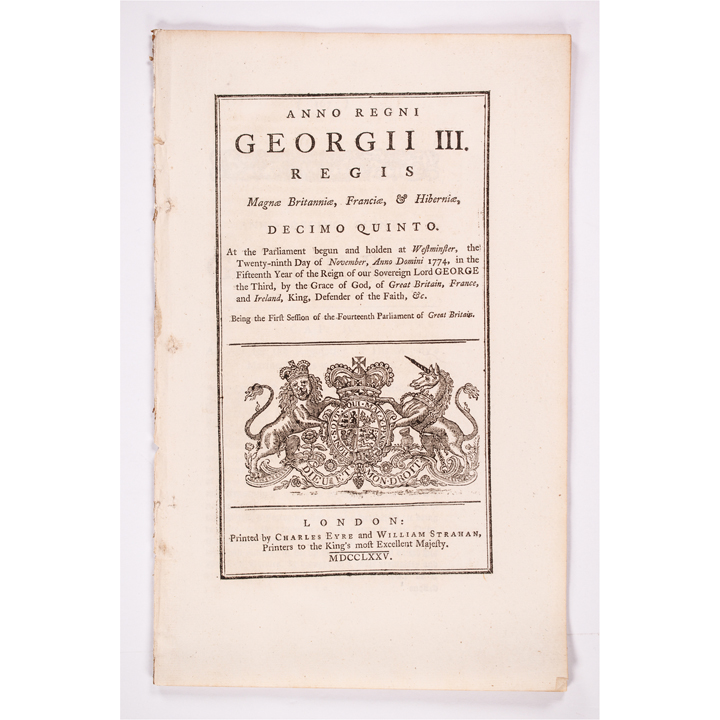
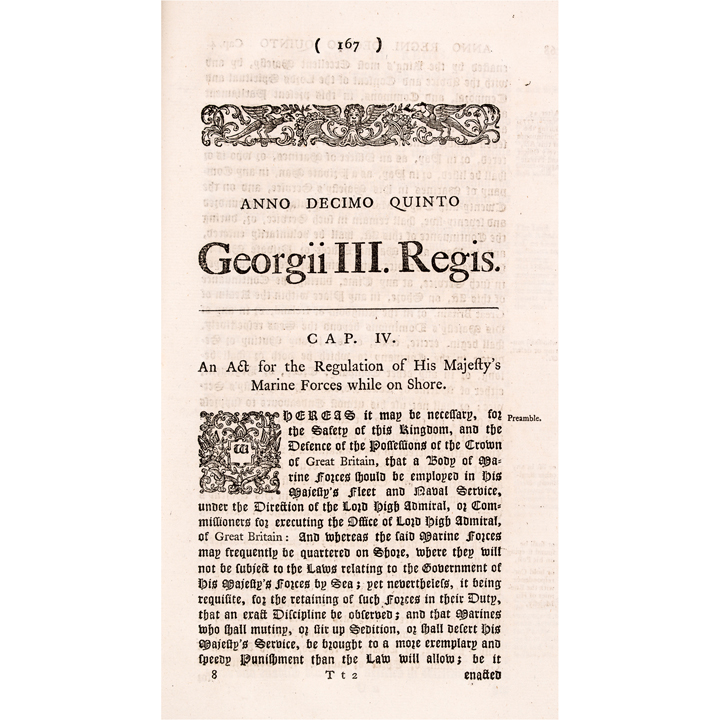
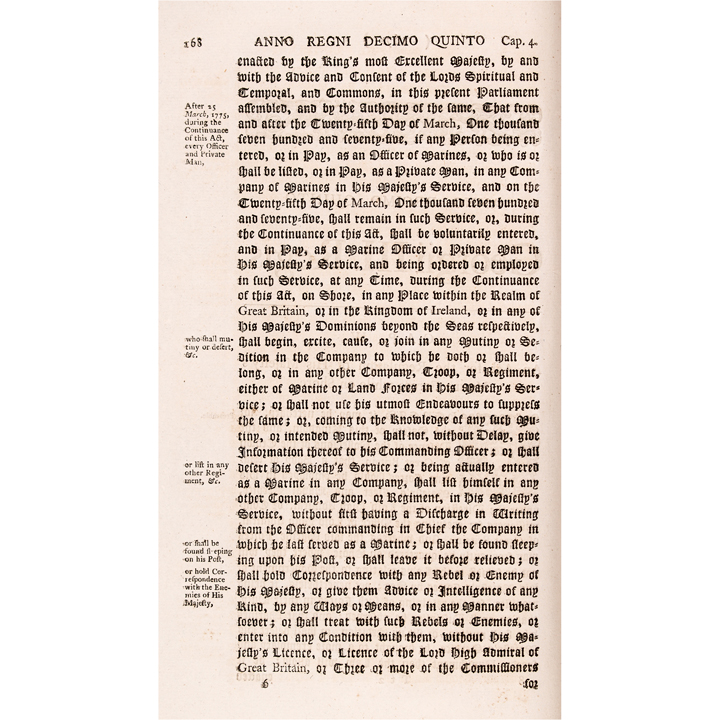
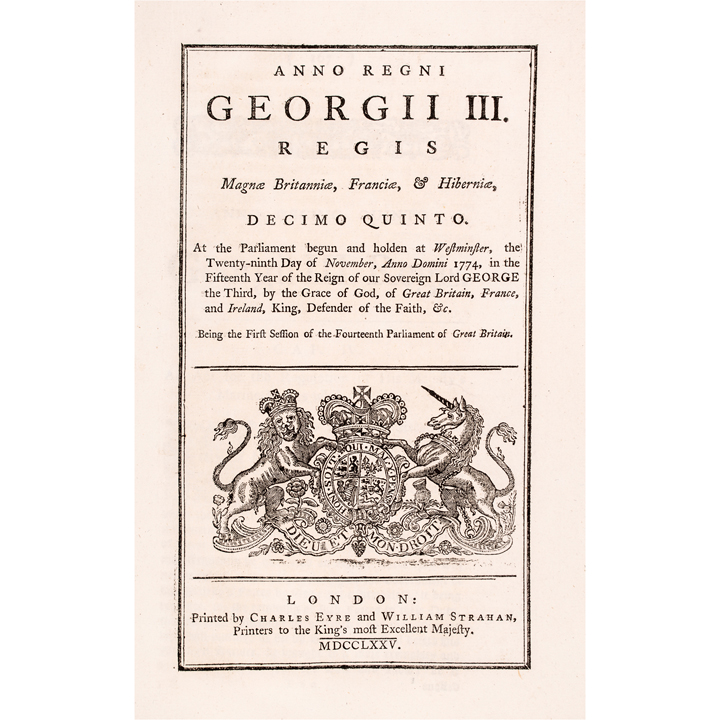
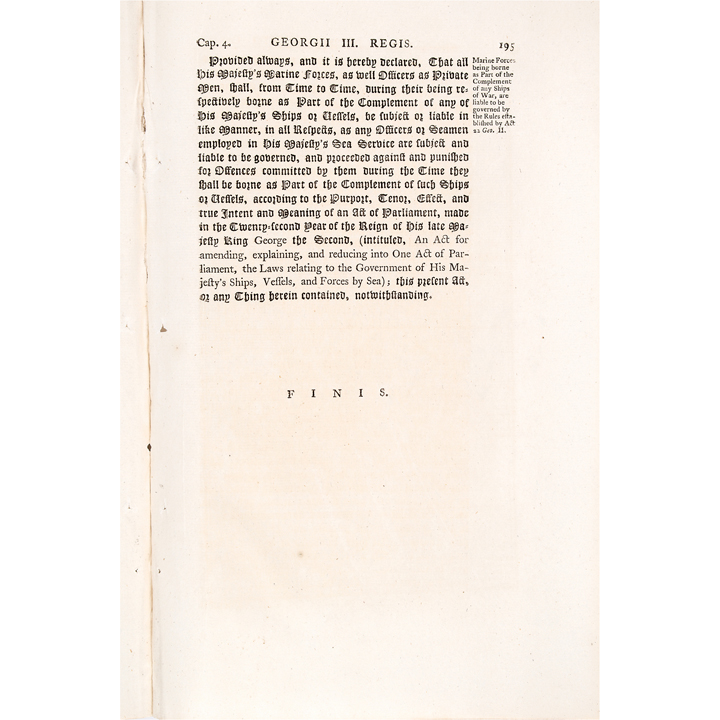
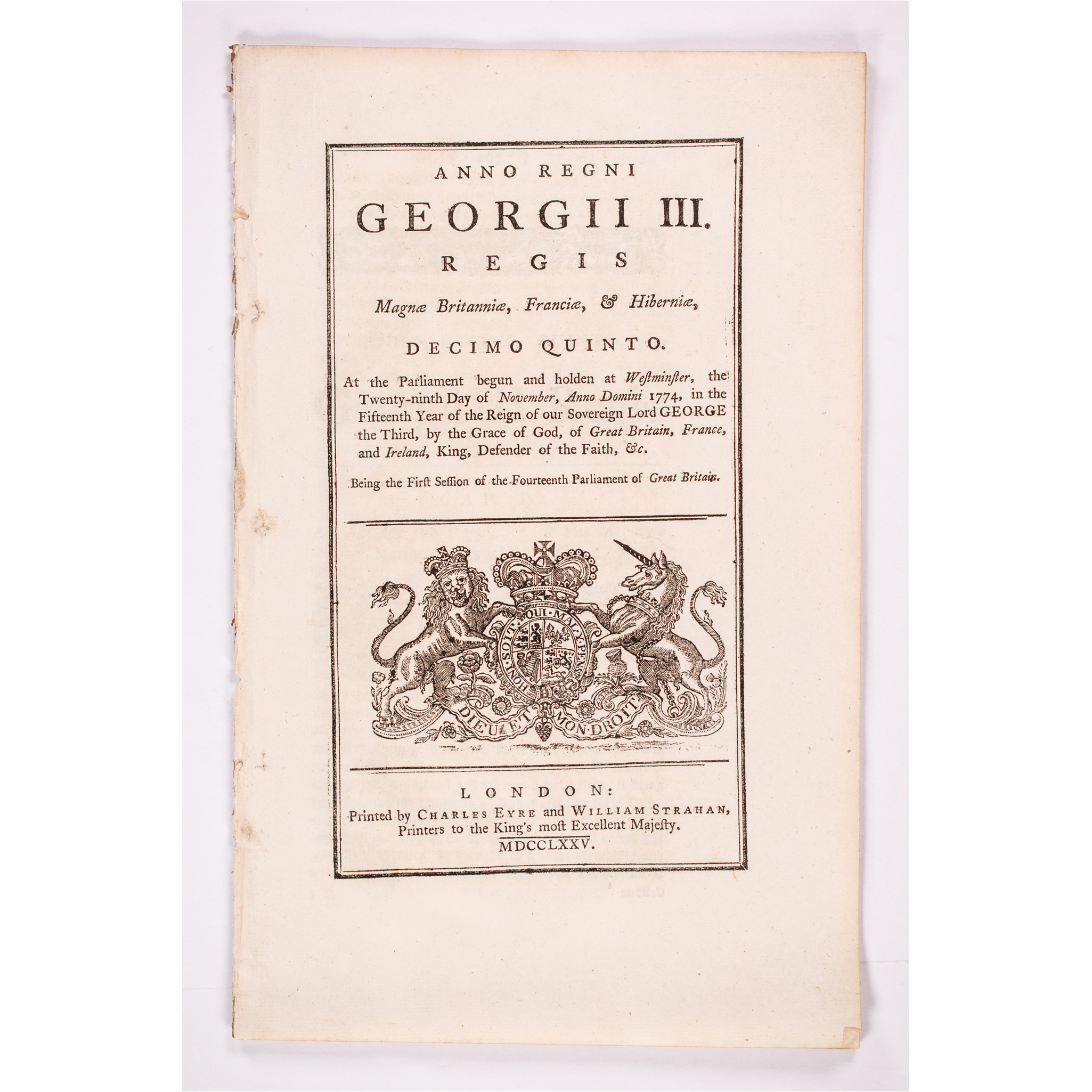
An Act for the Regulation of His Majesty's Marine Forces while on Shore, Including "Quartering", London: Printed by Charles Eyre and William Strahan, Printers to the King's most Excellent Majesty, [1775]. Folio, 27 pages plus Caption page, 15 Geo. III; Royal Arms woodcut at head, Session dated at Westminster November 29, 1774; disbound from the official Session Acts, as issued, Complete, Choice Crisp Mint. This true first edition original Official Printed Act, has 28 pages, measuring 12.25” x 7.75” plus its ornate caption page from, “Anno Regni Georgii III, Regis Magnae Britanniae, Franciae & Hiberniae, Decimo Quinto,” meaning, “The 15th Year of the Reign of George III, King of Great Britain, France and Ireland...” Printed in 1775 by Charles Eyre and William Strahan of London, the pages of this Act as an official government record. The laid period paper paper is bright, crisp, with full large margins, fresh in appearance and the printing is bold. Fully titled: “An Act for the Regulation of His Majesty's Marine Forces while on Shore.” Folio, 27 pages (paginated 167-193), 15 Geo. III; large Royal Arms Woodcut at head of caption title. The annual "Marine Mutiny Act" of the Fourteenth Parliament, includes "Quartering" extending Parliament's Courts-martial authority over His Majesty's Marines when serving on land. These annual mutiny acts were among the longest routine statutes of any session because they recited the full disciplinary framework; oaths, composition of courts-martial, punishable offenses, billeting and quartering provisions, and the schedule of forms. This renewal being required yearly under the “Bill of Rights of 1689,” and never more consequential than in this session. The marines it disciplined included the battalions garrisoning at Boston, the very men Major John Pitcairn led to Lexington Green and Concord on April 19th, 1775, and the Corps that stormed Breed's (Bunker) Hill that June, where Major Pitcairn fell. A highly important historic Revolutionary War-date Imprint of direct military association to the very first opening battles of the war. This being an exceptionally fresh and crisp example with wide margins; a superior quality example. The billeting provisions at pages 175-179 follow the pattern of the annual Mutiny Acts: they authorized constables and local magistrates to billet marines on shore in inns, livery stables, alehouses, and victualling houses, public houses, not private dwellings, with a fixed schedule of rates the innkeeper was owed for diet, small beer, and stabling. This was the machinery by which Britain lodged its forces at home in the absence of sufficient barracks, and it was tolerated in England precisely because it was confined to houses of public entertainment and paid for. The Marine Act needed these clauses because marines ashore fell outside naval jurisdiction and had to be housed and disciplined like soldiers. In comparison, “The Quartering Act” of June 2, 1774 (14 Geo. III, c. 54) which was the fourth of the Coercive Acts, addressed the same practical problem in America but with a critical difference in method. Colonial authorities had frustrated the army by insisting troops be housed in distant barracks (in Boston's case, out at Castle William in the harbor) rather than in town where they could actually police the populace. The 1774 Act cut through this by empowering the Royal Governor, when barracks were not made available, to seize and use uninhabited houses, outbuildings, barns, and other buildings to quarter troops directly among the people. Contrary to popular myth, neither it, nor the annual Mutiny Acts, authorized forcing soldiers into occupied private homes, but to American colonists the distinction felt thin as “Quartering” was imposed by Royal Fiat rather than by their own assemblies. The grievance was so great it made it into the Declaration of Independence: "for quartering large bodies of armed troops among us" and ultimately into the Third Amendment to the U.S. Constitution. An extraordinary, highly important original Revolutionary War British Act. George III succeeded his grandfather, George II, to the British throne in 1760 and ruled for 60 years, one of the longest reigns in British history. Caught in the midst of political turmoil at home and overseas, he was blamed for the loss of the American Colonies. Thought to have contracted porphyria, he became blind and incompetent in the years before his death. [Pre-Revolutionary War, American Revolution, Battles of Lexington and Concord] [Quartering Act, Declaration of Independence Signers, King George III] [Books, Imprints, Printed Americana] |
|||||||||||
|
Auction Closing: Saturday, August 29th
at Noon Eastern Time • 9:00 AM Pacific Time |
|||||||||||