
|
Lot: 11 ♡
|
|||||||||||
|
James Gibbon Revolutionary War Hero of Stony Point Receiving Highest Honors the Congress could Bestow
|
|||||||||||
|
|||||||||||
 |
|
||||||||||
|
Lot 11:
James Gibbon Revolutionary War Hero of Stony Point Receiving Highest Honors the Congress could Bestow
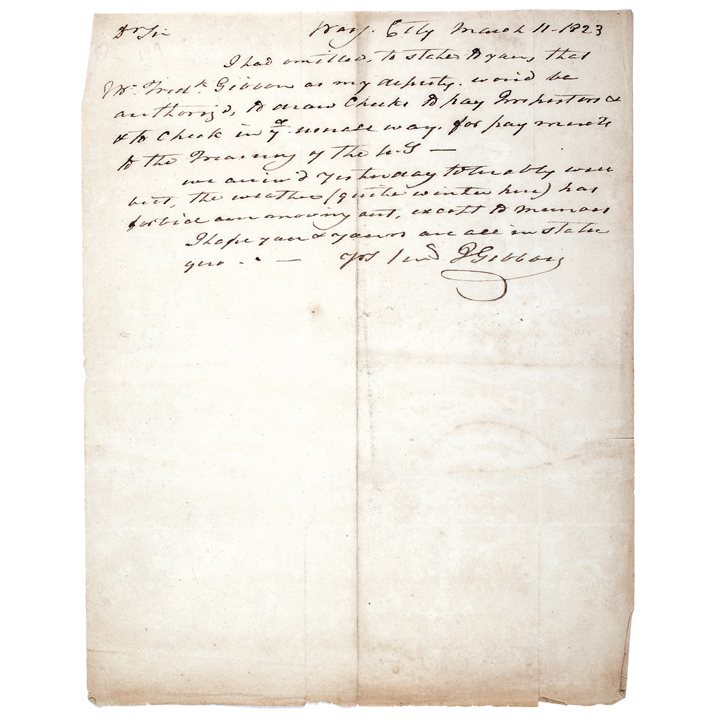
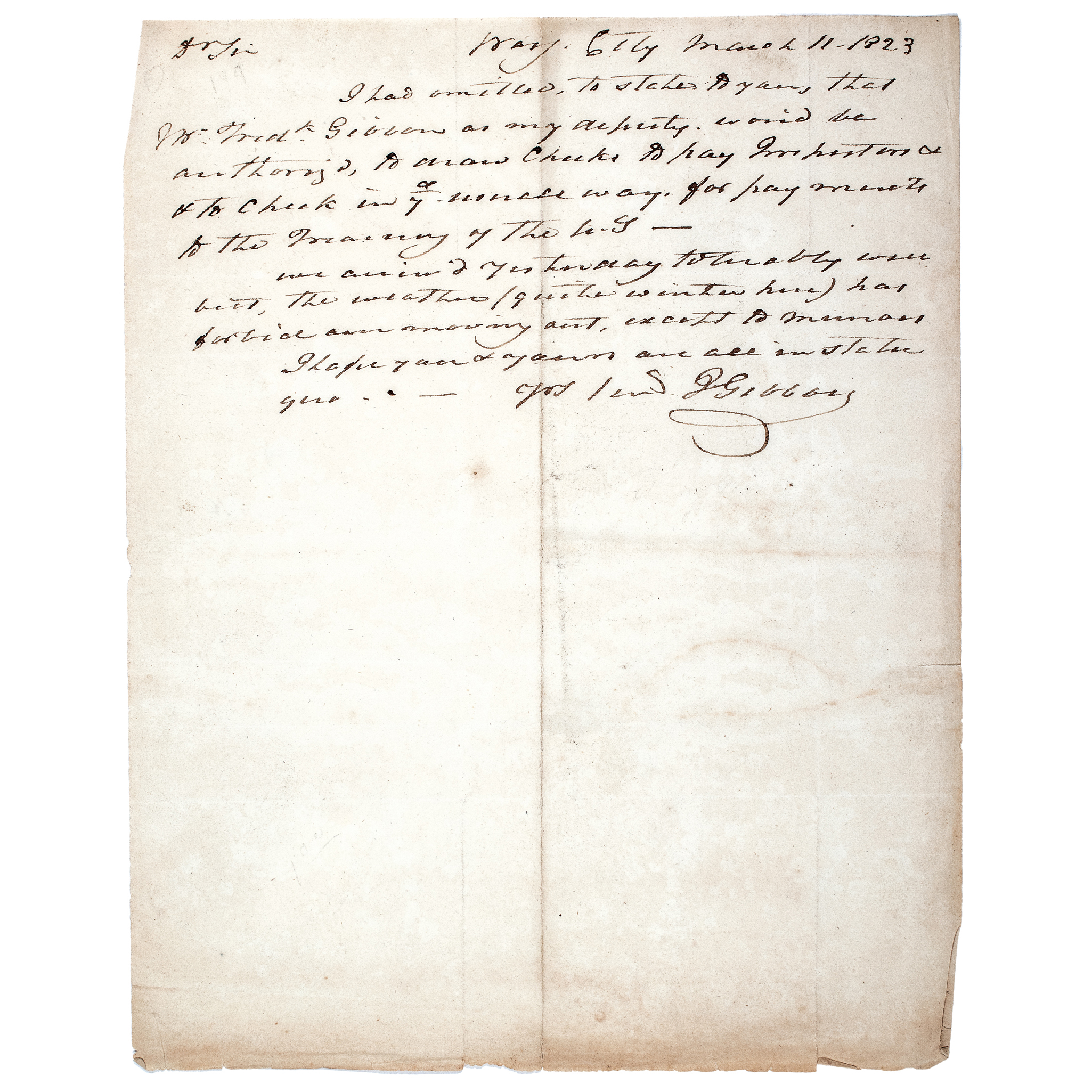
JAMES GIBBON (1758-1835). Continental Army Officer as an Ensign in the 5th Pennsylvania Battalion in 1776; best known for the daring nighttime assault at Stony Point, New York in 1779, opening up a key crossing point for Continental troops on the Hudson River, receiving the thanks of Congress for his bravery in that action; Longtime correspondent of Thomas Jefferson; was an Original Member of the Pennsylvania State Society of the Cincinnati; about 1787, he transferred his Membership to the Society of the Cincinnati in the State of Virginia. March 11, 1823-Dated, Autograph Letter Signed, "J. Gibbon", Washington City, advising that his son & deputy, Frederick Gibbon, is authorized to conduct his duties while he was away from Richmond, Very Fine. James Gibbon is a genuinely compelling Revolutionary War figure whose life spanned the founding era of the United States. He was awarded the brevet rank of captain and the thanks of the Continental Congress for bravery at the attack on Stony Point on July 16, 1779. This formal Resolution was among the highest honors the Congress could bestow on an individual officer; suffering 85% casualties in his detachment while personally breaching the enemy works, it stands as one of the more extraordinary acts of individual courage documented in the Revolutionary War record. This letter is 1 page, measuring 8” x 10” written in brown ink on lightly toned wove period paper with a moderate vertical centerfold, blank reverse and it reads, in part: "I had omitted to state to you, that Mr. Fred'k Gibbon as my deputy, would be authorized to draw checks to pay Inspectors & to check in usual way for payments to the Treasury of the U.S. -- We arrived yesterday tolerably well but the weather (quite winter here) has forbid our moving out... (Signed) J. Gibbon”. James Gibbon (1758-1835) served as an Ensign in the 5th Pennsylvania Battalion in 1776. After being captured and exchanged, he was commissioned in the 6th Pennsylvania Battalion, eventually rising to the rank of Major. His capture occurred during one of the most catastrophic American defeats of the Revolutionary War. On November 16, 1776, the 5th Pennsylvania Battalion was captured in part by the British Army at Fort Washington, New York. The remainder of the regiment was reorganized and re-designated on January 1, 1777 as the 6th Pennsylvania Regiment. Nearly 3,000 Patriots were taken prisoner, and valuable ammunition and supplies were lost. The prisoners faced a particularly grim fate: many later died from deprivation and disease aboard British prison ships anchored in New York Harbor. Gibbon was among those exchanged and returned to service. Gibbon's defining moment came on the night of July 15-16, 1779, in one of the most daring operations of the entire war. General "Mad Anthony" Wayne led a force of roughly 1,200 light infantrymen in a nighttime bayonet assault on the heavily fortified British position at Stony Point on the Hudson River. The left, or northern, wing consisted of 450 men, of which 150 would be detached for a diversion in the center. The forlorn hope of this wing was commanded by Lieutenant James Gibbons, followed by the advance party under Major John Stewart. The small advance detachment sent ahead of the main force into the teeth of enemy defenses to breach the works and open the way. Gibbon, his clothes "muddy to the neck and almost torn to rags," attacked the abattis with zeal and forced a path into the face of devastating enemy fire. He would lose seventeen of his twenty-man detachment killed or wounded. General Wayne's official report to Washington singled Gibbon out directly: "I am not satisfied with the manner in which I have mentioned the conduct of Lieutenants Gibbons and Knox, the two gentlemen who led the advance parties of twenty men each; their distinguished bravery deserves the highest commendation. The first belongs to the 6th Pennsylvania Regiment and lost 17 men killed and wounded in the attack." The Continental Congress voted formal resolutions of honor. Congress resolved unanimously that it "warmly approve and applaud the cool determined spirit with which Lieutenant Gibbons and Lieutenant Knox led on the forlorn hope, braving danger and death in the cause of their country," and granted brevets of captain to both Gibbons and Knox. After the war, Gibbon settled in Virginia rather than returning to Pennsylvania. Gibbon received federal appointments as surveyor for Petersburg in 1789 and inspector of a survey in 1792. He eventually relocated to Richmond, VA. and obtained a more prominent position: he served as Customs Collector at Richmond from 1800 until his death. Gibbon died in 1835 at a very advanced age. His obituary appeared in the Richmond Whig & Public Advertiser newspapers on July 3, 1835, and the Norfolk American Beacon on July 4th, both fitting dates for a man who had risked his life for American Independence. [American Revolution, Revolutionary War, Federal Period] [Stony Point, Military History, Continental Congress] [Manuscripts, Documents, Letters, Autograph Letters Signed] |
|||||||||||
|
Auction Closing: Saturday, August 29th
at Noon Eastern Time • 9:00 AM Pacific Time |
|||||||||||