
|
Lot: 138 ♡
|
|||||||||||
|
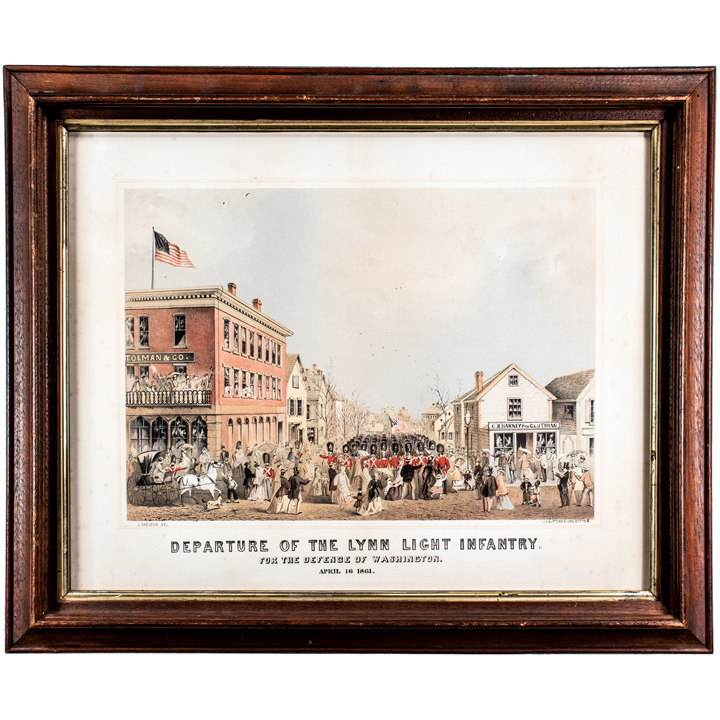
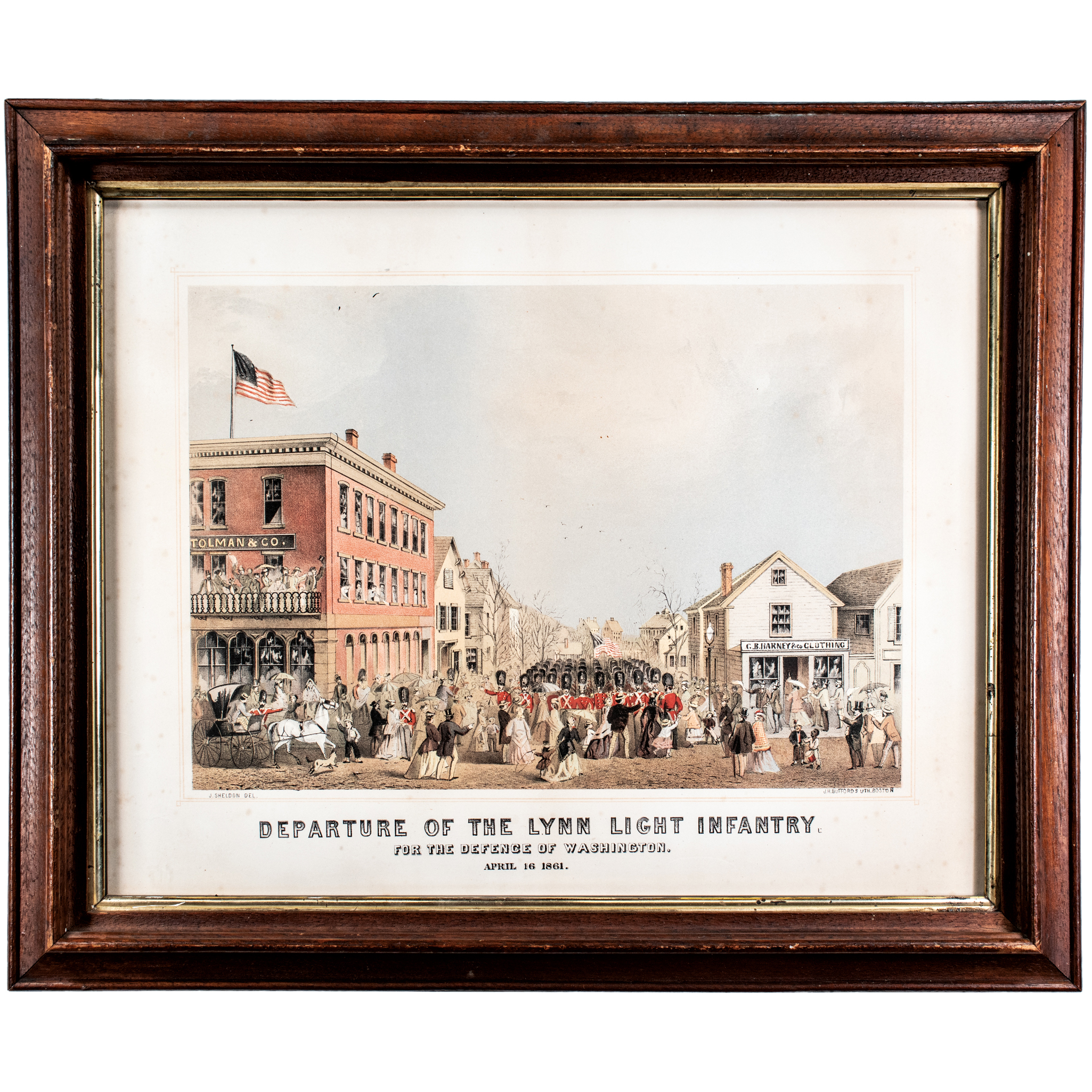
1861 “Departure of the Lynn Light Infantry for the Defense of Washington. April 16, 1861” by J.H. Buffords, Boston
|
|||||||||||
|
|||||||||||
 |
|
||||||||||
|
Lot 138:
1861 “Departure of the Lynn Light Infantry for the Defense of Washington. April 16, 1861” by J.H. Buffords, Boston
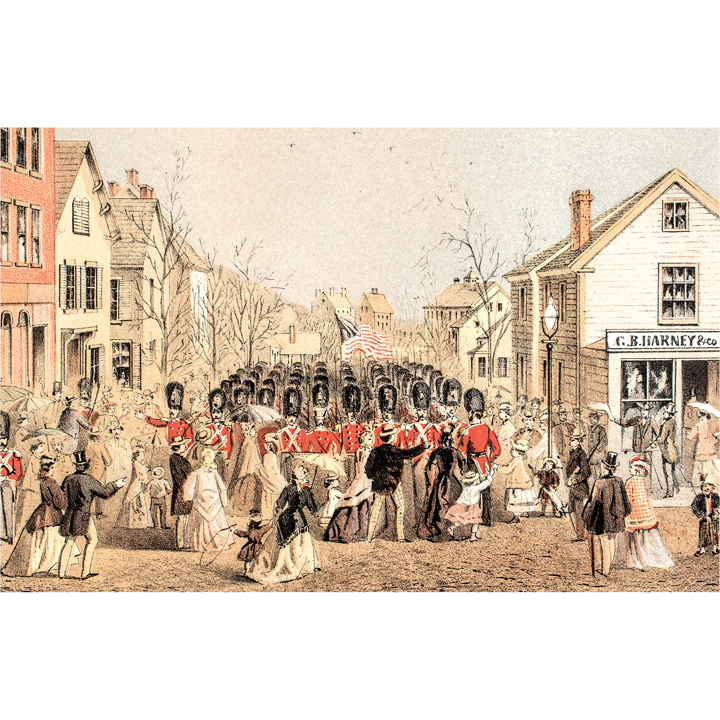
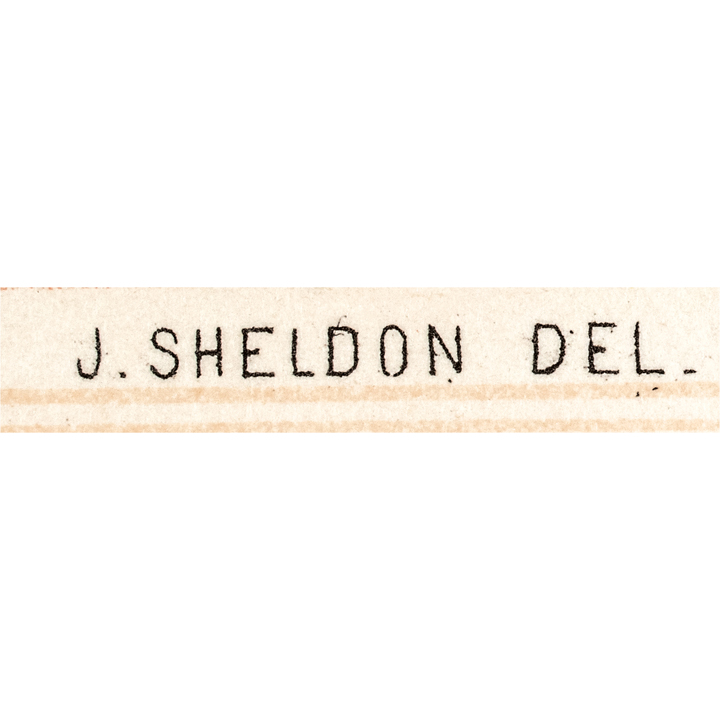
1861-Dated Civil War Colored Lithograph Print depicting and titled, “Departure of the Lynn (Massachusetts) Light Infantry for the Defense of Washington, April 16, 1861.” by J. Sheldon Del., printed by J.H. Buffords UTH., Boston, Framed, Choice Extremely Fine. An impressive colorful Lithograph Print of the Lynn Light Infantry militia in dress uniforms marching through the center of town, a large American Flag is flown atop a major building at left. A very attractive print that is decoratively framed, protected under special museum UV Plexiglas, measuring 11 3/4” x 14 3/4” fully framed to 15” x 18” and ready to hang on display. This Color Lithograph by artist J. Sheldon, lithographed by J.H. Bufford's Company at 260 Washington Street, Boston. Shows the regiment in Red Beefeaters style uniforms marching toward viewer. A three story stone building in a salmon color dominates the left side of the image, while smaller wooden frame houses are seen in the fore and backgrounds. Civilians gather in the foreground and in building windows to see the troops off, including a Black boy playing a drum in the lower right corner of the image. Girl at the center of the image carries a rolling hoop. Verso has note in pencil that says, "Collateral to GLC05508.137 Jul. Ward Howe" -- as this image depicts her house. PROPERTY FROM THE COLLECTION OF AMBASSADOR J. WILLIAM MIDDENDORF II The call for troops came from Washington by telegraph, through Henry Wilson, of the United-States Senate; which was dated April 15, 1861, and asked for twenty companies, to be sent on separately. In the course of the day, formal requisitions were received from the Secretary of War and the Adjutant-General of the Army for two full regiments. By command of Governor Andrew, Special Order No. 14 was immediately issued by the Adjutant-General, and was forwarded, by mail and by special messengers, to Colonel Wardrop of the Third Regiment, at New Bedford; Colonel Packard of the Fourth, at Quincy; Colonel Jones of the Sixth, at Pepperell; and Colonel Monroe of the Eighth, at Lynn. The order was to muster the regiments under their command in uniform on Boston Common forthwith, ‘in compliance with a requisition made by the President of the United States: the troops are to go to Washington.’ An order was also issued to fill all existing vacancies in regimental and line officers, waiving the usual notice. The reason for ordering four regiments when only two had been called for was, that, by detaching strong companies from weak regiments, the two called for might be filled to the maximum. The call aroused the people of the entire State to instant action. The State House became the great centre of interest. The Governor's room and the Adjutant-General's quarters were crowded with citizens, tendering their services in whatever capacity they could be made useful. Telegrams were received from military and civil officers, living in remote parts of the Commonwealth, making the same generous and patriotic offers. As if by magic, the entire character of the State was changed: from a peaceful, industrious community, it became a camp of armed men; and the hum of labor gave place to the notes of fife and drum. On the morning of the 16th of April, the companies began to arrive in Boston; and, before nightfall, every company that had received its orders in time reported at headquarters for duty. There has been some controversy in military circles as to which company can claim the honor of first reaching Boston. I can answer, that the first were the three companies of the Eighth Regiment belonging to Marblehead, commanded by Captains Martin, Phillips, and Boardman. I had been at the State House all night; and, early in the morning, rode to the Arsenal at Cambridge, to ascertain whether the orders from headquarters, to send in arms, ammunition, overcoats, and equipments, had been properly attended to. Messengers had also been stationed at the different depots, with orders for the companies, on their arrival, to proceed at once to Faneuil Hall, as a north-easterly storm of sleet and rain had set in during the night, and had not abated in the morning. On my return from Cambridge, I stopped at the Eastern Railroad Depot. A large crowd of men and women, notwithstanding the storm, had gathered there, expecting the arrival of troops. Shortly after eight o'clock, the train arrived with the Marblehead companies. They were received with deafening shouts from the excited throng. The companies immediately formed in line, and marched by the flank directly to Faneuil Hall; the fifes and drums playing ‘Yankee Doodle,’ the people following and shouting like madmen, and the rain and sleet falling piteously as if to abate the ardor of the popular welcome. And thus it was the Marblehead men entered Faneuil Hall on the morning of the 16th of April. It is impossible to overstate the excitement which pervaded the entire community through this eventful week. The railroad depots were surrounded with crowds of people; and the companies, as they arrived, were received with cheers of grateful welcome. Banners were suspended, as if by preconcerted arrangement. The American flag spread its folds to the breeze across streets, from the masts of vessels in the harbor, from the cupola of the State House, the City Hall, in front of private dwellings; and men and boys carried miniature flags in their hands or on their hats. The horse-cars and express-wagons were decked with similar devices; and young misses adorned their persons with rosettes and ribbons, in which were blended the national red, white, and blue. In the streets, on 'Change and sidewalk, in private mansion and in public hotel, no topic was discussed but the approaching war, the arrival and departure of the troops, and measures best adapted for their comfort and welfare [Antebellum Period, Massachusetts, 19th Century America] [State Militia, Julia Ward Howe, African American History] [Lithographs, Prints, Americana] |
|||||||||||
|
Auction Closing: Saturday, August 29th
at Noon Eastern Time • 9:00 AM Pacific Time |
|||||||||||