
|
Lot: 186 ♡
|
|||||||||||
|
1874 The First Kidnapping-for-Ransom Case in U.S. History Charley Ross Kidnapping $20,000 Reward Broadside with Pinkerton National Detective Agency Involvement Broadside
|
|||||||||||
|
|||||||||||
 |
|
||||||||||
|
Lot 186:
1874 The First Kidnapping-for-Ransom Case in U.S. History Charley Ross Kidnapping $20,000 Reward Broadside with Pinkerton National Detective Agency Involvement Broadside
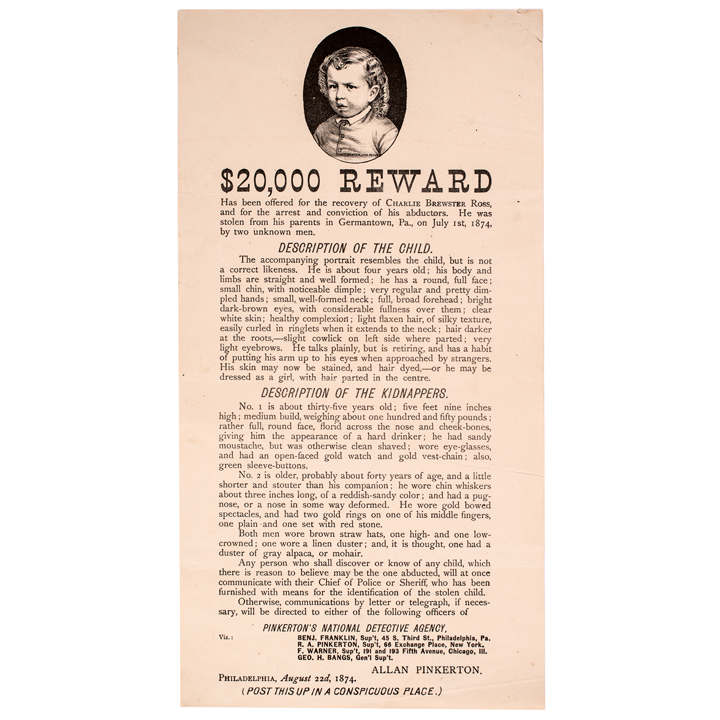
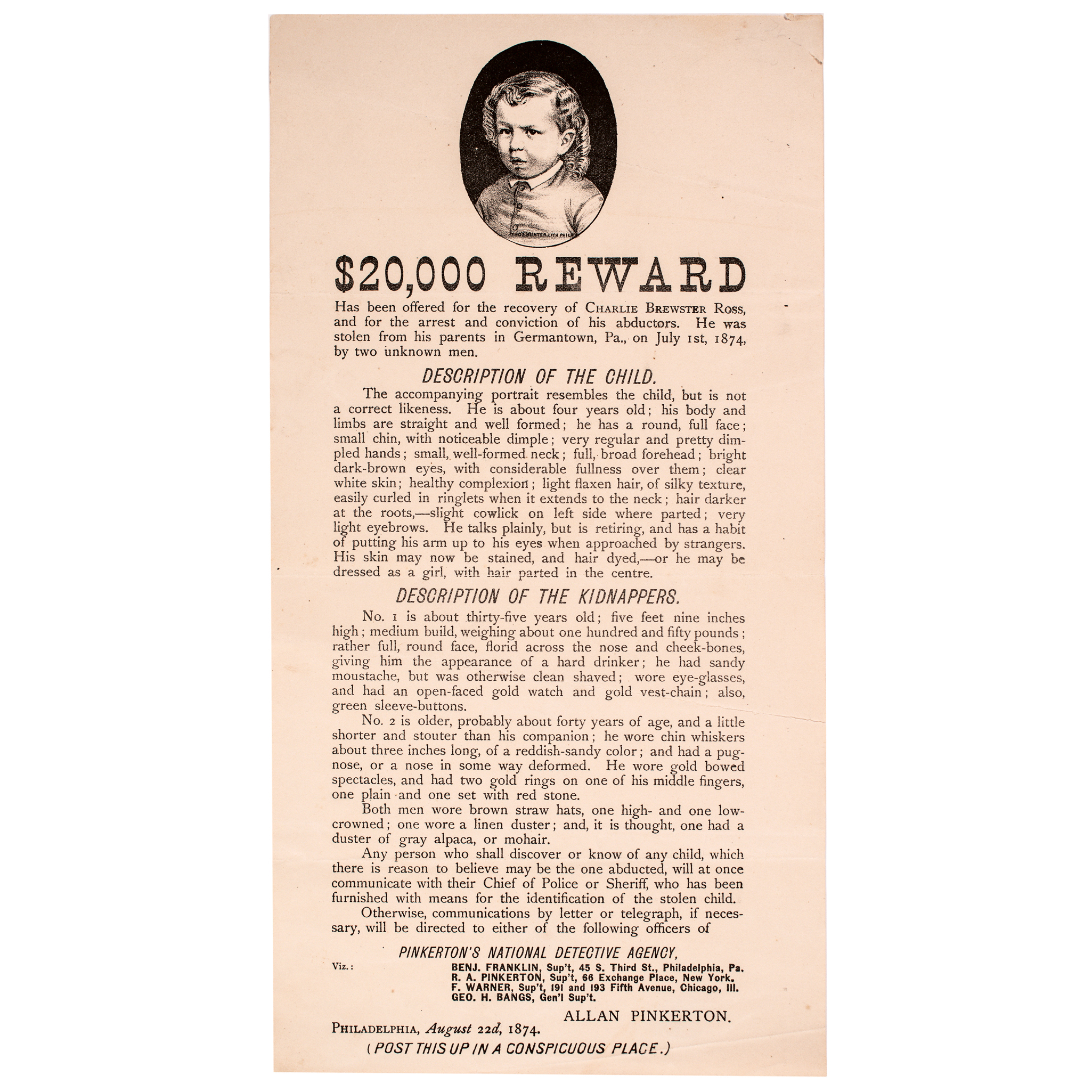
July 1, 1874 The First Kidnapping-for-Ransom Case in U.S. History Original Broadside Style Printed Reward Poster offering $20,000 for the recovery of Charley Ross, abducted in Germantown, Pennsylvania, First use of a Childs Portrait to enlist mass public help, Choice Crisp Extremely Fine. This rare historically important broadside relates to the sensational 1874 kidnapping of four-year-old Charley Brewster Ross, a case that profoundly shaped public awareness of child abduction in the United States. This reward poster prominently offers a staggering $20,000 reward, an enormous sum for the era, for information leading to the child's recovery and the arrest of his abductors. The Poster's use of a Childs Portrait to enlist mass public help is frequently cited as a direct precursor to later child-safety and missing-persons publicity efforts. From Wanted Posters into the 20th century up through the "milk carton" missing-children campaigns of the 1980s. When Charles Lindbergh Jr. was abducted and killed in 1932, one newspaper even ran reward posters for Lindbergh's son and Charley Ross side by side, explicitly drawing the historical line between the two cases. This choice example has a crisp vivid Portrait at top printed on clean wove period paper with some light transmittal folds. This broadside features an engraved portrait of the child at top, accompanied by extensive printed descriptions of both the boy and his captors. The text details Charley's physical characteristics with striking specificity, his "light flaxen hair... easily curled in ringlets," "bright dark-brown eyes," and notably cautious demeanor, while also warning that he may have been disguised, even "dressed as a girl," reflecting contemporary fears and investigative challenges. Equally compelling is the unusually detailed description of the suspected kidnappers, two adult males, carefully characterized by height, build, facial features, clothing, and personal effects such as gold watches, rings, and spectacles. Such descriptive thoroughness illustrates the evolving methods of criminal identification in the late 19th century. On July 1, 1874, four-year-old Charley Ross and his five-year-old brother, Walter Lewis Ross, were playing in the front yard of their family's home in Germantown, a well-to-do section of Philadelphia, Pennsylvania. A horse-drawn carriage pulled up to the residence and the boys were approached by two men who offered candy and fireworks if they would take a ride with them. These two men were known to the boys, as they had been visiting with candy in the days preceding July 1. So the boys agreed, and were transported through Philadelphia to a store where Walter was directed to buy fireworks inside with 25 cents ($7.11 today) given to him. Walter did so, but the carriage left without him. Charley Ross was taken away and never seen again. On the night of December 13, in Bay Ridge, Brooklyn, New York, the house belonging to Judge Charles Van Brunt was burgled. Holmes Van Brunt, Charles' brother who lived next door, gathered armed members of his household to stop the intruders in the act. Holmes's group entered Charles's house and brought down both burglars with a torrent of gunfire. The burglars, Bill Mosher and Joe Douglas, were career criminals who had recently been released from jail. Mosher was killed instantly from the gunfire. Douglas was mortally wounded, but managed to live approximately two more hours and was able to communicate with Holmes. There is no clear consensus regarding exactly what Douglas said as he was dying, as all who were present to witness were too shaken by the night's events to give accurate reports. It is thought that Douglas may have said that lying was pointless, as he knew he was mortally wounded, and he for this reason admitted that he and Mosher had abducted Charley Ross. Douglas is believed to have reported that Ross had been killed, or that Mosher knew where the boy was, possibly adding that he would be returned unharmed to his family within a few days. Douglas did not give any clues to Ross's location or other particulars of the crime and died soon afterwards. Charley's brother Walter was taken to New York City to look at the bodies of Mosher and Douglas so as to determine if they were the men from the carriage ride. Walter confirmed that they were the same men who had taken the boys from in front of their home the previous summer. Mosher in particular was very identifiable because he had a distinctively malformed nose, which Walter had described to police as a "monkey nose". (The cartilage of Mosher's nose had been destroyed by syphilis or cancer). For most, the issue of who the men in the carriage were was settled beyond reasonable doubt, but Charley Ross was still missing. [Gilded Age, 19th Century America, Post-Civil War Era] [Charley Ross Kidnapping, Crime and Justice, Missing Persons] [Broadsides, Ephemera, Printed Americana] |
|||||||||||
|
Auction Closing: Saturday, August 29th
at Noon Eastern Time • 9:00 AM Pacific Time |
|||||||||||