
|
Lot: 19 ♡
|
|||||||||||
|
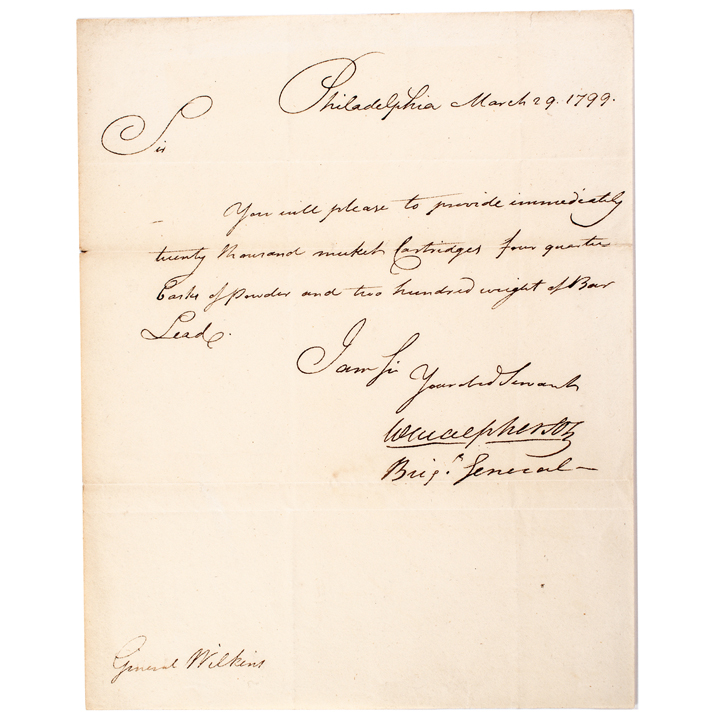
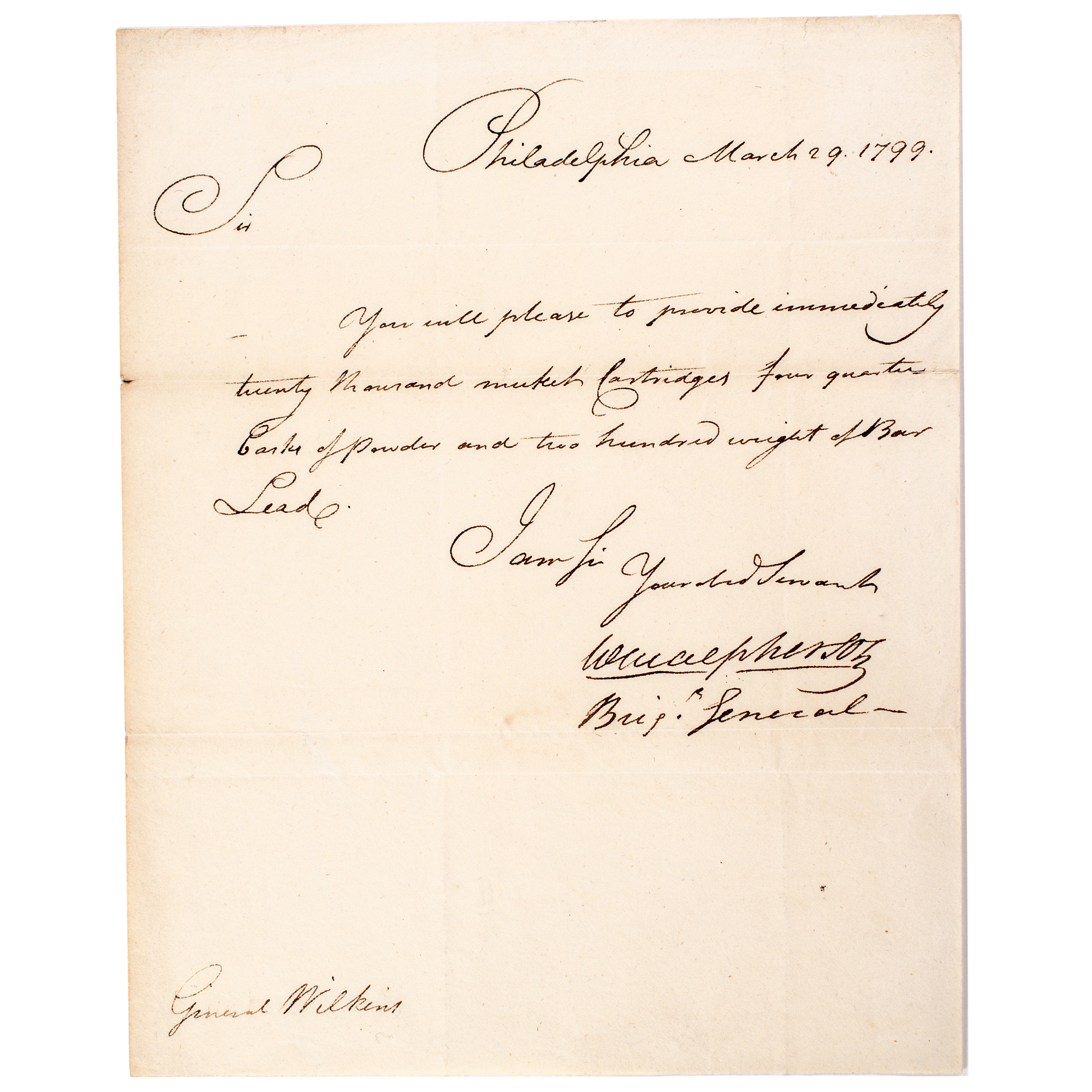
March 29, 1799 Brigadier General William Macpherson ALS to Quartermaster General John Wilkins at Philadelphia; 18 Days before this Letter, President John Adams appointed Macpherson Brigadier General of the Provisional Army with Command of the Troops to crush “Fries’s (Tax) Rebellion”
|
|||||||||||
|
|||||||||||
 |
|
||||||||||
|
Lot 19:
March 29, 1799 Brigadier General William Macpherson ALS to Quartermaster General John Wilkins at Philadelphia; 18 Days before this Letter, President John Adams appointed Macpherson Brigadier General of the Provisional Army with Command of the Troops to crush “Fries’s (Tax) Rebellion”
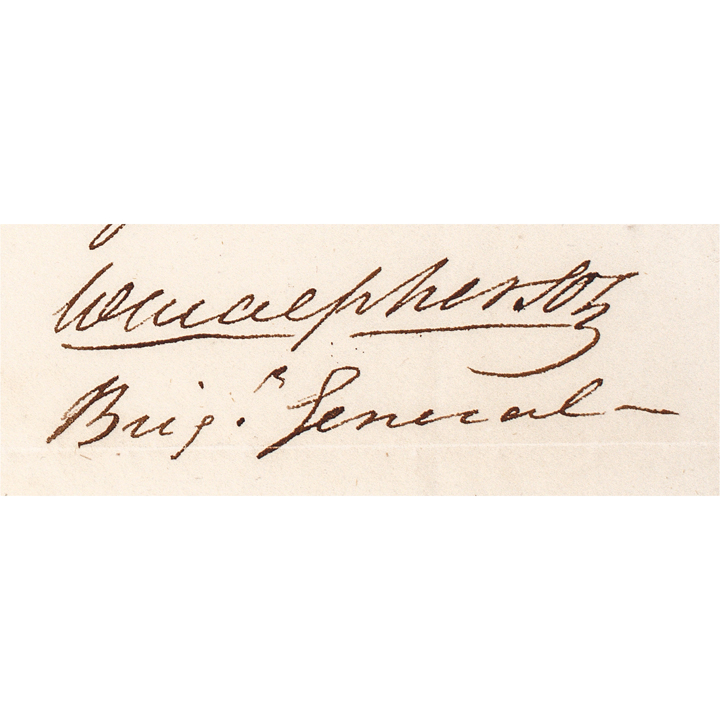
BRIGADIER GENERAL WILLIAM MACPHERSON (1756-1813). Born to a prominent Philadelphia family, Macpherson resigned a commission in the British army at the outbreak of the Revolutionary War to join the Continental cause; Aide-de-Camp to both the Marquis de Lafayette and Major General Benjamin Lincoln; later Surveyor of the Port of Philadelphia; On March 11, 1799, just 18 days before this Letter, then President John Adams appointed Macpherson Brigadier General of the Provisional Army with orders to command the troops dispatched to quell FRIES'S REBELLION, a direct federal property tax on land, houses, and Enslaved people; Appointed to the State Society of the Cincinnati of Pennsylvania. March 29, 1799-Dated Federal Period, Autograph Letter Signed, Philadelphia, as Commander of the Provisional Army Forces Sent to Suppress Fries's Rebellion, Choice Very Fine. This letter is addressed to GENERAL JOHN WILKINS (1761-1816), who served as Quartermaster General of the United States Army from 1796 to 1802. Wilkins was the officer responsible for overseeing the supply and equipment of the expanded United States Federal Army during the period of heightened tension surrounding the Quasi-War with France and the domestic unrest of Fries's Rebellion against the new federal Taxes. During the “Whiskey Rebellion” Insurrection of 1794, Macpherson raised and Commanded a volunteer militia battalion known as "Macpherson's Blues," earning high commendations from both George Washington and Lafayette for his service. This Autograph Letter Signed is 1 page with a blank reverse, measuring 10.0" x 8.0", being dated "Philadelphia March 29, 1799" and it reads in full: "Philadelphia March 29, 1799 --- Sir, --- You will please to provide immediately twenty thousand musket cartridges, four quarter casks of powder and two hundred weight of Bar Lead. --- I am Sir Your Obt. Servant, -- (Signed) W. Macpherson, Brig. General". Addressed at the lower left to: "General Wilkins." This letter is very well written in a bold, confident period hand in dark brown ink on very clean wove period paper with light transmittal folds, Macpherson’s handwritten text having with excellent strength and full clear legibility. Macpherson’s signature measuring a huge 3” long signed as “Brigr. General”. In July 1798, Congress, facing the costs of the looming Quasi-War with France, passed a direct federal property tax on land, houses, and enslaved people. This tax caused widespread national resentment against the John Adams administration and infuriated the German farmers of Bucks, Northampton, and Montgomery counties in Pennsylvania. The tax became known popularly as the "house tax" or "window tax" because assessors measured window sizes as one factor in calculating a home's value, which German-American farmers found deeply intrusive. FRIES'S REBELLION: In July 1798, Congress, facing the costs of the looming Quasi-War with France, passed a direct federal Property Tax on Land, Houses, and Enslaved people. This tax caused widespread national resentment against the John Adams administration and infuriated the German farmers of Bucks, Northampton, and Montgomery counties in Pennsylvania. The tax became known popularly as the "house tax" or "window tax" because assessors measured window sizes as one factor in calculating a home's value, which German-American farmers found deeply intrusive. Starting in early 1799, Pennsylvania auctioneer John Fries organized meetings to discuss a collective response to the tax, and assessors in Milford township were unable to complete their work due to intimidation from protesters. The flashpoint came on March 7, 1799, when Fries and his men forced, through intimidation rather than actual violence, the release of a group of tax resisters who had been imprisoned at Bethlehem under the custody of the federal marshal. President John Adams responded with a proclamation on March 12, 1799, demanding the insurgents disperse by March 18, and on April 4 mobilized over 400 militia under Major General William Macpherson to quell the unrest. MacPherson was a well-established Pennsylvania military figure by this point. He had joined the Continental Army as a brevet-major, served as aide-de-camp to Lafayette, and in 1781 was appointed by Washington to command an irregular cavalry corps in Virginia. During the Whiskey Rebellion of 1794, he commanded the "McPherson Blues," a militia battalion named in his honor, and when war with France seemed likely in 1798, the Blues were reorganized into a legion under his command. In 1799 he was appointed Brigadier-General of the provisional army and commanded the troops sent to enforce the revenue laws in Northampton County during Fries's Rebellion. Federal troops under MacPherson encamped in the rebellious counties and began making arrests. According to local historical accounts, federal troops camped in "Schaeffer's Woods" in Macungie from April 10 to 16, and General MacPherson ordered a parade and review of more than 1,000 troops through the small town of Macungie as a show of force. John Fries himself was arrested on April 5, 1799. Thirty men went on trial in federal court. Fries, Frederick Heaney, and John Getman were tried for Treason and, amid a Federalist-stirred frenzy, sentenced to be hanged. Adams ultimately pardoned Fries and the others convicted of treason, prompted partly by a narrower Constitutional reading of treason, and issued a general amnesty for everyone involved on May 21, 1800. Historians generally agree the Federalists overreacted to and mishandled what was a relatively small episode, and the long-term political effect was that German-American communities turned away from the Federalist Party. ___ WILLIAM MACPHERSON (1756-1813) was a distinguished Philadelphia military officer whose career spanned the Revolutionary War through the turbulent early years of the Federal period. Born to a prominent Philadelphia family, Macpherson resigned a commission in the British army at the outbreak of the Revolution to join the Continental cause, serving as aide-de-camp to both the Marquis de Lafayette and Major General Benjamin Lincoln. Following the Revolutionary War, Macpherson was appointed Surveyor of the Port of Philadelphia and Inspector of Revenue, and during the Whiskey Insurrection of 1794 he raised and commanded a volunteer militia battalion known as "Macpherson's Blues," earning high commendations from both Washington and Lafayette for his service. On March 11, 1799, just eighteen days before the present letter, President John Adams appointed Macpherson Brigadier General of the Provisional Army with orders to command the troops dispatched to quell FRIES'S REBELLION, a.k.a. “The Whiskey Rebellion” the armed tax resistance uprising against the Federal house and land tax that erupted in Northampton, Berks, Montgomery, and Bucks Counties, Pennsylvania, in early 1799. Macpherson's own surviving correspondence to Alexander Hamilton from this very week, dated March 25, 1799, just four days prior to the present letter, describes the insurgents in vivid detail as having "manifested the strongest determination to oppose the Laws, by openly, and with a military Force, rescuing from the Marshal a number of prisoners," confirming that the present letter was written at the precise operational moment Macpherson was mobilizing and equipping his forces to suppress the Rebellion, his final military service before his later appointment to the State Society of the Cincinnati of Pennsylvania. [Federal Period, Fries's Rebellion, Quasi-War with France] [Military History, Taxation, Whiskey Rebellion] [Manuscripts, Documents, Letters, Autograph Letters Signed] |
|||||||||||
|
Auction Closing: Saturday, August 29th
at Noon Eastern Time • 9:00 AM Pacific Time |
|||||||||||