
|
Lot: 32 ♡
|
|||||||||||
|
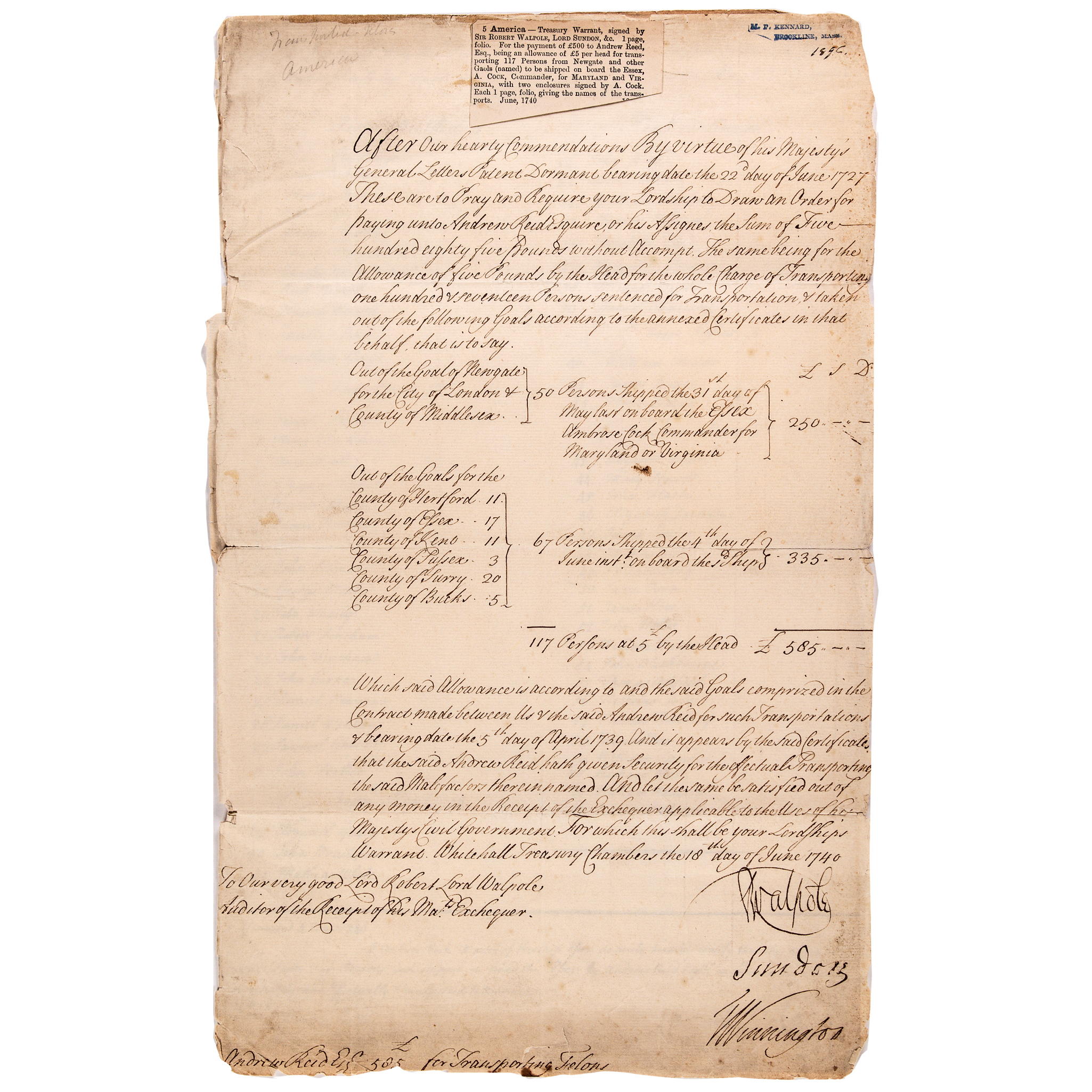
June 18, 1740-Dated Manuscript Document Signed, "R. Walpole" as First Prime Minister Great Britain's Official Treasury Warrant Paying for the Shipment of 117 Convicts from Newgate Prison and Six County Jails to Maryland and Virginia - The Foundational Document of "Convict Transportation" to Colonial America Archive of Four (4) Items - We know of No Other Comparable Robert Walpole-Signed Convict Transportation Warrant being Offered at Public Sale
|
|||||||||||
|
|||||||||||
 |
|
||||||||||
|
Lot 32:
June 18, 1740-Dated Manuscript Document Signed, "R. Walpole" as First Prime Minister Great Britain's Official Treasury Warrant Paying for the Shipment of 117 Convicts from Newgate Prison and Six County Jails to Maryland and Virginia - The Foundational Document of "Convict Transportation" to Colonial America Archive of Four (4) Items - We know of No Other Comparable Robert Walpole-Signed Convict Transportation Warrant being Offered at Public Sale
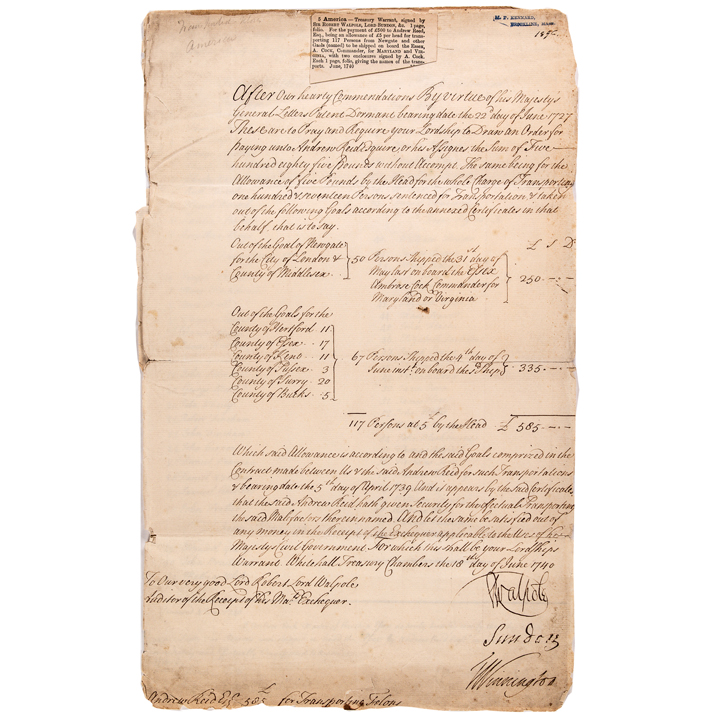
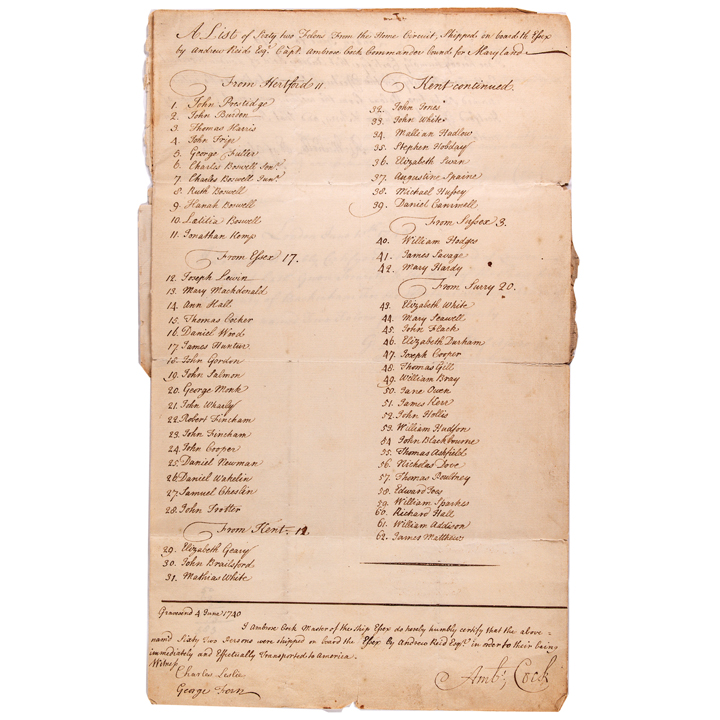
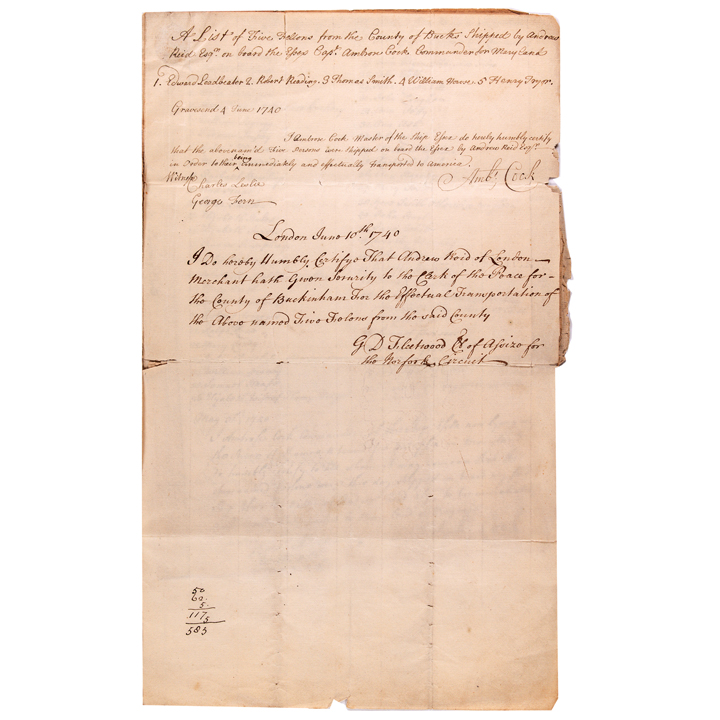
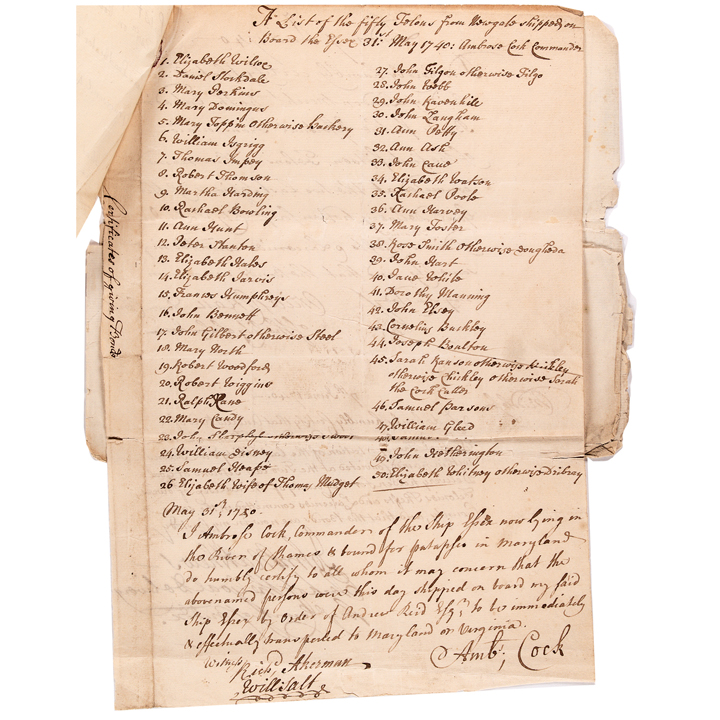
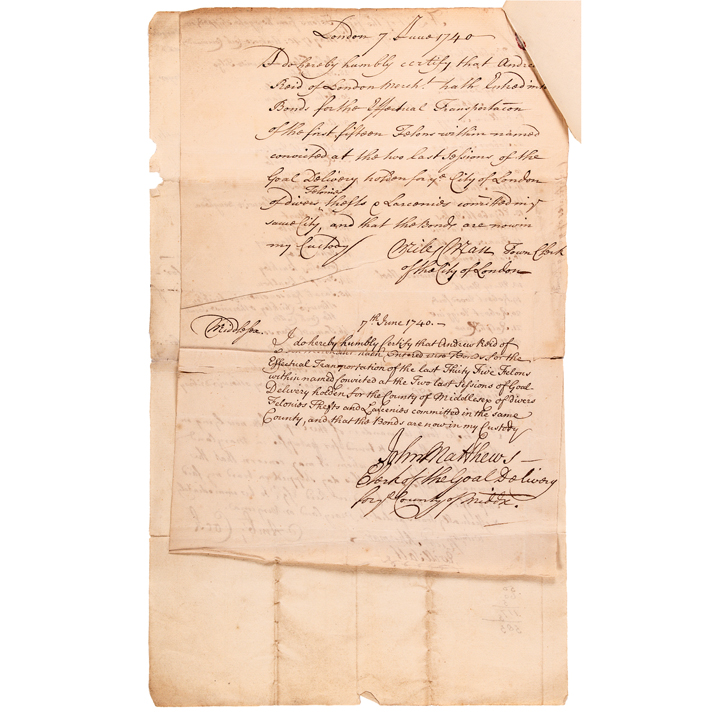
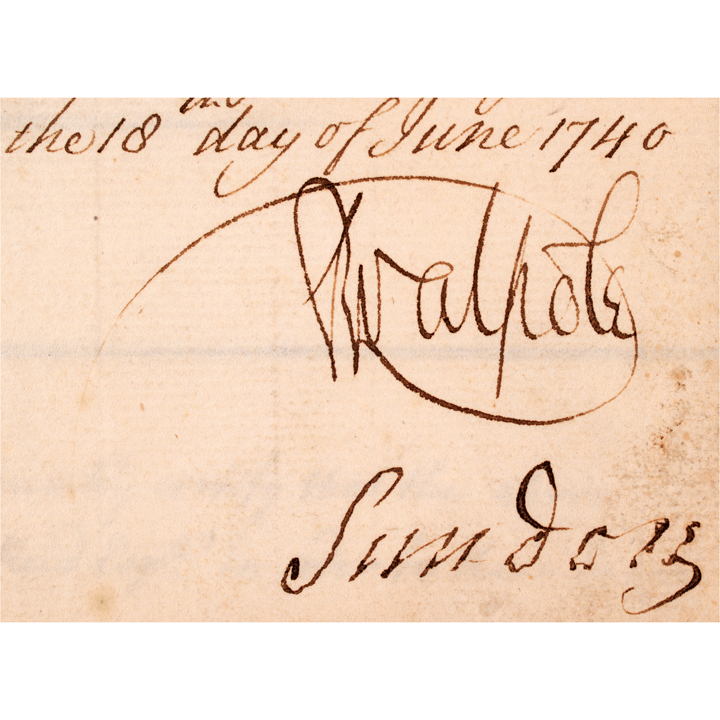
SIR ROBERT WALPOLE (1676-1745). Prime Minister of Great Britian who conducted the Impeachment of Bolingbroke and Harley, helped accomplish the Reconciliation of George I and the Prince of Wales, and Navigated Investors through the South Seas Bubble scandal, in 1740 Walpole personally authorizes payment from the Royal Treasury for the transportation of 117 convicted felons drawn from London's Newgate Prison to be "shipped" across the Atlantic and Sold into Bound Servitude in Maryland or Virginia. June 18, 1740-Dated Manuscript Document Signed, "R. Walpole" as First Prime Minister - Great Britain's Official Treasury Warrant Paying for the Shipment of 117 Convicts from Newgate Prison and Six County Jails to Maryland and Virginia, Very Good. The Foundational Document of "Convict Transportation" to Colonial America being an Archive of Four (4) Items. June 18, 1740-Dated Colonial America Era, Historic "Convict Transportation" Manuscript Document Signed, “R. Walpole” as First Lord of the Treasury, and First Prime Minister of Great Britain, and Countersigned by two Lords of the Treasury, Lord Sundon and Wimmington" from the 1740 Treasury board. One page, small folio, measuring 9" x 14.75", Whitehall Treasury Chambers (London), Fine. Accompanied by Three Additional related manuscript documents, together forming this remarkable Original Source Archive of Four (4) Items, documenting the forced shipment of British convicts and felons to the American Colonies. This exceedingly important, museum-quality Treasury warrant is boldly Signed, "R. Walpole" by SIR ROBERT WALPOLE (1676-1745), First Earl of Orford, First Lord of the Treasury, Chancellor of the Exchequer, and universally recognized as Great Britain's first Prime Minister, who dominated British government for over two decades (1721-1742) under Kings George I and George II. Here, at the height of his power and in the reign of George II, Walpole personally authorizes payment from the Royal Treasury for the transportation of 117 convicted felons drawn from London's infamous Newgate Prison and the jails of six additional counties to be "shipped" across the Atlantic and sold into bound servitude in Maryland or Virginia. This historic foundational document reads, in part ; "... By virtue of His Majesty's General Letters Patent... Require your Lordship to Draw an Order for paying unto Andrew Reid Esq. or his assigns the sum of Five hundred eighty five Pounds... the same being the Allowance of five Pounds by the Head for the whole Charge of Transporting one hundred & seventeen Persons sentenced for Transportation..." The document further itemizes the prisoners removed from Newgate Prison and the county jails, noting in part: "... Persons shipped the... on board the Essex Ambrose Cock Commander for Maryland or Virginia..." Plus, Three (3) other additional related Manuscript Documents comprising this Archive of Four (4) Items. The single most important archive of original source documentation relating to the tens of thousands of Covicts and Felons ejected from Britain, being lieratlly “shipped” out of their jails and to the American colonies. Historians of “Convict Transportation” to America have settled on much higher numbers of British Felon Prisoners being shipped off to the American colonies than those cited in the nineteenth century. Of the 585,800 immigrants to the Thirteen colonies during the years 1700-1775, about 52,200 were Convicts and Prisoners (9 Percent of the total). During these same years, Slaves by far constituted the largest group of immigrants (278,400; 47%), followed by people arriving with their freedom (151,600; 26%) and Indentured Servants (96,600; 18%). Therefore, almost three quarters of all the people arriving in the American colonies during this time period did so without their freedom! This exceedingly important original source archive and its historic foundational main Document reads, in part: “... By virtue of His Majesty's General Letters Patent... Require your Lordship to Draw an Order for paying unto Andrew Reid Esq. or his assigns the sum of Five hundred eighty five Pounds... the same being the Allowance of five Pounds by the Head for the whole Charge of Transporting one hundred & seventeen Persons sentenced for Transportation...” The document also lists the numbers of prisoners removed from Newgate Prison and other jails in six other counties, noting: "... Persons shipped the... on board the Essex Ambrose Cock Commander for Maryland or Virginia..." Newgate Prison was a prison in London, at the corner of Newgate Street and Old Bailey just inside the City of London. It was originally located at the site of Newgate, a gate in the Roman London Wall. The main Document is Signed at bottom by Robert Walpole. Also Signed by; William Clayton, Lord Sundon (1671-1752) and Spencer Compton, 1st Earl Of Wilmington (1673-1743). There is an old catalog description tipped at top, along with a collector's stamp from 1896, somewhat rough original margins, yet quite nice overall. “Andrew Reid Esq.” was no ordinary merchant. In April 1739, Reid succeeded Jonathan Forward as the British Treasury's exclusive official Contractor for the Transportation of Felons, holding the government's convict shipping monopoly until 1757. The "five Pounds by the Head" subsidy cited in this document was the standard Treasury rate, and the arithmetic is exact: 117 convicts at £5 per head equals precisely the £585 here ordered paid. Reid's tenure is remembered by historians as the grim low point of the convict trade, his voyages notorious for their high death rates in the holds. This warrant is thus a direct payment order, signed by the Prime Minister himself, fueling the machinery of Britain's Human Export Trade The Convict Ship “Essex,” Ambrose Cock, Commander, is recorded in the standard census of convict voyages (see Peter Wilson Coldham, The King's Passengers to Maryland and Virginia and Emigrants in Chains), sailing from London for the Chesapeake, where planters purchased transported felons at dockside sales to labor in the tobacco fields alongside Enslaved Africans and Indentured Servants, customarily held under seven or fourteen-year terms. This Lot also includes Three (3) Additional Related Documents: 1. June 4, 1740-Dated, Manuscript Document Signed by Capt. Andrew Cock, Master of the (Ship) Essex, 1 page, small folio, measuring 9” x 14.5”, Gravesend. Being a list of the names of 62 prisoners which he certifies he has shipped onboard on behalf of Andrew Reid: ”... in order to their being immediately and Effectually transported to America..." The prisoners and their respective county jails are each listed by name. 2. June 4, 1740-Dated, Similar Manuscript List of five (5) felons being shipped from Bucks Co. (Pennsylvania), also Signed by Capt. Andrew Cock. 3. May 31, 1740-Dated, Autograph Document Signed, Capt. Andrew Cock, 1 page, quarto, Thames River [London], "... bound for the passages in Maryland... the above persons were this day shipped... to be immediately and effectually transported to Maryland or Virginia...". Listed by name are: "... fifty Felons from Newgate (prison)...". Both "bills of lading" bear performance bonds on verso, this one from Newgate describing the cargo as those convicted of "... divers Felonies Thefts and Larcenies...". Overall an exceedingly rare, highly important collection. This impressive set of foundational Documents directly relates to the original populations of the American colonies. This archive is made all the more interesting when one considers that the descendants of many of these "Convicts” and “Felons" were to hold prestigious places in Colonial American government, partake in the American Revolutionary War and the very founding of our industry and national history! Note: Coldham's King's Passengers lists Convict Ships and sailing dates confirming the Essex / Ambrose Cock voyage of 1740 there, and noting that the 117 transportees are potentially nameable from the surviving landing certificates and transportation bonds, whereby "the individual convicts aboard are recoverable by name." Overall, a cornerstone Colonial American, Black History-related (comparative bound-labor migration), Maryland, Virginia, and British Prime Ministerial Autograph rarity, worthy of the finest institutional or private collection. (4 items) Historians of “Convict Transportation” to America have settled on much higher numbers of British Felon Prisoners being shipped off to the American colonies than those cited in the nineteenth century. Under the Transportation Act of 1718, Britain systematically emptied its jails into the American Colonies for nearly six decades. Historians of "Convict Transportation" to America have now settled on far higher numbers of British felon prisoners shipped to the American Colonies than those cited in the nineteenth century. Of the 585,800 immigrants to the Thirteen Colonies during the years 1700-1775, about 52,200 were Convicts and Prisoners (9 percent of the total). During these same years, enslaved people by far constituted the largest group of arrivals (278,400; 47%), followed by people arriving with their freedom (151,600; 26%) and Indentured Servants (96,600; 18%). Therefore, nearly three-quarters of all people arriving in the American Colonies during this period did so without their freedom! Maryland and Virginia - the very destinations named in this document - received the overwhelming majority of Britain's transported convicts. Benjamin Franklin famously protested the practice, acidly proposing that the Colonies ship rattlesnakes to Britain in fair exchange. Original manuscript documentation of the convict trade signed at the very top of the British government is of the utmost rarity, virtually all surviving Treasury records being held by the British National Archives at Kew. We know of no comparable Walpole-signed convict transportation warrant having been offered at public sale. The three accompanying related manuscript documents further enhance and support this foundational document, forming the single most important archive of original source documentation relating to the tens of thousands of convicts and felons ejected from Britain, literally "shipped" out of their jails to the American Colonies. Of the 585,800 immigrants to the Thirteen colonies during the years 1700-1775, about 52,200 were convicts and prisoners (9 Percent of the total). During these same years, slaves by far constituted the largest group of immigrants (278,400; 47%), followed by people arriving with their freedom (151,600; 26%) and indentured servants (96,600; 18%). Therefore, almost three quarters of all the people arriving in the American colonies during this time period did so without their freedom! These numbers account for immigrants arriving in America from all countries during these years. When the numbers arriving in America from Great Britain are examined in isolation, the percentage of immigrants who were convicts is of course much higher. From 1718 to 1775, when the Transportation Act was in full force, convicts accounted for one-quarter of all immigrants arriving in the American colonies from the British Isles. Either way, the numbers are much higher than the “one thousandth part of the whole inhabitants” cited by Jefferson. Short Stories, Momentous Events This series on convict transportation to the American colonies began with the story of James Bell, who in 1723 was caught stealing a book and was sentenced to transportation for a 7 year term. Other than the description of his criminal act at his trial in the Proceedings of the Old Bailey and the appearance of his name on a convict shipping list, we do not know much more about his story. More well-known and hardened criminals were certainly transported to America, but Bell’s story is more typical of the thousands of petty thieves who received a sentence of transportation for their crime. Even though Bell’s story of petty theft is short and lacks detail, the event turned out to be a momentous one for him. In being sentenced to transportation, he joined the ranks of thousands of others who could tell a similar story. Transportation to the American colonies constituted a major transformation in the lives of the people who received this punishment-a transformation so profound that they probably never could have conceived of what was in store for them before it actually happened to them. For what could very well have been an impulsive act, Bell was sent on an epic journey across the ocean and into the unknown. When convict transportation to America had reached its height after mid-century, the British government was ambivalent about the success of this enterprise and sought alternatives, although none of them proved satisfactory enough to displace it. The stories and experiences of the various groups involved in convict transportation offer different shades of light on the success of convict transportation. All of them must be taken into account when evaluating how effective the punishment ultimately was in diminishing the crime rate, rehabilitating the offenders, and establishing new lives for the convicts. There were many winners in the practice of transportation. Convict merchants, who specialized in moving this form of human cargo across the Atlantic, made a fortune. Plantation owners were also beneficiaries of this form of punishment by taking advantage of the cheap labor that convicts provided. There were risks, to be sure. Convicts with ill temperaments could disrupt plantation life, and many convicts jeopardized plantation owners’ investment in them by escaping and running away. Even so, planters quickly bought up convicts almost as soon as they arrived in port, because they were such a bargain. The British government probably benefited the most. Not only was it able to empty its jails of convicts at minimal cost, but it could pass their convicted felons off on someone else and forget about them as soon as they set foot on American shores. The convicts, for the most part, were the losers. Some of the transported convicts ended up thriving in their new setting. Many, however, died during their trip overseas before they even arrived in America. Others were mistreated by their new masters once they did arrive. Most of them, uprooted from their family and friends in England and shipped off to a strange land, either ran away or served out their terms before disappearing into obscurity. Convict transportation played a significant role in the workings of colonial America. In the same way that Australia has learned to acknowledge and embrace its criminal legacy, America needs to come to terms with its similar criminal past. The history of convict transportation to colonial America asks Americans to re-examine their roots and compels them to recognize the contribution of British convicts such as James Bell in establishing and populating what would eventually become the United States. Learn more about convict transportation to colonial America by reading my book, “Bound with an Iron Chain: The Untold Story of How the British Transported 50,000 Convicts to Colonial America” by Anthony Vaver. Resources for this article: Butler, James Davie. “British Convicts Shipped to American Colonies.” American Historical Review 2.1 (1896): 12-33. Fogleman, Aaron S. “From Slaves, Convicts, and Servants to Free Passengers: The Transformation of Immigration in the Era of the American Revolution.” The Journal of American History 85.1 (1998): 43-76. Jefferson, Thomas. The Writings of Thomas Jefferson. Ed. Paul Leicester Ford. Vol. IV. New York: G. P. Putnam’s Sons, 1894. Liptak, Adam. “More Than 1 in 100 Adults Are Now in Prison in U.S.” The New York Times Friday, February 29, 2008, National Report: A14. Morgan, Kenneth. “Convict Transportation to Colonial America (Review of A. Roger Ekirch, Bound for America: The Transportation of British Convicts to the Colonies, 1718-1775).” Reviews in American History 17.1 (1989): 29-34. Old Bailey Proceedings. (www.oldbaileyonline.org, 7 April 2008), January 1723, trial of James Bell (t17230116-9). __________ Walpole was a British Whig statesman, considered to the first holder of the office of prime minister, who dominated politics in the reigns of George I and George II. Robert Walpole was born on 26 August 1676 in Houghton, Norfolk into a wealthy landowning family. He was educated at Cambridge University and in 1701 became member of parliament for Castle Rising in Norfolk, where his father had previously been MP. He rose rapidly, becoming a member of the Admiralty Board, secretary of war and, in 1709, treasurer of the navy. His rise was temporarily halted by the Tories, who came into power in 1710. In 1712, they accused him of corruption and he was briefly imprisoned. In 1714, George I came to the throne. George distrusted the Tories, whom he believed opposed his right to the throne, and as a result the Whigs were in the ascendant again. In 1715, Walpole became first lord of the treasury and chancellor of the exchequer. He resigned in 1717 after disagreements within his party but in 1720 was made paymaster general. He avoided the scandal that surrounded the collapse of the South Sea Company and was subsequently appointed first lord of the treasury and chancellor of the exchequer again. In this position he effectively became prime minister, although the term was not used at the time. He remained in this position of dominance until 1742. Walpole consolidated Whig power through a system of royal patronage. He pursued a policy of peace abroad, low taxation and reducing the national debt and he knew the importance of keeping parliament on his side. He was also accused of bribery and corruption in his efforts to retain power. After George I's death in 1727, Walpole was briefly superseded by George II's favourite, Spencer Compton, but succeeded in returning himself to favour, partly through the support of the new queen, Caroline. In 1735, George II made Walpole a gift of 10 Downing Street, now the permanent London residence of the British prime minister. Opposition eventually began to develop within Walpole's own party, and a trade dispute with Spain was used by his critics to force him to declare war in 1739, known as the War of Jenkins' Ear. A poor general election result in 1741 made his position more unstable. A number of Whig politicians opposed Walpole's conduct of the war and he resigned in February 1742. He was created earl of Orford in the same year and continued to maintain influence over George II. Walpole died on 18 March 1745. [Colonial America, Colonial Virginia, Colonial Maryland] [Robert Walpole, Convict Transportation, British Government] [Manuscripts, Documents, Ships Manifests, Autographs] |
|||||||||||
|
Auction Closing: Saturday, August 29th
at Noon Eastern Time • 9:00 AM Pacific Time |
|||||||||||