
|
Lot: 37 ♡
|
|||||||||||
|
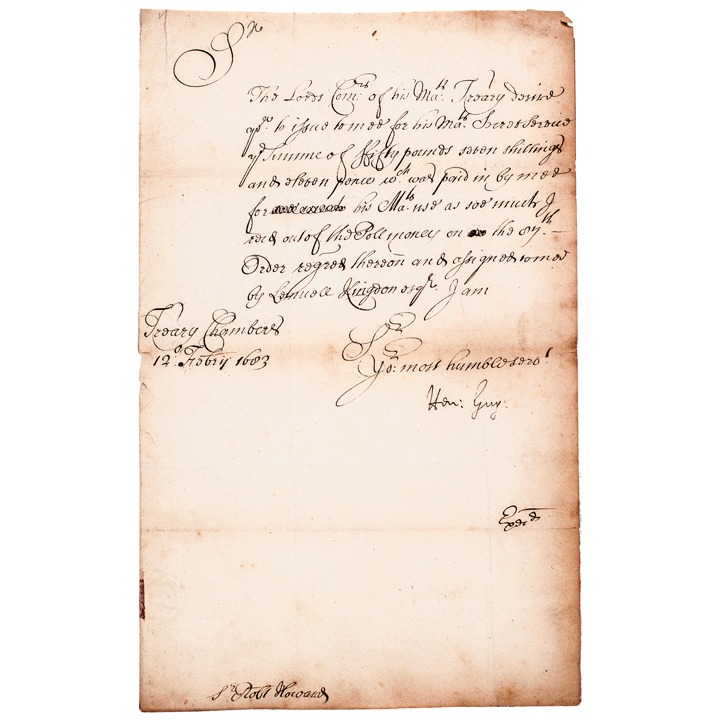
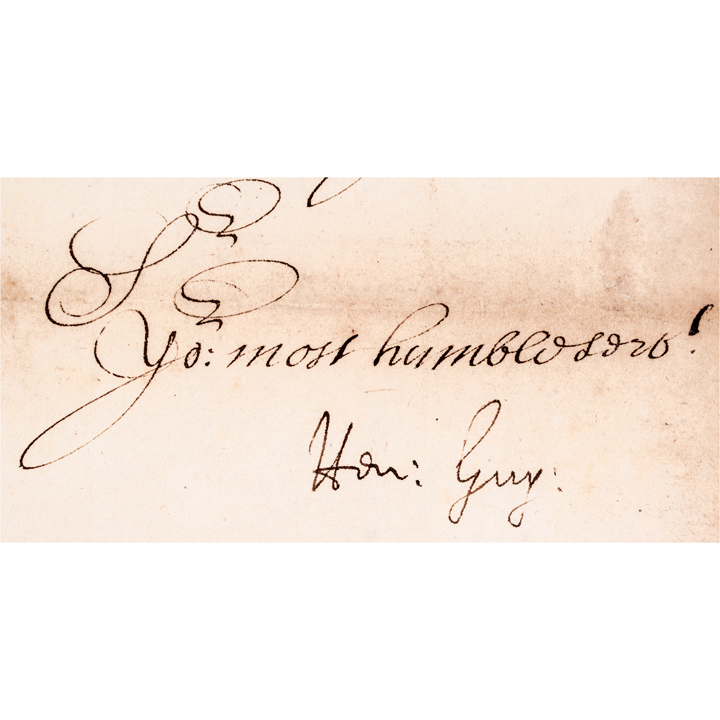
1683 Sir Henry Guy British Royal Treasurer with Integral Transmittal Leaf Payment “for His Majesty's Secret Service”
|
|||||||||||
|
|||||||||||
 |
|
||||||||||
|
Lot 37:
1683 Sir Henry Guy British Royal Treasurer with Integral Transmittal Leaf Payment “for His Majesty's Secret Service”
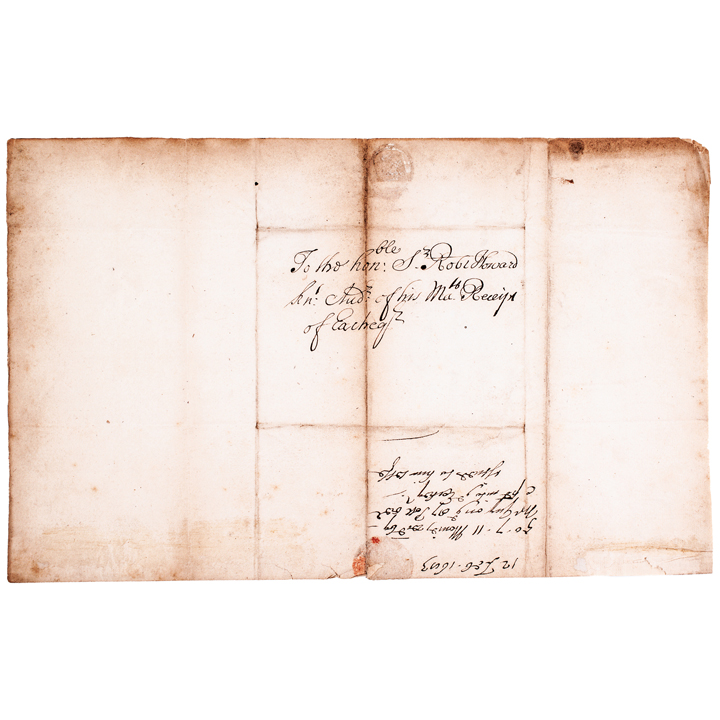
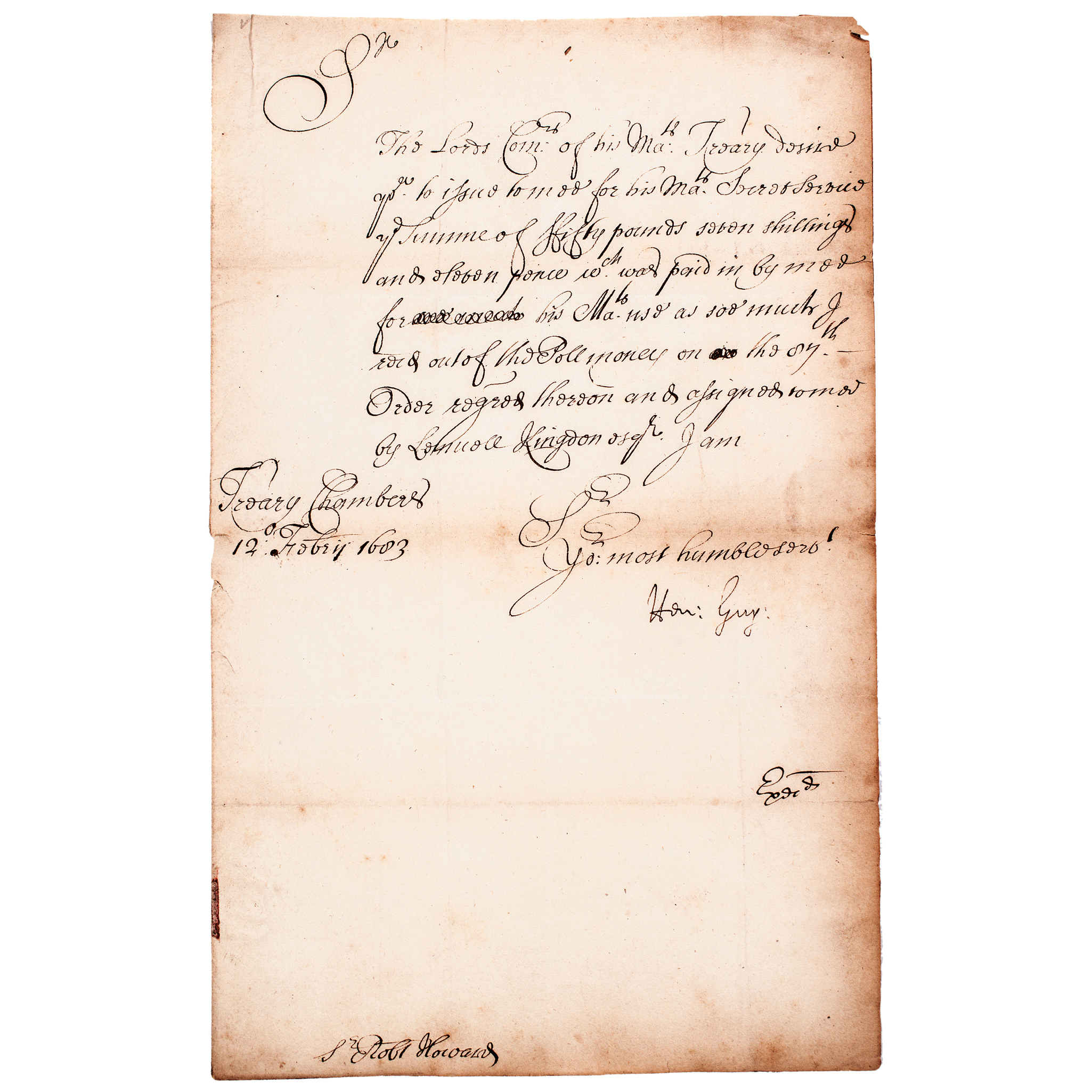
February 12, 1683-Dated, Manuscript Document Signed, “Hen: Guy” as Treasurer of Britain (1679-1688) under Charles II and James II, the restored Stuart monarch who reigned from the Restoration in 1660 until his death in February 1685, an Original British Order by Sir Henry Guy to Sir Robert Howard as Auditor of the Exchaquer, with an Integral Transmittal Leaf, England, Very Fine. Treasury Chambers - 12th Febry 1683, 1 page, measuring 7” x 11.25”, Treasury Chambers. In the Correspondence of Henry, Earl of Clarendon are particulars of sums paid to him for “Secret Service money for one year” to March 7th, 1688. This item being an Order to sent to Sir Robert Howard, as Auditor of the Exchequer “fifty pounds seven shillings and eleven pence” to return money for His Majesty's Secret Service. 1683 fell in the final years of his reign notably the year of the Rye House Plot, an alleged conspiracy to assassinate both Charles II and James II, which led to the execution of prominent Whigs including Algernon Sidney and William Russell. This document with a small Embossed Seal, well written in bold brown ink on clean evenly toned laid period paper. Docket on the reverse, along with Integral Transmittal Leaf “To the Honorable Sir Robert Howard...”. An intriguing financial document regarding a British Royal Treasury confirmation of “his Maj(esty’s) Secret Service” by this payment order in 1683. Charles II, the restored Stuart monarch, reigned from the Restoration in 1660 until his death in February 1685, when he was succeeded by his brother, James II. This document dated 1683 fell in the final years of his rein, n notably the year of the Rye House Plot, an alleged conspiracy to assassinate both Charles and James, which led to the execution of prominent Whigs including Algernon Sidney and William Russell. Henry Guy (1631-1711) was Secretary to the Treasury under Charles II and James II, and the officer through whose hands the Crown's "secret service" money passed. Secret service funds were largely a discretionary royal account used for pensions, political payments, and expenses the King preferred off the public books which is precisely why these records fascinate historians. Guy's ledger of secret service payments for 1679-1688 was famously published much later by the Camden Society in 1851, and his later account volumes survive at the National Archives. The Clarendon in question is Henry Hyde, 2nd Earl of Clarendon (1638-1709), James II's brother-in-law, who served as Lord Privy Seal and then Lord Lieutenant of Ireland (1685-87) before being dismissed in favor of Tyrconnel; he received substantial Crown payments, and an accounting of secret service sums paid to him "for one year to March 7th, 1688" fits that moment exactly and lands, dramatically, just months before the Glorious Revolution swept James II from the throne. Clarendon himself refused the oaths to William and Mary and ended as a nonjuror and suspected Jacobite. In the House of Commons Henry Guy spoke for the party of the Earl of Sunderland. His first appointment about the court was to the post of cupbearer to the queen, but he was soon admitted among the boon companions of Charles II. On the resignation in 1675 of Colonel Silas Titus, he became Groom of the Bedchamber, but sold his office by November 1679 to Thomas Neale. In March 1679 he was appointed Secretary to the Treasury, and the payments from the public funds passed through his hands until Christmas 1688. John Yonge Akerman edited, from a manuscript in the possession of William Selby Lowndes, for the Camden Society in 1851, as vol. lii. of their publications, details of secret service funds of Charles II and James II from 30 March 1679 to 25 December 1688; it was an account rendered by Guy some time after the accession of William III. The Rye House Plot of 1683 was an alleged conspiracy to assassinate King Charles II and his brother James, Duke of York (the future James II), and it stands as one of the pivotal political episodes of Restoration England. The plot grew out of the Exclusion Crisis of 1679-1681, the bitter parliamentary struggle to bar the Catholic James from the succession. When Charles outmaneuvered the Whigs by dissolving Parliament in 1681 and ruling without one, radical Whigs and old Cromwellian soldiers began contemplating more desperate remedies against what they saw as a drift toward popery and arbitrary government. The plan, attributed chiefly to a group of lower-level conspirators including the maltster Richard Rumbold, was to ambush the royal brothers as they returned to London from the Newmarket races in the spring of 1683. The chosen spot was Rye House, Rumbold's fortified manor at Hoddesdon in Hertfordshire, which commanded a narrow lane the royal party would have to pass. The scheme was foiled by chance: a major fire at Newmarket in March 1683 forced the king to return to London earlier than planned, before the ambush could be laid. The plot unraveled in June 1683 when a conspirator, Josiah Keeling, turned informer. In the Correspondence of Henry, Earl of Clarendon (ed. 1828) are particulars of sums paid to him for secret service money for one year, to 7th March 1688. On the death of Henrietta Maria in 1669 Guy obtained a grant of the manor of Great Tring, and on the estate he built, from the design of Sir Christopher Wren, a house and gardens. This property he sold in 1702. In 1680 he acquired from Catherine of Braganza a lease for thirty years of the manor of Hemel Hempstead, and in 1686 some lands in Ireland were ordered by the king's letter to be transferred to him. In 1686 he was also residuary legatee to Thomas Naylor, a man of much wealth, who was buried in Westminster Abbey on 12 Nov. 1686. William III dined with him at Tring in June 1690. In March 1691 he was made a commissioner of customs, but in the following June returned to the secretaryship of the treasury. His displacement was talked of in February 1695, and when the charge of having accepted a bribe was brought home to him, he was forced to resign and was committed to the Tower of London (16th February). In 1696 he guaranteed, with many other members of his party, a loan from the Dutch government of £300,000. Henry Guy died on 23rd February 1710 aged 78. He left £500 a year and £40,000 in cash to William Pulteney, who succeeded him as the MP for Hedon. [British History, Stuart Restoration, 17th Century] [Royal Treasury, Espionage and Intelligence, Rye House Plot] [Manuscripts, Documents, Letters, Royal Correspondence] |
|||||||||||
|
Auction Closing: Saturday, August 29th
at Noon Eastern Time • 9:00 AM Pacific Time |
|||||||||||