
|
Lot: 4 ♡
|
|||||||||||
|
RICHARD CASWELL Signed August 21, 1775 North Carolina Four Dollars “Hillsborough” Issue PCGS EF-40
|
|||||||||||
|
|||||||||||
 |
|
||||||||||
|
Lot 4:
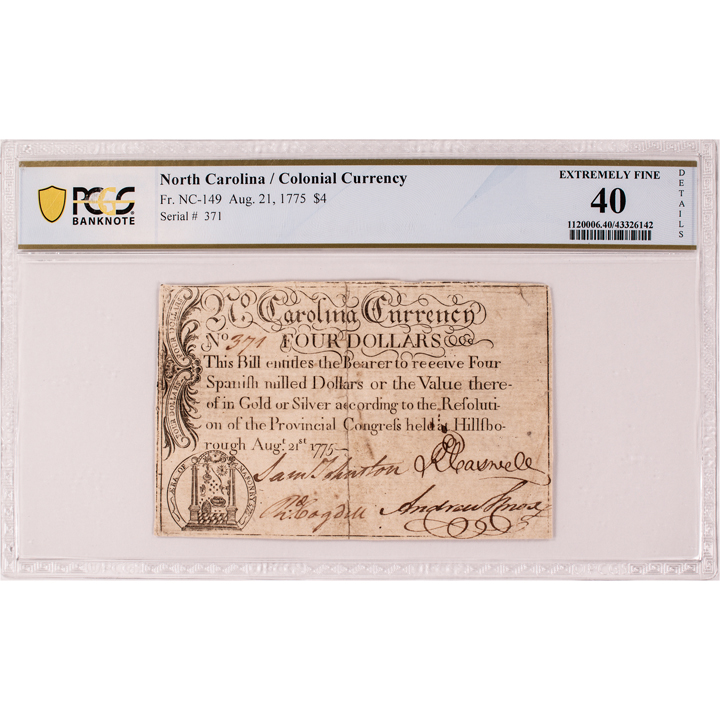
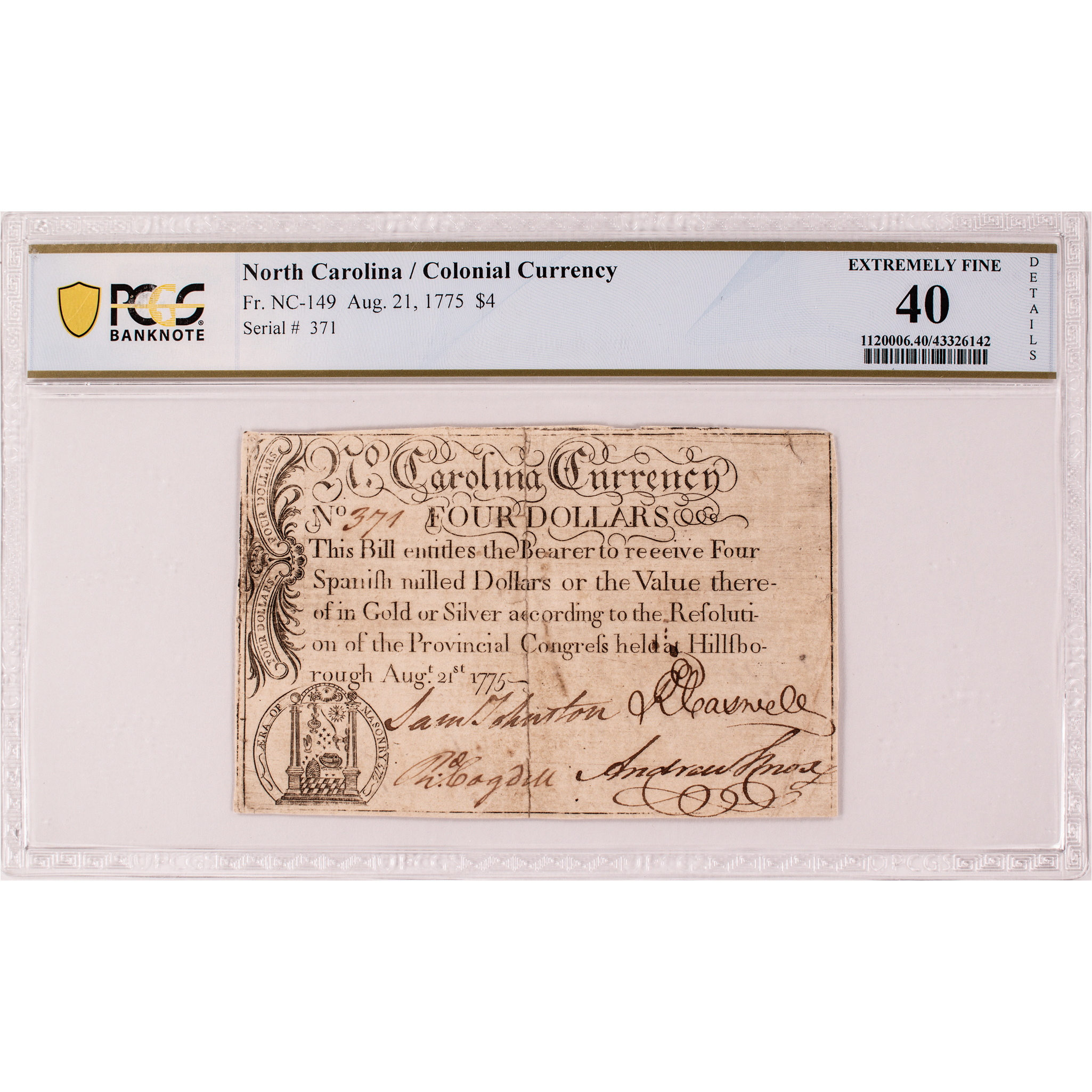
RICHARD CASWELL Signed August 21, 1775 North Carolina Four Dollars “Hillsborough” Issue PCGS EF-40
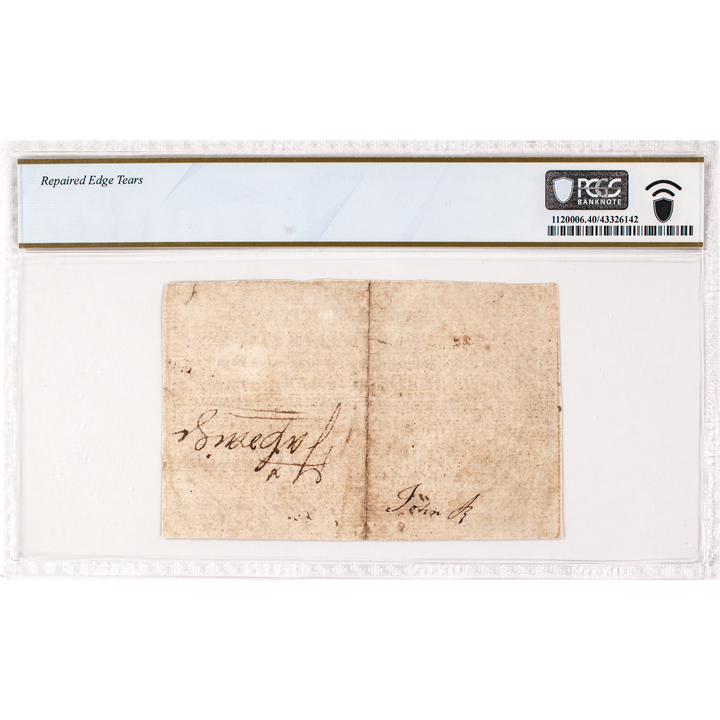
RICHARD CASWELL (1729-1789). Delegate to the First Continental Congress (1774-1775); a Signatory of the 1774 Continental Association; American Revolutionary War Major General; First (1776-1780) and Fifth (1785-1789) Governor of the State of North Carolina; 1776 was President of the North Carolina Provincial Congress that wrote the First Constitution of North Carolina. August 21, 1775, North Carolina, Revolutionary War Hillsborough Issue, Four Dollars, “Masonic Emblems or Symbols” Vignette, Motto “AERA OF MASONRY” around the perimeter, boldly Signed, “R(ichard) Caswell” (Major General & NC Governor, etc.), Finest PCGS Banknote Certified as “TOP POP”, PCGS graded Extremely Fine-40. Fr. NC-149. This Exceedingly Rare and historic North Carolina Colonial Currency example is the finest quality PCGS certified Four Dollars “Hillsborough” issue note we have seen and offered. There is only one other example recorded by PCGS graded Good-6. All 1775 “Hillsborough” issue notes are among the rarest North Carolina paper money emissions as noted by the Friedberg 20th Edition “Paper Money of the United States” reference simply states "Very Rare" (unpriced) reflecting values of each denomination issued due to rarity. The 2008 5th Edition of THE EARLY PAPER MONEY OF AMERICA, by Eric Newman shows only 4,000 note printed, to be exchanged for the August 8, 1778 issue or ultimately to become invalid by by February 4, 1784, listed with a value of $1,500 in the typically encountered grade Very Good with “dashes” for all higher grades. This note has its pedigree to the John Ford Collection Ford XV Sale of 2006 where it realized a hair under $5,000 a couple of decades ago. This important note is fully and boldly Signed by: Samuel Johnston, Richard Cogdell, Richard Caswell, and Andrew Knox. All four signatures are perfectly clear and fully readable, written in brown ink on clean laid period paper. This uniface note is very well centered and overall “beautiful” a word not normally relating to this exceeding rare “Hillsborough” issue. It is printed on laid period paper with an intricate left border design. The engraved Masonic Symbols vignette are located at lower left, appearing sharp and distinct, with all its varied elements amazingly sharp and distinct. Noted on its Details holder is the comment repaired edge splits. There are also some scattered tiny pinholes along the centerfold not mentioned and two signatures on the blank reverse “John R” and “LaConige.” Overall, note exhibits a clean well printed appearance and choice eye appeal that should create strong interest among North Carolina specialist collectors and “Top Pop” enthusiasts alike. Ex: John Ford Jr. Collection Sale XV, October 4, 2006 (no lot tag). Richard Caswell (August 3, 1729 - November 10, 1789) was an American politician and lawyer who served as the First and Fifth Governor of the U.S. State of North Carolina from 1776 to 1780 and from 1785 to 1787. He also served as a senior officer of militia in the Southern theater of the American Revolutionary War. As a Delegate to the First Continental Congress, he was a signatory of the 1774 Continental Association. Caswell represented North Carolina in the Continental Congresses of 1774 and 1775. When the militia district of New Bern was formed on May 4, 1776; Caswell was appointed to Command that regions Minutemen. As such, he led the Provincial Congress' force at the Battle of Moore's Creek Bridge (1776). Soon after that, the Provincial Congress disbanded minuteman battalions in favor of militia. In 1780, he was commissioned Major General of militia and state troops. At the Battle of Camden Court House in 1780, his troops fled after Virginia militia broke and ran in panic, exposing him to attack without greater defense, leaving the Continentals behind to suffer defeat. After his defeat at Camden Court House, Caswell returned home with an unnamed illness. In the meantime, the North Carolina General Assembly appointed William Smallwood of Maryland to the command of North Carolina's militia without informing Caswell, so he resigned on October 21, 1780. When General Smallwood returned to Maryland in January 1781, the General Assembly once again appointed Caswell as Major General of militia, and he retained the position until the end of the American Revolution. Caswell was President of the North Carolina Provincial Congress, that body wrote the First Constitution of North Carolina in 1776. As that Congress adjourned, it elected Caswell as the acting Governor, for which he took the oath of office on January 16, 1777. Under the new Constitution, the State Legislature ("General Assembly") re-elected him as the First Governor in April 1777. Caswell stepped down in 1780, as the State Constitution allowed only three consecutive one-year terms to command the militia. [American Revolution, Colonial North Carolina, Revolutionary War] [Freemasonry, Political History, Richard Caswell] [Currency, Colonial Currency, Numismatics, Exonumia] |
|||||||||||
|
Auction Closing: Saturday, August 29th
at Noon Eastern Time • 9:00 AM Pacific Time |
|||||||||||