
|
Lot: 48 ♡
|
|||||||||||
|
Extremely Rare Fully Signed and Issued 1766 Province of Georgia One Pound Sterling SAVANNAH COURT-HOUSE
|
|||||||||||
|
|||||||||||
 |
|
||||||||||
|
Lot 48:
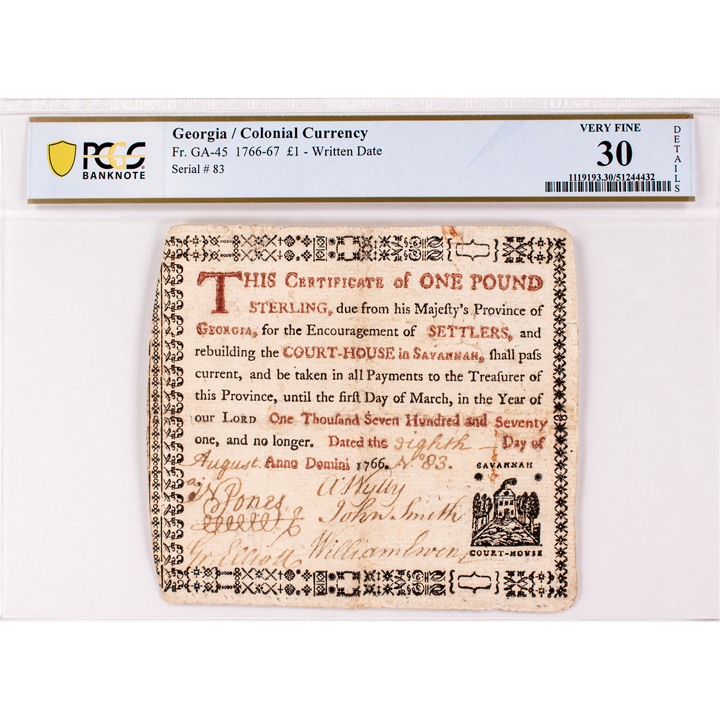
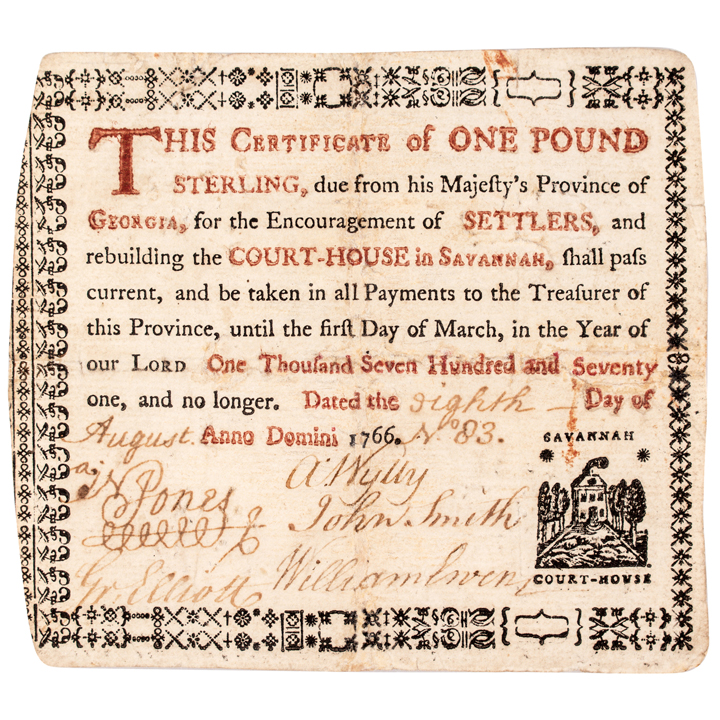
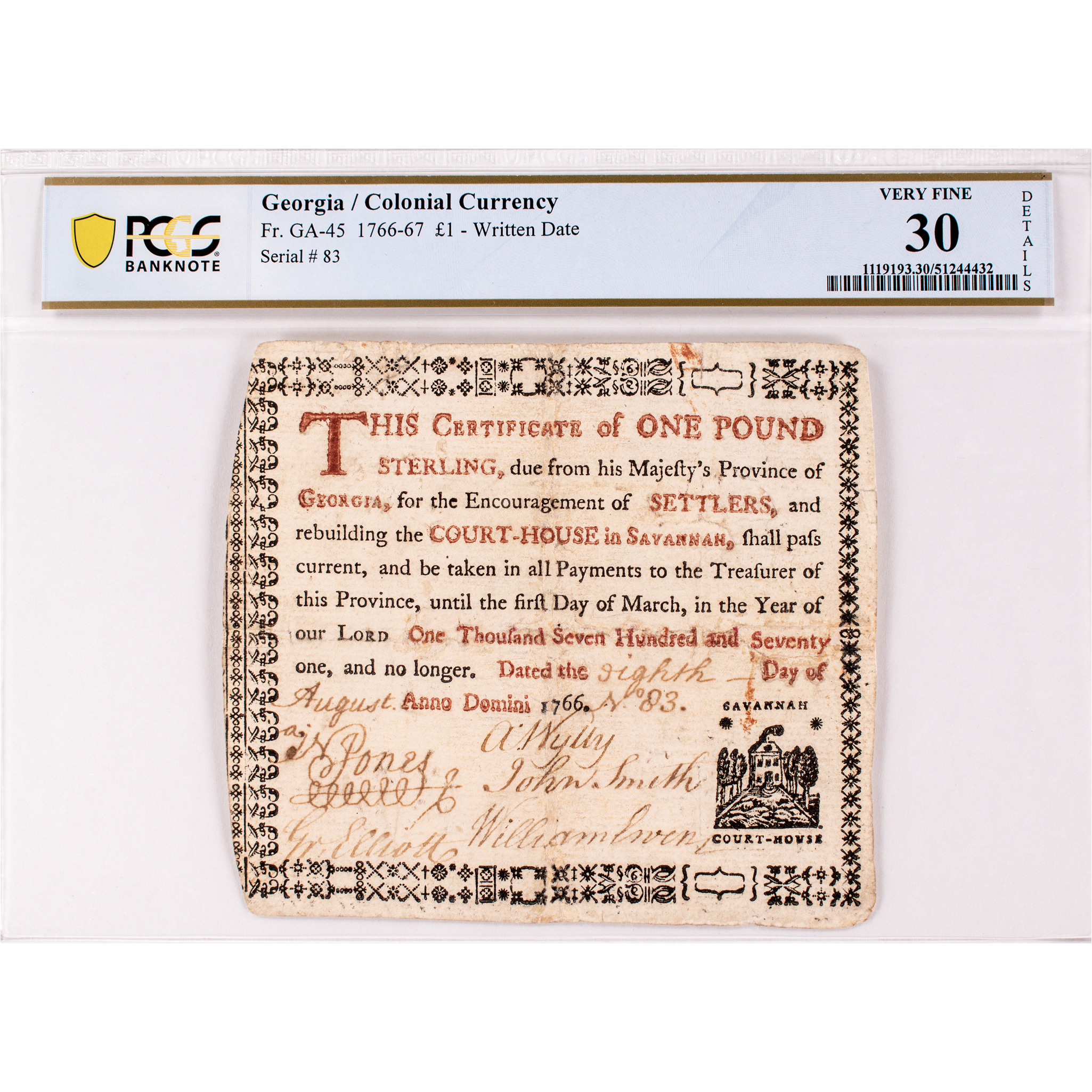
Extremely Rare Fully Signed and Issued 1766 Province of Georgia One Pound Sterling SAVANNAH COURT-HOUSE
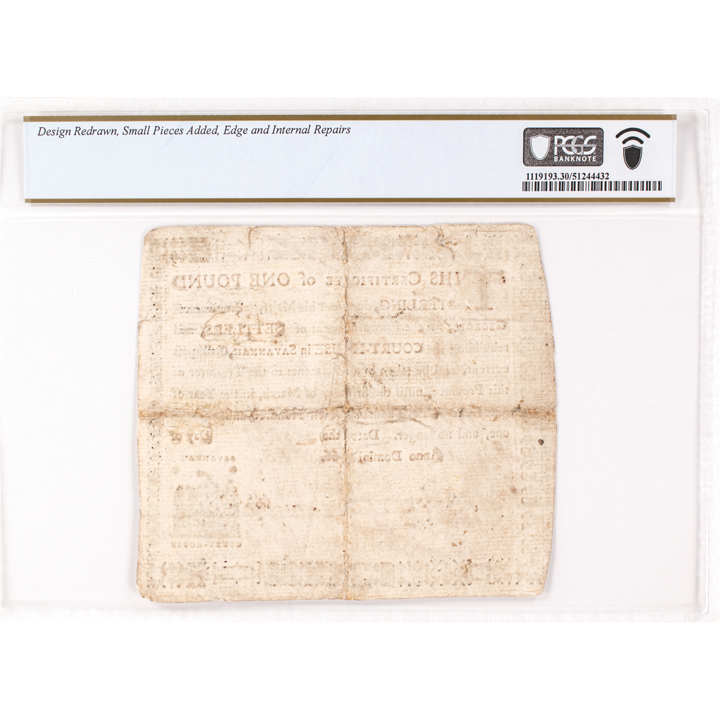
August 8th (Written Date) 1766 Act, Province of Georgia Colonial Currency, One Pound Sterling Certificate, SAVANNAH COURT-HOUSE with “Court-House” Vignette, Large Format Printed in Red & Black, PCGS Banknote graded Very Fine-30. Fr. GA-45. Very Low Serial No. 83. This extremely rare Sterling Certificate is fully Signed by; N. Jones, Grey Elliott, A. Wylly, John Smith, and William Ewen. Among the Finest Known, as PMG reports only two certified which were likely Unissued Remainder notes. This pleasing Large Format sterling Certificate measuring about 4.25” x over 4.75” (123mm x 115mm), Uniface having no detractions on its blank reverse. This special 1766 Act Certificate was issued, “For the Encouragement of SETTLERS, and rebuilding the SAVANNAH COURT-HOUSE in Savannah.” Its details holder adds comments about the expert conservation performed as; design redrawn, small pieces added, edge and internal repairs. A rare historic Georgia currency prize that is fully signed and issued. Some remainders are also known, being more plentiful than the actual signed and issued notes. This example is well printed in deep black ink with bold red ink text inserts. Georgia's colonial government’s 1766 Act was literally printing these Certificates bearing a woodcut picture of the very building, Savannah's original Colonial Court House, to fund the needed major repair of its decaying most important seat of justice in Savannah. This note has significant overall eye appeal, being vastly superior for this dedicated Court House issue and in comparison the example in Newman's reference work certificate No. 605 illustrated on page 136 of the 5th Edition 2008, which also lists a value of that note selling in Fine quality for $3,747 in the John Ford Collection sale May 2004. Our currently offered note, having some expert conservation is clearly superior in quality and eye appeal to the illustrated Newman plate note. Numismatist Eric Newman estimated roughly 2,523 certificates were printed, exceeding the officially authorized number, with some dated into the following year. A surviving example cited in Newman's reference work certificate No. 605 illustrated on page 136 of the 5th Edition 2008, was issued September 1, 1766, giving a sense of how the serial numbering ran chronologically alongside the hand-written dates. The current note having some expert conservation is clearly superior in quality and eye appeal to the Newman plate note. The building on the vignette was Savannah's original Colonial Court House, and its history explains exactly why this currency issue existed. It stood in what is now Wright Square (originally named Percival Square, after John Perceval, 1st Earl of Egmont; renamed in 1763 for Georgia's last Royal Governor, James Wright). Around the square stood the original court house as well as a market place, and near the courthouse was the public gaol (jail), while officially representing Christ Church Parish, the small scale of Georgia's infrastructure left it as the primary gaol for the entire province. The building was a wooden structure that had fallen into disrepair by the 1760s: in 1763, complaints about poor sanitation and a lack of a fireplace were read before the Commons House. This deterioration is precisely what prompted the 1766 Currency emission, being dedicated to its rebuilding. The courthouse had earlier religious significance too. It was the building where John Wesley, founder of Methodism, preached in 1736 and 1737, during Georgia's earliest colonial years. Despite the 1766 rebuilding effort, the structure continued to decline. By the early 1770s the colony had moved on from it: unable to afford building their own church, Savannah's Lutherans instead bought the deteriorating wooden court house in 1772 and moved it to serve as their house of worship. Today the site is occupied by the Tomochichi Federal Building and U.S. Courthouse, and Wright Square itself is also notable as the burial site of Tomochichi, the Yamacraw leader whose alliance with James Oglethorpe was essential to Savannah's founding. [Colonial America, Colonial Georgia, 18th Century America] [Currency and Finance, Local History] [Currency, Colonial Currency, Certificates, Bonds, Numismatics, Exonumia] |
|||||||||||
|
Auction Closing: Saturday, August 29th
at Noon Eastern Time • 9:00 AM Pacific Time |
|||||||||||