
|
Lot: 7 ♡
|
|||||||||||
|
Confederate General Jubal Early 1881 Autograph Letter Signed With Great Content Regarding His Civil War Service
|
|||||||||||
|
|||||||||||
 |
|
||||||||||
|
Lot 7:
Confederate General Jubal Early 1881 Autograph Letter Signed With Great Content Regarding His Civil War Service
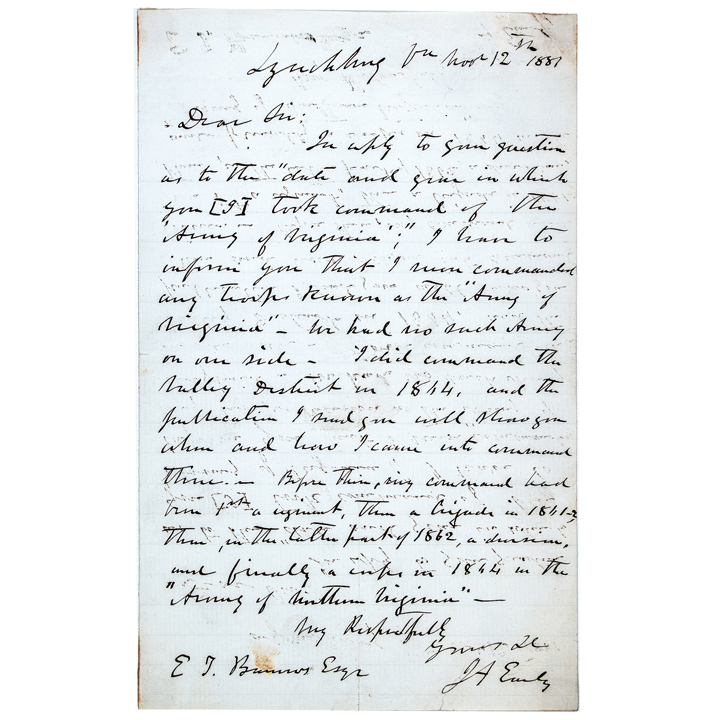
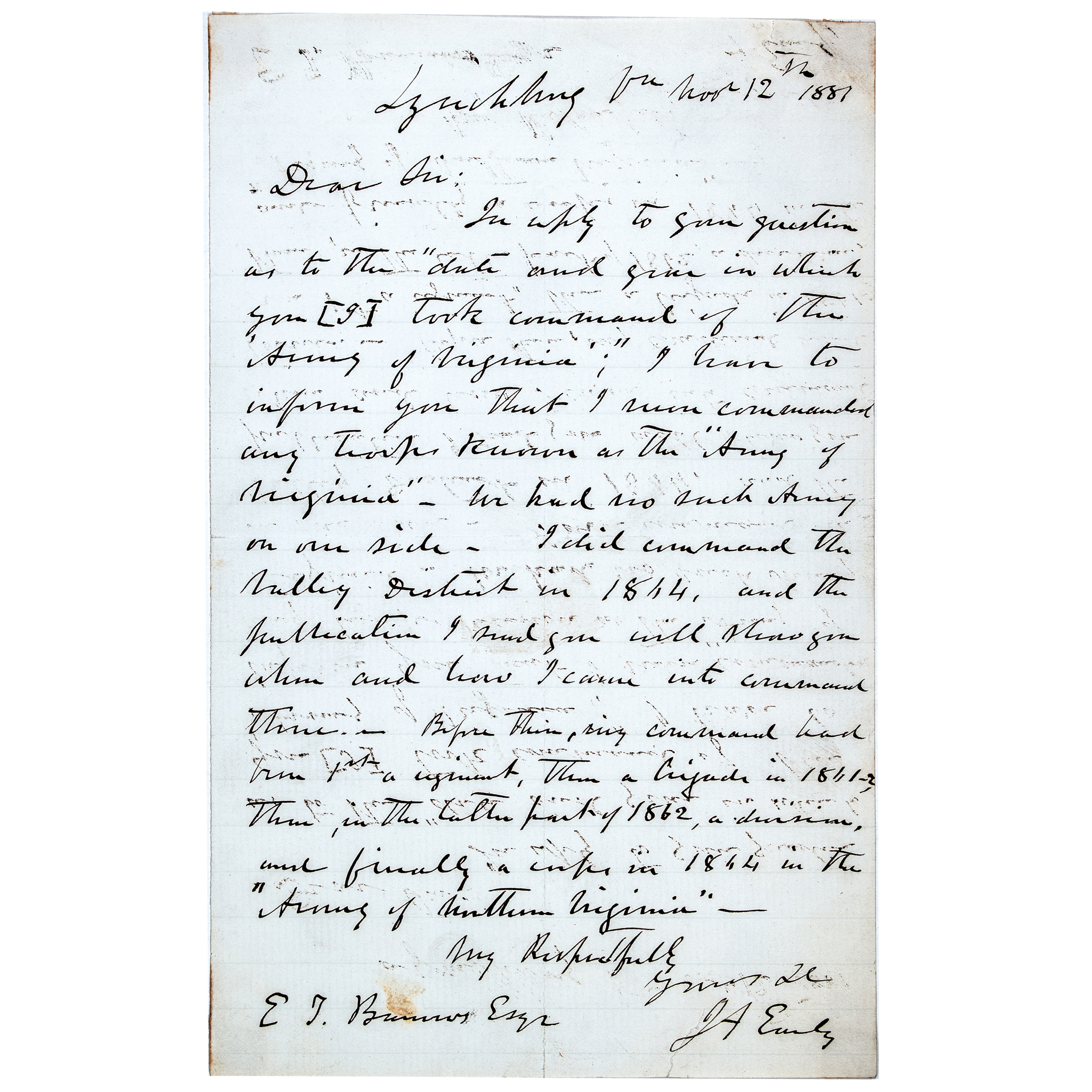
JUBAL A. EARLY (1816-1894). Confederate Major General who fought throughout the Civil War, leading a division at Antietam, Chancellorsville, Gettysburg and Spotsylvania, and conducted a threatening raid on Washington; after the end of the war, Jubal Early fled to Mexico, then Cuba, and Canada, and on his return to the U.S., he gained a reputation as an "Unrepentant Rebel", he gave speeches advocating the "Lost Cause of the Confederacy." November 12, 1881-Dated Autograph Letter Signed, "J. A. Early", 1 page, measuring 5.6” x 9”, Lynchburg, VA., to E.J. Burrows Esqr, Choice Very Fine. This is an Excellent Content ALS in which General Early writes of the commands he held during the Civil War (to set the record straight). This letter is boldly written entirely by Jubal Early’s own hand in dark brown ink on white blue lined period wove paper and reads, in full: "Lynchburg, Va. Nov'r 12, 1881 --- Dear Sir: In reply to your question as to the 'date and year in which you [ I ] Took command of the 'Army of Virginia' ; I have to inform you That I never commanded any Troops known as The 'Army of Virginia'. - We had no such Army on our side. - I did command the Valley District in 1864, and the publication I send you will show you when and how I came into command There. - Before This, my command had been 1st a regiment, Then a brigade in 1861-2, Then, in the latter part of 1862, a division, and finally a corps in 1864 in the 'Army of Northern Virginia'. -- Very Respectfully, Yours &c - (Signed) J. A. Early" Jubal Early graduated from West Point in 1837 and went on to serve in the Second Seminole War in Florida (1835-42) and later in the Mexican-American War (1846-48), though he saw no active combat in Mexico. He mustered into service as a Major of the 1st Virginia Volunteers for the Mexican War, and it was during that campaign that he contracted the chronic rheumatism that plagued him for the rest of his life. Between his military stints he practiced law in Virginia and served a term in the House of Delegates. As a Delegate to the Virginia Convention of 1861, Early strongly opposed Secession; but once Virginia voted to leave the Union, he felt obligated to follow his state and joined the Confederate service. He was appointed a General in the Virginia State Militia, then colonel of the 24th Virginia Infantry. After his performance at Blackburn's Ford and his troops' charge along Chinn Ridge helped rout Union forces at First Manassas, he was promoted to Brigadier General. He fought in most of the major battles of the Eastern Theater; the Seven Days Battles, Second Bull Run, Antietam, Fredericksburg, and Chancellorsville and was promoted to Major General on January 17, 1863. At Gettysburg, on the evening of the first day, he asked corps commander Richard Ewell for permission to assault Cemetery Hill, but was refused. He fought at the Wilderness and Spotsylvania, briefly taking temporary command of the Third Corps when A.P. Hill fell ill. This is the action for which Early is best remembered. In June 1864, Robert E. Lee temporarily promoted Early to Lieutenant General and gave him command of the new Army of the Valley. Early defeated a small Union force under General Lewis Wallace at the Battle of Monocacy on July 9th, then led roughly 8,000 troops to the gates of Fort Stevens on Washington's northwestern fringe two days later, bringing Confederate forces closer to the U.S. Capital than at any other point in the war. After two days of skirmishing with the Capital's defenders, Early withdrew to Virginia on July 13th. In response, U.S. Grant sent Philip Sheridan to clear the Shenandoah Valley for good. Heavily outnumbered, Early suffered three decisive defeats; at Winchester, Fisher's Hill, and Tom's Brook, between September 19th and October 9th. He attempted one more well-planned strike at Cedar Creek on October 19th, but was repulsed and forced to retreat to Waynesboro, where his command was effectively destroyed by George Custer in March 1865. After the Battle of Waynesboro on March 2nd, 1865, ended Confederate resistance in the region and opened the way to Richmond, Lee relieved Early of command. When the Army of Northern Virginia surrendered, Early fled on horseback to Texas hoping to find Confederate forces still in the field, then made his way through Mexico and Cuba before reaching Canada. While living in Toronto, he wrote A Memoir of the Last Year of the War for Independence (1866), being the first book published by a Confederate major general about the war. Pardoned by President Andrew Johnson, he returned to Lynchburg, Virginia, in July 1869 and became, as first President of the Southern Historical Society, one of the chief architects of the "Lost Cause" interpretation of the Civil War. He died at age 77 after a fall down a flight of stairs in Lynchburg on March 2nd, 1894, and is interred at Spring Hill Cemetery. [Civil War, Confederate States of America, Reconstruction Era] [Jubal Early, Army of Northern Virginia, Shenandoah Valley Campaign] [Manuscripts, Documents, Letters, Autograph Letters Signed] |
|||||||||||
|
Auction Closing: Saturday, August 29th
at Noon Eastern Time • 9:00 AM Pacific Time |
|||||||||||