
|
Lot: 9 ♡
|
|||||||||||
|
1801 Secretary of the Treasury Albert Gallatin Letter Signed with Integral Signed “FREE” Franked Date-Stamped Cover Setting Market Valuations of United States Treasury Bonds
|
|||||||||||
|
|||||||||||
 |
|
||||||||||
|
Lot 9:
1801 Secretary of the Treasury Albert Gallatin Letter Signed with Integral Signed “FREE” Franked Date-Stamped Cover Setting Market Valuations of United States Treasury Bonds
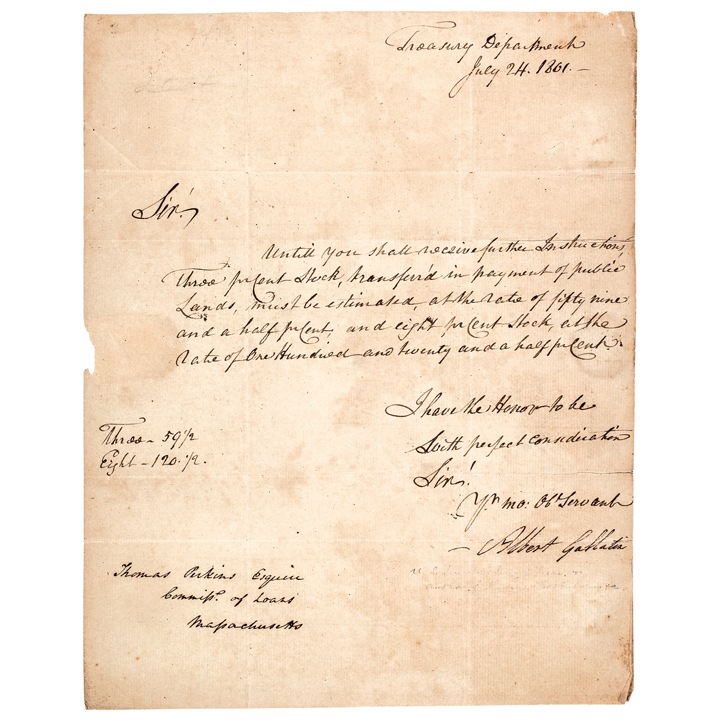
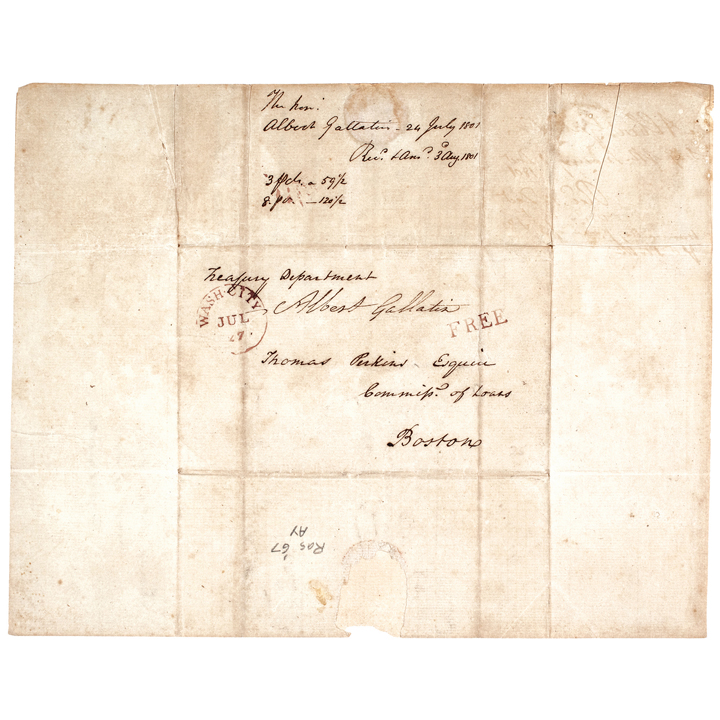
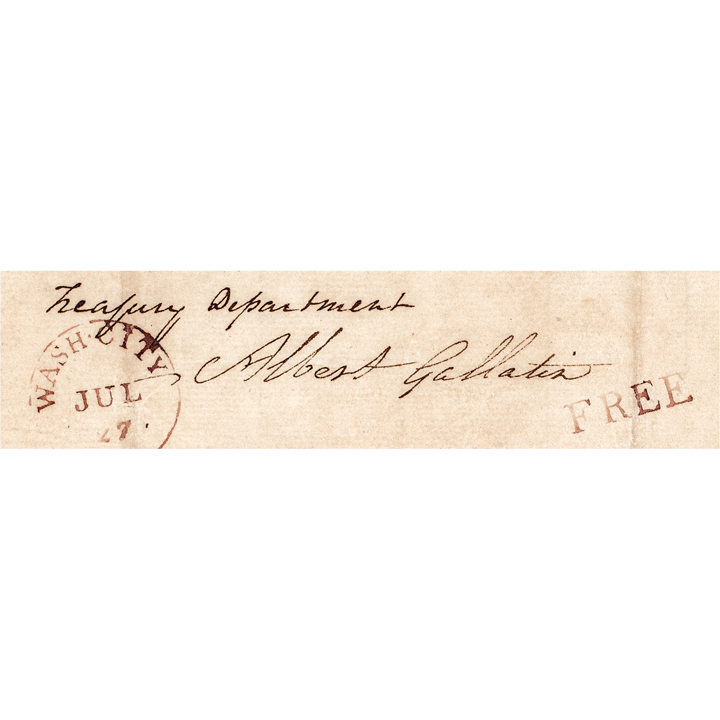
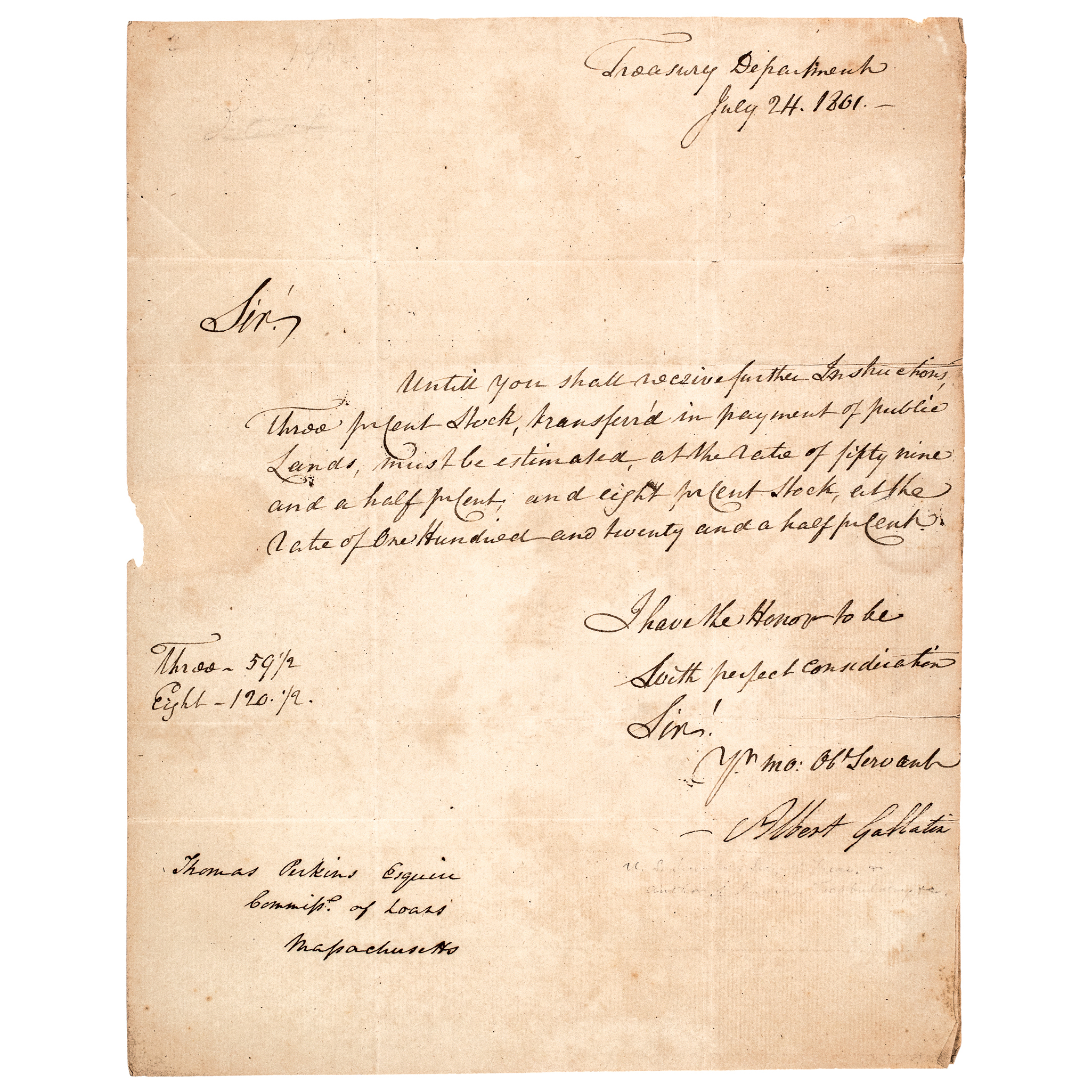
ALBERT GALLATIN (1761-1849). Secretary of the Treasury under Presidents Thomas Jefferson and James Madison; an American Commissioner that Agreed to the Treaty of Ghent ending the War of 1812; U.S. Minister to France (1816-1823); U.S. Minister to the United Kingdom (1826-1827). July 24, 1801-Dated Federal Period, Manuscript Letter Signed, "Albert Gallatin" as Secretary of the Treasury, 1 page, with Integral “Treasury Department” Address Leaf, Letterhead measuring 8.5” x 10.5”, Very Fine. Even light age tone, well written in brown ink and boldly signed (twice) having light transmittal folds and a tear where the wax seal was opened, not affecting any text. It is Signed Twice by Mr. Gallatin, once at the conclusion, and with his Franking signature on the verso address leaf. This is addressed to: Thomas Perkins Esquire / Commissioner of Loans (for Massachusetts at) Boston. It contains instructions regarding the Interest Rate of loans on Lands extended to the Commonwealth of Massachusetts. This brief letter is a small but telling window into the nuts and bolts of early American public finance. The Revolutionary War debt was transformed into tradable securities, those securities circulating as a form of money on the frontier, and a meticulous Treasury Secretary here is making sure the accounting was done precisely right. Gallatin's letter reads, in part: "Treasury Department July 24, 1801 Sir, -- Until you shall receive further instructions, Three percent Stock, transferred in payment of public lands, must be estimated at the rate of fifty nine and a half percent, and eight percent Stock at the rate of One Hundred and twenty and a half percent. -- I have the Honor to be - With perfect consideration - Sir, -- Yr. mo. Obt. Servant - (Signed) Albert Gallatin". The Significance of the Specific Rates: The valuations Gallatin set 59.5 cents on the dollar for 3% stock and $1.205 on the dollar for 8% stock, reflecting the actual market prices of those bonds at that moment in the summer of 1801. This matters for two reasons: The 3% stock traded well below par (face value) because its low interest rate made it less attractive to investors. Accepting it at only 59.5% of face value meant the government was not overpaying for land. The 8% stock traded above par because its high interest rate made it very desirable, hence the premium valuation of 120.5%. By standardizing these rates, Gallatin was ensuring that land office receivers across the frontier accepted these securities at fair, consistent market values, preventing both fraud and inconsistency between offices. This small administrative letter fits directly into Gallatin's overarching financial philosophy. As Secretary of the Treasury, Gallatin stressed simplicity in government and the termination of the public debt. Despite heavy naval expenditures and the Louisiana Purchase, he managed to reduce the public debt by $23,000,000 within eight years. Accepting government bonds for public lands was one way to retire that debt, citizens would hand their bonds back to the Treasury in exchange for land, effectively canceling the government's obligation to pay interest on them. The Land Law of 1800 further encouraged land sales in the Northwest Territory by reducing the minimum parcel size and enabling sales on credit, with the goal of stimulating settlement by ordinary farmers. The government created land offices to handle these sales, established within easy reach of prospective landowners. Because hard currency (specie) was scarce on the frontier, the transfer of government stock was considered essentially equivalent to payment in specie. In countries where national debt was properly funded, stock passed current as specie in the principal transactions of business. Accepting government bonds as payment for land was a practical extension of this principle. [Federal Period, Early Republic, Treasury Department] [Public Finance, Land Policy, Massachusetts] [Manuscripts, Documents, Letters, Autograph Letters Signed] |
|||||||||||
|
Auction Closing: Saturday, August 29th
at Noon Eastern Time • 9:00 AM Pacific Time |
|||||||||||