
|
Lot: 93 ♡
|
|||||||||||
|
1776 Autograph Letter Building a Bridge in Rhode Island, Integral Cover, Recd by Samuel Vernon, Merchant, Newport
|
|||||||||||
|
|||||||||||
 |
|
||||||||||
|
Lot 93:
1776 Autograph Letter Building a Bridge in Rhode Island, Integral Cover, Recd by Samuel Vernon, Merchant, Newport
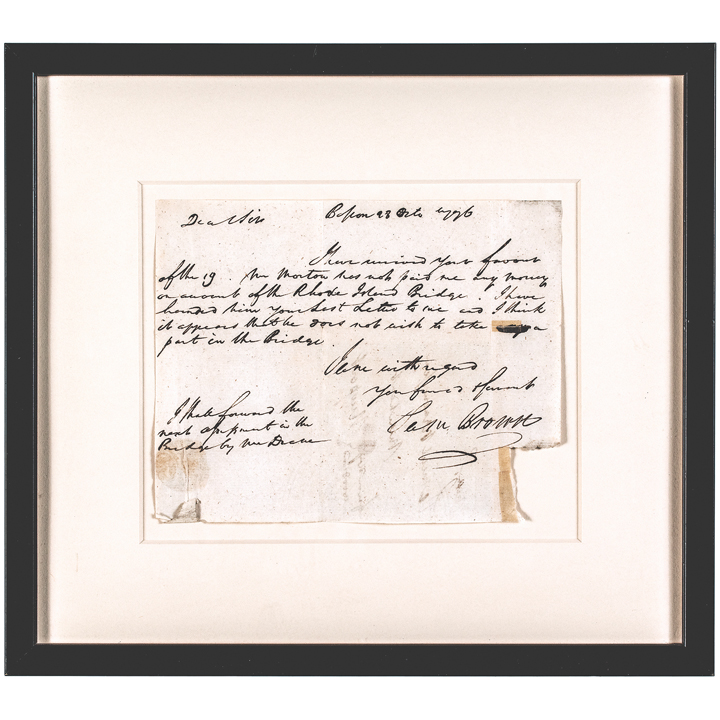
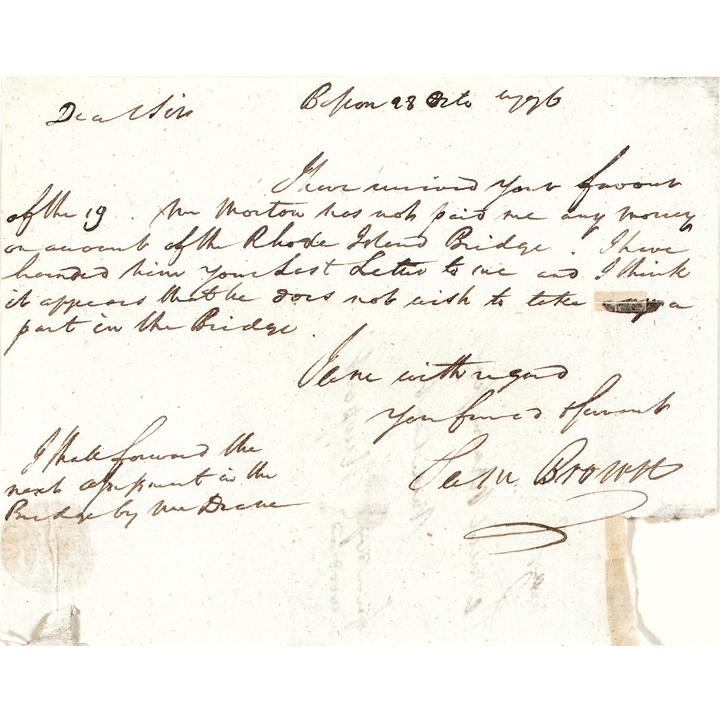
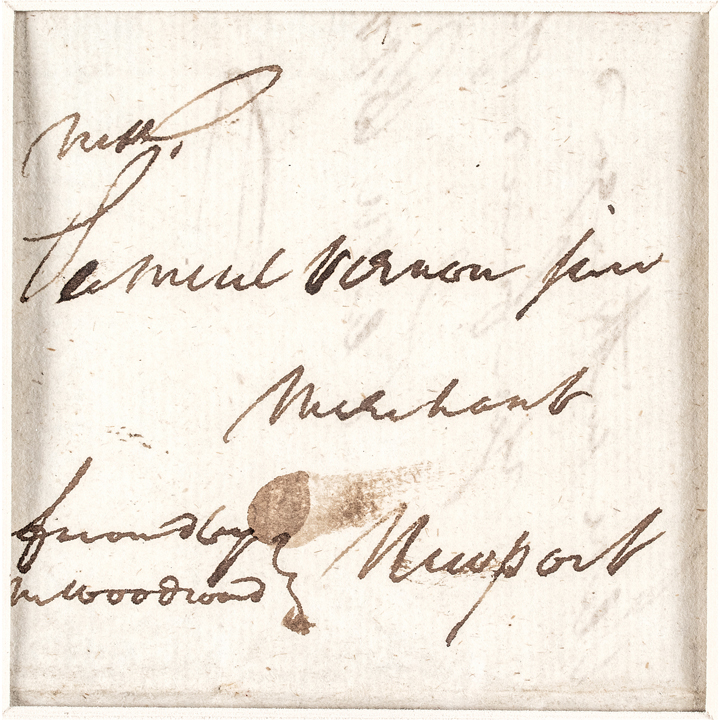
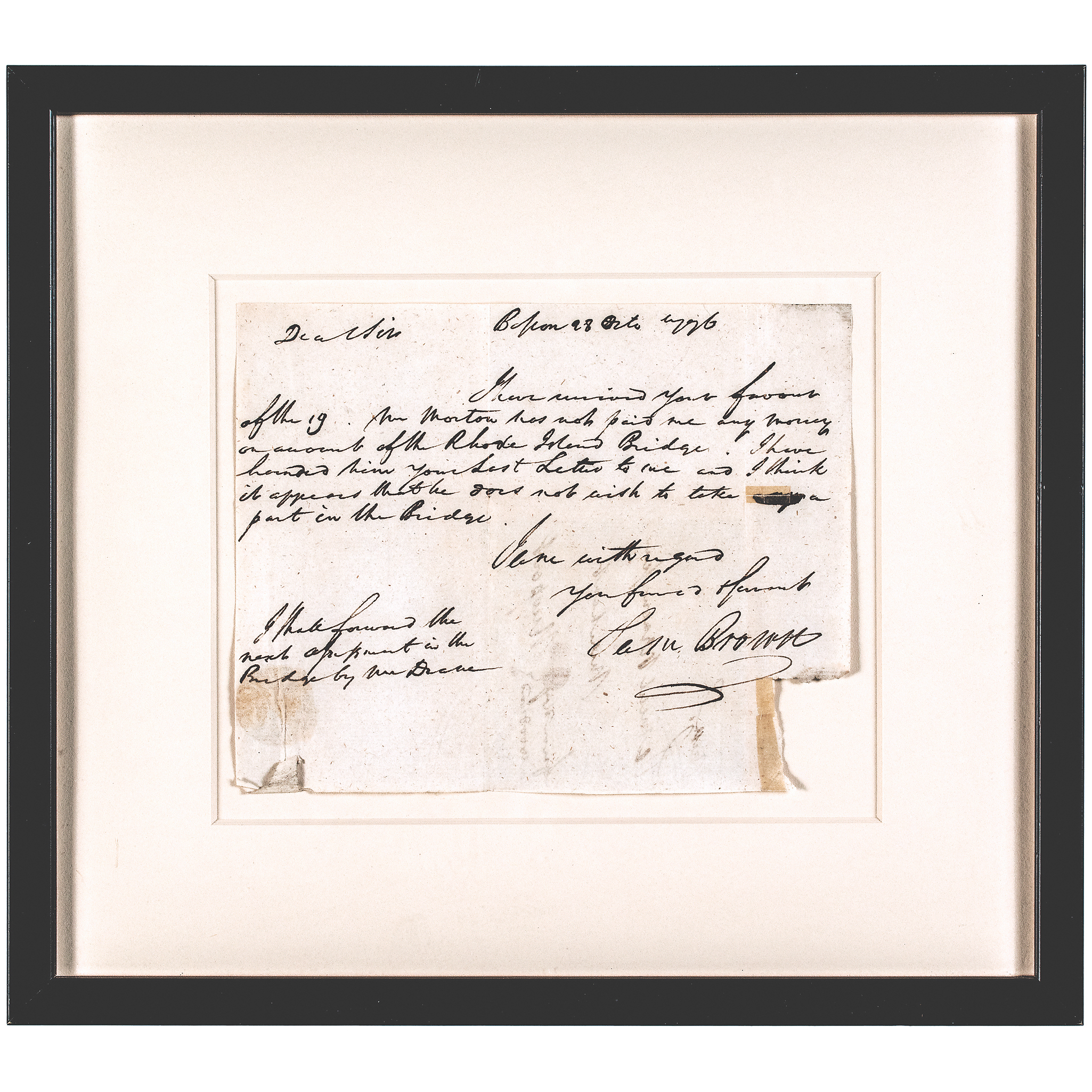
October 28, 1776-Dated Revolutionary War Period, Autograph Letter Signed, “Sam(uel) Brown”, from Boston, regarding building a Bridge in Rhode Island having rare military/infrastructure content, with an Integral Transmittal Cover on the blank reverse, reading: “Recd. Samuel Vernon Merchant Newport (Rhode Island), Framed, Fine. Professionally Framed measuring to 11” x 12.5” the letter displayed under special UV Plexiglas with a custom 3” x 3” cut away to show the Integral Transmittal Cover on the blank reverse, reading: “Recd. Samuel Vernon / Merchant / Newport (Rhode Island) / from Mr Woodward”. This 1 page letter is boldly handwritten in rich brown ink on laid period paper measuring 5.75” x 7”. Its red wax seal appears intact located on the reverse side, it having torn a 1.5” x .75” piece off the bottom right corner of the outer selvage when opened yet not affecting any text of the signature. Here, Signed, “Sam(uel) Brown” of Boston, is a message reguarding the funds paid for building “the Rhode Island Bridge.” This letter reads, in full: “Boston 28 Octo 1776 -- Dear Sirs --- I have received your favour of the 19. Mr Morton has not paid me any money on account of the Rhode Island Bridge. I have handed him your Last Letter to me and I think it appears that he goes no wish to take a part in the Bridge. --- I am with regard - your Obd’t Servant -- (Signed) Sam Brown.” Samuel Brown (1753 or 1754-1825) was born in Newport, Rhode Island. He remained in Newport until the British occupation in 1776, which led him to flee to Boston, Massachusetts, where he lived and worked as a merchant until his death in 1825. Throughout his career, Brown was involved in Privateering and the Slave Trade in America. He provided investment capital and insurance to other merchants and was a close associate of William Vernon (1719-1806), a Newport merchant also active in the Slave Trade. This letter, dated October 28, 1776, is therefore written at a pivotal personal moment for Brown as he had very recently fled his home in Newport as the British prepared to occupy the island, and was now writing from Boston, likely still in the immediate aftermath of his displacement. The timing of this letter is extraordinarily significant. October 1776 was a period of intense anxiety in Rhode Island, with a British invasion imminent. Brown's October 28th letter predates this invasion by roughly six weeks, meaning it was written during the anxious period when Patriots knew the British were coming and were desperately preparing defenses. The mention of building a bridge in Rhode Island in late October 1776 is deeply significant in military terms. At this moment, American forces were fortifying Aquidneck Island (Rhode Island Island) against a British amphibious landing; preparing evacuation and retreat routes across waterways separating the island from the mainland; building or improving crossings over the passages around Narragansett Bay (Bristol Ferry, Tiverton/Howland Ferry). Brown's close ties to William Vernon, who was appointed by the Continental Congress as president of the Continental Naval Board on May 6, 1777, suggest Brown moved in high-level Patriot commercial and military-logistics circles. This letter sits at the intersection of Brown’s personal displacement, Patriot military planning, and Rhode Island's central role in the Revolutionary War. Written just weeks before the British seized Aquidneck Island, a Boston-based refugee merchant discussing bridge construction in Rhode Island would almost certainly have been addressing urgent wartime infrastructure. After abandoning revolutionary Boston in March 1776 and invading Long Island and Manhattan beginning in August 1776, the British decided to seize and occupy Aquidneck Island and Narragansett Bay. Brown fled Newport for Boston due to the British occupation in 1776, making a letter written from Boston on Rhode Island affairs in October 1776 perfectly consistent with what is known of his movements and concerns at that time. Both Admiral Richard Howe and General William Howe agreed on the need for a base of operations in New England, so geographically the island and the bay were a good solution. Strategically, with Narragansett Bay as a base, British forces could launch operations to other parts of New England, as well as defend New York City merchant ships from revolutionary privateers operating from Boston and ports to the north. On December 7, 1776, British Commodore Sir Peter Parker entered Narragansett Bay with fifteen warships and seventy transports. Alerted by lookouts at Point Judith, Rhode Island residents began evacuating livestock, cannon, and anything else of use to the British. Most anyone who had the wherewithal, wealthy merchants, shipowners, and captains, left the area. The British landed the next morning at Weavers Cove in Portsmouth and quickly occupied the entire island. Bridge construction in Rhode Island is of rare military/infrastructure content. Brown fled Newport for Boston due to the British occupation in 1776, making a letter written from Boston on Rhode Island affairs in October 1776 perfectly consistent with what is known of his movements and concerns at that time. Discussing bridge construction in Rhode Island would almost certainly have been addressing urgent wartime infrastructure, whether for troop movements, defensive preparations, or evacuation planning. This is a rare and historically rich document from one of the most tension-filled months of the entire Revolutionary War in New England. In 1776, Rhode Island Patriots were spectacularly successful at privateering, hauling in large British merchant ships from the Caribbean, and supply ships off the Canadian coast. Controlling the waterways and land crossings around the Bay was essential to maintaining that Patriot advantage. The Vernon brothers were well known as the First Newport Merchants to sell African Slaves directly to the Southern Colonies, making their first sale in Charleston, South Carolina, in 1755. They were also involved in Privateering during King George’s War (1744-1748). Samuel and William Vernon were in various business enterprises, including the Middle Passage / Trans-Atlantic Slave Trade together until Samuel’s death on July 6, 1792. [American Revolution, Revolutionary War, Rhode Island] [Samuel Brown, Aquidneck Island, Slave Trade] [Manuscripts, Documents, Letters, Autographs] |
|||||||||||
|
Auction Closing: Saturday, August 29th
at Noon Eastern Time • 9:00 AM Pacific Time |
|||||||||||