
|
Lot: 96 ♡
|
|||||||||||
|
1779 6th Massachusetts Regiment Revolutionary War Field Manuscript Enlistment Document Hand-Signed by Soldiers
|
|||||||||||
|
|||||||||||
 |
|
||||||||||
|
Lot 96:
1779 6th Massachusetts Regiment Revolutionary War Field Manuscript Enlistment Document Hand-Signed by Soldiers
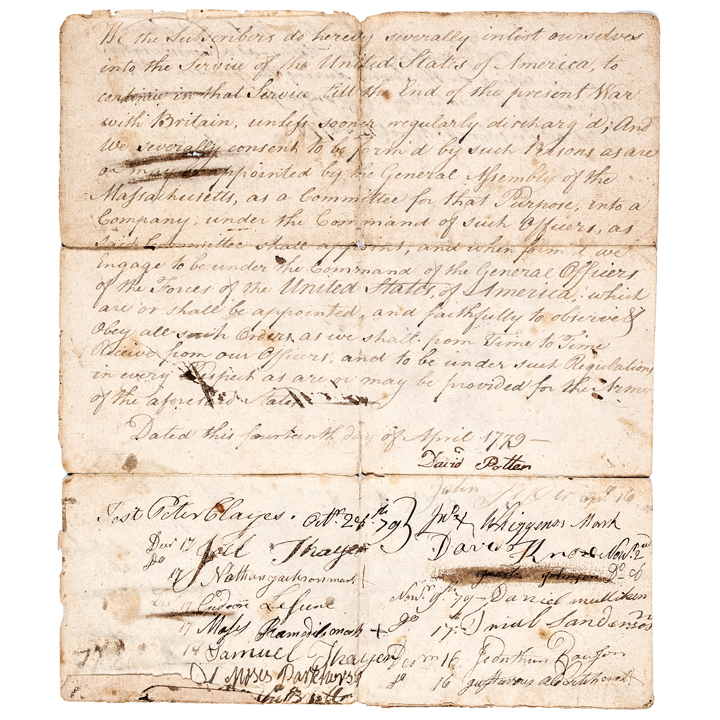
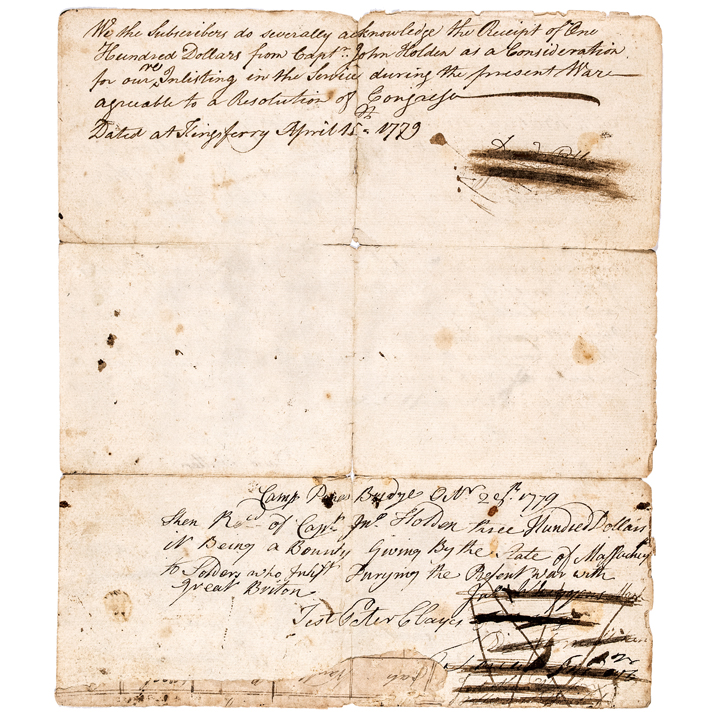
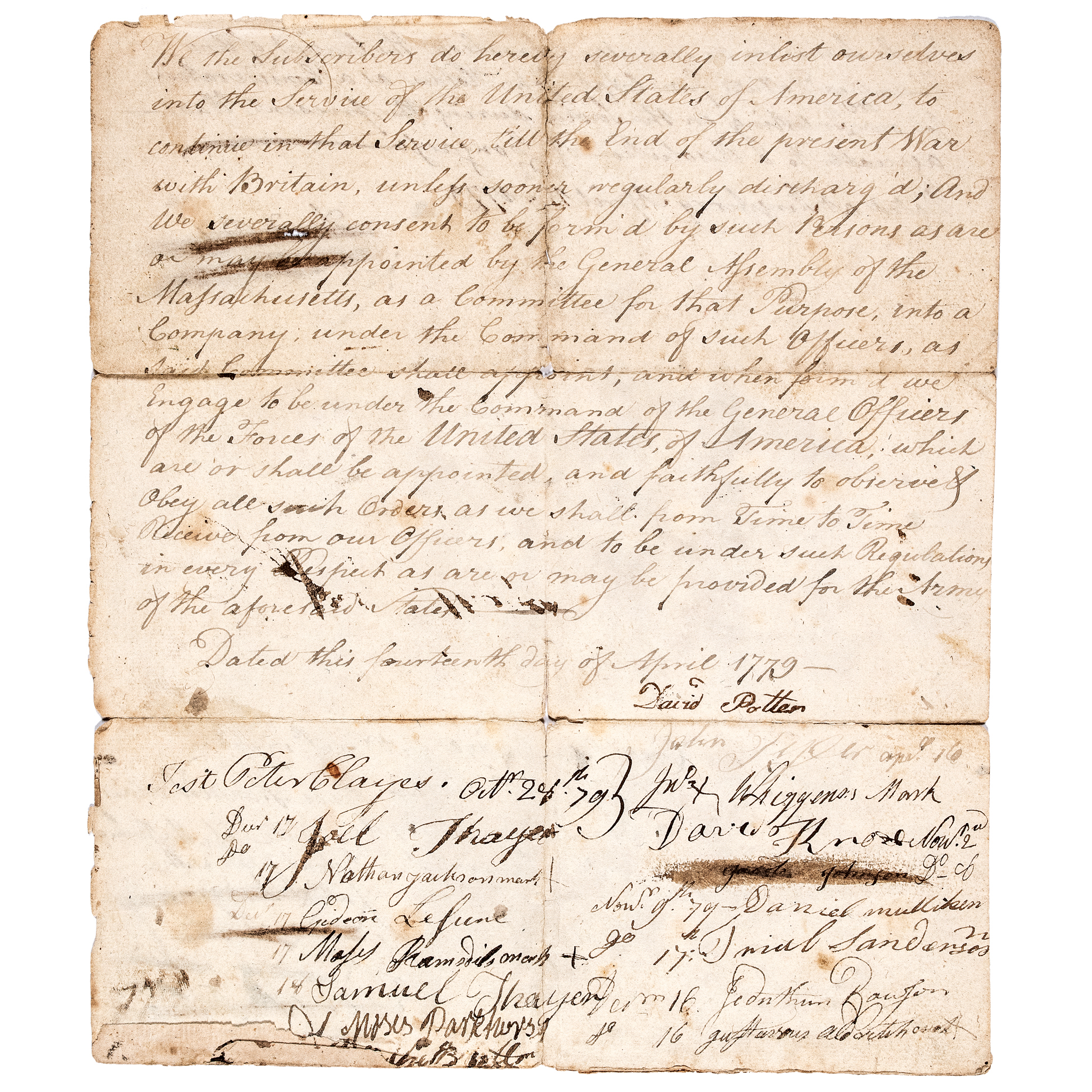
April 14th, 1779-Dated Revolutionary War, Manuscript Enlistment Document Individually Hand-Signed by Multiple Soldiers, “into the Service of the United States of America, to continue in that Service till the end of the present War with Britain”..., Dated at Kings Ferry April 15th 1779 & Camp Pines Bridge, Oct'r 28th 1779, Near Fine. Original Revolutionary War Soldiers’ Manuscript Handwritten Enlistment Sheet, Signed multiple times bearing all Original Signatures of those Enlisted, 2 pages, single sheet front and back written and signed on a special watermarked “1776” laid period paper. This field document is worn and folded with some minor wear holes at the central fold intersections, as shown. The dual dating shows that this was a living document, kept with the unit and attested as men signed at different times while the regiment moved: King's Ferry, April 15, 1779 and Camp Pines Bridge, October 28, 1779. The 6th Massachusetts Regiment was a significant infantry unit in the Continental Army during the American Revolutionary War. The regiment was initially formed on April 23, 1775, under Colonel John Nixon and was also known as the 4th Continental Regiment. They participated in the Battle of Bunker Hill. Notable commanders included Colonel John Nixon and Colonel Thomas Nixon. Peter Salem, a freed African-American man, served in the regiment at Bunker Hill and from 1775 to 1779 in many significant campaigns and battles. The phrase "to continue in that Service till the end of the present War with Britain" is the signature language of a duration enlistment. By 1779, most Continental soldiers' three-year enlistments from early 1777 were approaching expiration, and George Washington was deeply worried about the Continental army dissolving. Congress responded on January 23, 1779 by offering a $200 bounty (later supplemented by state and town bounties) to men who would enlist or re-enlist "for the war" rather than a fixed term. Rolls with multiple soldiers signing individually were the working paperwork of that re-enlistment drive. Documents actually signed by the rank-and-file soldiers themselves (as opposed to officers) are considerably scarcer than officer correspondence. This document was apparently carried for a period of time while doing general recruitment of Troops for George Washington’s Continental Army. As such, it has a rough appearance, with some ink smears, a couple small fold intersection holes and minor splits, still being intact, yet a bottom section is possibly lacking. Though not seen mentioned on this document as they enlisted in 1775, several noted Black soldiers served in the 6th Massachusetts Infantry during this period of the Revolutionary War, most notably the famous Peter Salem, and Cato Smith. The men who Signed this Enlistment Document Served in the 6th Massachusetts Regiment but at this point we could find nothing specific on them except for Peter Clayes, who we found was a Lieutenant in the 6th Massachusetts Regiment, along with John Holden (1736-1818) who served in the French and Indian War with the Colonial forces (1755-1760), and later in the American Revolution. We have not cross-checked all the names signed to this document. Written and signed in medium to dark rich brown ink by multiple men below the sworn statement above, it reads, in full: “We the Subscribers do hereby severally enlist ourselves into the Service of the United States of America, to continue in that Service till the end of the present War with Britain, unless sooner regularly discharged; And we severally consent to be form'd by such persons as are or may be appointed by the General Assembly of the Massachusetts, as a Committee for that Purpose, into a Company, under the Command of such Officers, as said Committee shall appoint, and when form'd we engage to be under the Command of the General Officers of the Forces of the United States of America, which are or shall be appointed, and faithfully to observe & obey all such orders as we shall from Time to Time receive from our Officers; and to be under such Regulations in every Respect as are or may be provided for the Army of the aforesaid States. -- Dated this fourteenth day of April 1779 / Test.(imony) Peter Clayes, Octr. 28th '79 -- Signatories below, with their enlistment dates include: Dec. 17 Joel Thayer / do Nathan Jackson's mark X / Dec. 17 Gideon Lesune / 17 Moses Pramsdil's mark X / 18 Samuel Thayer, Moses Parkhurst / David Potter / John [Salor] (sic) April 16 / Jno. X Whiggens's Mark / David Knox Nov'r 2nd / Jacob Johnson Do. / Nov'r 9th '79 - Daniel Mulliken / do (ditto Nov.) 17th - Israel Sanderson / Dec'r 16 Jedidia Rawson / do (ditto Dec’r) 16 Gustavus Aldritch mark X” Most signers enlisting had poor handwriting and signatures some with their Marl “X” next to their names. Continued on the reverse side, it reads, in full: “We the Subscribers do severally acknowledge the Receipt of One Hundred Dollars from Capt. John Holden as a consideration for our re-Inlisting in the Service during the present War agreeable to a Resolution of Congress. --- Dated at Kings Ferry April 15th 1779” At bottom reverse it reads, in full: “Camp Pines Bridge, Oct'r 28th 1779 --- Then Rec'd of Capt. Jno. Holden three Hundred Dollars, it Being a Bounty Giving by the State of Massachusetts to Soldiers who Inlist (sic) During the Present War with Great Britain. --- Test(imony). (Signed) Peter Clayes” The 6th Massachusetts Regiment was raised on April 23, 1775, just four days after the battle of Lexignton and Condord on April 19th, 1775. It was under command of Colonel John Nixon outside Boston, and was also known as the 4th Continental Regiment. It fought at Bunker Hill, in the New York Campaign, at Trenton, Princeton, and Saratoga. In January 1777 it was reorganized from the 4th Continental Regiment and redesignated as Nixon's Regiment, like all Massachusetts units at that point, it went by its colonel's name rather than a number. So the unit only officially became "the 6th Massachusetts Regiment" partway through 1779. Also that year, the Continental Line's reorganization (finalized March 9, 1779) restructured regiments to nine companies, with the ninth being a light infantry company kept at strength by drafts, from the other eight companies; during Campaign season these light infantry companies were combined into a special corps of light infantry. The two dates and places make sense being listed together. The dual dating tells you this was a living document, kept with the unit and attested as men signed at different times while the regiment moved: King's Ferry, April 15, 1779: As covered earlier, the ferry was in American hands that spring, with troops garrisoning, ferrying, and building a blockhouse at Stony Point. A regiment posted at or near the crossing administering re-enlistments in mid-April fits perfectly, about six weeks before the British seized the ferry on May 31-June 1st, 1779. Camp Pines Bridge, October 28, 1779: Pines Bridge was the key crossing of the Croton River in Westchester County (near present-day Yorktown). The forward defensive line between the Hudson Highlands and the contested "Neutral Ground" toward British-held New York. Continental detachments maintained a permanent guard at Pines Bridge, checking passes of everyone crossing and receiving deserters and flags of truce. Critically, the date is just Six Days after the British abandoned Stony Point and Verplanck's Point on October 22, 1779, withdrawing to New York. So this document's second attestation comes at the very moment American forces were pushing back down toward the recovered ferry and re-establishing their lines. The unit that signed at King's Ferry in April and Pines Bridge in October traced exactly the arc of the 1779 Hudson campaign. The 6th Massachusetts Regiment was in Nixon's brigade in the Highlands Department, and Whiting's company orderly book places the regiment at Bedford, Groton, Peekskill, and the Highlands from September 1779 to April 1780. Bedford and Pines Bridge are only a few miles apart on the same defensive line. Many Continental regiments (Massachusetts, Connecticut, New Hampshire, Rhode Island) rotated through those posts, so the unit here is best confirmed from the document itself. Colonel Thomas Nixon, the brother of John Nixon, who had been promoted to Brigadier General in 1776 commanded the regiment, having led it since August 1776. The regiment was attached to General John Nixon's brigade, and a surviving orderly book from Daniel Whiting's company covering September 1779 to April 1780 places the regiment at Bedford, Groton, Peekskill, and the Highlands of New York. It even records John Nixon's address spoken to his brigade from October 23, 1779. In short, the regiment spent 1779 on garrison and defensive duty in the Hudson Highlands guarding the approaches around West Point, rather than in a major battle. Its heavy fighting years (Bunker Hill through Saratoga) were behind it. Peter Salem, a Freed African-American who had served since April 1775 and at Bunker Hill, left the this regiment on December 31, 1779. Captain Thomas Barnes was promoted to major in the 12th Massachusetts in March 1779, Captain William Toogood resigned in April 1779, and Captain Richard Buckmaster died in November 1779. Later, Thomas Nixon retired January 1, 1781, and command passed to Lieutenant Colonel Calvin Smith, then to Colonel Benjamin Tupper in 1783; the regiment was disbanded June 12, 1783, having been furloughed at West Point. The 6th Massachusetts Regiment was a significant infantry unit in the Continental Army during the entirelty of the American Revolutionary War. The regiment was involved in the New York campaign in August 1776, including battles at Harlem Heights and Trenton. They reinforced General Philip Schuyler at Stillwater, New York, in July 1777 and played a role at the Battles of Saratoga. They also took part in the Philadelphia campaign, Wintered at Valley Forge, and were involved in the Monmouth campaign, and the Battle of Rhode Island in 1778. Notable commanders included Colonel John Nixon and Colonel Thomas Nixon. Peter Salem, a freed African-American man, served in the regiment from 1775 to 1779. This historic Massachusetts regiment was furloughed on June 12th, 1783, at West Point, New York and was officially disbanded on November 3, 1783. John Holden was of Mendon, enlisted 1 May, 1755, in company commanded by Captain Ephraim Doolittle, in the Expedition against Crown Point, and served until 11th December. His travel was allowed from Albany home. He was in the service the following year, having enlisted prior to 15th April, and had joined the forces moving against Crown Point prior to July 21st. He was at Camp William Henry 28th August, at which time he was aged 19 years, born in Sutton and a resident of Mendon. On 11th October, he was reported "sick." He was a member of company commanded by Captain-Lieutenant Nathan Tyler, in Lieutenant-Colonel Thwing's regiment. Holden again enlisted in 1757 and marched from Mendon to Westfield, 16th August. This tour of duty was on an alarm, and was but fourteen days; he was a Corporal in company commanded by Captain Phinehas Lovett, in Colonel Abraham Williams' Regiment. He was anapprentice of Nathaniel Tyler, Esq., and was allowed for forage for his horse. He again enlisted 29 March, 1758, in Captain Nathan Tyler's company, in Colonel William Williams' Regiment, and served to the "West-ward." The next year he enlisted 26th March in the same regiment, raised for the Invasion of Canada, and served until 3rd Dec., 1759, as Sergeant in company commanded by Captain John Furnass. Holden again enlisted 20 March, 1760, in Colonel John Chandler's Regiment, and was mustered in 25th of April, in company commanded by Captain Jonathan Shores, in which he served as Sergeant until 3rd December. Captain Shores was succeeded by Captain Daniel Reed on 15 August. He was allowed one hundred and twenty miles travel home. John Holden became Adjutant of the 7th Worcester County, Massachusetts Regiment, under Colonel Wheelock, 19 April, 1775, and served nine days at Cambridge and Roxbury. He was Adjutant of Colonel Joseph Read's Regiment at Roxbury, May,1775, serving from 24 April to Aug. 1st, 1775, in Read's Regiment. Holden continued in the Continental Army regiment; 26 months as lieutenant, and as Captain from 10 March, 1779. He continued in the service until 13 April, 1780. He signed an order at Mendon as being a “late Captain, 6th Massachusetts Regiment” for ration allowance due to him to February 28th, 1784. Although we did not find and African Americans in this enlistment document, Massachusetts formally permitted African American enlistment by law on April 28, 1778, and by August 1778, 162 Black soldiers were serving in the Massachusetts regiments of Colonels Nixon, Learned, and Paterson Nixon's 6th among them. Peter Salem of Framingham, the enslaved man credited with shooting Major Pitcairn at Bunker Hill, served as waiter to Colonel Thomas Nixon himself, earned his freedom through his service, and as we saw earlier fought at Stony Point in Capt. John Holden's company and transferred into Capt. Peter Clayes' company on January 1, 1780. This document's officers commanded Black soldiers. Later, a West Indian-born veteran named Cicero Sweet stated in his pension application that he served in "the black company" commanded by Captain Matthew Chambers in the 6th Regiment, so the regiment even concentrated some of its Black soldiers into a designated company in its later years. [American Revolution, Revolutionary War, Massachusetts] [Battle of Bunker Hill, Continental Army, African American History] [Manuscripts, Documents, Military Enlistments, Autographs] |
|||||||||||
|
Auction Closing: Saturday, August 29th
at Noon Eastern Time • 9:00 AM Pacific Time |
|||||||||||