
|
Lot: 97 ♡
|
|||||||||||
|
June 27, 1780 Massachusetts War-Dated Boston Promissory Note £200 to Benjamin Austin, Signed by Town Treasurer David Jefferies “for the sole Purpose of carrying on the War"
|
|||||||||||
|
|||||||||||
 |
|
||||||||||
|
Lot 97:
June 27, 1780 Massachusetts War-Dated Boston Promissory Note £200 to Benjamin Austin, Signed by Town Treasurer David Jefferies “for the sole Purpose of carrying on the War"
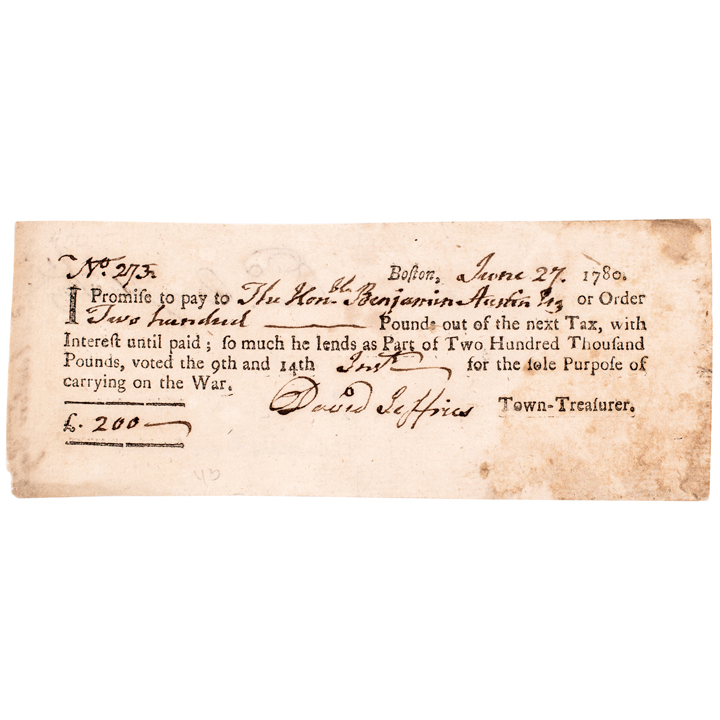
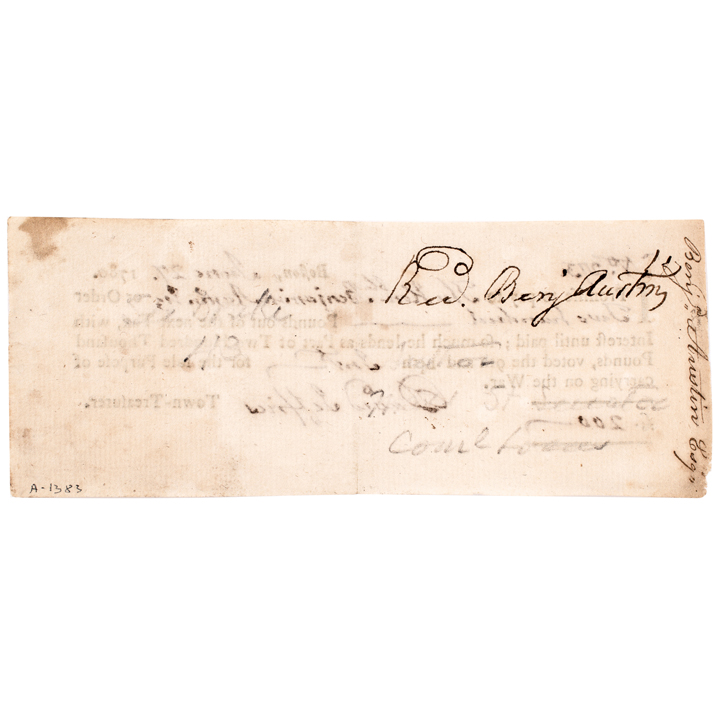
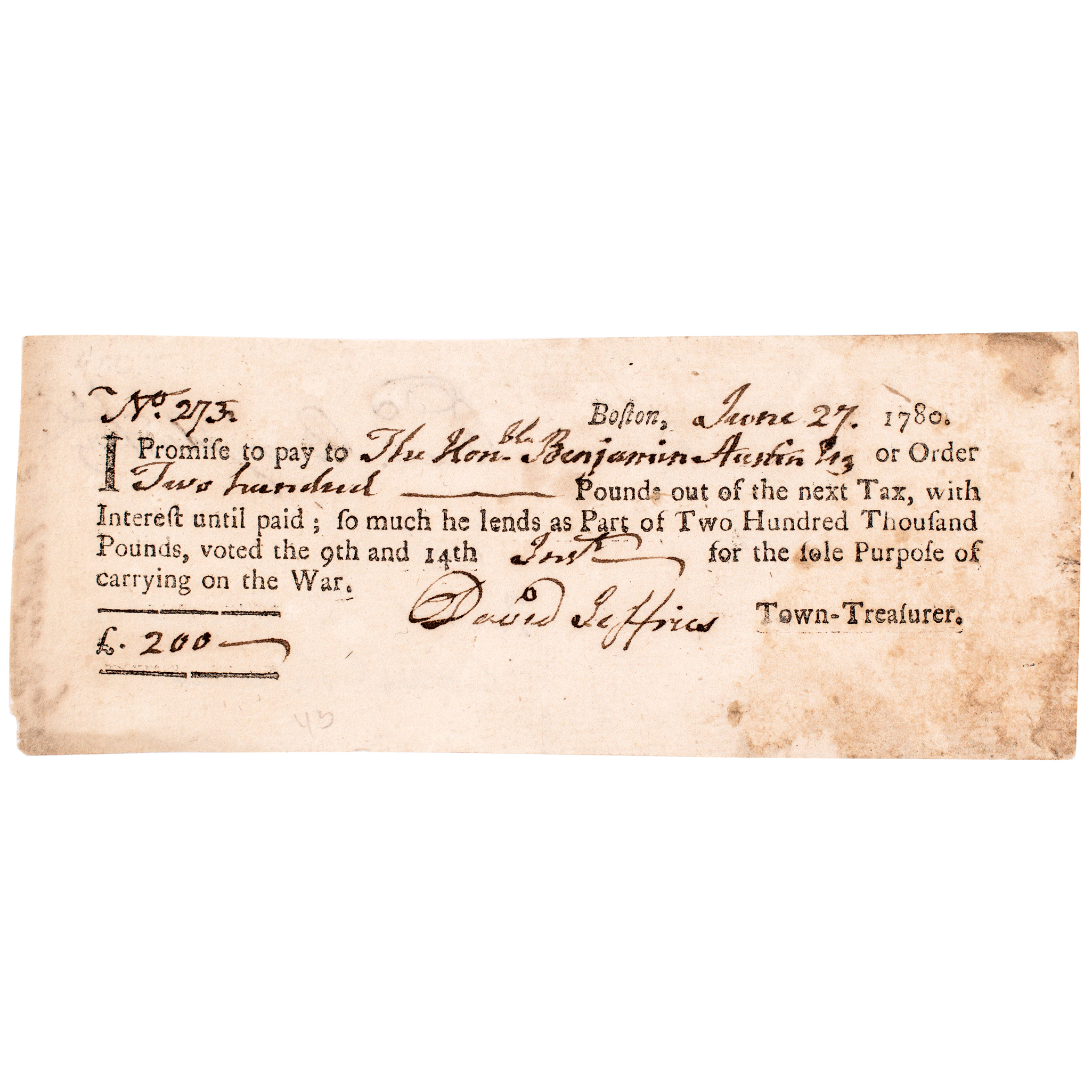
June 27, 1780-Dated Revolutionary War Period, Partly-Printed Document for 200 Pounds, Massachusetts State Promissory Note, Boston, Signed, “David Jefferies” (1714-1784), was the Deacon of Old South Church and Boston Town-Treasurer, made to Benjamin Austin of Boston who Signs as Received, Endorsement on the reverse, Very Fine. This Revolutionary War Promissory Note, numbered 273, measures 6.5" x 2.5" being typeset printed in black on laid period paper, dated in manuscript "Boston, June 27, 1780." This form Promising to Pay to Benjamin Austin or Order, "Two Hundred Pounds out of the next Tax, with Interest, until paid; so much he lends as Part of Two Hundred Thousand Pounds, voted the 9th and 14th for the sole Purpose of carrying on the War," Signed, in vivid brown ink “Recd. Benj. Austin” on the blank verso in receipt. BENJAMIN AUSTIN (1717-1806) was a Boston merchant-shopkeeper and shipper who served as a Boston Selectman from (1758-1766), a Justice of the Peace, a Member of the Massachusetts Council from (1776-1780), and a Member of the House of Representatives in 1780. That makes him "Hon. Benjamin Austin" and exactly right for this June 1780 promissary loan certificate, as he'd have just rotated off the Council and into the House, where both bodies would have voted the £200,000 Revolutionary War loan referenced. He was also a longtime Patriot activist, a former Boston selectman and member of the Committee of Inspection during the run-up to the Revolution. He corresponded directly with Benjamin Franklin on war matters in 1777. (He's also the father of the more famous Benjamin Austin Jr., the "Old South" pamphleteer / "Honestus" who later fought the Federalists in print. The elder Austin is this loan note's payee, given his political standing in 1780. Austin’s son, Charles, in 1806, assailed Thomas O. Selfridge on State Street in Boston, for slandering his father and was killed by Selfridge, who was subsequently tried and acquitted. The printed text of this exceedingly rare Boston Town-Treasury fiscal loan receipt form is fully completed in manuscript, reading in full: "I Promise to pay to The Hon. Benjamin Austin Esq. or Order Two hundred Pounds out of the next Tax, with Interest until paid ; so much he lends as Part of Two Hundred Thousand Pounds, voted the 9th and 14th Inst. for the sole Purpose of carrying on the War." This fiscal note is signed at lower right "David Jeffries Town-Treasurer," and bears the manuscript denomination "£200" at lower left. The reverse side bears Austin's own signature acknowledging receipt, directly connecting this financial instrument to the hand of the important Boston Revolutionary era and early Republic figure to whom it was issued. Some medium water stains consistent with age along the right side area. The manuscript and typeset text printed elements show bold excellent ink strength with full clear legibility throughout. A note like this typeset promissory instrument acknowledging a sum lent toward that £200,000 authorization, and signed by Jeffries in his capacity as town treasurer would have functioned essentially as a short-term war bond. It was an individual lender's receipt for money advanced to the town/state treasury, redeemable later (often at 6% interest, the standard rate for Massachusetts war loans of this era) once Tax revenue caught up and became available. This extreme rarity is lacking in virtually all Colonial fiscal collections. David Jeffries (1714-1784), also known as David Jeffries IV, was the deacon of Old South Church and town treasurer of Boston. He came from a prominent Boston family with a long history of public finance; an earlier David Jeffries had served as a Massachusetts Colonial Treasurer generations before, and the family's papers include receipts and orders connected to that office going back to the late 17th century. By the Revolutionary War period, David Jeffries had held the Boston town-treasurer post for years; a surviving December 1779 record shows Boston's selectmen ordering payment through him, as town-treasurer, to a supplier of shoes for the Continental Army... exactly the kind of war-supply financing your note would have been part of. By 1780, Massachusetts (and Boston specifically, as its largest town) was deep into financing the Revolutionary War through short-term borrowing rather than simply printing paper money. By 1780 there had clearly been years of currency overprinting and the paper money had badly depreciated. The state had already begun experimenting with new instruments like the "depreciation notes" bonds tied to commodity prices. These were bonds established by legislation passed in January 1780 to pay soldiers in an inflation-linked instrument rather than ordinary paper currency. A "Two Hundred Thousand Pounds" loan voted in a specific session (your note cites votes of "the 9th and 14th") fits this pattern of towns or the state authorizing large emergency loan subscriptions earmarked explicitly "for the sole Purpose of carrying on the War"... language typical of the General Court's war-finance resolves of that year, when Massachusetts needed to fund both its own militia and to fill its quota obligations to the Continental Army. By the Revolutionary War period, David Jeffries (1714-1784) had held the town treasurer post for years; a surviving December 1779 record shows Boston's selectmen ordering payment through him, as town treasurer, to a supplier of shoes for the Continental Army, exactly the kind of war-supply financing your note would have been part of. This important 2.5 x 6.5 inch Revolutionary War Promissory Note, dated, June 27, 1780, in which the Boston Town Treasurer David Jefferies promises to pay BENJAMIN AUSTIN: “Two Hundred pounds out of the next tax, with interest, until paid so much he lends as Part of Two Hundred Thousand Pounds, voted the 9th and 14th for the sole Purpose of carrying on the war.” Signed by David Jefferies and by Austin on the verso as received. [American Revolution, Revolutionary War, Massachusetts] [War Finance, Political History, Boston History] [Currency, Manuscripts, Promissory Notes, Autographs] |
|||||||||||
|
Auction Closing: Saturday, August 29th
at Noon Eastern Time • 9:00 AM Pacific Time |
|||||||||||