
|
Lot: 99 ♡
|
|||||||||||
|
1781 Philadelphia Revolutionary War Letter in French about an American Sailors Murder and Arrival of the French Fleet
|
|||||||||||
|
|||||||||||
 |
|
||||||||||
|
Lot 99:
1781 Philadelphia Revolutionary War Letter in French about an American Sailors Murder and Arrival of the French Fleet
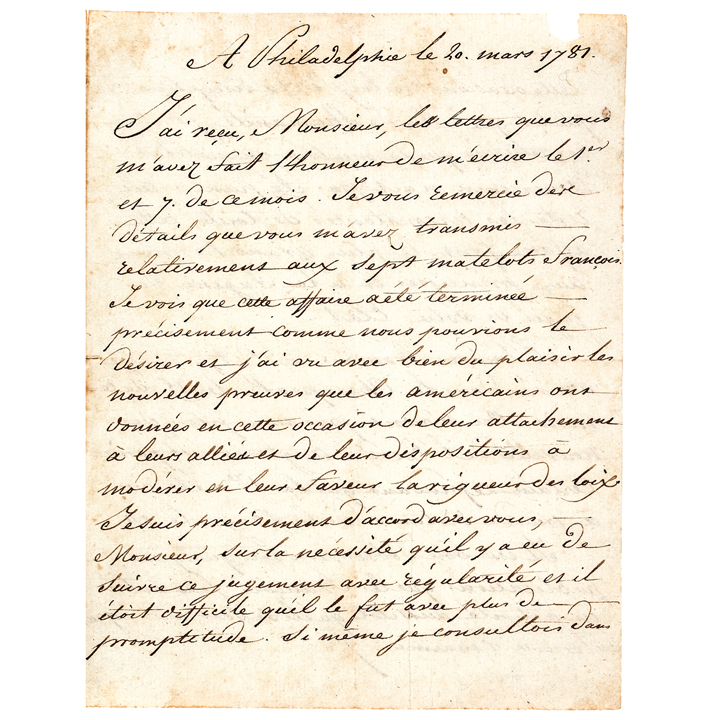
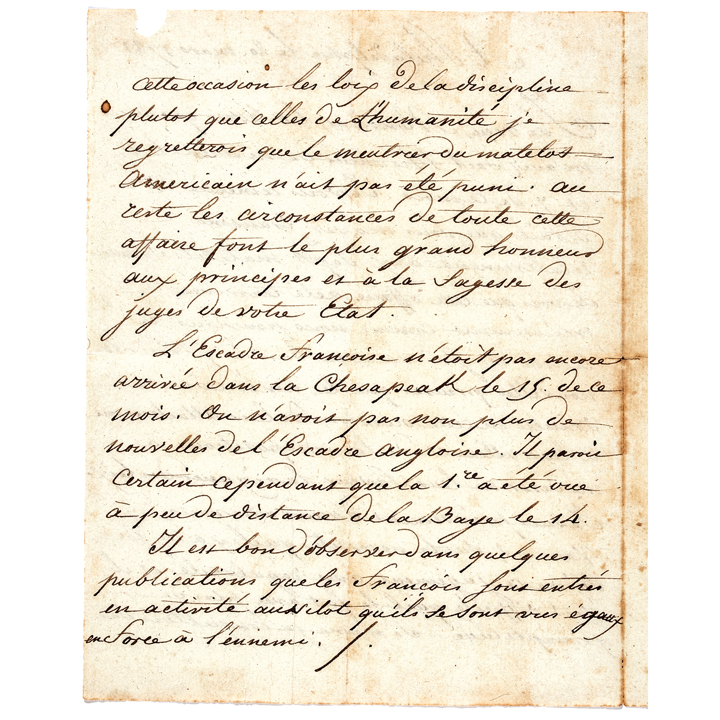
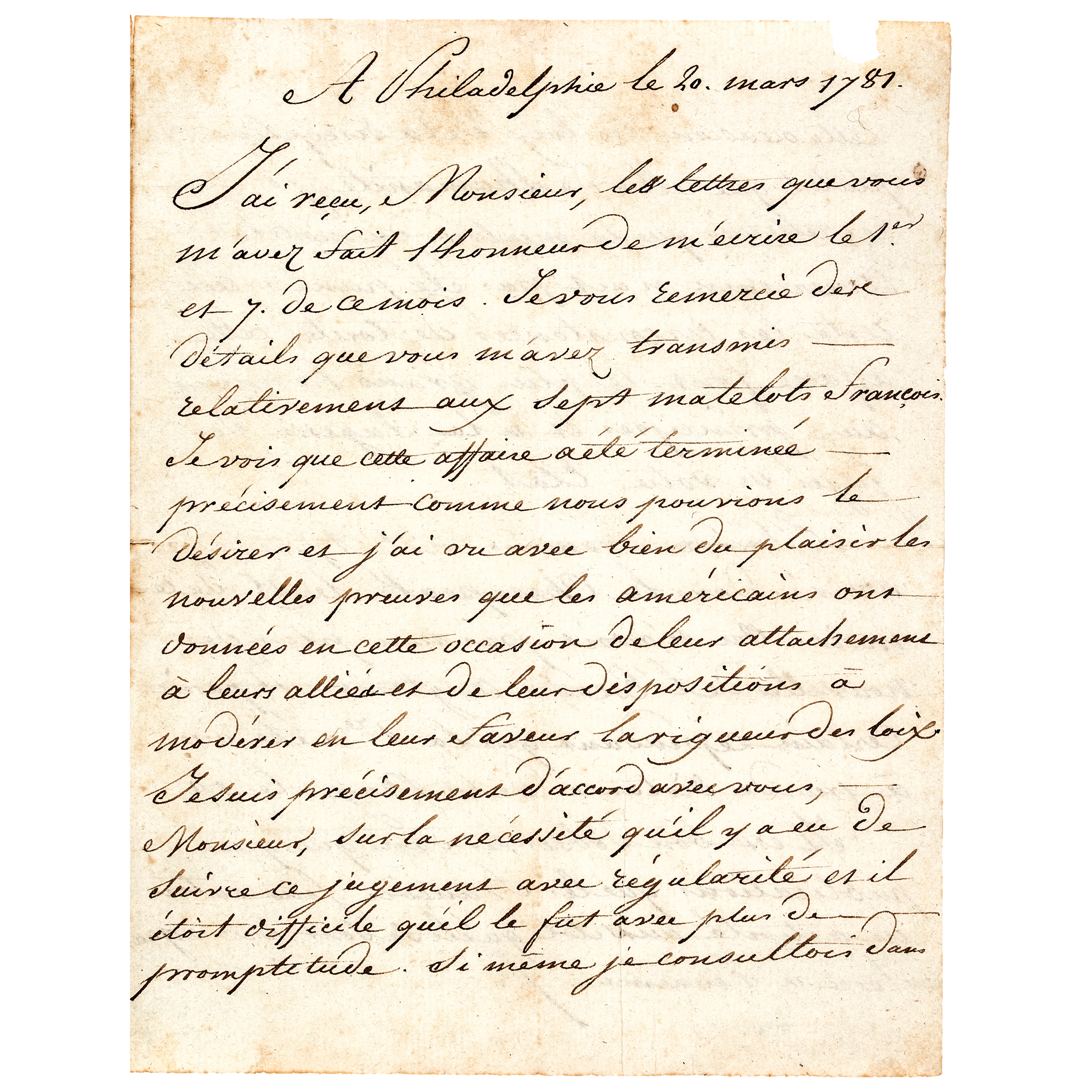
March 20, 1781-Dated Revolutionary War Period, Manuscript Letter, written in French, regarding seven French Sailors and the murder of an American Sailor, expected arrival of the French Fleet and whereabouts of the Enemy Squadron, Choice Very Fine. This important French Consul’s Military Letter regards issues surrounding French Naval Aid and Assistance expected to arrive soon to the American Colonies and a separate legal matter. It is 2 pages, measuring 6.5" x 8.5", at Philadelphia (PA), unsigned and to an unnamed correspondent obviously familiar with each other, written in French. Evidence is strong that the writer is Anne-Cesar, Chevalier de La Luzerne, French Minister to the United States. The recipient is almost certainly a French consul in New England, most likely the consul at Boston. The letter also concerns legal proceedings against Seven French sailors related to the murder of an American Sailor, and evokes the leniency America has shown towards her allies. The writer also gives the latest news concerning the expected arrival of the French fleet to the Chesapeake Bay, and the whereabouts of the British fleet. This historic Letter translates to English roughly as follows, in full: “Philadelphia, March 20, 1781 --- I have received, Sir, the letters you did me the honor of writing to me on the 1st and 7th of this month. I thank you for the details you have conveyed to me regarding the seven French sailors. I see that this affair has been concluded precisely as we could have wished, and I have seen with great pleasure the new proofs that the Americans have given on this occasion of their attachment to their allies and of their disposition to moderate the rigor of the laws in their favor. I am precisely in agreement with you, Sir, on the necessity there was to carry out this judgment with regularity, and it would have been difficult for it to be done with greater promptness. Even if I were to consult on this occasion the laws of discipline rather than those of humanity, I would regret that the murderer of the American sailor was not punished. Moreover, the circumstances of this whole affair do the greatest honor to the principles and the wisdom of the judges of your State. The French squadron had not yet arrived in the Chesapeake on the 15th of this month. Nor was there any news of the English squadron. It seems certain, however, that the former was seen at a short distance from the Bay on the 14th. -- It would be well to observe in some publications that the French entered into action as soon as they found themselves equal in force to the enemy.” The original Letter fully reads, in French: PROBLEM: À Philadelphie le 20. mars 1781. J'ai rePROBLEM: çu, Monsieur, les lettres que vous m'avez fait l'honneur de m'ecrire le 1er et 7. de ce mois. Je vous remercie des details que vous m'avez transmis relativement aux sept matelots FranPROBLEM: çois. Je vois que cette affaire a ete terminee precisement comme nous pouvions le desirer et j'ai vu avec bien du plaisir les nouvelles preuves que les americains ont donnees en cette occasion de leur attachement a leurs allies et de leur dispositions a moderer en leur faveur la rigueur des loix. Je suis precisement d'accord avec vous, Monsieur, sur la necessite qu'il y a eu de suivre ce jugement avec regularite et il etoit difficile qu'il le fut avec plus de promptitude. Si mPROBLEM: ême je consultois dans (page 2) cette occasion les loix de la discipline plutot que celles de l'humanite je regretterois que le meurtrier du matelot Americain n'ait pas ete puni. Au reste les circonstances de toute cette affaire font le plus grand honneur aux principes et a la sagesse des juges de votre PROBLEM: État. L'Escadre FranPROBLEM: çoise n'etoit pas encore arrivee dans la Chesapeak le 15. de ce mois. On n'avoit pas non plus de nouvelles de l'Escadre angloise. Il paroit certain cependant que la 1.re a ete vue a peu de distance de la Baye le 14. Il est bon d'observer dans quelques publications que les FranPROBLEM: çois sont entres en activite aussitot qu'ils se sont vus egaux en force a l'ennemi. ____ The writer: Anne-Cesar, Chevalier de La Luzerne, French Minister to the United States. Everything points to him. The letter is written from Philadelphia, the seat of the French legation in the formal French diplomatic register ("the letters you did me the honor of writing"), and the author speaks of "the Americans" and "their allies" from the French side of the alliance, praising American courts for moderating "the rigor of the laws" in favor of Frenchmen. Only a very small circle in Philadelphia could write this way in March 1781: La Luzerne (minister since 1779) and his legation secretary FranPROBLEM: çois Barbe-Marbois. The clincher is the final paragraph... Directing that "some publications" should emphasize that the French engaged the enemy... "as soon as they found themselves equal in force", is exactly La Luzerne's signature activity as he was the great manager of the French image in the American press, subsidizing printers and feeding framing to friendly newspapers. That instruction is a minister's prerogative, which tips the identification toward La Luzerne himself rather than his secretary. The recipient: almost certainly a French consul in New England, most likely the consul at Boston. Several clues converge. The recipient wrote detailed reports on March 1 and 7 about a judicial affair involving seven French sailors, one of whom murdered an American sailor and was tried and punished by the courts of "your State" while the kind of protection-of-nationals casework that was the core duty of French consuls, who were expected to keep close watch on French sailors ashore and report such affairs up to the minister. The recipient is also someone positioned to influence local newspapers, another standard consular function. In March 1781, the French consul for New England, resident at Boston, was Joseph Dupas de Iden de Valnais (his successor Philippe-Andre-Joseph de Letombe took over the post shortly afterward, and La Luzerne's correspondence with the Boston consulate from these years survives in the consular archives now held at Nantes). S even French sailors ashore in New England in early 1781 would most plausibly have come from the French fleet wintering at Newport or from French frigates using Boston, so the trial took place in Massachusetts or Rhode Island, with the "State" most likely being Massachusetts if the recipient was the Boston consul. The naval passage dates and anchors the letter precisely. The French squadron expected in the Chesapeake is Chevalier Destouches' fleet, which sailed from Newport on March 8, 1781 to contest control of the Bay (this was the expedition aimed at Arnold's forces in Virginia). The British squadron is Admiral Arbuthnot's, which sailed in pursuit from Gardiner's Bay. The two fleets, almost exactly equal in force, fought the Battle of Cape Henry off the Virginia Capes on March 16, 1781. Writing on March 20, La Luzerne knew only that the French had been sighted near the Bay on the 14th but not the battle's outcome; his press instruction is him pre-positioning the narrative, insisting the French be credited for seeking action the moment they reached parity. (He would need that framing: as Destouches had fought creditably but withdrew, and the British got into the Bay.) [American Revolution, Franco-American Alliance] [Diplomatic History, Military History, Naval History] [Manuscripts, Documents, Letters, Autographs] |
|||||||||||
|
Auction Closing: Saturday, August 29th
at Noon Eastern Time • 9:00 AM Pacific Time |
|||||||||||