
|
Lot: 1 ♡
|
|||||||||||
|
July 11, 1770 Pennsylvania Grand Jury Indictment Against Jacob Johe for Passing Counterfeit “Half-Joannes” Coins
|
|||||||||||
|
|||||||||||
 |
|
||||||||||
|
Lot 1:
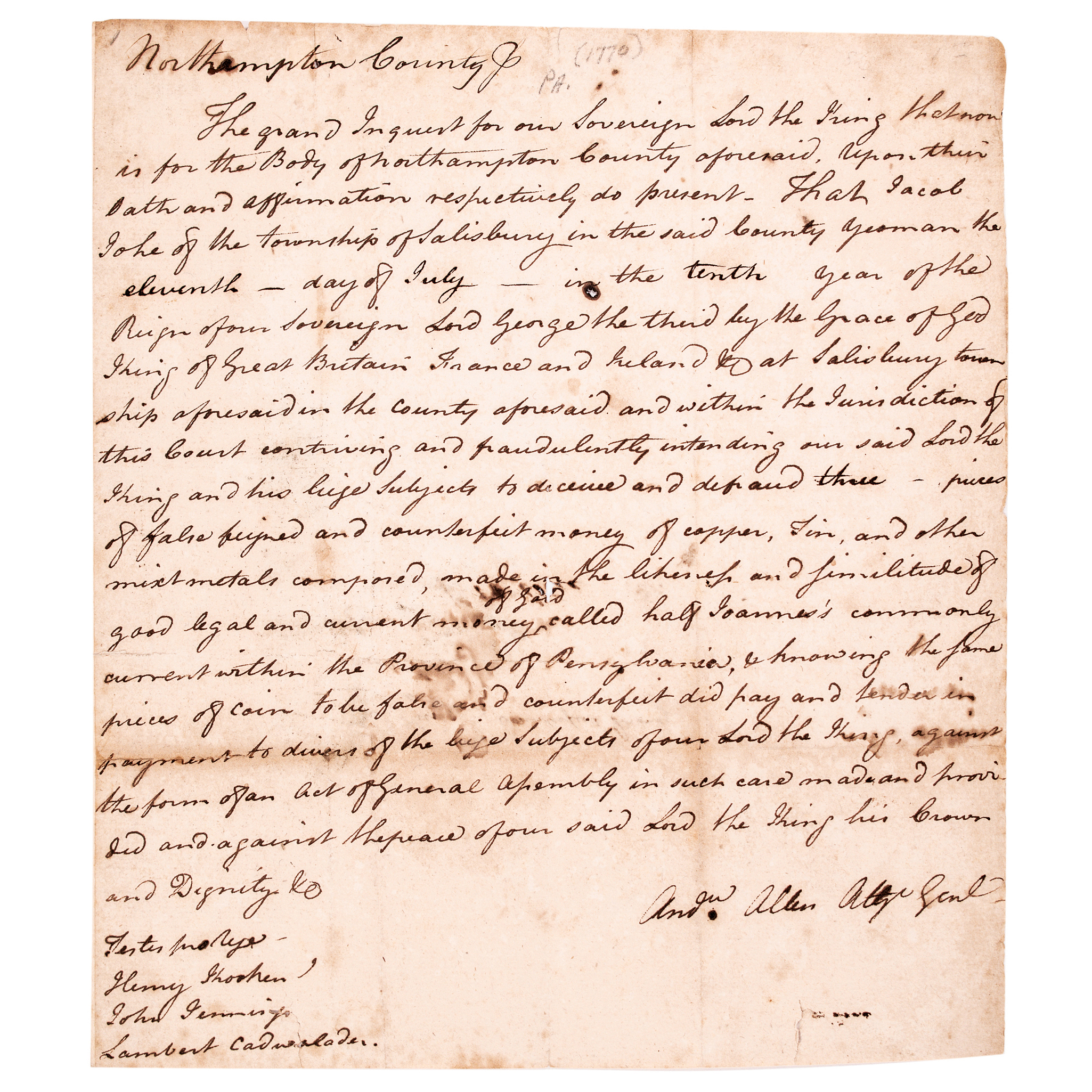
July 11, 1770 Pennsylvania Grand Jury Indictment Against Jacob Johe for Passing Counterfeit “Half-Joannes” Coins
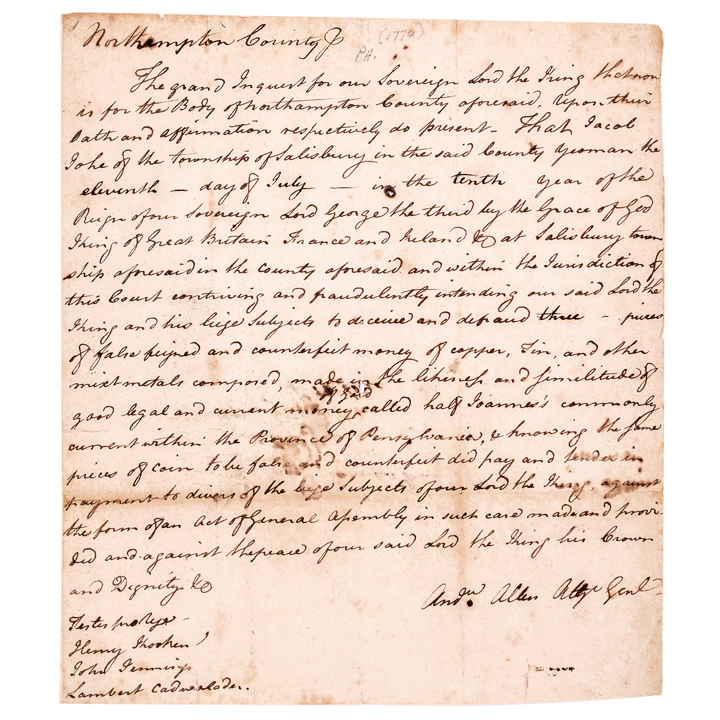
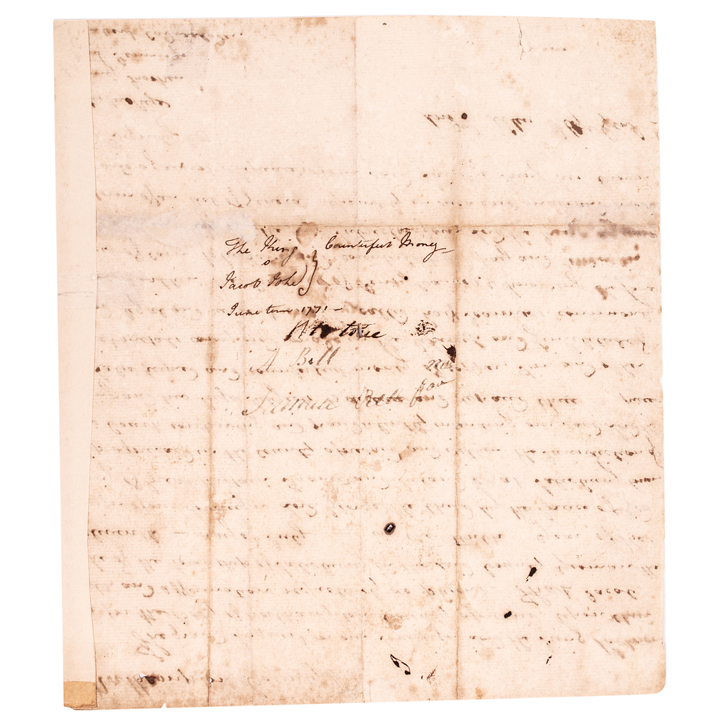
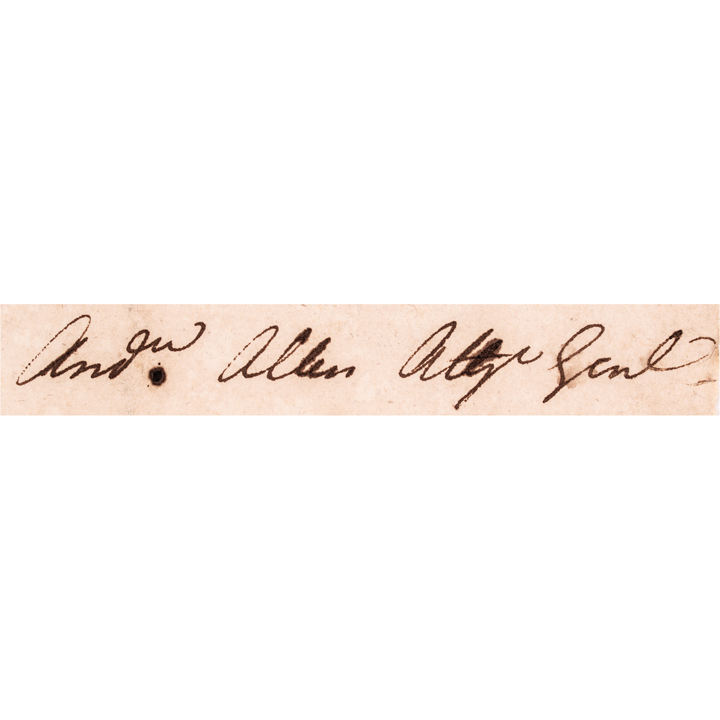
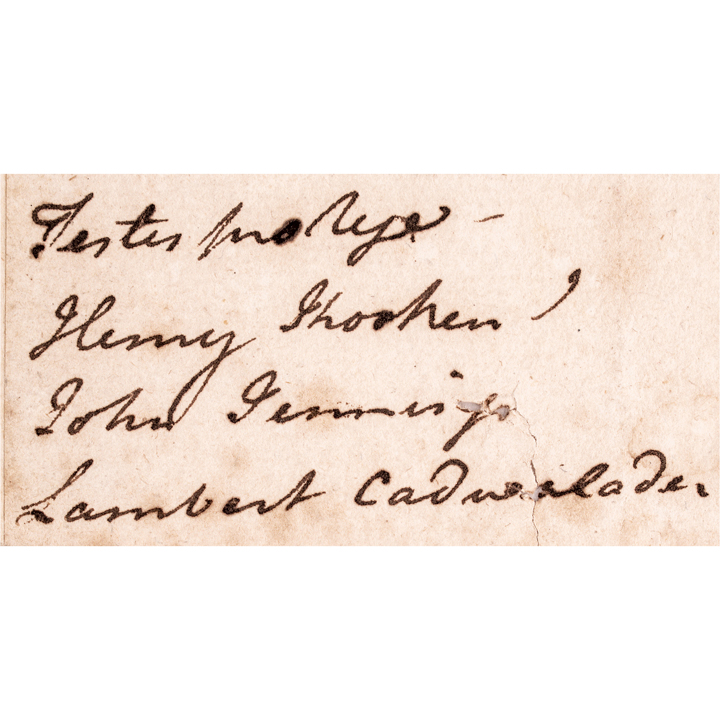
ANDREW ALLEN (1740-1825). Colonial Attorney General of Pennsylvania, delegate to the Second Continental Congress, and later turned to be a British Loyalist attainted (a person has been sentenced to death or otherwise convicted of a serious crime) of attainder Treason. July 11, 1770-Dated Colonial Period, Autograph Manuscript Document Legal Indictment written and Signed, “Andr. Allen” as Attorney General of the Province of Pennsylvania, Fine. This 1 page document measures about 8.25 x 9.25 inches, is dated and written by the hand of Andrew Allen. It records the grand jury's presentment against Jacob Johe, a yeoman of Salisbury Township in Northampton County, charged with: "contriving and fraudulently intending our said Lord the King and his liege Subjects to deceive and defraud" by passing three pieces of "false, feigned, and counterfeit money, of copper, tin, and other mixt metals," made in imitation of the "half Joannes" (a Portuguese gold coin that circulated widely and at a premium in the colonies, and whose half-denomination was a frequent target for counterfeiters working in cheap alloys). This document is signed at the bottom right by Allen and witnessed by three men whose names follow: Henry Shoemaker, John Jennings, and Lambert Cadwalader. The docket on the blank verso restates the case as: "The King vs. Jacob Johe - Counterfeit Money," notes the term "June Term 1771," and carries the grand jury's endorsement, "A True Bill," with an additional signature beneath. Andrew Allen, appointed Attorney General of Pennsylvania in 1769, was the son of Chief Justice William Allen and a member of one of the colony's wealthiest and most influential families; he went on to represent Pennsylvania in the Second Continental Congress... that was before his loyalties shifted away from Patriot, to decisively toward the British Crown. Allen made his flight to the British lines in December 1776 and his eventual conviction attainder for treason by the Pennsylvania Assembly. Among the witnesses named here, Lambert Cadwalader took the opposite path: within six years of witnessing this routine county indictment, the young Philadelphia merchant was Commissioned an Officer in the Continental Army, rose to the rank of Colonel of the 4th Pennsylvania Regiment, and was taken Prisoner at the fall of Fort Washington, in New York City in November 1776. When released Cadwalader began a long postwar career as a Delegate to the Confederation Congress and then to the United States House of Representatives. Allen initially sided with the colonial cause, serving as a Pennsylvania delegate to the Second Continental Congress in 1775-76. But as a wealthy, conservative elite tied to Pennsylvania's old proprietary establishment, he opposed independence outright and resigned from Congress in June 1776 rather than support it. When the British army occupied New York, he crossed into British lines, swore an oath of allegiance to the King (formally renouncing his earlier oaths to Congress), and eventually went to London. As a direct consequence, the Pennsylvania Assembly formally attainted Allen of treason, either 1778 (under Pennsylvania's broader Attainder Act) or specifically 1781, depending on the source and confiscated his estate, along with property belonging to other members of his prominent family (his father was William Allen, Chief Justice of the Pennsylvania Supreme Court). This legislative attainder used specifically to strip Loyalists of property and civil standing without a criminal trial. The British government compensated him for his losses: their "Commission for Claims and Losses" awarded him a lifetime pension of £400 per year. In 1792, Pennsylvania pardoned him. He returned briefly to Philadelphia in 1794, hoping to recover old debts owed to him under the Jay Treaty, but that effort failed. He went back to London and spent the rest of his life there, dying in 1825 at age 84, never having recovered his American property or reintegrated into American life Counterfeit half-Joannes coins were indeed circulating in Philadelphia in exactly this period. Harrold E. Gillingham's Counterfeiting in Colonial Pennsylvania (American Numismatic Society) documents that in late 1770, about six months after a May 1770 warning about counterfeit Maryland bills and counterfeit half Johannes coins dated 1746 appeared, which were "made of base Metal, thinly gilt over, somewhat broader and thicker than the true Ones (tho' lighter)," with letters that were "irregular and badly executed." DOCUMENTS FULL TRANSCRIPTION: Northampton County ss: (1770) PA. The grand Inquest for our Sovereign Lord the King, [inquiring?] is for the Body of Northampton County aforesaid, upon their Oath and Affirmation respectively do present - That Jacob Johe, of the township of Salisbury in the said County, yeoman, the eleventh day of July in the tenth year of the Reign of our Sovereign Lord George the Third, by the Grace of God, King of Great Britain, France, and Ireland &c., at Salisbury town- ship aforesaid, in the County aforesaid, and within the Jurisdiction of this Court, contriving and fraudulently intending our said Lord the King and his liege Subjects to deceive and defraud, three pieces of false, feigned, and counterfeit money, of copper, tin, and other mixt metals composed, made in the likeness and similitude of good, legal, and current money [of said?], called half Joannes's, commonly current within the Province of Pennsylvania, & knowing the same pieces of coin to be false and counterfeit, did pay and tender in payment to divers of the liege Subjects of our Lord the King, against the form of an Act of General Assembly in such case made and provi- ded, and against the peace of our said Lord the King, his Crown and Dignity, &c. Test[es]. per Cur. - Andw. Allen, Atty Genl Henry Shoemaker John Jennings Lambert Cadwalader. DOCKET ON BACK: The King } Counterfeit Money vs. Jacob Johe June Term 1771 - A True Bill. [signature, illegible - possibly foreman's name] |
|||||||||||
|
Auction Closing: Saturday, November 14th
at Noon Eastern Time • 9:00 AM Pacific Time |
|||||||||||