
|
Lot: 107 ♡
|
|||||||||||
|
Commodore John Paul Jones Polychrome Wax Relief Portrait Vintage Tag on Period Ornate Deep Display Frame
|
|||||||||||
|
|||||||||||
 |
|
||||||||||
|
Lot 107:
Commodore John Paul Jones Polychrome Wax Relief Portrait Vintage Tag on Period Ornate Deep Display Frame
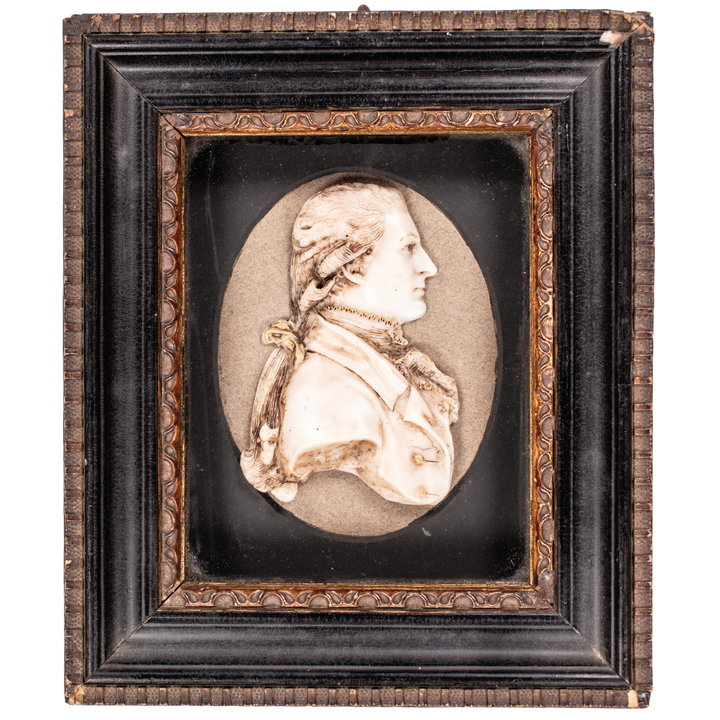
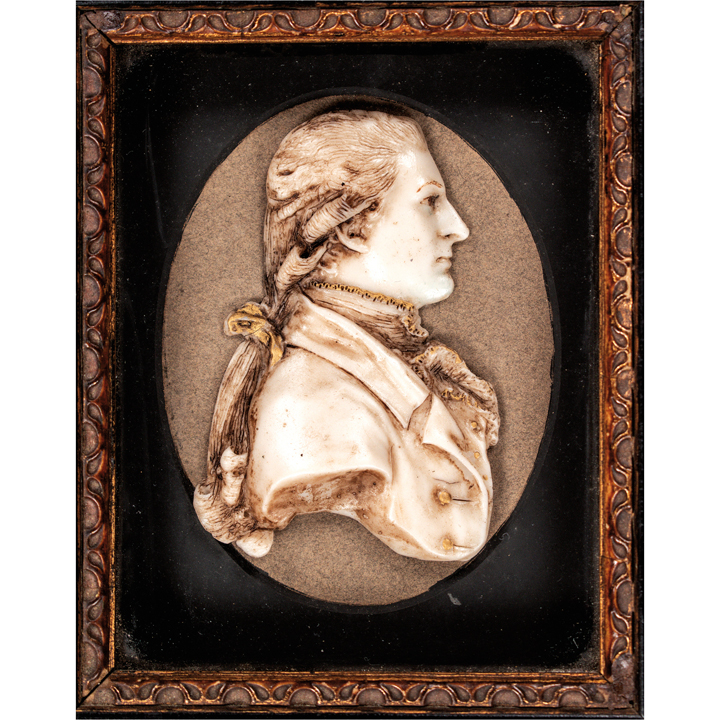
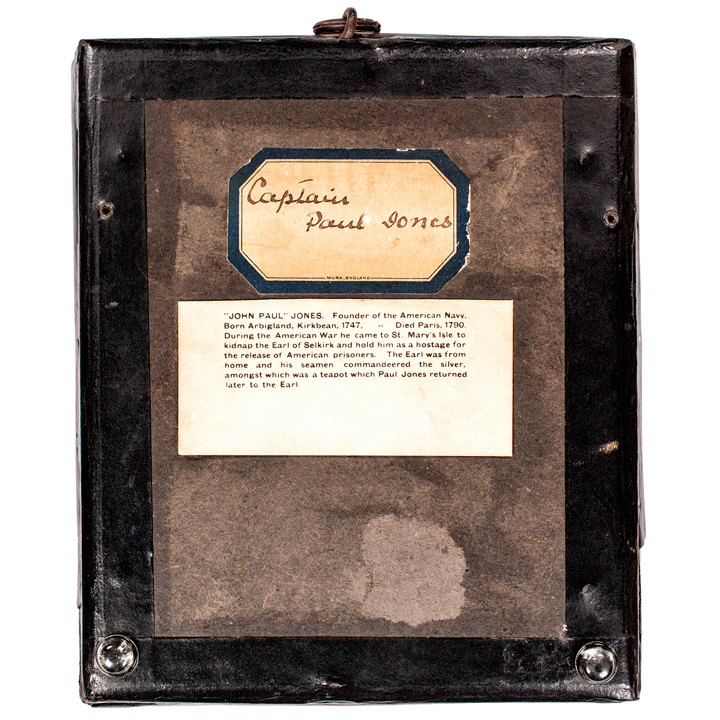
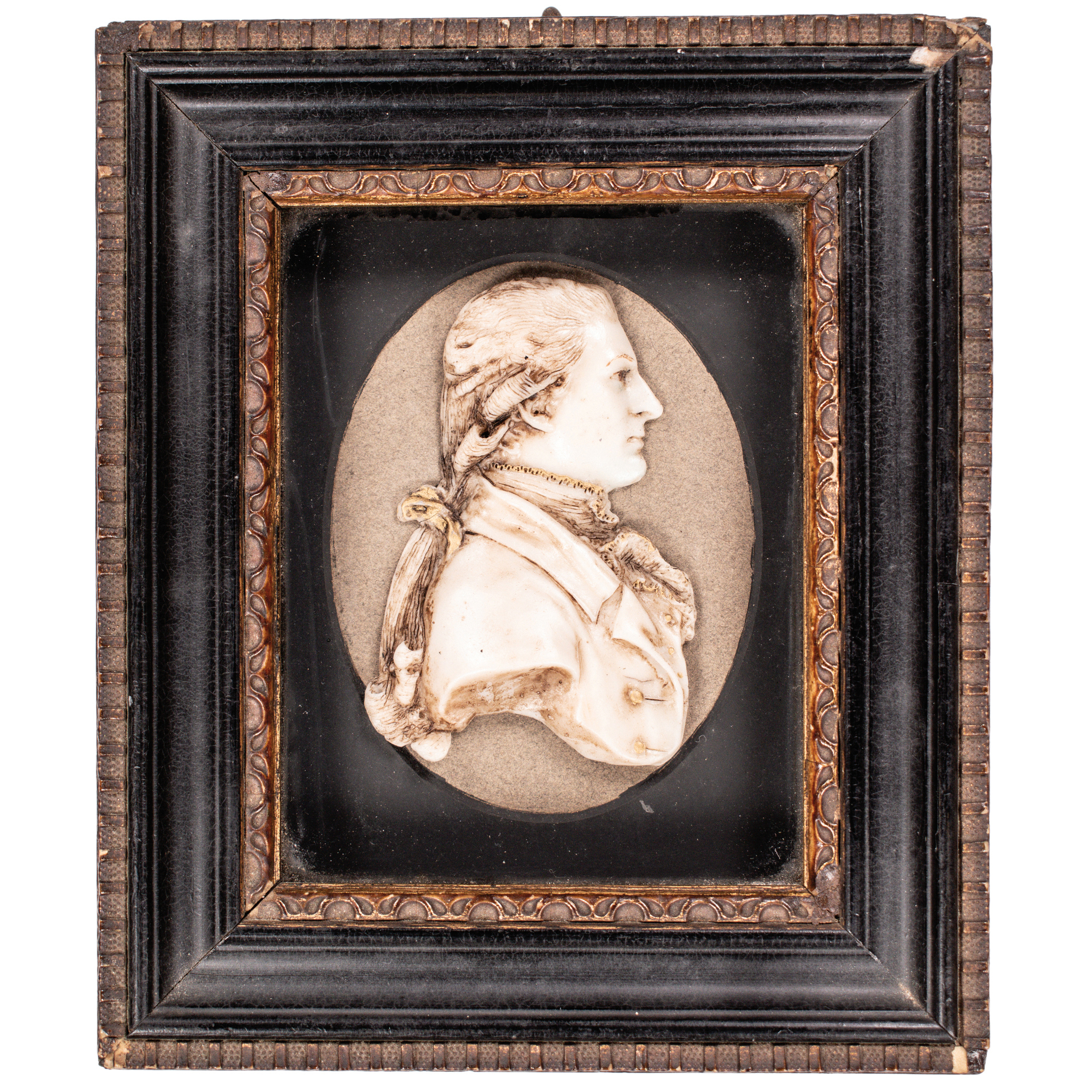
c. 1780-1790 Revolutionary War Era, “Captain (John) Paul Jones” (1747-1792), Polychrome High-Relief Miniature Wax Portrait, often called the "Father of the American Navy," Display Framed with top loop, Choice Very Fine. This impressively crafted wax high-relief Portrait of Commodore John Paul Jones (1747-1792), measures about 4.5 x 3.5 inches (by sight) and fully 7 x 6 inches framed. John Paul Jones is one of the most colorful and important figures in early American naval history, often called the "Father of the American Navy" though he never actually held that formal title in his lifetime. Artist, date and place created are not known. The frames reverse has a later prior owner’s tag adhered that is written in period style brown ink “Captain Paul Jones” and written on a label is printed “Mura, England” also having a later plain typeset information card below telling of an incident in England involving Jones. The portrait and frame appear likely produced in France as a tribute to Jones. Housed in a period deep black wooden frame with a highly decorative ornate face designs of inner and outer deep golden toned surrounds which show some light expected wear and age, a small outer frame chip at its upper right corner and the intact original loop at top shows this piece was meant to hang on display. This artwork depicts the handsome Commander in right-facing bust profile, his long powdered hair dressed in a queue tied with a ribbon, shown dressed wearing his naval military coat with gilt buttons and a white stock at the throat tinted with light golden tone. Even his eye and eyebrow are detailed in gold. The whole portrait is beautifully modeled with great skill having crisp exceptional detail, mounted against an oval sand-colored background. Period wax portrait relief of John Paul Jones of this quality and detail are exceptionally rare. Jones’ fame was concentrated in the Revolutionary and early Federal periods before his death in Paris in 1792, and the window for the production of commemorative wax portraiture in his likeness was correspondingly narrow. John Paul Jones, whose bold raids on British coastal towns and whose celebrated refusal to surrender during the battle between the Bonhomme Richard and HMS Serapis in September 1779, which rings out to this day per his uttering the immortal words "I have not yet begun to fight," that made him the preeminent Continental Navy hero of the American Revolution and a figure of transatlantic celebrity in both America and France. John Paul Jones was born John Paul in 1747 in Scotland, the son of a gardener. He went to sea at 13 and worked his way up through the merchant marine and slave trade before an incident in the West Indies when he killed a mutinous crew member, reportedly in self-defense. This forced him to flee to the American colonies around 1773. He added "Jones" to his name at that point, likely to obscure his identity. When the Revolutionary War broke out, Jones offered his services to the fledgling Continental Navy and received one of the first commissions issued by the Continental Congress in 1775. He commanded several ships in his early career, but his reputation grew fastest through bold, aggressive action rather than administrative rank: USS Providence (1776) He captured or destroyed numerous British merchant vessels along the American coast and near Nova Scotia. USS Ranger (1777-7 - Sailing to European waters, he raided the English port of Whitehaven, becoming one of the only American commanders to strike the British mainland during the war. He also captured the British sloop HMS Drake off the coast of Ireland, a notable single-ship victory. His defining moment came on September 23, 1779. Commanding a converted merchantman renamed the Bonhomme Richard (in honor of Benjamin Franklin, whom Jones worked closely with while operating out of France), he engaged the more heavily armed British frigate HMS Serapis off Flamborough Head, England. The battle was brutal and the Bonhomme Richard was badly damaged and taking on water. When the British captain asked if Jones was ready to surrender, Jones is said to have replied, "I have not yet begun to fight!" He lashed his ship to the Serapis and continued fighting until the British struck their colors. His own ship sank two days later, but he'd won the fight and sailed off in his captured prize, a stunning propaganda victory for the American cause, achieved essentially in British home waters. After the war, with the Continental Navy being dissolved, Jones struggled to find a role in the young United States. In 1788, he accepted a commission as a rear admiral in the Russian Navy under Catherine the Great, fighting the Ottoman Turks in the Black Sea. The assignment ended badly amid scandal and rivalries with other officers, and he left Russian service in 1789. Jones spent his final years in Paris, largely forgotten and in declining health, and died there in 1792 at just 45 years old. He was buried in an unmarked grave. His body wasn't rediscovered until 1905, when it was identified, exhumed, and returned to the United States with great ceremony. Today he rests in a marble sarcophagus at the U.S. Naval Academy chapel in Annapolis, Maryland. |
|||||||||||
|
Auction Closing: Saturday, November 14th
at Noon Eastern Time • 9:00 AM Pacific Time |
|||||||||||