
|
Lot: 114 ♡
|
|||||||||||
|
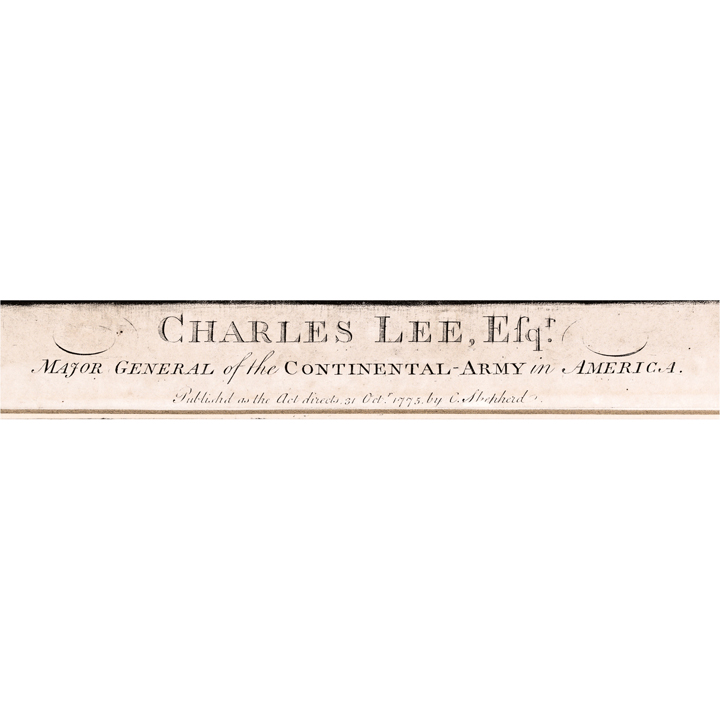
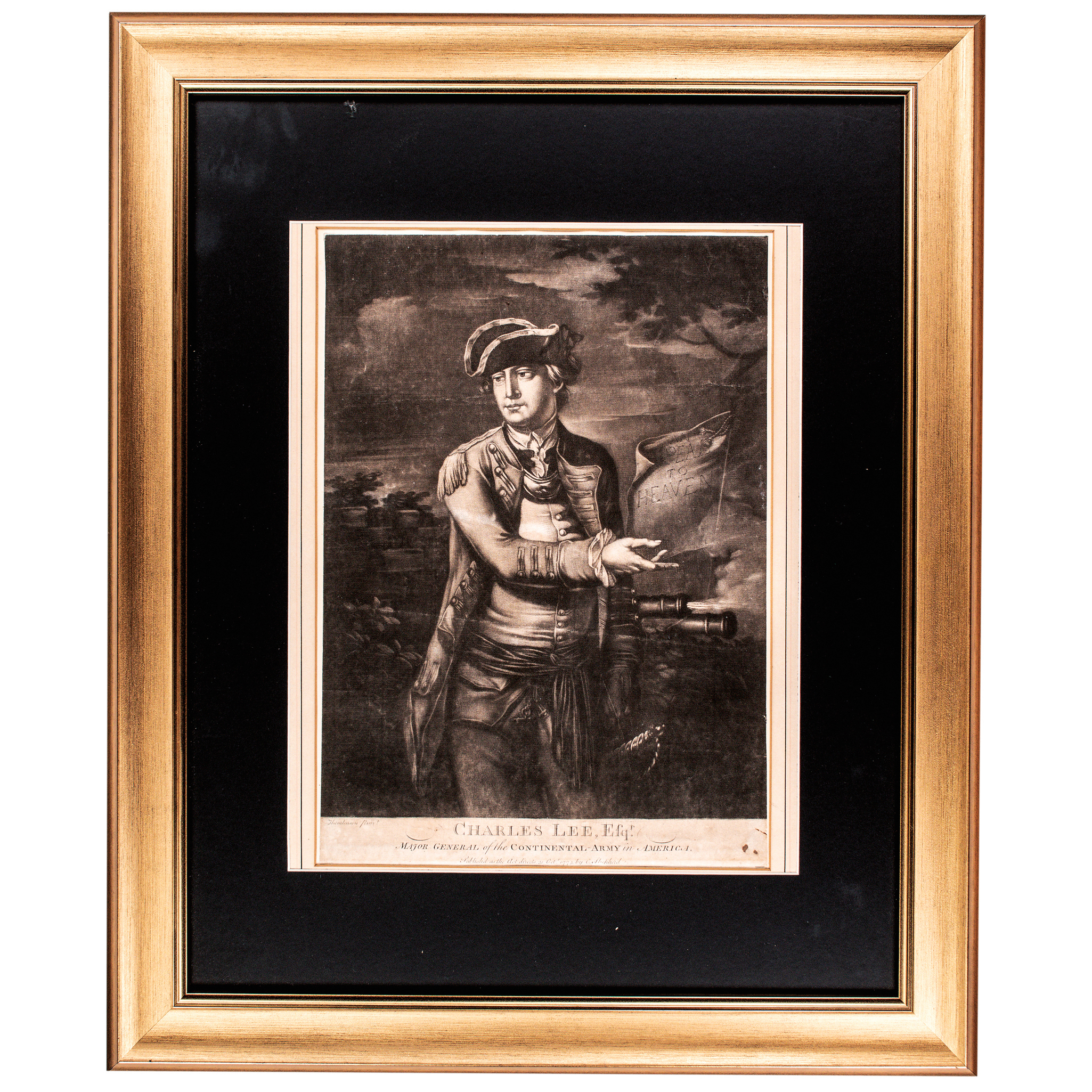
"Charles Lee, Esq'r / Thomlinson pinxt. / Major General of the Continental-Army in America / Published as the Act directs, 31 Oct'r 1775 by C. Shepherd, London."
|
|||||||||||
|
|||||||||||
 |
|
||||||||||
|
Lot 114:
"Charles Lee, Esq'r / Thomlinson pinxt. / Major General of the Continental-Army in America / Published as the Act directs, 31 Oct'r 1775 by C. Shepherd, London."
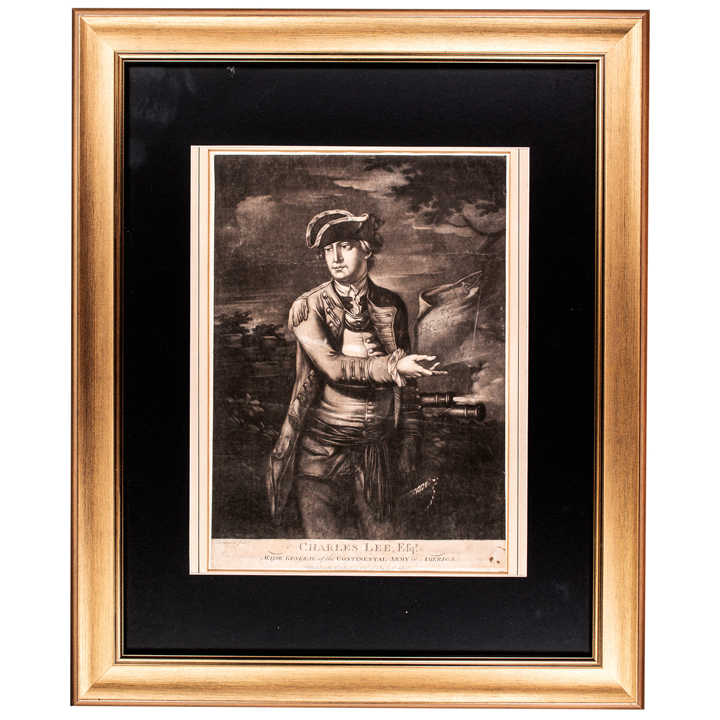
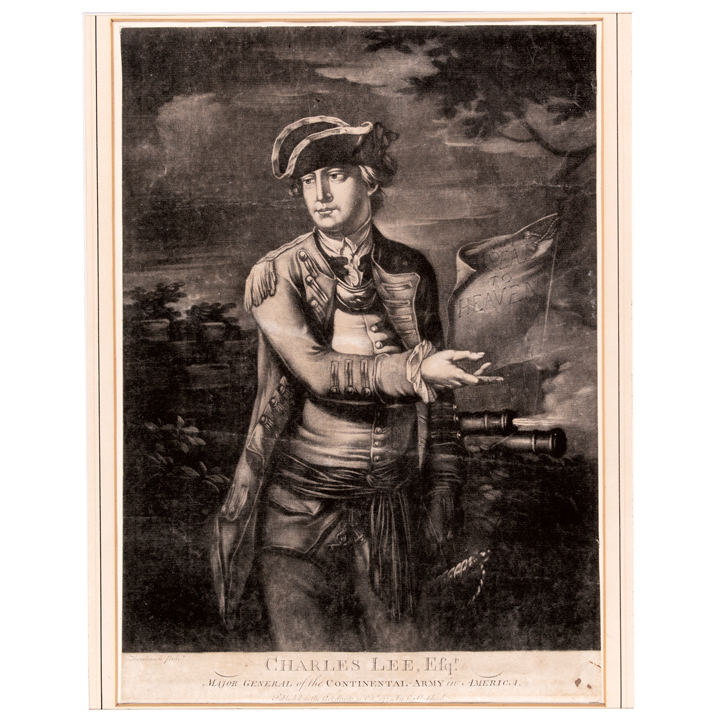
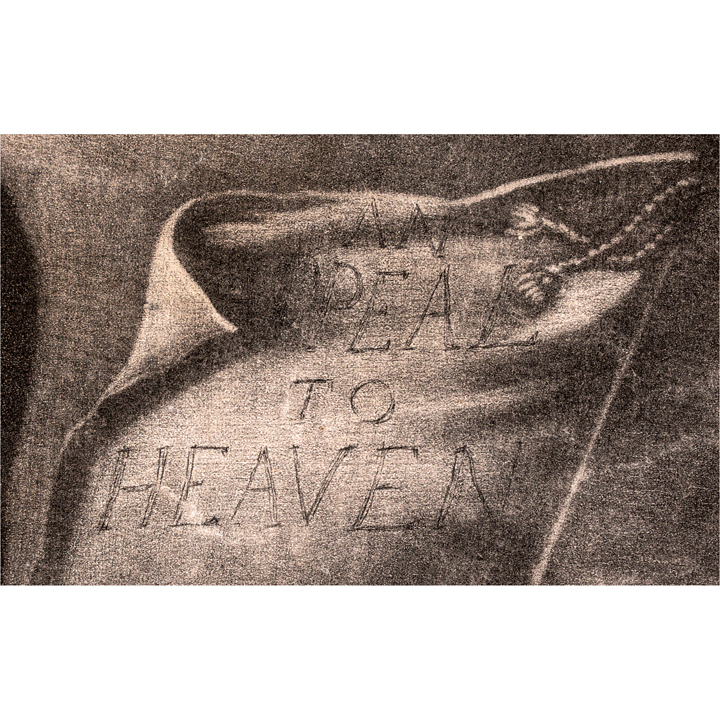
October 31, 1775 Published Revolutionary War Period Mezzotint Engraved Print titled, "Charles Lee, Esq'r / Thomlinson pinxt. / Major General of the Continental-Army in America / Published as the Act directs, 31 Oct'r 1775 by C. Shepherd, London.", Framed, Very Fine. This is one of the earliest published portraits of a Revolutionary War General. Charles Lee (1731-1782), was an English-born military officer who became General George Washington's Second-in-Command early in the Revolutionary War. Lee was a Major General later court-martialed for his conduct at the Battle of Monmouth, a fall from grace that stands in sharp contrast to the heroic, wholly invented image of him circulated in this print. The publisher, C. Shepherd, was a London print-seller active c. 1775, publishing October 31, 1775, mere months after Lee's appointment by the Continental Congress as Major General. The print measures about 14” x 10” (by sight) trimmed to fit the professional outer mat and beautifully modern light-golden wood frame measuring fully 23” x 19”, and viewed under special UV Plexiglas, ready to display. It is presented in its original black and white having a couple spots of brown ink on the lower right corner far away from the image. All title and informational text below the image is present. Light expected tone per age and a faint crease appears part of the imagery. This image is after a “supposed” painting by "Thomlinson." However, No such portrait actually existed. Lee's likeness in this print is a complete fiction, invented to meet the sudden British and European demand for images of American Revolutionary leaders while accurate information was still slow to cross the Atlantic. In the image General Lee stands in his military uniform beside a firing cannon and his outstretched hand is located beneath a flag reading, "An Appeal to Heaven" which is one of the earliest print appearances of that historic Revolutionary flag and motto. Of note, Shepherd, along with fellow London publishers using the names Thomas Hart and John Morris, issued a whole series of these invented mezzotint "portraits" of American officers (Washington, Hancock, Gates, etc.) with none based on real sittings. References: Cited in the British Museum's Catalogue of Political and Personal Satires (no. 5296) and John Chaloner Smith's British Mezzotinto Portraits; Impressions are held by the Library of Congress; the Met; Colonial Williamsburg; and the Birmingham Museum of Art. Charles Lee was born in 1731 (some sources say 1732) in Darnhall, Cheshire, England, into a military family. His father was a British Army officer. Lee received a classical education and, like his father, entered the army young, receiving a commission as an ensign at age 14. He served in North America during the French and Indian War, fighting at the disastrous Battle of the Monongahela in 1755 and later in the campaigns around Fort Ticonderoga and Niagara. He was adopted into the Mohawk nation, who reportedly gave him the name "Boiling Water" for his volatile temper, and he married the daughter of a Seneca chief. After the war he continued his military career in Europe, serving with distinction (and gaining a reputation for eccentricity and abrasiveness) in Portugal and later as a mercenary general in the Polish and Russian armies, rising to major general in Polish service. Lee returned to the American colonies in 1773, settling in Virginia, and quickly became an outspoken supporter of the Patriot cause, publishing pamphlets against British policy. When the Continental Congress organized the Continental Army in 1775, Lee's extensive professional military experience made him one of the most credentialed officers available, and he was appointed one of the first major generals, ranking just behind George Washington. He played an important role in organizing the defense of New York and later distinguished himself in defending Charleston, South Carolina, against a British assault in 1776. However, Lee was privately critical of Washington's leadership and abilities, and this rivalry simmered beneath the surface of his service. Lee's career and reputation collapsed after he was captured by British forces in New Jersey in December 1776. That was an embarrassing episode, as he was caught essentially unguarded at an inn. After his exchange in 1778, he returned to command, but at the Battle of Monmouth that June he ordered a confusing retreat that infuriated Washington, who publicly and furiously reprimanded him on the field. Lee demanded a court-martial to clear his name, but was instead convicted of disobedience, poor conduct, and disrespect toward the commander-in-chief. That resulting in a one-year suspension from command. He never returned to military service, spent his final years writing bitter letters attacking George Washington and the Contiental Congress. Lee died in Philadelphia in 1782, largely estranged from the Patriot cause he had once served. |
|||||||||||
|
Auction Closing: Saturday, November 14th
at Noon Eastern Time • 9:00 AM Pacific Time |
|||||||||||