
|
Lot: 12 ♡
|
|||||||||||
|
November 7, 1863 Rear Admiral David G. Farragut Autograph Letter Signed Regarding the Critical Naval military USS Monongahela Naval Ordnance Armaments
|
|||||||||||
|
|||||||||||
 |
|
||||||||||
|
Lot 12:
November 7, 1863 Rear Admiral David G. Farragut Autograph Letter Signed Regarding the Critical Naval military USS Monongahela Naval Ordnance Armaments
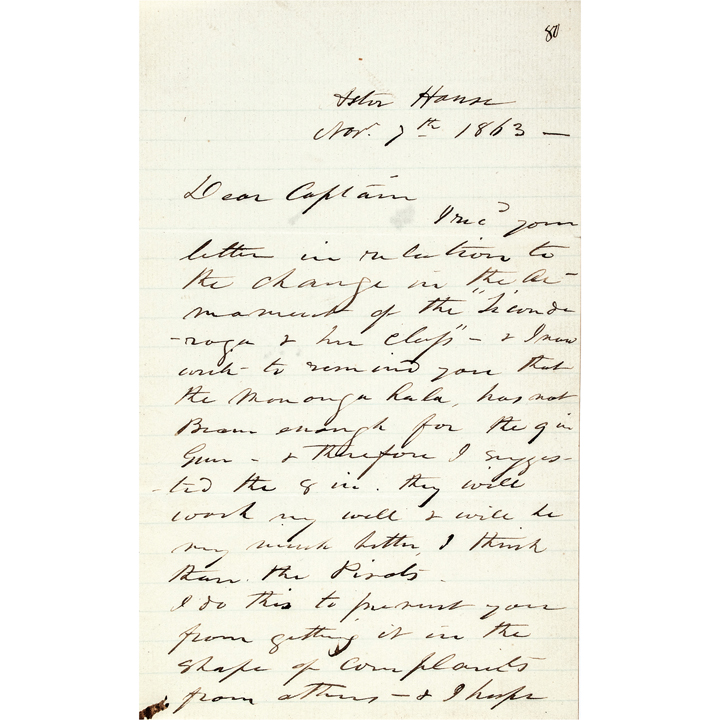
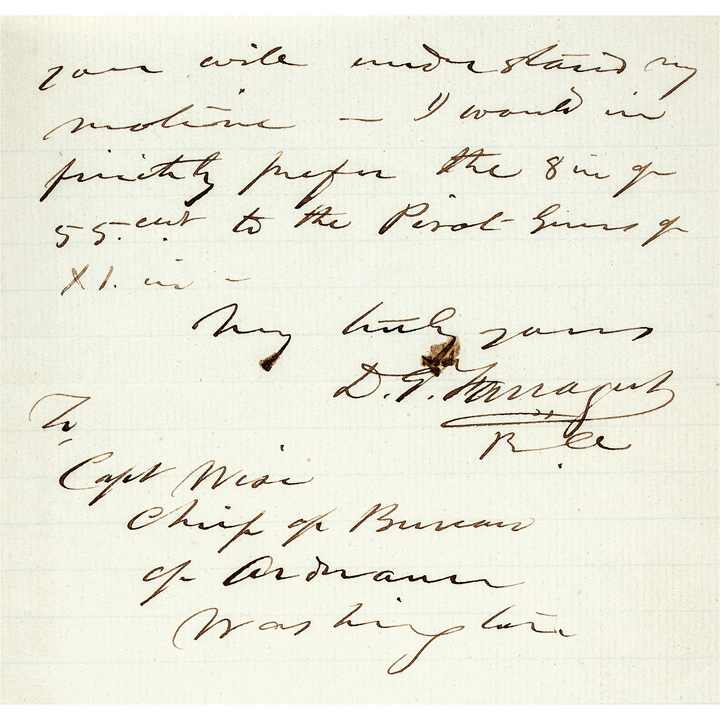
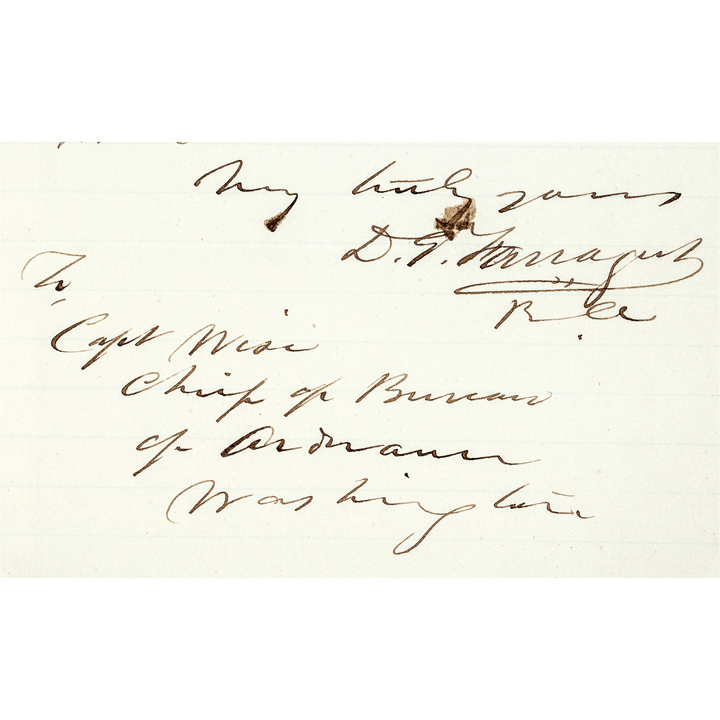
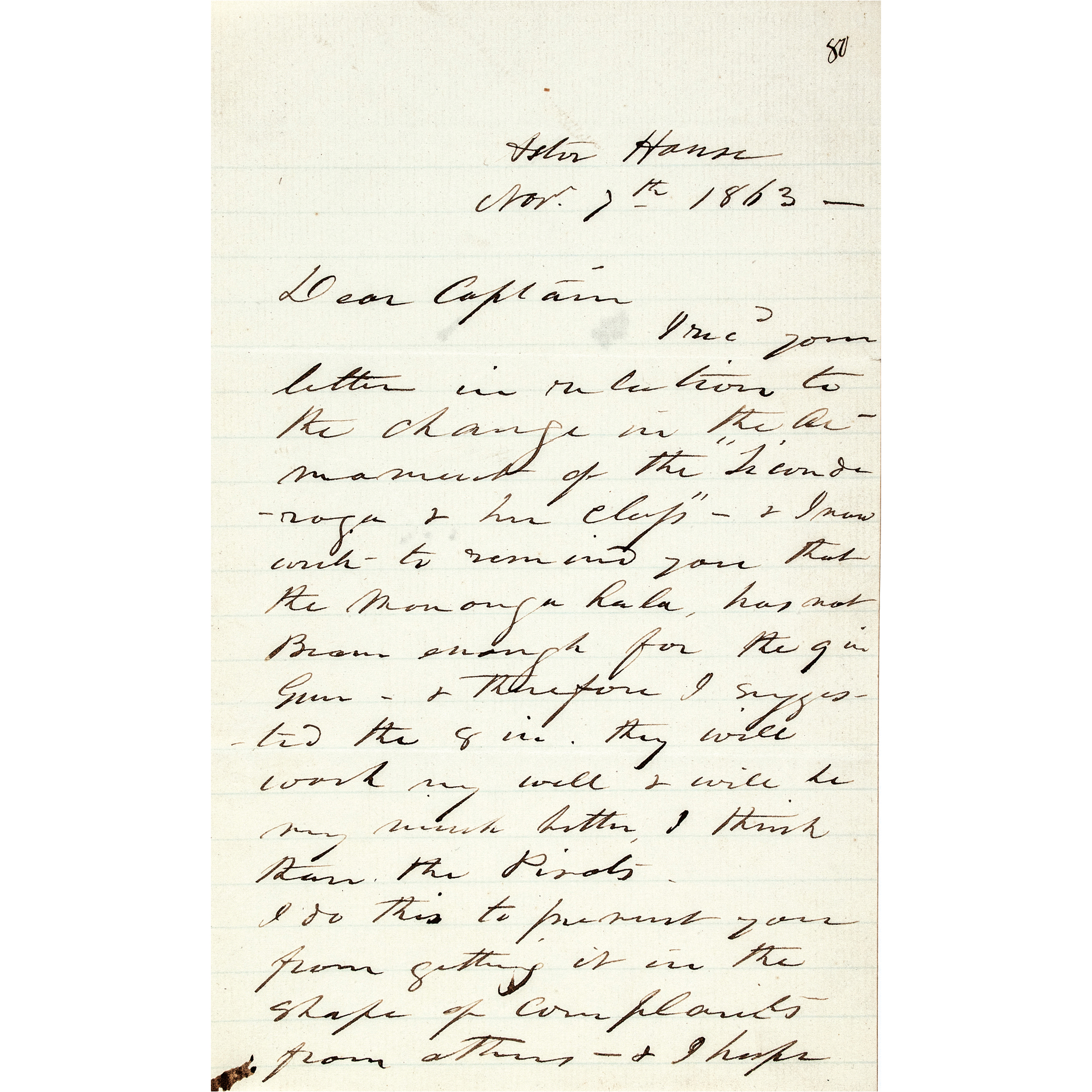
DAVID G. FARRAGUT (1801-1870). Celebrated Union Naval Commander, First Rear Admiral in United States History, and Future Hero of the Battle of Mobile Bay. November 7, 1863-Dated Civil War Period, Autograph Letter Signed, "D.G. Farragut, R.A.” (Rear Admiral), 1-1/2 pages, measuring 8” x 5”, written at the “Astor House”, New York, being addressed “To Capt(ain Henry A.) Wise, Chief of this Bureau of Ordnance, Washington”, Very Fine. The Ticonderoga was a class of vessels defined as “barque rugged wooden screw sloops.” There were only two ships in this class, one of which, the “Lackawanna,” which David Farragut would command at Mobile Bay. Rear Admiral John A. Dahlgren had been the Chief of Bureau of Ordnance until June 1863, and the Ticonderoga had been scheduled to have “Dahlgren” guns, which were 11 inches. This critical Naval military armaments letter reads, in full: "Dear Captain, --- I recd your letter in relation to the change in the armament of the 'Ticonderoga & her class,' & I now wish to remind you that the Monongahala, has not Beam enough for the 9 in Gun, & therefore I suggested the 8 in. (gun), they will work very well & will be very much better, I think than the Pivots. -- I do this to prevent you from getting it in the shape of complaints from others, & I hope you will understand my motive. -- I would infinitely prefer this 8 in(ch) of 55 cent to the Pivot Guns of x 1 in. -- Very truly yours, (signed) D.G. Farragut, R.A." “To --- Capt. Wise Chief of Bureau of Ordinance - Washington” This letter finds FARRAGUT deep in this practical, technical work of fleet management during one of this most active stretches of his Civil War career, just months after this Union's Mississippi River campaign and less than a year before his legendary run past Confederate defenses at Mobile Bay would make him a national hero. Writing directly to Wise, this Union Navy's chief ordnance officer, Farragut weighs in on a genuine engineering constraint aboard this USS Monongahela, a screw sloop that had already seen hard service under his own command at Port Hudson earlier that year. Here, explaining that her hull simply lacked sufficient beam to safely mount this larger 9 inch gun then being considered for this Ticonderoga class of sloops. His preference for this smaller 8 inch gun over both this 9 inch piece and this heavier 11 inch pivot guns reflects this kind of hands on operational judgment. This letter is clean and written in brown ink on wove period paper. It shows a couple of ink smudges when written, one above this "G" in this signature, and prior mounting traces on the blank reverse, overall in nice condition. Provenance: Ex Collection of Ambassador J. William Middendorf II. The Ticonderoga was a class of vessels defined as “barque rugged wooden screw sloops.” There were only two ships in this class, one of which, the “Lackawanna,” Farragut would command at Mobile Bay. Rear Admiral John A. Dahlgren had been the Chief of Bureau of Ordnance until June 1863, and the Ticonderoga had been scheduled to have Dahlgren guns, which were 11 inches. Farragut tries to be delicate in this letter to Dahlgren’s successor, as he suggests that 8 inch guns would fit better than 11 inch ones. Here, not wanting to offend Dahlgren, who spent the rest of the war at sea, and who was a colleague of Farragut’s. In 1862 David Farragut had succeeded in taking New Orleans without bloodshed after running his ships past the Confederate defenses at For Jackson and Fort St. Philip. Although he wished to proceed against the defenses at Mobile, he spent much of the rest of 1862 in blockade duties. In March of 1863 he attacked the batteries at Port Hudson; his flagship, the “USS Hartford” and a gunboat, passed them. On August 1, 1863, Farragut sailed for New York in the “Hartford,” where he and his ship, which had been struck 240 times by shot and shell, were the objects of much interest and adulation. He was presented with resolutions of congratulations by the Chamber of Commerce, and the Union League Club gifted him with a Sword with a Scabbard was of Gold and Silver. It was from New York that Farragut wrote this letter at the Astor hotel. In January, he would Sail for the Gulf again and his new objective of capturing the Confederate defenses in Mobile Bay. Congress created two grade ranks especially for Farragut; Vice Admiral in 1864, and Admiral in 1866. |
|||||||||||
|
Auction Closing: Saturday, November 14th
at Noon Eastern Time • 9:00 AM Pacific Time |
|||||||||||