
|
Lot: 145 ♡
|
|||||||||||
|
c. 1820 Captain Theodore Hunt U.S. Navy Reverse Painting on Glass Silhouette Portrait Original Frame Housed
|
|||||||||||
|
|||||||||||
 |
|
||||||||||
|
Lot 145:
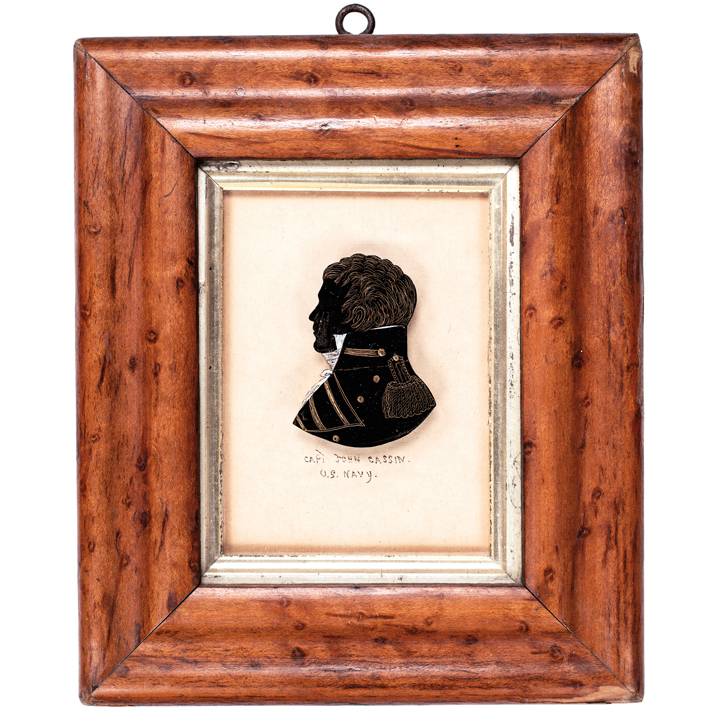
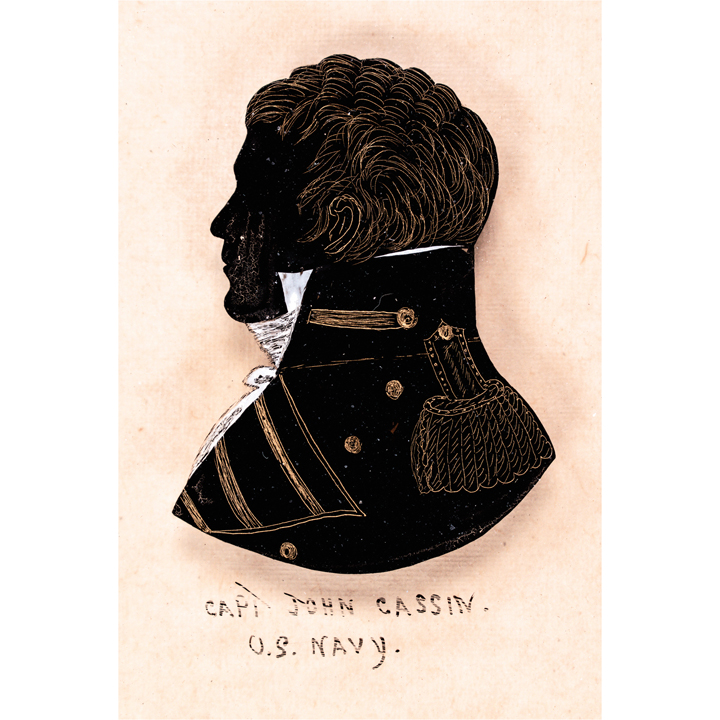
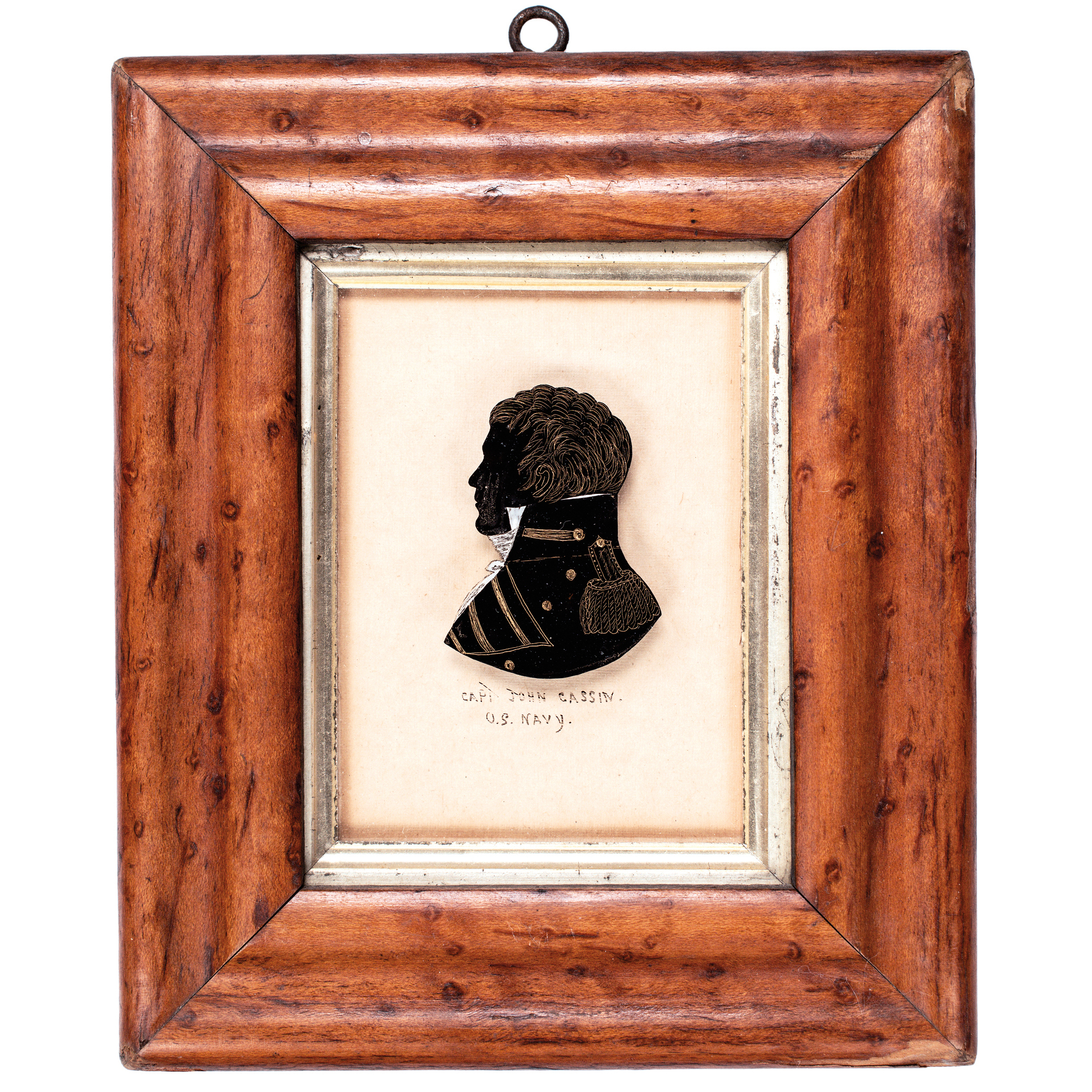
c. 1820 Captain Theodore Hunt U.S. Navy Reverse Painting on Glass Silhouette Portrait Original Frame Housed
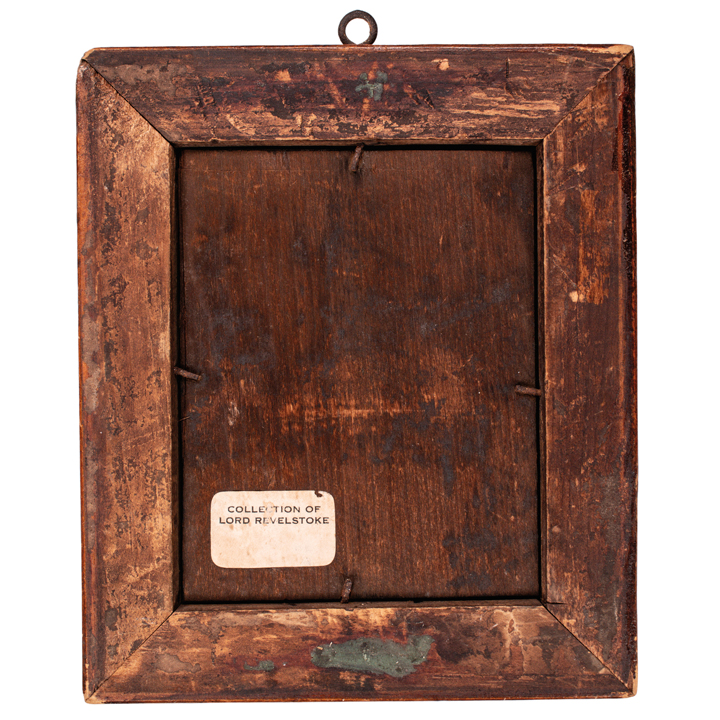
c. 1820 Captain Theodore Hunt, U.S. Navy, Reverse Painted Portrait on Glass in Gold & Black Silhouette of this remarkable Revolutionary War to War of 1812 officer, Gold Ink-Inscribed Identification, in its original Walnut Frame with a decorative Gilt Inner Border, Choice Extremely Fine. This Identified Reverse Painting on Glass Silhouette Portrait, is framed to 7 x 6.25 Inches and measures 4 x 3.75 Inches (by sight). It depicts the historic Captain Theodore Hunt of the United States Navy wearing his dress military uniform coat, epaulette, and stock, facing right. The portrait glass is mounted above a cream background within a walnut frame with a gilt inner border. Museum quality, it was created with a precision and delicacy characteristic of the finest American silhouette work of the Federal and early antebellum periods. The portrait belongs to a well-established but largely anonymous early American decorative tradition, in which a black ground and fine detail were painted directly onto the back of the glass rather than cut from paper. This technique was favored for keepsake portraits of military and naval officers of this era. Below the silhouette, written in neat contemporary gold ink lettering, below the portrait is Inscribed, "Capt. Theodore Hunt. / U.S. Navy.” Theodore Hunt's naval career spanned two of the most dramatic chapters of the early United States Navy, serving aboard the USS Ganges in the West Indies during the Quasi-War with France, and later he was held prisoner at Tripoli during the First Barbary War. In 1814 he married Anne Lucas, of one of St. Louis's most prominent founding families, and went on to a second career as a St. Louis businessman in partnership with fur trader Manuel Lisa and William Clark of the historic Lewis and Clark Expedition. Hunt’s name is listed alongside a notable roster of famous naval officers of that era such as James Lawrence (later famed for "Don't give up the ship"), John Trippe (a First Barbary War hero of a celebrated naval action), John Orde Creighton, Beekman V. Hoffman, and Samuel Woodhouse. All this suggesting Hunt moved in a fairly prominent circle of Navy officers in the years just before the War of 1812. A miniature portrait of Captain Hunt and his wife by the artist Millet survives in the collection of the Missouri Historical Society. Provenance: Consigned together with a completely matching Portrait of Capt. John Cassin which has a tag stating, Provenance: "Collection of Lord Revelstoke." (Baron Revelstoke is a British peerage title created in 1885 for Edward Charles Baring, head of Barings Bank.) Theodore Hunt was born circa 1778 in Trenton, New Jersey. He was the son of Abraham Hunt (1741-1821), who was a local Patriot merchant remembered for the story that he hosted the local Hessian garrison's Commanding Officers for dinner and cards on the night of December 25-26, 1776. That fatefull delay is credited by tradition, with helping enable General George Washington's surprise Crossing of the Delaware River and the successful Continental Army attack on Trenton early the next morning. Abraham Hunt himself has an interesting lifes story. In 1764, at age 21, Hunt partnered with Moore Furman to form Furman and Hunt, a Trenton mercantile firm that came to dominate the Trenton-Philadelphia river trade. He became the principal merchant and a major landowner in Trenton, operating a shop attached to his home at the corner of King and Second Streets. He also served as a Commissioner for improving Delaware River navigation (1770). Benjamin Franklin, then Colonial Postmaster General, commissioned Abraham Hunt as Trenton's first Postmaster on January 10, 1764, and he was reappointed him in 1775. Hunt also served as Militia Barrack Master (1770), a Member of the New Jersey Committee of Correspondence (1774), and was a Delegate to New Jersey's Provincial Congress sessions held in Trenton (1775-1776). Hunt held a commission as Lieutenant Colonel in Colonel Isaac Smith's First Regiment, Hunterdon County Militia, and served as a Hunterdon County commissioner disbursing funds for militia supplies, arms, and pay in 1776-1777. When the Hessian brigade under Colonel Johann Rall occupied Trenton in mid-December 1776, Abraham Hunt, despite his militia commission and Patriot sympathies, remained in town rather than retreating across the river, and freely socialized with both sides. On Christmas evening 1776, Rall and his senior officers gathered at Hunt's well-stocked home (noted for fine wines, strong beer, and good Virginia tobacco) for food, drink, and cards late into the night. A Loyalist farmer arrived with an urgent warning about Washington's approaching Continental Army; a servant turned him away, and the scribbled note Rall received was stuffed unread into his coat pocket. Washington's attack came the next morning; Rall was mortally wounded and died with the unread note still on him. Because his hospitality had effectively neutralized the Hessian command on the war's most consequential night, Hunt was formally charged with high treason afterward. He was tried and acquitted by a grand jury of prominent Patriots. The case against Hunt turned on a single witness who could only allege Hunt spoke "in seditious tones" to the Hessians, not that he'd actively aided them. The trial was significant enough to make the front page of the Pennsylvania Gazette, April 22, 1777. Notably, neither Washington's army nor the British ever confiscated his property, which historians (including David Hackett Fischer in Washington's Crossing) cite as evidence he was never seriously regarded as being disloyal. ___ Captain Theodore Hunt, beyond just "Commanding" it in general terms, there's a documented entry from the ship's log of USS Vixen, dated 7 November 1809: "U.S. Sloop Hornet, Lieut. Hunt, came in & anchored" at New London, Connecticut. This places Hunt in active peacetime Command of the Hornet during the Navy's 1809-1810 coastal training cruises, during a period when Secretary of the Navy Paul Hamilton kept smaller vessels (Hornet, Vixen, Siren, Argus) cruising the Atlantic coast to season young officers ahead of an anticipated war with Britain. Hunt's Hornet operated in company with Vixen along Long Island Sound, into New London and Newport, under the general command of Commodore John Rodgers. This same source lists Hunt alongside a notable roster of officers of that era such as James Lawrence (later famed for "Don't give up the ship"), John Trippe (a First Barbary War hero of a celebrated boat action), John Orde Creighton, Beekman V. Hoffman, and Samuel Woodhouse. All this suggesting Hunt moved in a fairly prominent circle of Navy officers in the years just before the War of 1812. |
|||||||||||
|
Auction Closing: Saturday, November 14th
at Noon Eastern Time • 9:00 AM Pacific Time |
|||||||||||