
|
Lot: 16 ♡
|
|||||||||||
|
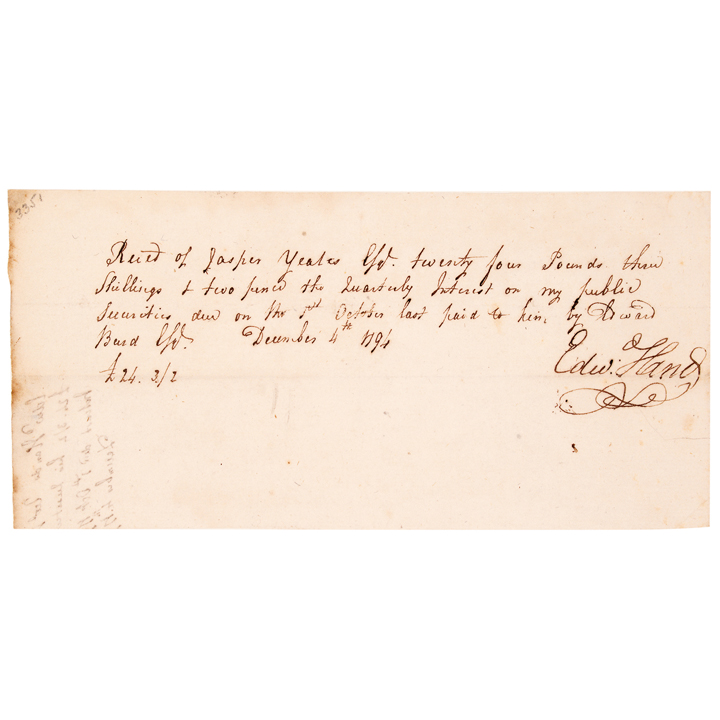
December 4, 1794 Autograph Receipt Signed by General Edward Hand, as Adjutant General of the Continental Army
|
|||||||||||
|
|||||||||||
 |
|
||||||||||
|
Lot 16:
December 4, 1794 Autograph Receipt Signed by General Edward Hand, as Adjutant General of the Continental Army
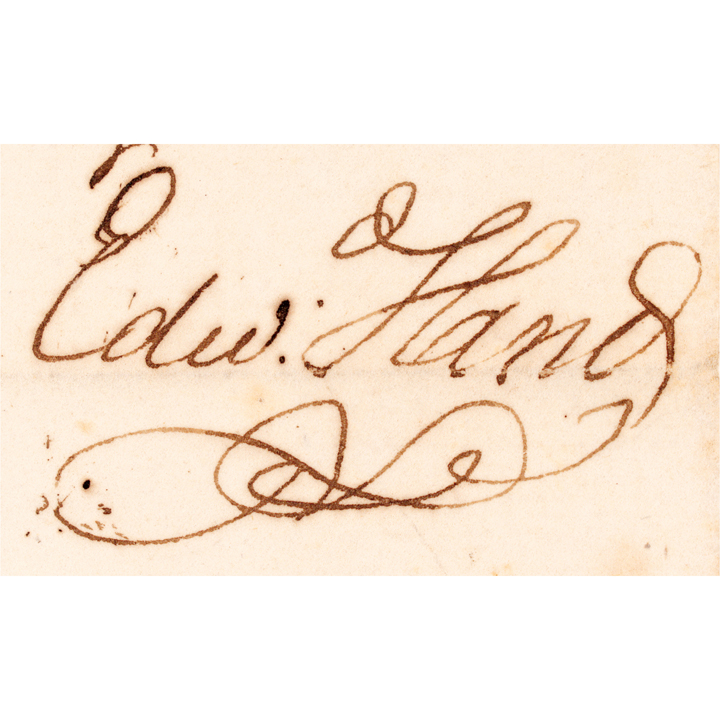
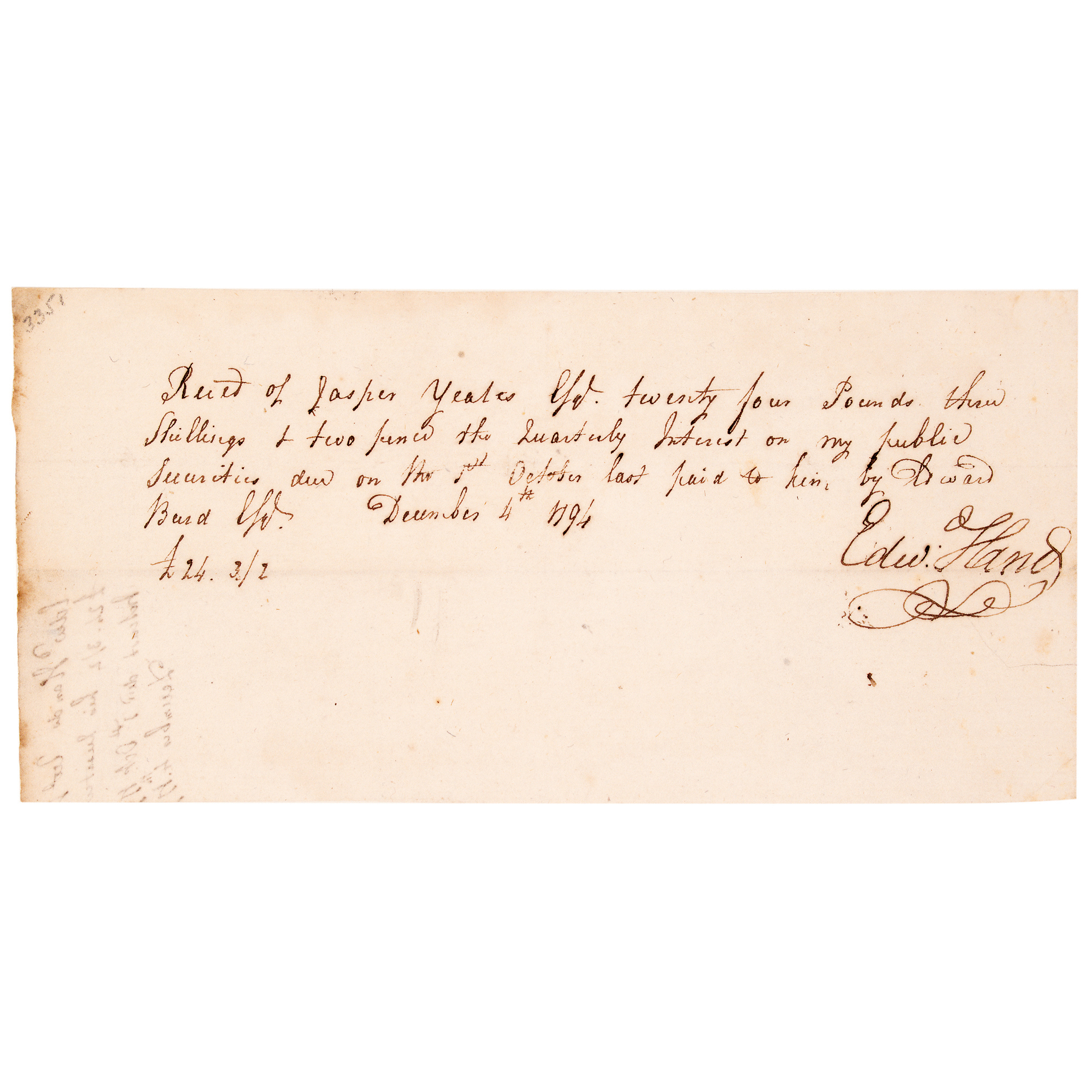
EDWARD HAND (1744-1802), Irish-born American army officer who rose to General of the Continental Army under George Washington from 1781 to 1783, was brevetted Major General; represented Pennsylvania in the Confederation Congress, and helped suppress the Whiskey Rebellion of 1794. December 4, 1794-Dated Federal Period, Autograph Document Signed, "Edw: Hand," is a Manuscript Autographed Receipt acknowledging twenty-four pounds, three shillings, and two pence being received of Jasper Yeates as the quarterly interest on Hand's public securities due to be paid the previous October, Extremely Fine. That sum mention having first been paid to Jasper Yeates (for Hand) by Edward Burd. This document measures 8.5 x 4.5 inches, is well handwritten in rich brown ink on very clean fresh appearing laid period paper. The "Public Securities" referenced here were most likely Interest-bearing federal Revolutionary War debt issued under the funding program of Alexander Hamilton that Congress enacted in 1790. In 1794 General Edward Hand helped suppress the Whiskey Rebellion of the same year. This document reads, in full: “Recd of Jasper Yeates Esqr. twenty four Pounds three Shillings & two pence the Quarterly Interest on my public Securities due on the 1st October last paid to him, by Edward Burd Esqr. -- December 4th 1794 --- (Signed) Edw : Hand” --- Docket on the blank reverse reads, in full: “Edwd Hands Recd L24 3/2 his Quarter Interest due 1st Oct last 17(93) December 4th 17(94)” Edward Hand (1744-1802), an Irish-born physician who settled in Lancaster, Pennsylvania, rose through the Continental Army from lieutenant colonel of a Pennsylvania rifle battalion to Adjutant General under George Washington from 1781 to 1783, seeing service at Boston, Long Island, Trenton, and the Siege of Yorktown before his brevet to Major General in 1783. He went on to represent Pennsylvania in the Confederation Congress, and in the same year as this receipt, in 1794 helped suppress the Whiskey Rebellion. 1794 also marked Hand's move with his family to Rock Ford, the Lancaster County, Pennsylvania estate that remains his best-known memorial to this day. Jasper Yeates (1745-1817), was a prominent Pennsylvania Jurist who sat on the state's Supreme Court, he was Hand's Uncle by marriage, his sister Sarah Yeates having married Hand's father-in-law, Captain John Ewing. EDWARD HAND (1744-1802) was an Irish-born physician who came to America in 1774 as a British army surgeon's mate, then resigned to join the Continental cause. He was promoted to brigadier general in March 1777 and commanded Fort Pitt, fighting British loyalists and their Native American allies, and in early 1778 led an expedition into the Ohio country. He later became Adjutant General of the Continental Army, serving in that role during the siege of Yorktown, and was brevetted Major General in September 1783 before resigning from active duty that November. After the war Hand returned to Lancaster, Pennsylvania, and reentered public life. He was a Delegate to the Confederation Congress in 1783 and 1784, and other sources place his service through 1785. He represented Pennsylvania in the Congress of the Confederation during the mid-1780s, taking part in debates over national authority, finance, and interstate cooperation. He also held a string of other civic posts, Chief Burgess of Lancaster, Presidential Elector, and a seat in the Pennsylvania General Assembly, followed by a Delegate role at the state's 1790 Constitutional Convention. Hand's Confederation Congress work is technically separate from the 1794 Whiskey Rebellion, since that came several years after the Confederation period ended with the Constitution's ratification, but the same man was involved in both. The rebel leaders fled before the army arrived, and there was no real confrontation. By mid-November the militia had arrested about 150 people, including 20 prominent leaders of the uprising. Only 24 men were eventually charged with treason, two were convicted, and both were pardoned by President Washington. By the 1790s he was serving as Inspector of Revenue for the Department of Pennsylvania, an appointment he received in 1791 and held until 1801. When the crisis broke out, President Washington called on him again, and as Adjutant General he accompanied the army to Fort Pitt during the Whiskey Insurrection, the federal government's move to militarily suppress the uprising against Alexander Hamilton's liquor excise tax in western Pennsylvania. On August 7, 1794, Washington issued a proclamation declaring he would not let "a small portion of the United States dictate to the whole union". Roughly 13,000 militiamen were raised from Virginia, Maryland, New Jersey, and Pennsylvania. On September 19, Washington became the only sitting U.S. president to personally lead troops in the field, marching the militia west over the Alleghenies toward Bedford. After reaching Bedford in late October, Washington returned to Philadelphia and handed command to Virginia governor Henry "Light-Horse Harry" Lee, with Hamilton remaining alongside the troops. Edward Hand re-enters the as Inspector of Revenue for Pennsylvania and a former Adjutant General. He was called back into active military service by Washington and accompanied the militia to Fort Pitt during the crisis which was his last visit to the fort he'd once commanded during the American Revolution. |
|||||||||||
|
Auction Closing: Saturday, November 14th
at Noon Eastern Time • 9:00 AM Pacific Time |
|||||||||||