
|
Lot: 160 ♡
|
|||||||||||
|
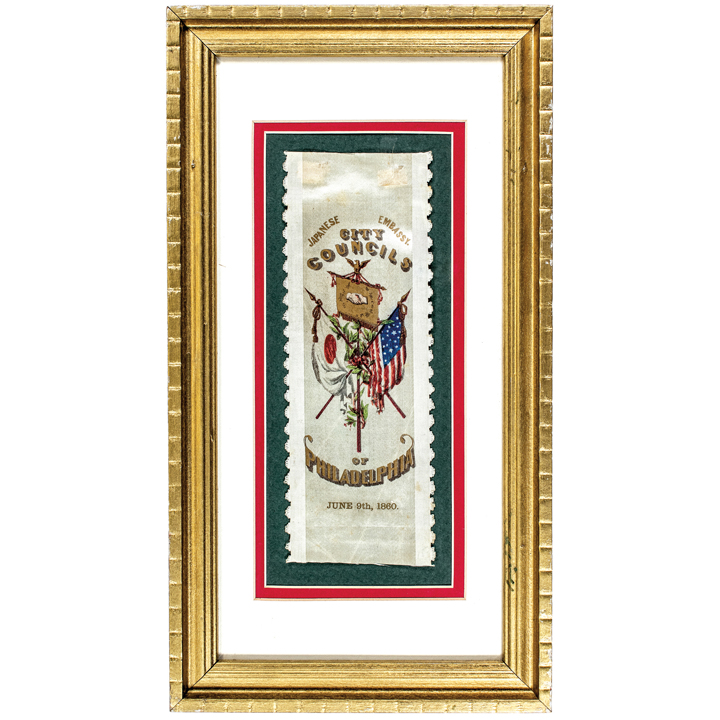
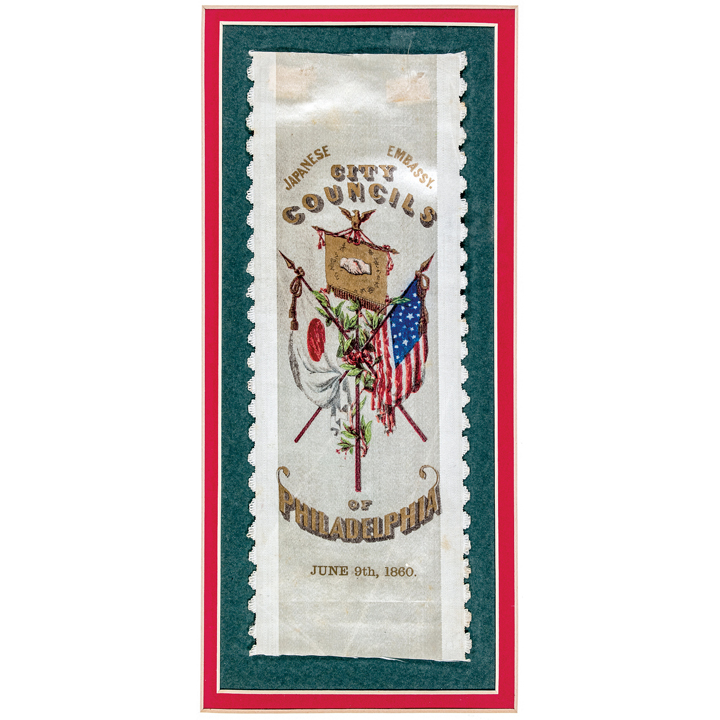
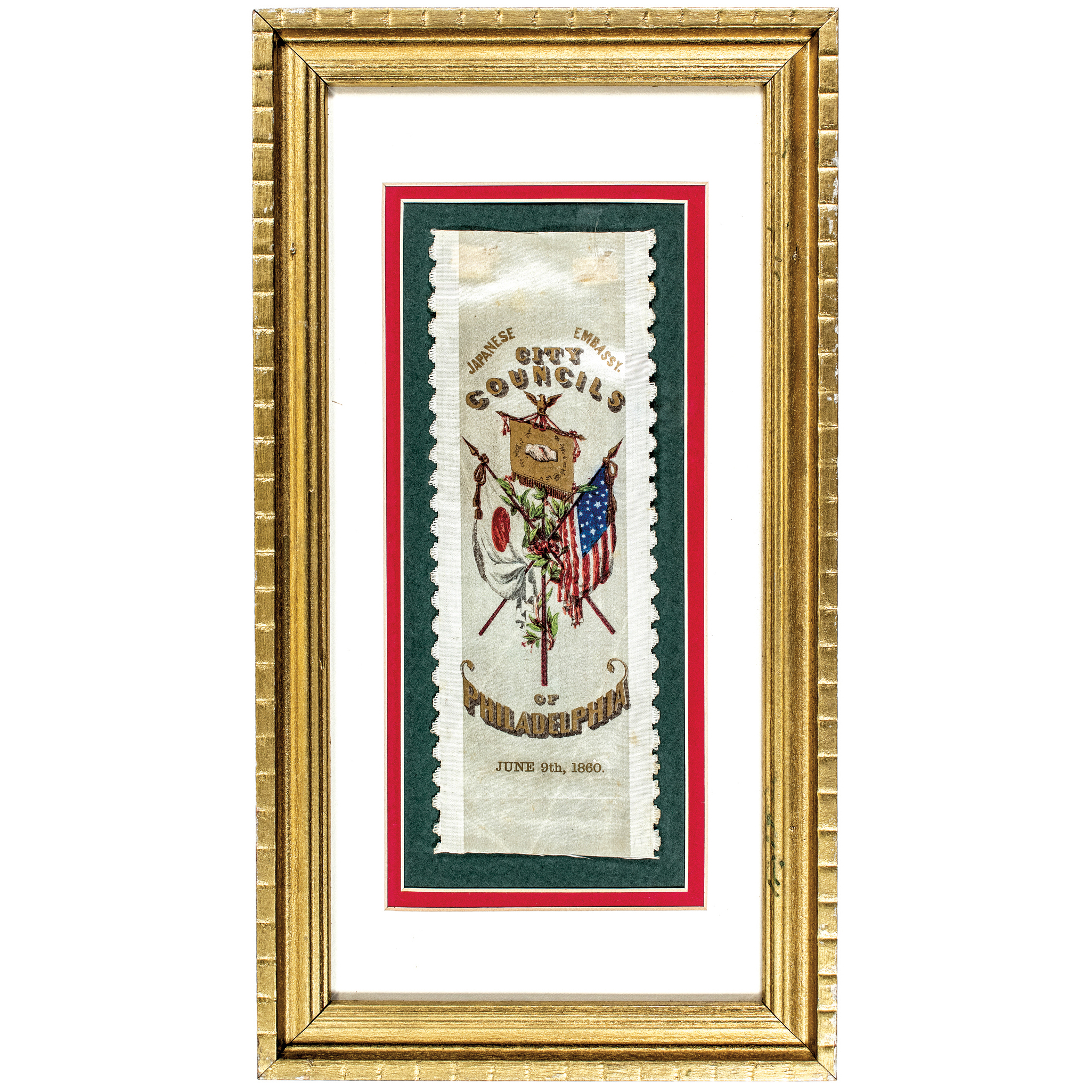
1860 Orante Color Silk Ribbon Commemorating the First Japanese Embassy to the United States by "City Councils of Philadelphia, June 9th, 1860"
|
|||||||||||
|
|||||||||||
 |
|
||||||||||
|
Lot 160:
1860 Orante Color Silk Ribbon Commemorating the First Japanese Embassy to the United States by "City Councils of Philadelphia, June 9th, 1860"
1860 Colorful Printed Silk Ribbon produced in Commemorating the First Japanese Embassy to the United States, Issued by the City Councils of Philadelphia for the Embassy's June 9, 1860 Visit, Depicting Crossed American and Japanese Flags beneath an Eagle with Banner and a Clasped-Hands friendship Emblem, Framed, Choice Extremely Fine. This fancy scalloped edge large printed Silk Ribbon, measuring 8.75 x 3 inches, fully professionally double-matted and framed to 15 x 8 inches. This silk was issued by the City Councils of Philadelphia to commemorate the June 9, 1860 visit of the First Japanese Embassy to the United States. It is decorated with arched lettering across the top reading: JAPANESE EMBASSY (above) CITY COUNCILS in larger letters; below, an American Eagle sits atop a fringed banner inscribed with Japanese characters framing a pair of clasped hands, also flanked by crossed American and Japanese flags entwined with green leaves and gold tassels. A scrolled banner beneath reads: OF PHILADELPHIA, with JUNE 9th, 1860 printed at the base. Philadelphia's reception began June 9, 1860, when Mayor Alexander Henry and the City Councils led the delegation in procession to the newly opened Continental Hotel; the visit, which continued for several days, also included a tour of the Philadelphia Mint and, by local tradition, the first recorded game of Japanese shogi played in the United States. An example of this same ribbon is held today in the McAllister Collection at the Library Company of Philadelphia. The Japanese Embassy of 1860 was dispatched by the Tokugawa Shogunate to formally ratify the Treaty of Amity and Commerce, or Harris Treaty, signed with the United States two years earlier, and stands as the first diplomatic mission Japan ever sent abroad. After landing in San Francisco and crossing Panama by rail, the delegation reached Washington in mid-May for an audience with President Buchanan before touring the country's major cities. Souvenir ribbons, medals, envelopes, and prints were produced in quantity across the cities the embassy visited, and material specifically tied to the 1860 Japanese Embassy tour forms a recognized collecting category bridging American historical ephemera and early U.S.-Japan relations. The chief Japanese envoys were Ambassador Shinmi Masaoki, Vice-Ambassador Muragaki Norimasa, and Metsuke (inspector) Oguri Tadamasa, leading a suite of some 76 samurai and support staff who crossed the Pacific aboard the USS Powhatan, which also carried the ratified Treaty of Amity and Commerce originally signed with Townsend Harris in 1858. The delegation was escorted across the Pacific by the Kanrin Maru, the first Japanese-crewed vessel to make the crossing; among those aboard was Fukuzawa Yukichi, later one of modern Japan's most influential intellectuals and founder of Keio University. Before reaching Philadelphia, the embassy was received at the White House by President Buchanan on May 17, 1860, and later toured the country's major cities, drawing enormous public crowds; Walt Whitman witnessed the embassy's New York procession on June 16 and wrote the poem later titled "A Broadway Pageant," first published in the New York Times on June 27, 1860 and later collected in Leaves of Grass. During the Philadelphia stop, the delegation also witnessed a balloon ascension by aeronaut Thaddeus S. C. Lowe, who would go on to organize the Union Army's Balloon Corps during the Civil War, and toured the Philadelphia Mint. One young interpreter's aide on the mission, Tateishi Onojiro, nicknamed "Tommy" by the American press, became something of a celebrity during the tour and inspired a popular contemporary song, "The Tommy Polka." |
|||||||||||
|
Auction Closing: Saturday, November 14th
at Noon Eastern Time • 9:00 AM Pacific Time |
|||||||||||