
|
Lot: 163 ♡
|
|||||||||||
|
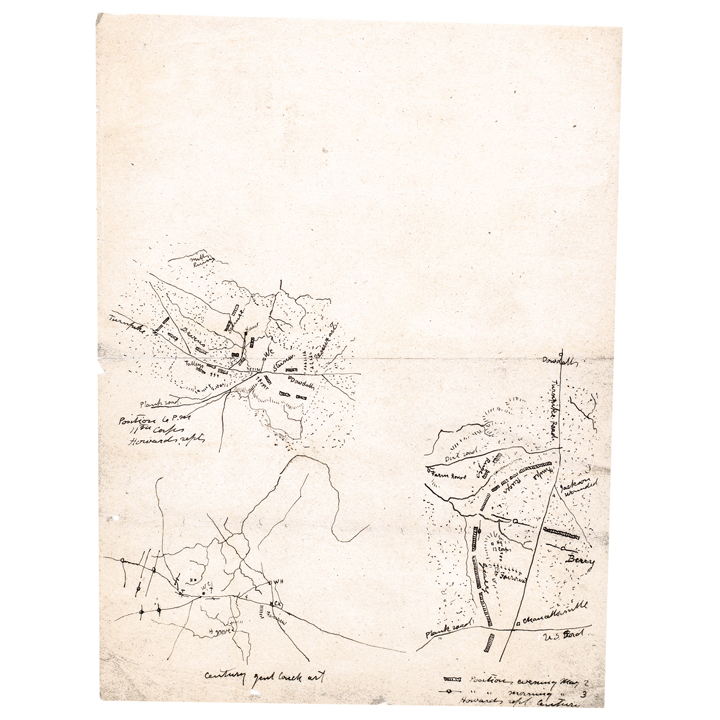
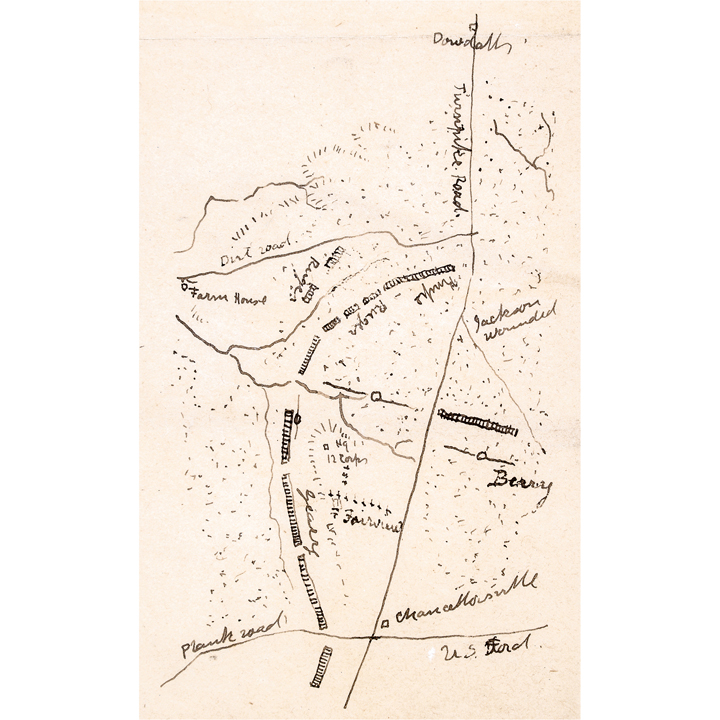
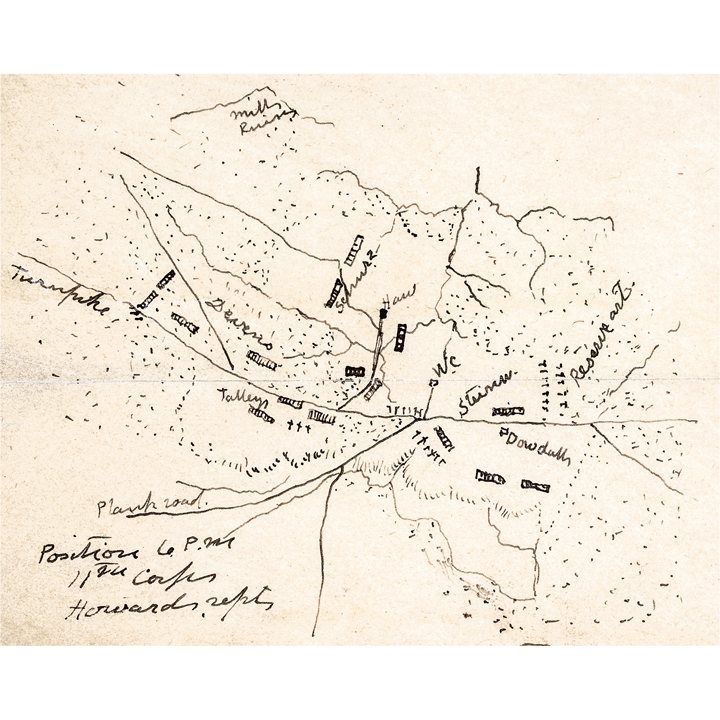
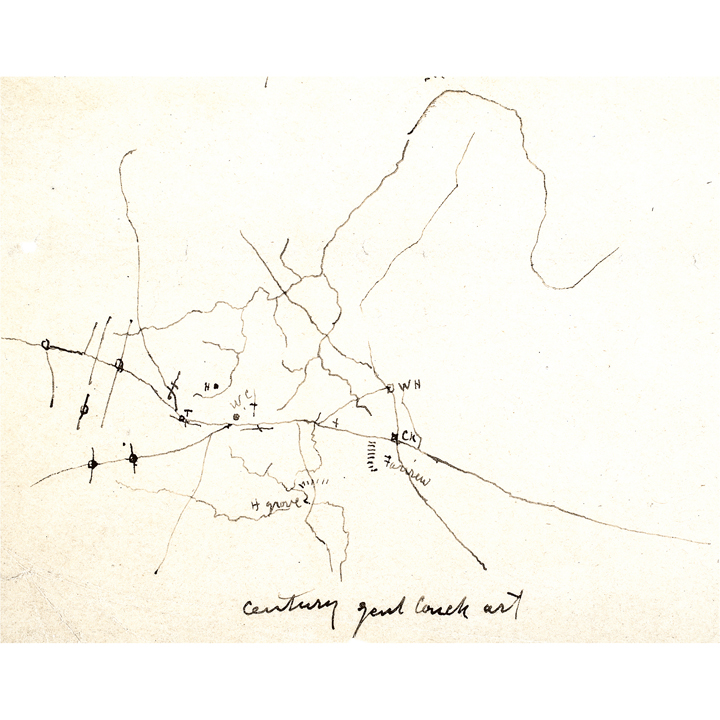
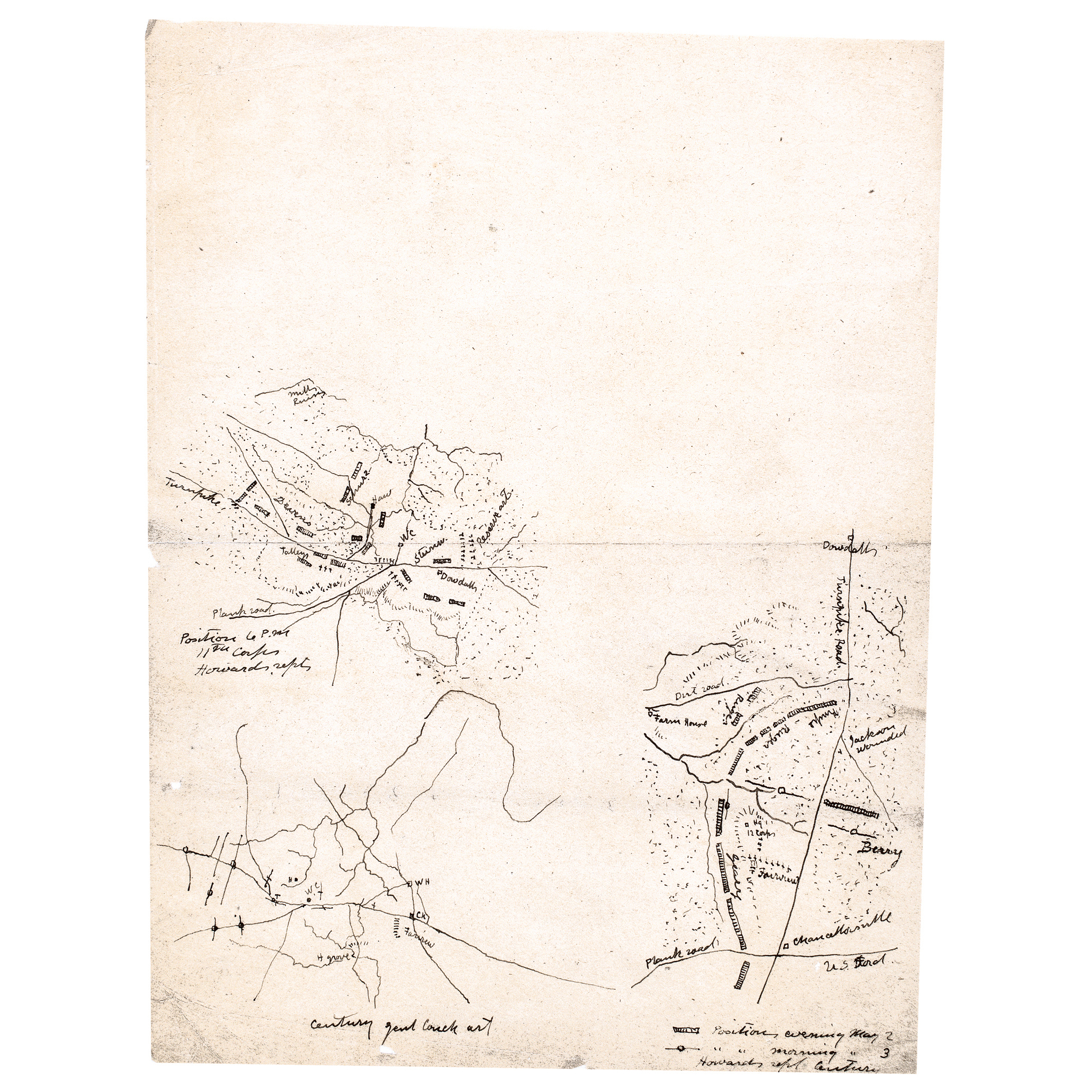
Exceptional Trio of Accurately Detailed Hand-Drawn Battle Maps of the Early Stages of the Battle of Chancellorsville
|
|||||||||||
|
|||||||||||
 |
|
||||||||||
|
Lot 163:
Exceptional Trio of Accurately Detailed Hand-Drawn Battle Maps of the Early Stages of the Battle of Chancellorsville
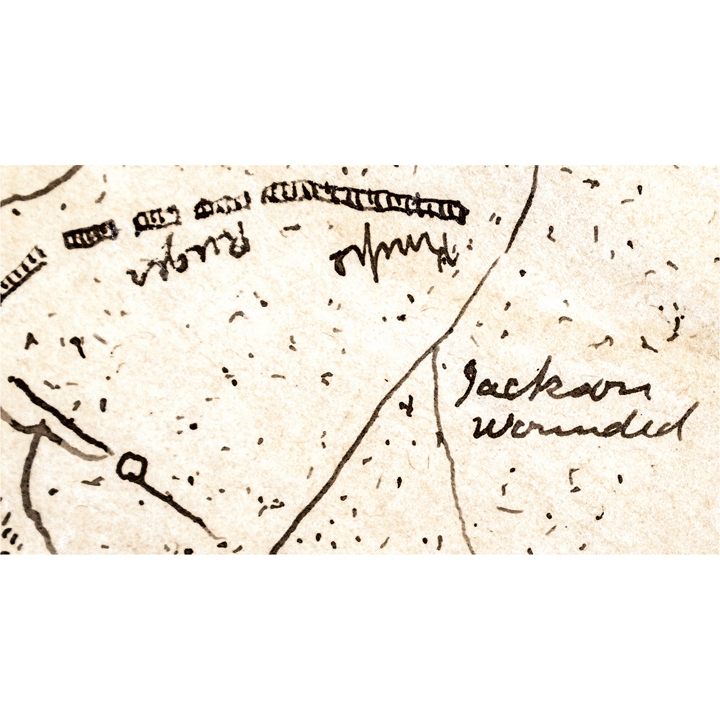
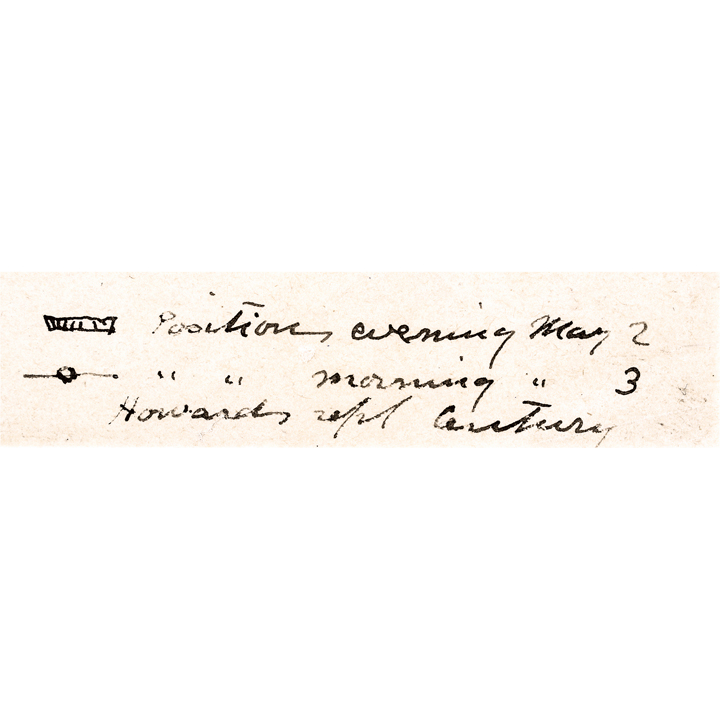
Hand-Drawn Battlefield Overview Maps of the early stages of the Battle of Chancellorsville, Virginia fought (April 30th-May 6th, 1863), also detailing where Thomas “Stonewall” Jackson was Wounded, writing “Jackson Wounded” at the spot on one map, and where the 11th Corps was stationed plus other details, drawn by Civil War Union Army Surgeon Augustus C. Hamlin (who was present), Choice Very Fine. Surgeon Augustus Hamlin of Maine, was present at the Battle of Chancellorsville as the Medical Director of the Union army Eleventh Corps. In 1896 Hamlin authored and published his book titled: "The Battle of Chancellorsville: The Attack of Stonewall Jackson and His Army...". This authentic original presentation of three small maps drawn on a single sheet of wove light tan paper measuring about 7.5” wide x 10” tall, archivally silked on its blank reverse for preservation, some light folds and trivial outer edge chipping, as shown. The fine expert penmanship of the three maps is obvious being impressively executed and extremely sharp in detail, all hand-drawn in deep brown ink. Union Army surgeon and later author Augustus C. Hamlin, created these maps illustrating his firsthand knowledge and detailed research of the battle, himself having been present with the 11th Corps. Hamlin’s apparent reason for creating these maps was to provide a more accurate historical record of the battle, including comparison to other’s recollection, meant to set the record straight on the events in the early stages of the Battle of Chancellorsville. Referencing: (Chancellorsville, VA), (April 30-May 6, 1863). The first map is their position at 6 p.m. on May 3, according to General Oliver O. Howard's official report, filed with Major General Joseph Hooker on May 13, 1863, showing the position of the 11th Corps. Stating: “Position 6 PM 11th Corps / Howards regt”. The second map is drawn based on another map that was presented in an article by Union General Darius N. Couch, commander of the 2nd Corps. The third map is comparing their positions on the evening of May 2nd and the morning of May 3rd, which is based on a map in General Oliver O. Howard's authored article titled: "The Eleventh Corps at Gettysburg." which took place in early July. In his quest to get the correct facts related to the assault on the Union 11th Corps by Stonewall Jackson's Second Corps, Hamlin consulted with both Union and Confederate officers and soldiers, visited the battlefield three times, and sketched and revised maps. In the preface to his published 1896 account, Hamlin wrote, "All accessible maps, official and unofficial, relating to the territory, have been consulted, and with their aid, strengthened with new surveys, a series of new maps had been constructed, showing the position of the various bodies of troops at brief intervals of time, to demonstrate the correctness of the narrative." In his published book Hamlin included a series of nine colored maps, detailing positions during short intervals of time from the evening of May 2, 1863, basing those maps on the research evident in the currently offered maps. Of historical note, for decades after the Battle of Chancellorsville, the 11th Corps of the Army of the Potomac bore the brunt of the blame for the Union Army's failure to trap and destroy Confederate General Robert E. Lee's much smaller Army of Northern Virginia. With Union units primarily composed largely of New York, Pennsylvania, and Ohio regiments made of large numbers of German and other Central European immigrants, the 11th Corps was led by Major General Oliver O. Howard, who had recently replaced Franz Sigel. Nearly a third of the corps had never seen any actual field combat action. It secured the right flank of the Army of the Potomac on May 1, 1863, a few miles west of Chancellorsville, Virginia. In a bold gamble, Robert E. Lee divided his Confederate army in the face of a superior force, and he sent General Thomas "Stonewall" Jackson's Second Corps with 28,000 men to be marching west behind the main Confederate force, to attack the Union Army's right flank. Although he was the overall Union Commander, General Joseph Hooker instructed O.O. Howard to defend against any attack from the west, but he failed to do so as neither officers believed the Confederates could attack through the dense woods to the west. Jackson's forces attacked around 5:30 p.m. on May 2nd, and what happened next became the subject of controversy for decades. Some of the Union regiments, including the 75th Ohio and Major General Carl Schurz's division, quickly reoriented to face the Confederate attack and resisted for twenty minutes before the overwhelming strength of the Confederate assault forced them to retreat. The Union corps lost about one quarter of its soldiers, including 12 of 32 regimental commanders, as they resisted the Confederate attack. The Union rout might have been worse, but General Jackson rode forward to survey the possibility of a night attack under the timely full moon. As he and his staff officers returned to their lines, Confederates from the 18th North Carolina Infantry mistook them for Union cavalry and fired into the group. General Thomas “Stonewall” Jackson was wounded three times, and his left arm had to be amputated. While recovering from his wounds, Jackson developed pneumonia and died after the battle had concluded on May 10th. His wounding having effectively ended the Confederate attack. The battle continued the next day, as the Army of Northern Virginia forced the Army of the Potomac to retreat toward the Rappahannock River. Union forces under General John Sedgwick drove Confederate defenders away from nearby Fredericksburg but failed to rejoin Hooker's main force. By May 6th, General Hooker had withdrawn over the Rappahannock river. Robert E. Lee savored his greatest victory, but with the loss of 22% of his army which he could not easily or timely replace. In the 1890s, Surgeon Augustus Hamlin of Maine, who was present at the Battle of Chancellorsville as the Medical Director of the Eleventh Corps, decided to set the record straight and defend them against what he considered unjust criticism. In 1893, he published his own lengthy account of Stonewall Jackson's attack on May 2nd at Chancellorsville in “The National Tribune”. Hamlin published in installments of his story between June 22nd and August 10th, that written account being an early version of his 1896 published book titled: "The Battle of Chancellorsville: The Attack of Stonewall Jackson and His Army..." Augustus Choate Hamlin (1829-1905) was born in Maine and graduated from Bowdoin College in 1851 and from Harvard Medical School in 1855. After spending a year in Europe, he established a medical practice in Bangor, Maine. Hamlin served in the Union Army during the entire Civil War, first as an assistant surgeon with the 2nd Maine Infantry, then as a brigade surgeon from April 1862, and as a medical inspector from February 1863. He was haunted by reports that he fled from the 2nd Maine Infantry when it came under fire at the First Battle of Bull Run in the summer of 1861, but spent decades denying it. He later served as medical director under General Franz Siegel in northern Virginia. Hamlin was the nephew of Vice President Hannibal Hamlin. After the war, he resumed his medical practice in Bangor and twice served as mayor. In 1866, he wrote and illustrated "Martyria; or Andersonville Prison" about the notorious Confederate prison in Georgia. In 1896, he published "The Battle of Chancellorsville: The Attack of Stonewall Jackson and His Army..." in defense of Major General Howard's Eleventh Corps. |
|||||||||||
|
Auction Closing: Saturday, November 14th
at Noon Eastern Time • 9:00 AM Pacific Time |
|||||||||||