
|
Lot: 169 ♡
|
|||||||||||
|
November 25, 1862 Autograph Letter Signed Aboard the U.S.S "Louisiana" off Washington, N.C., Reporting Ironclad Plating and Officer Fitness to Rear Admiral Samuel P. Lee a Virginian loyal to the Union and Cousin of Robert E. Lee
|
|||||||||||
|
|||||||||||
 |
|
||||||||||
|
Lot 169:
November 25, 1862 Autograph Letter Signed Aboard the U.S.S "Louisiana" off Washington, N.C., Reporting Ironclad Plating and Officer Fitness to Rear Admiral Samuel P. Lee a Virginian loyal to the Union and Cousin of Robert E. Lee
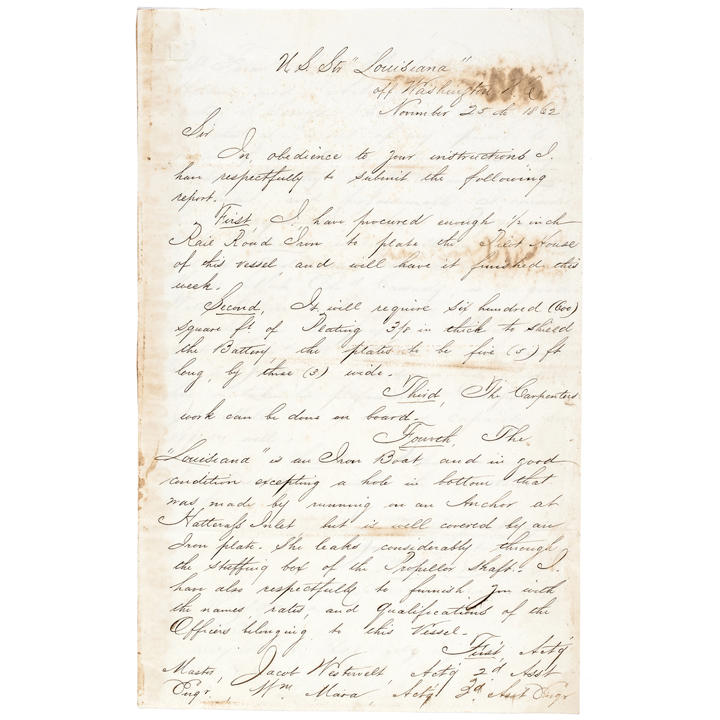
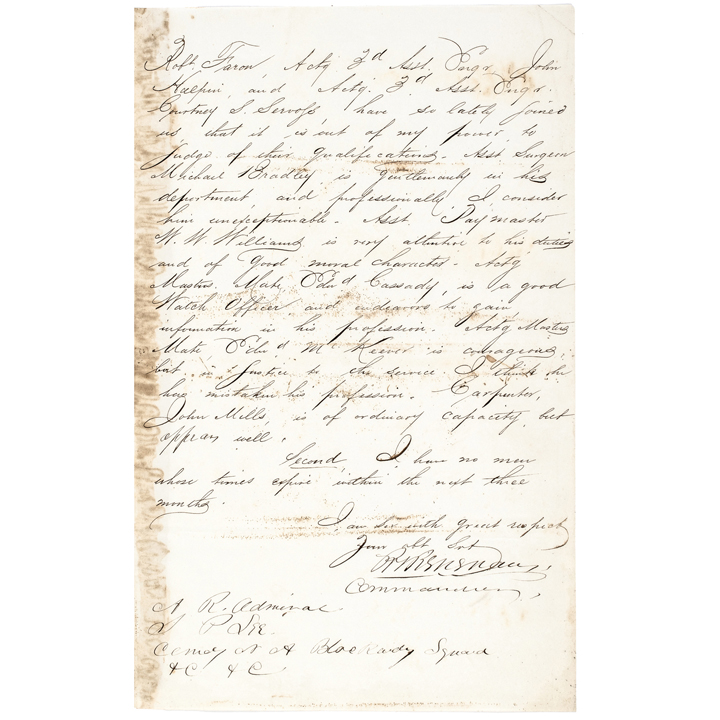
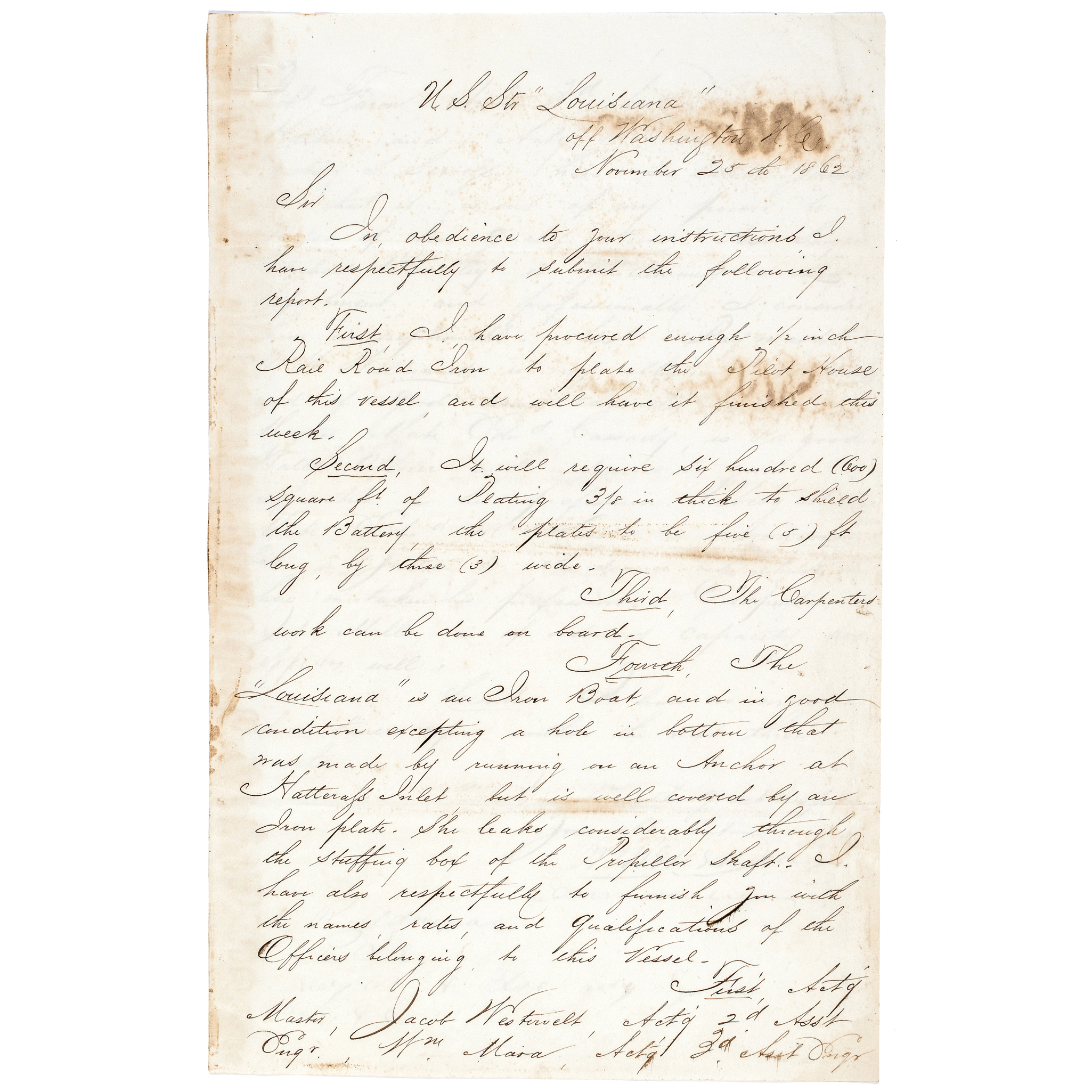
November 25th, 1862-Dated Civil War Naval Letter, U.S. Str. "Louisiana" off Washington, N.C., Reporting Railroad Iron Plating of the Vessel and Officer Fitness Evaluations to Rear Admiral Samuel Phillips Lee, North Atlantic Blockading Squadron, Two Pages, Fine. This Manuscript Letter is Signed, “Alexander Murray Commanding” (1816-1884), measuring 12.5 x 8 inches and bound together as two pages, is written on thin Vellum paper, with some humidity ink spread, written aboard the U.S. Str. "Louisiana," off Washington, North Carolina, and dated November 25th, 1862, addressed to Rear Admiral Samuel Phillips Lee, commanding the North Atlantic Blockading Squadron. This letter is a formal officer's report, submitted in response to Lee's standing instructions, covering both the vessel's material readiness and the character and competence of her officers. The U.S. Steamer Louisiana (a screw steamer in the North Atlantic Blockading Squadron) was commanded in early-to-mid 1862 by Lieutenant Alexander Murray. The bulk of the letter documents the improvised armoring of the Louisiana with salvaged railroad iron, a practice widely used by both Union and Confederate forces during the war when purpose-built armor plate was scarce or unavailable, most famously aboard the Confederate ironclad CSS Arkansas. The commander reports on iron already procured for the pilot house and plans for further plating to shield the vessel's battery, along with a candid account of existing damage, including a patched hull breach sustained running onto an anchor at Hatteras Inlet and an ongoing leak at the propeller shaft. This kind of running material report was essential to blockade squadron logistics, allowing a squadron commander like Lee to track the operational readiness of the many small gunboats under his command along the treacherous, shoal-filled waters of the North Carolina sounds. The letter's second portion offers individualized assessments of the Louisiana's officers, from her acting assistant engineers and surgeon to her paymaster, watch officers, and carpenter, the kind of routine but historically valuable personnel evaluation that shaped promotion and assignment decisions within the wartime Navy. The Louisiana herself went on to a dramatic end, deliberately packed with explosives and detonated as a "powder boat" in the Union's failed December 1864 attempt to destroy Fort Fisher, one of the more unusual episodes of Civil War naval history. This letter documents the vessel two years earlier, in the midst of the grinding, unglamorous blockade and riverine service that made up the great majority of her wartime record. This letters full transcript along with its naval history is located in the Online auction version at: www.EarlyAmerican.com This Letters Full Transcript Reads: “U.S. Str. "Louisiana" off Washington N.C. - November 25th 1862 Sir --- In obedience to your instructions I have respectfully to submit the following report. First. I have procured enough 1/2 inch Rail Road Iron to plate the Pilot House of this vessel, and will have it finished this week. Second. It will require six hundred (600) square ft of Plating 3/8 in thick to shield the Battery, the plates to be five (5) ft long, by three (3) wide. Third. The Carpenters work can be done on board. Fourth. The "Louisiana" is an Iron Boat, and in good condition excepting a hole in bottom that was made by running on an Anchor at Hatteras Inlet, but is well covered by an Iron plate. She leaks considerably through the Stuffing box of the Propeller Shaft. I have also respectfully to furnish you with the names, rates, and Qualifications of the Officers belonging to this Vessel. First. Actg Master, Jacob Westervelt, Actg 2d Asst Engr, Wm Mara, Actg 3d Asst Engr, Robt Farrow, Actg 3d Asst Engr, John Halpin, and Actg 3d Asst Engr Courtney S. Servoss, have so lately joined us that it is out of my power to judge of their qualifications. Asst Surgeon Michael Bradley is gentlemanly in his department, and professionally I consider him unexceptionable. Asst Paymaster M. W. Williams is very attentive to his duties and of good moral character. Actg Masters Mate Edw'd Cassady, is a good Watch Officer and endeavors to gain information in his profession. Actg Masters Mate Edw'd McKeever is courageous, but in justice to the service I think he has mistaken his profession. Carpenter, John Mills, is of ordinary capacity, but appears well. Second. I have no men whose times expire within the next three months. I am Sir with great respect -- Your obt Svt (Signed) Alexander Murray, Commanding (To) R. Admiral S. P. Lee (Note: In September 1862 (commissioned effective September 4), Secretary of the Navy Gideon Welles selected Lee, notably passing over other, more senior officers, to command the newly organized North Atlantic Blockading Squadron, with the rank of Acting Rear Admiral. Comdg N.(orth) A.(tlantic) Blockading Squadron, &c &c The U.S. Steamer Louisiana (a screw steamer in the North Atlantic Blockading Squadron) was commanded in early-to-mid 1862 by Lieutenant Alexander Murray. Louisiana was one of the "90-day gunboats" a screw steamer commissioned in 1861, assigned to the North Atlantic Blockading Squadron under Flag Officer Louis M. Goldsborough. Lieutenant A. (Alexander) Murray commanded her through the major North Carolina operations of early 1862: Battle of Roanoke Island (Feb. 7-8, 1862). Louisiana took part in the Union bombardment of the Confederate forts under the overall command of Flag Officer Goldsborough. Battle of Elizabeth City (Feb. 10, 1862). Commander Stephen C. Rowan led the flotilla of Union gunboats (including Louisiana) up the Pasquotank River against the Confederate "Mosquito Fleet." Rowan took fourteen Union gunboats from those at anchor off Roanoke Island, with Louisiana under Lieutenant A. Murray among them. Murray reported that Louisiana took her assigned position in the column of Union vessels and engaged the fortified works at Cobb's Point. Edenton expedition (Feb. 11, 1862). Commander Rowan sent Louisiana, along with Underwriter, Lockwood, and Commodore Perry, under Lt. Murray's command, on a reconnaissance to Edenton, North Carolina, at the western end of Albemarle Sound, to check for Confederate fortifications and, if none were found, destroy public property while sparing private property. Before the North Carolina campaign, Louisiana had operated along the Virginia coast blockading Confederate runners, engaging the CSS Patrick Henry off Newport News on September 13, 1861 alongside the Savannah, and her boats destroyed a Confederate Privateer schooner near Chincoteague Inlet on October 5. Later in 1862/1864: Louisiana remained active in the sounds of North Carolina; she is also notably remembered for a later role in December 1864 she was famously used (under a different command by then) as the explosives-laden "powder boat" in the failed attempt to breach Fort Fisher. |
|||||||||||
|
Auction Closing: Saturday, November 14th
at Noon Eastern Time • 9:00 AM Pacific Time |
|||||||||||