
|
Lot: 182 ♡
|
|||||||||||
|
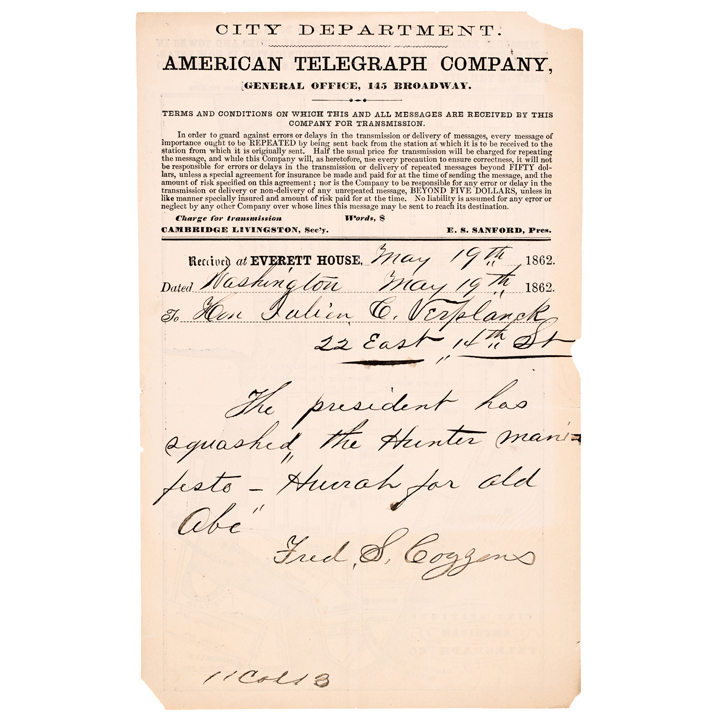
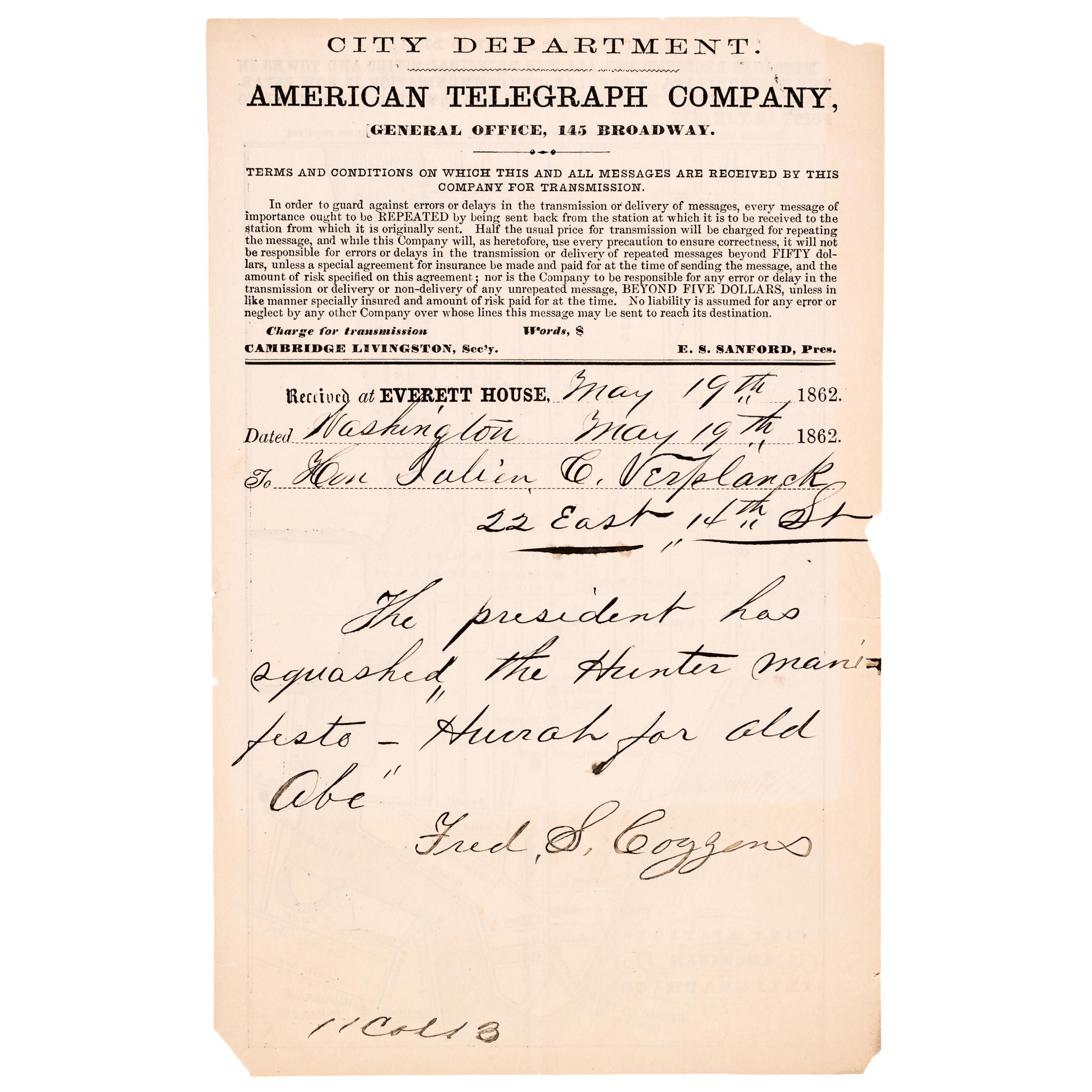
May 19th, 1862 Telegraph Message Sent “The President has squashed the Hunter manifesto. - Hurrah for old Abe” Signed Fred. S. Coggens Celebrating Abraham Lincoln on Slavery Nullified General David Hunter’s Slavery Order
|
|||||||||||
|
|||||||||||
 |
|
||||||||||
|
Lot 182:
May 19th, 1862 Telegraph Message Sent “The President has squashed the Hunter manifesto. - Hurrah for old Abe” Signed Fred. S. Coggens Celebrating Abraham Lincoln on Slavery Nullified General David Hunter’s Slavery Order
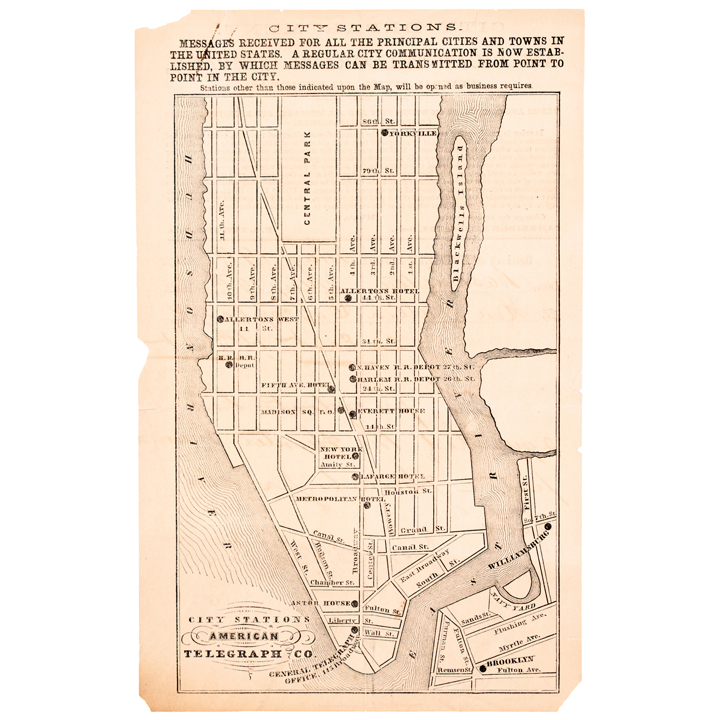
May 19th, 1862-Dated Civil War Period, Partially-Printed Document, Telegraph celebrating Abraham Lincoln's defense of Slavery, “The President has squashed the Hunter manifesto. - ‘Hurrah for old Abe”, Washington (DC), Very Fine. Emancipation and Black History and Slavery related Original Printed completed Telegraph Message Form sent with a message celebrating Abraham Lincoln’s initial “Defense of Slavery” (of a sort) in May of 1862. Historic Hand-written message on an official black printed and handwritten message on the American Telegraph Company transmittal form. It has informational text on its face side plus a period Map of Manhattan, New York printed upon its verso. This telegraph form measures 8.5” x 5.5” it being sent to a Julien C. Verplanck on May 19th 1862 from Washington (DC), having several small edge and corner tip chips in the outer marginal selvage, well away from any text and design. The Hunter "Manifesto" and Lincoln's Revocation. On May 9th, 1862, Union Army Major General David Hunter declared all of the Slaves of Florida, Georgia, and South Carolina to be “Free” from his headquarters at Hilton Head, issued as General Orders No. 11. President Lincoln thought this announcement to be premature and nullified David Hunter’s Order on May 19th, 1862. On THAT VERY SAME DAY, (American humorist) Frederick Swartout Cozzens (1818-1869) SENT THIS TELEGRAPH MESSAGE to a friend in New York with the news. It reads, in full: “The President has squashed the Hunter manifesto. - ‘Hurrah for old Abe” - (Signed) Fred. S. Cozzens" A telegram dated the very same day as Lincoln's proclamation, May 19, 1862, celebrating that "The President has squashed the Hunter manifesto" is a genuinely immediate, same-day civilian reaction to a major and controversial national event, sent by the fastest communication medium then available, make this kind of tinely artifact historically very significant. a. Apparent relief or approval (rather than the abolitionist disappointment the order also provoked) that Lincoln kept control of the emancipation question centralized in his own hands. b. Reaction to Hunter's revocation split sharply: abolitionists and Radical Republicans were frustrated that Lincoln had again quashed a general's emancipation initiative, while more moderate Unionists and conservatives, precisely the sentiment "Hurrah for old Abe" suggests many were relieved the President had reasserted a cautious, centrist course and avoided a step that might alienate the border states. c. This episode came almost exactly four months before Lincoln's preliminary Emancipation Proclamation (September 1862), making it part of the immediate political run-up in which Lincoln was visibly testing, resisting, and ultimately working toward the very policy he'd twice overruled subordinates for attempting on their own. Cozzens was probably not cheering, or acting so cheerful, just seven months later when “Old Abe” officially issued the historic “Emancipation Proclamation.” An extraordinary message, sent in extraordinary tines, during the American Civil War. Directly related to the struggle with the issue of American Slavery and Abraham Lincoln, who at this juncture in history, had to rescind an order to Set Slaves Free! On May 9, 1862, Major General David Hunter, commanding the Union's Department of the South (Georgia, Florida, and South Carolina) from his headquarters at Hilton Head, issued General Orders No. 11. The Order declared martial law across the three-state department and, in a single sweeping sentence, proclaimed that "the persons in these three States... heretofore held as slaves, are therefore declared forever free," reasoning that "Slavery and martial law in a free country are altogether incompatible." It was the boldest Unilateral Emancipation act by any Union commander to that point in the war, going well beyond the more limited "contraband of war" policies then in use. Ten days later, on May 19, 1862, President Lincoln issued Proclamation No. 90, publicly voiding Hunter's order. Lincoln stated plainly that the federal government "had no knowledge, information, or belief, of an intention on the part of General Hunter to issue such a proclamation," and declared that neither Hunter "nor any other commander, or person, has been authorized by the Government of the United States, to make proclamations declaring the slaves of any State free." He reserved the Emancipation question explicitly for himself as Commander-in-Chief, writing that whether such power existed and when it might become "a necessity indispensable to the maintenance of the government" were "questions which, under my responsibility, I reserve to myself." Lincoln then used the moment to again press slaveholding border states to consider his own preferred path... gradual, compensated Emancipation, which Congress had endorsed by joint resolution that March. This was not Lincoln's first such reversal: he had revoked General John C. Fremont's similar order freeing slaves in Missouri the previous autumn (1861), for the same underlying reason fear that unilateral military emancipation would push wavering border states (Missouri, Kentucky, Maryland, Delaware) into the Confederacy, and that Congress and public opinion weren't yet ready to accept emancipation as a war aim. Historians have noted Lincoln initially hesitated even to overrule Hunter, worried European powers might otherwise conclude the Union was simply waging a war of conquest, but on May 19 he acted anyway, surprising some of his own Republican allies who supported Hunter's boldness. Frederick Swartwout Cozzens (1818-1869) was an American humorist, born in New York City. He became in early life a wine merchant, and later editor of the Wine Press. He had previously contributed humorous poems and articles to magazines, and in 1853 he issued his first volume, Prismatics, under the pen name "Richard Haywarde." Then came the Sparrowgrass Papers, his best performance, first published in The Knickerbocker, and in 1856 as a widely read volume. They dealt with the trials of a city man who undertakes to run a country home (near Yonkers), and although the humor is mild, they are still fairly readable. Three years later in 1859, he published a volume of travel sketches, Acadia; or a Sojourn among the Blue Noses. Soon after the American Civil War he failed in a business for which he had labored earnestly. |
|||||||||||
|
Auction Closing: Saturday, November 14th
at Noon Eastern Time • 9:00 AM Pacific Time |
|||||||||||