
|
Lot: 184 ♡
|
|||||||||||
|
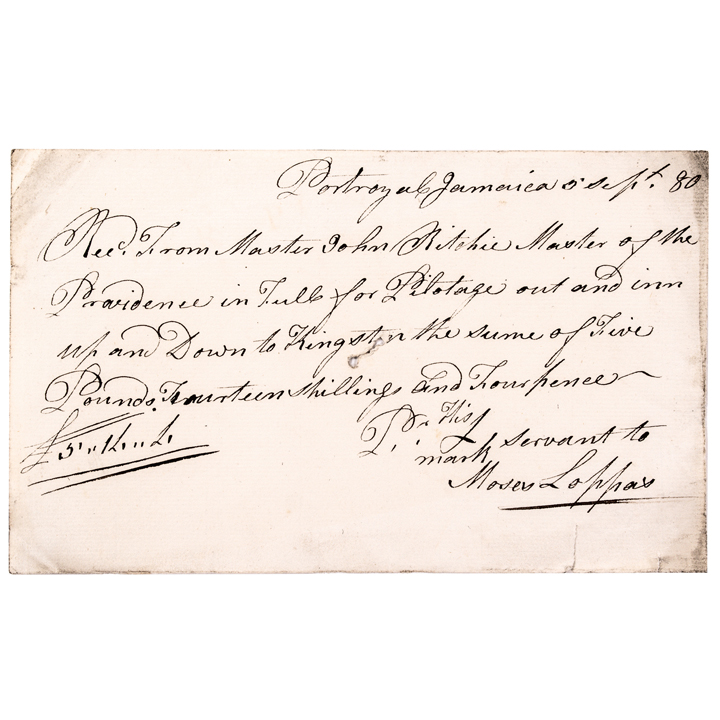
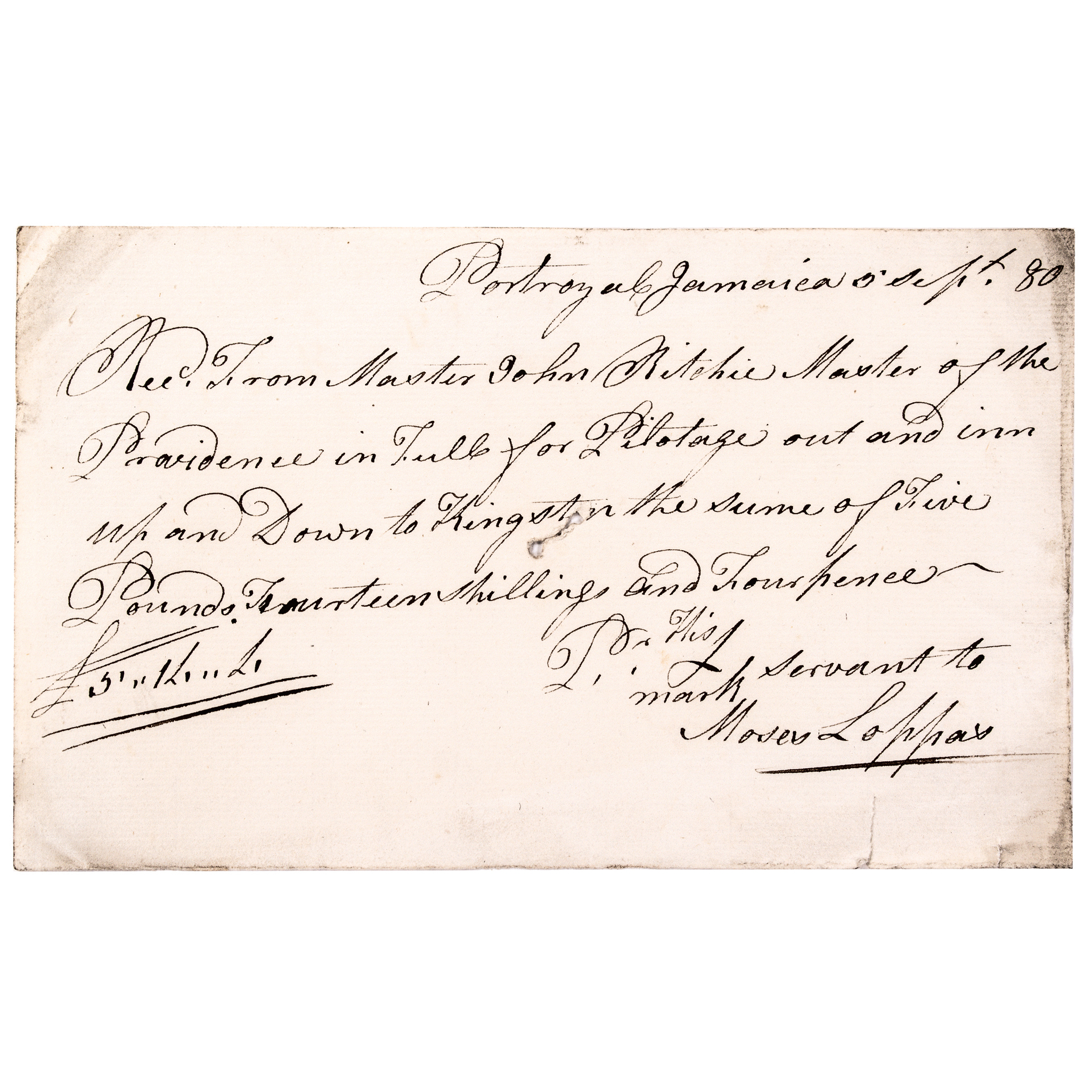
1780 Master John Ritchie, Master of the (ship) Providence Payment Receipt for a Slave’s “Pilotage” to Kingston
|
|||||||||||
|
|||||||||||
 |
|
||||||||||
|
Lot 184:
1780 Master John Ritchie, Master of the (ship) Providence Payment Receipt for a Slave’s “Pilotage” to Kingston
September 5, 1780-Dated Revolutionary War Period, Master John Ritchie, Master of the (ship) Providence, Manuscript Document Signed, Payment receipt for a Slave’s “Pilotage” to Kingston, “His X mark Servant to Moses Loppas”, Port Royal Jamaica, Choice Very Fine. This navigational/Black History related document is stating: “Recd From Master John Ritchie Master of the Providence in Full for Pilotage out of and inn up and Down to Kingston the sume of Five Pounds Fourteeen shillings and Four pence - (Signed) His X mark Servant to Moses Loppas.” “His X mark” indicates the person receiving or acknowledging the payment could not write, so a clerk or witness recorded the transaction and the person made an "X" in place of a signature, often followed by "his mark" as a notarial-style confirmation. "Servant to Moses Loppas" in 1780 Jamaica almost certainly does not mean "servant" in the modern domestic sense. In the Caribbean plantation-economy usage of this period, "servant" was frequently used euphemistically (and sometimes literally, in legal/probate language) to describe an Enslaved person who was the property of, or hired out by, their enslaver. Given the location (Port Royal/Kingston), the trade (pilotage), and the era, an Enslaved man acting as a boatman, pilot's assistant, or agent for his enslaver is the far more likely reading. An Enslaved or bonded person signing "with an X" instead of a name was standard practice for anyone who was not permitted or able to write. This was common for Enslaved boatmen, pilots' assistants, or personal servants acting on an owner's behalf when receiving or acknowledging payment. Very clean and well written in rich brown ink on laid period paper. In the 18th-century Caribbean, ships arriving from open sea often anchored at Port Royal and paid a licensed pilot to guide them the rest of the way through Kingston Harbour to the Kingston wharves. A routine, compulsory service (pilotage is still compulsory at Kingston today), and receipt or account entry for this fee is exactly the kind of routine expense that would show up among Ritchie's voyage accounts to Bayles. Pilots and their support crews at Jamaican ports very often relied on Enslaved labor, Enslaved men frequently worked as boat hands, pilots, or intermediaries who rowed out to arriving ships, guided them in, and collected fees on behalf of a free person (in this case, presumably Moses Loppas) who held legal and financial ownership of the business or of the man himself. The Enslaved individual's unnamed, unlettered mark on the receipt with his identity subsumed entirely under his enslaver's name, is unfortunately typical of how such transactions were recorded. The document record preserves the fact of the payment and the owner's name, but erases the individual's own name and voice. Sephardic merchant families in Kingston and Port Royal, including Lopez, Lindo, Bravo, and Delgado, are all documented as having engaged enslaved people in this kind of harbor/shipping work, so "Moses Loppas" being a variant rendering of the name "Lopez" remains quite plausible. There was also a Moses Lopez branch active in Jamaica's own merchant/shipping-agent community. |
|||||||||||
|
Auction Closing: Saturday, November 14th
at Noon Eastern Time • 9:00 AM Pacific Time |
|||||||||||