
|
Lot: 200 ♡
|
|||||||||||
|
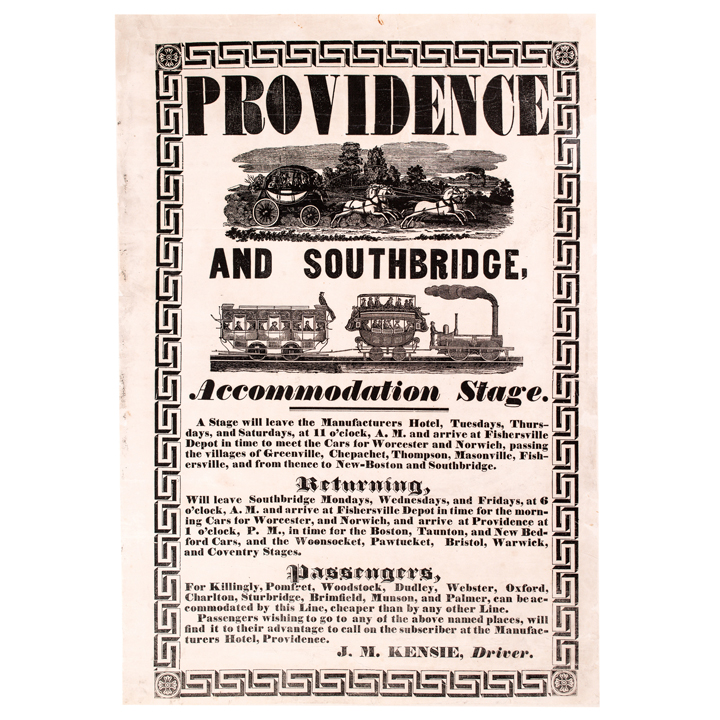
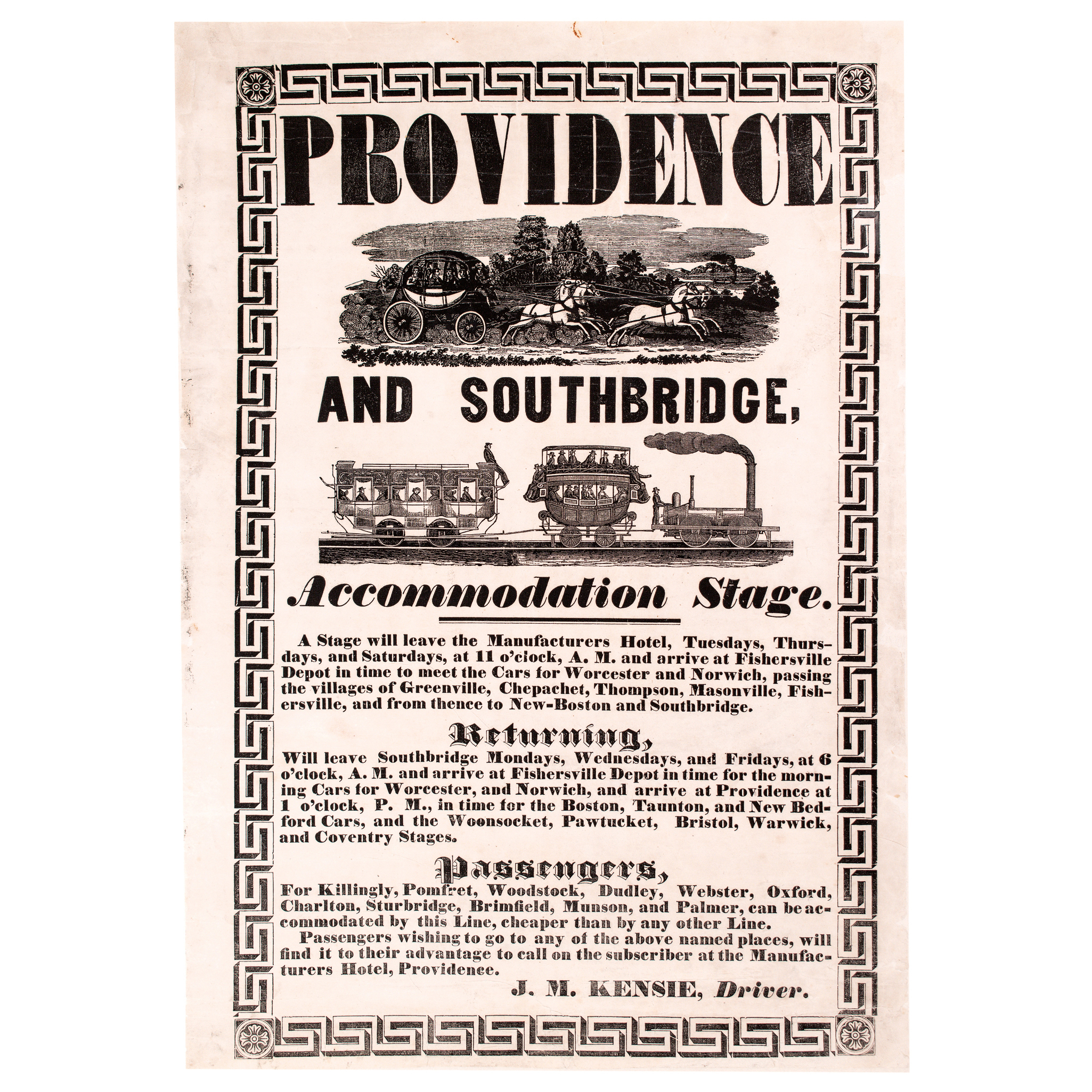
c. 1835 “Providence and Southbridge Accommodation Stage.” Illustrated 15.5” x 22” Advertising Broadside
|
|||||||||||
|
|||||||||||
 |
|
||||||||||
|
Lot 200:
c. 1835 “Providence and Southbridge Accommodation Stage.” Illustrated 15.5” x 22” Advertising Broadside
c. 1835 Illustrated Advertising Broadside for the Providence and Southbridge Accomodation Stage displaying the stagecoach’s schedule, the list of stops on its route and instructions for its passengers if they wish to travel to somewhere off-route by horse or train,Very Fine. This large size Advertising Broadside measures 15.5” x 22” mounted and conserved on archival paper backing, some light smudges at the left outer margin edges. The bold black text detailing its departure and return routes is printed inside a contiguous geometric pattern that runs around the inside of the broadside’s edge. The title, “PROVIDENCE AND SOUTHBRIDGE, Accommodation Stage.” is interspersed with two engraving-style illustrations of the Stagecoach pulled by a team of horses and two early passenger “stagecoaches” behind a period Steam Engine. It uses several different attractive fonts in its title and body texts, likely intended to draw the eye of potential customers. The stagecoach driver’s name is listed at the bottom as J. M. Kensie. Overall, this Broadside has choice eye appeal and would present well if framed for display. One other example of this stagecoach advertisement broadside is held in the collection of Old Sturbridge Village, Massachusetts. A rare large Advertising Broadside. This is a rare printed handbill advertising a regional "accommodation stage" (a local, multi-stop passenger line, as opposed to an express or mail stage) connecting Providence, Rhode Island, with Southbridge, Massachusetts. It was run by a driver named J.M. Kensie, operating out of the Manufacturers Hotel in Providence. Outbound: Departed the Manufacturers Hotel in Providence three days a week (Tuesday, Thursday, Saturday) at 11 a.m., passing through Greenville, Chepachet, Thompson, Masonville, and Fishersville before continuing on to New Boston and Southbridge. At Fishersville the stage timed its arrival to connect with the railroad cars running to Worcester and Norwich. Return: Left Southbridge on the alternating days (Monday, Wednesday, Friday) at 6 a.m., again timed to meet the morning rail cars at Fishersville, and got passengers back into Providence by 1 p.m., early enough to connect with cars bound for Boston, Taunton, and New Bedford, plus onward stages to Woonsocket, Pawtucket, Bristol, Warwick, and Coventry. The line also pitched itself as a cheap way to reach a long list of connecting towns of Killingly, Pomfret, Woodstock, Dudley, Webster, Oxford, Charlton, Sturbridge, Brimfield, Monson, and Palmer. This kind of broadside captures a very specific moment in New England transportation history during the transition period when railroads were creeping outward from hubs like Worcester and Providence, but hadn't yet reached the smaller inland mill towns. Stagecoach lines like this one survived by functioning as feeder routes, deliberately timing their runs to meet the trains at the nearest rail depot (here, Fishersville) rather than competing with rail directly. Within a decade or two, most such feeder-stage routes in this corridor were displaced as branch rail lines (like the later Southbridge Branch) pushed further into the region. New England’s highway system in 1840 was among the best in the United States, although far below the standards of such advanced countries as England and France. The best roads were in eastern Massachusetts and in the vicinity of Hartford, Providence, and other large towns. These were in good condition nearly all year except for short periods during the early spring and fall. New England’s stagecoaches, like the Accommodation Stage, were also well-regarded during this period. |
|||||||||||
|
Auction Closing: Saturday, November 14th
at Noon Eastern Time • 9:00 AM Pacific Time |
|||||||||||