
|
Lot: 220 ♡
|
|||||||||||
|
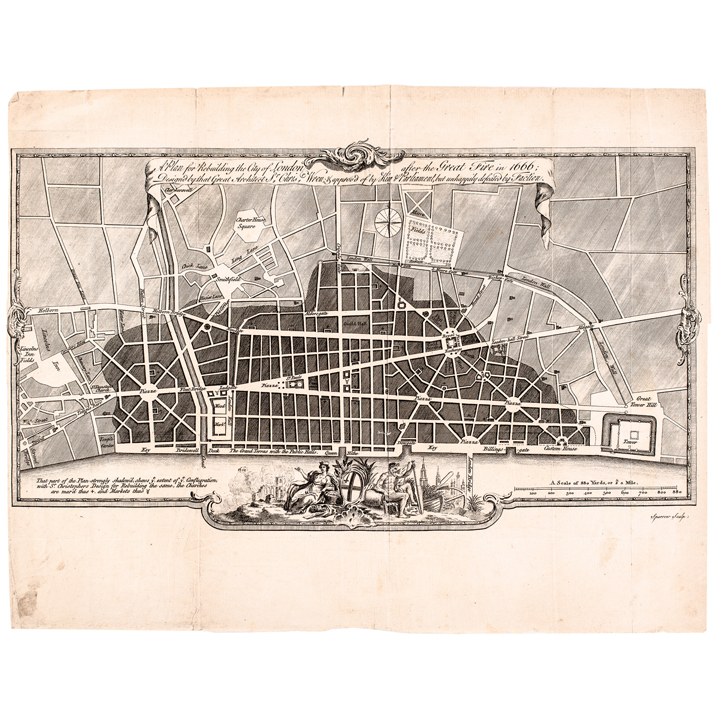
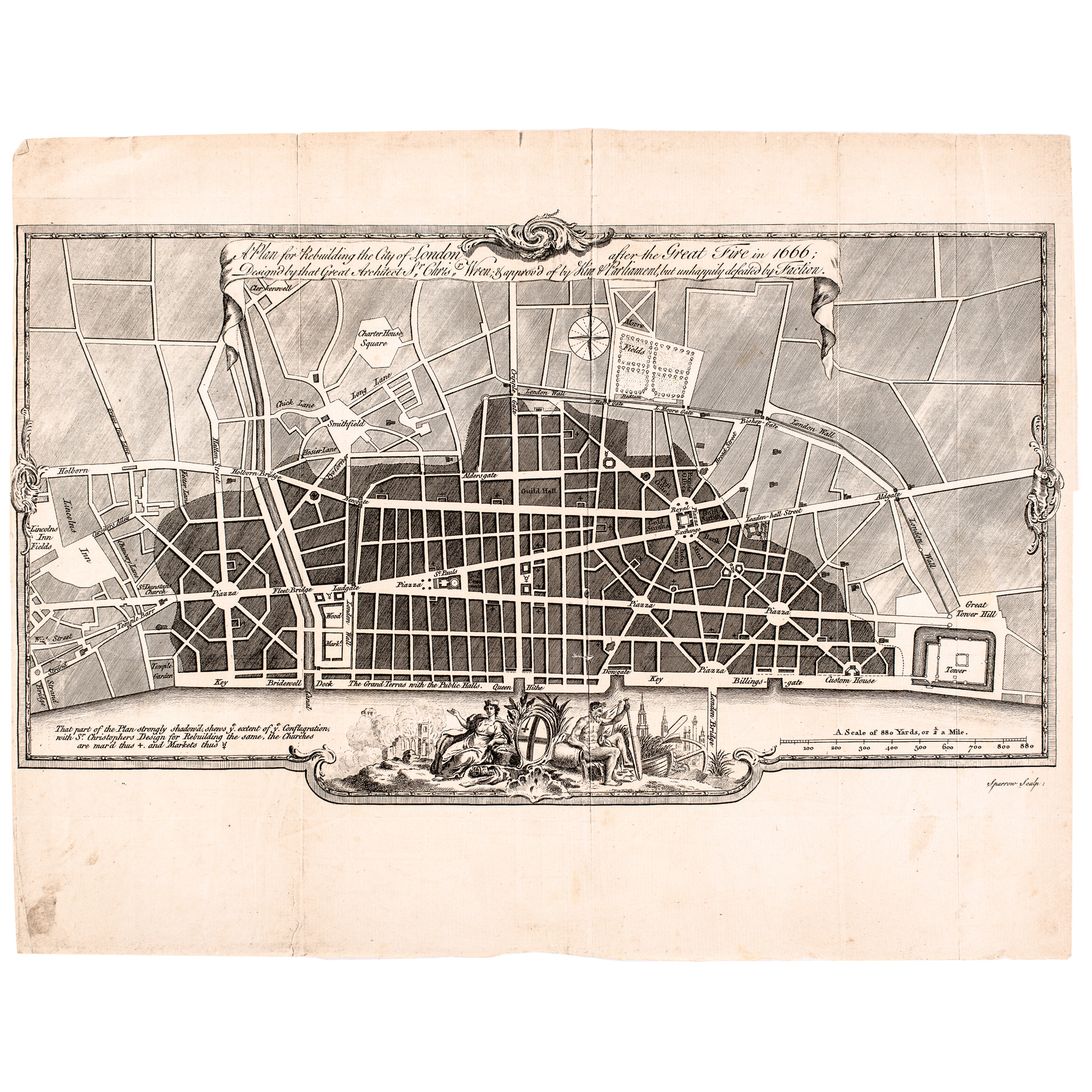
1767 Engraved Print titled "A Plan for Rebuilding the City of London after the Great Fire in 1666" with Vignette
|
|||||||||||
|
|||||||||||
 |
|
||||||||||
|
Lot 220:
1767 Engraved Print titled "A Plan for Rebuilding the City of London after the Great Fire in 1666" with Vignette
1767 Engraved Print titled, "A Plan for Rebuilding the City of London after the Great Fire in 1666," Sir Christopher Wren's Design, Engraved by Sparrow, Published in Knox's "A New Collection of Voyages," Fine. Engraved Map that measures 14.5" x 10.5" overall on period laid paper and presents Wren's complete unrealized vision for London in remarkable topographical detail, the geometric grid radiating from multiple piazzas clearly visible, with St. Paul's, the Royal Exchange, Guild Hall, the Custom House, and other significant public buildings and streets identified by name throughout, the area damaged by the Great Fire indicated by heavier shading as explained in the explanatory note at lower left: "That part of the Plan strongly shadow'd, shews ye extent of ye Conflagration, with Sr. Christopher's Design for Rebuilding the same, the Churches are mark'd thus, and Markets thus." The title is lettered within a decorative scrolled ribbon banner at the top of the sheet. At lower center is a finely engraved allegorical vignette depicting Father Thames reclining among classical figures and London landmarks, a traditional decorative convention of period London maps, with a graphic scale of 880 yards, or a quarter mile, at lower right, and the engraver's credit "Sparrow Sculp." in the lower right corner. The sheet shows overall age-consistent toning, some small edge splits reinforced with prior tape on the blank reverse, old folds, and minor edge wear, the engraved image and lettering retaining sharp clarity and with strong legibility throughout. Quite presentable for framing and display. SIR CHRISTOPHER WREN (1632-1723), the celebrated English architect and scientist, submitted his visionary plan for the complete rebuilding of the City of London to King Charles II within days of the catastrophic Great Fire of London, which raged from September 2 to September 6, 1666, and destroyed the medieval heart of the City, consuming over 13,000 houses, 87 parish churches, and the original St. Paul's Cathedral. Wren's plan called for a radical reimagining of London along baroque urban planning principles then fashionable on the Continent, featuring broad straight avenues radiating outward from major public squares and piazzas in a geometric pattern, wide processional streets connecting key civic and religious monuments, and an open quay along the riverfront, a vision of grandeur and rational order entirely at odds with the cramped, organic medieval street pattern it would have replaced. Despite the King's personal favor, Wren's plan, like the competing proposals submitted by John Evelyn and others, was ultimately rejected by the House of Commons and never implemented, defeated by the practical necessities of property rights, the urgency of rebuilding for a population in desperate need of shelter, and the political faction noted ruefully in the engraving's own title. Wren's creative energies were instead channeled into the design of the new St. Paul's Cathedral and more than fifty parish churches that would come to define London's skyline for centuries, while his rejected city plan was memorialized by subsequent generations, including his own son and grandson, as one of history's great lost opportunities in urban design, a status reflected in the print's lamenting subtitle. |
|||||||||||
|
Auction Closing: Saturday, November 14th
at Noon Eastern Time • 9:00 AM Pacific Time |
|||||||||||