
|
Lot: 27 ♡
|
|||||||||||
|
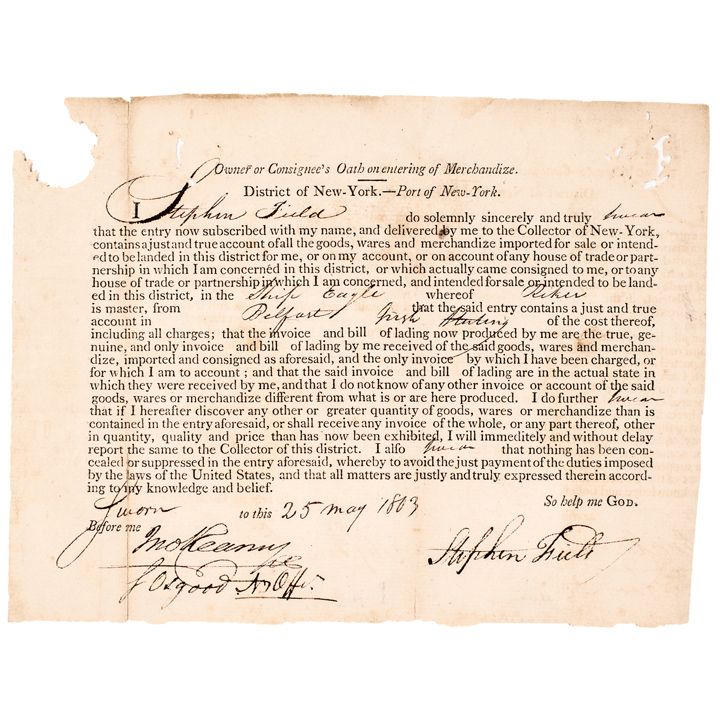
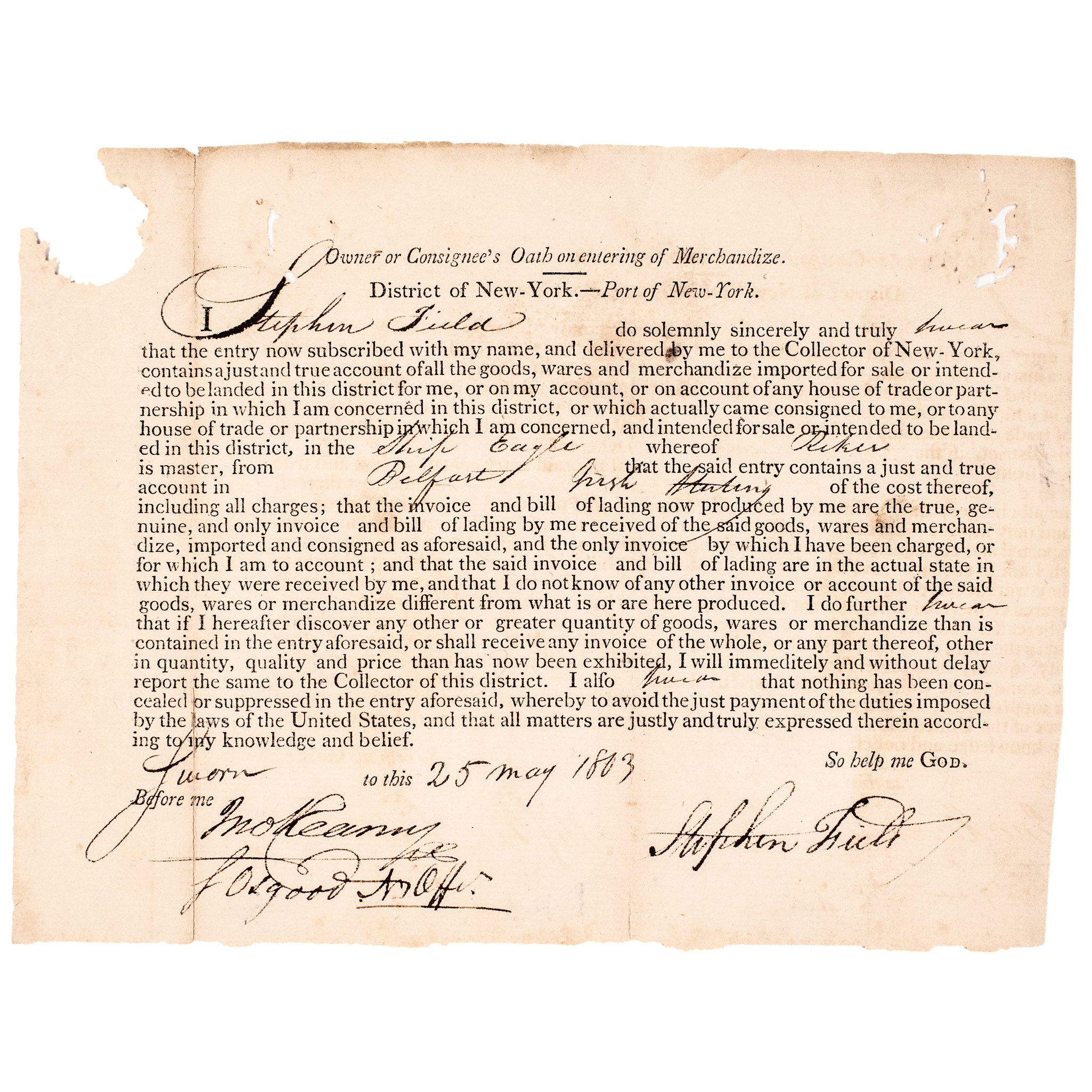
1803 Samuel Osgood Signed as witness to a Consignee's Sworn Oath entering Merchandize' in the Port of New York
|
|||||||||||
|
|||||||||||
 |
|
||||||||||
|
Lot 27:
1803 Samuel Osgood Signed as witness to a Consignee's Sworn Oath entering Merchandize' in the Port of New York
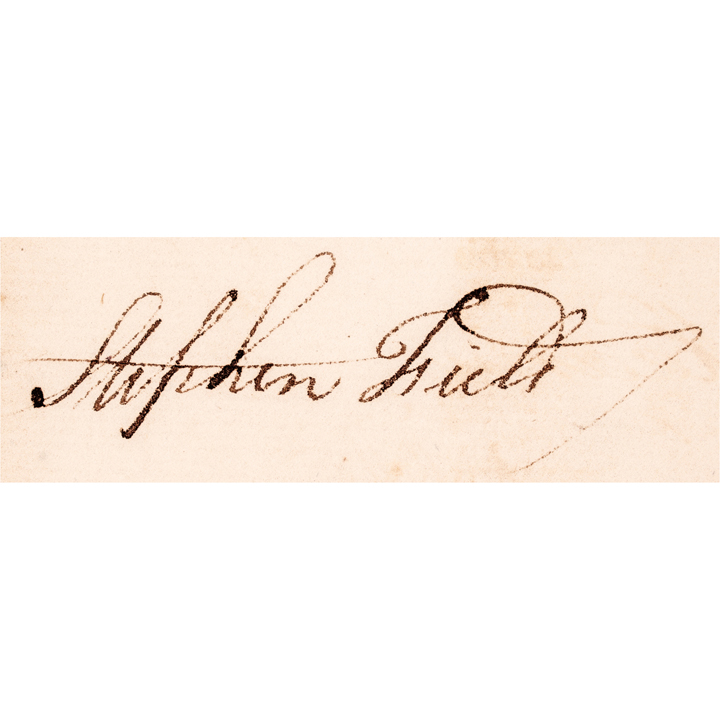
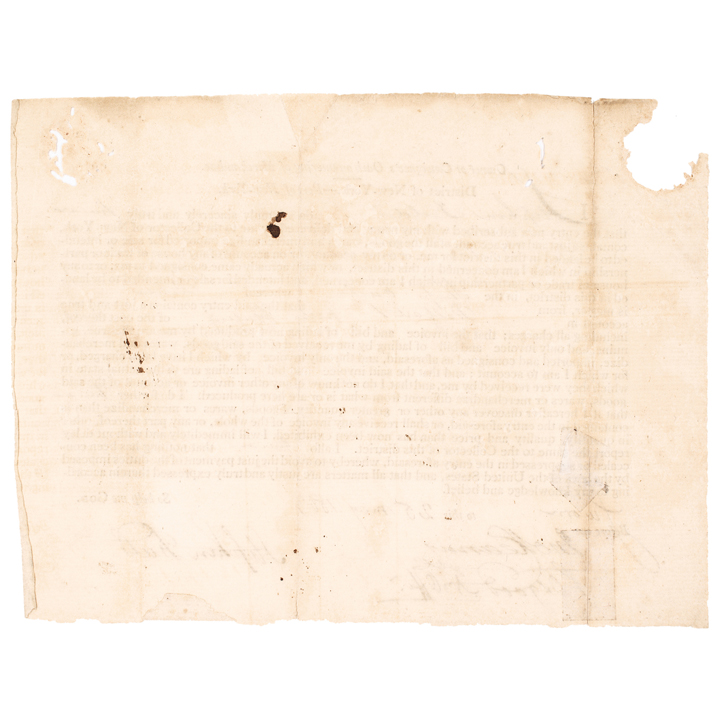
SAMUEL OSGOOD (1747-1813). Revolutionary War officer, Member of the Continental Congress, Commissioner of the Continental Treasury and Fourth Postmaster General of the United States under George Washington (Sept. 26, 1789-August 18, 1791); elected the First President of the then newly-formed City Bank of New York, which later became Citibank. May 25, 1803-Dated Federal Period, Partly-Printed Document Signed, “S. Osgood”, 1 page measuring about 6” x 7.75” (oblong 8vo.), New York, Fine. An official form for an ‘Owner or Consignee's Sworn Oath on entering Merchandise' from Belfast into the Port of New York,” this being completed and signed by Stephen Field for a shipment received aboard the ship “Eagle”. Nicely typeset printed on period laid paper with all signatures written in rich brown ink. Samuel Osgood countersigns as a witness at bottom left, along with collector of customs John Kearny. Light folds, some margin splits at left side with some insect damage to the top corners, yet in good overall condition. At the outset of the Revolutionary War, Osgood led a local company of Minutemen into the Battle of Lexington and Concord on April 19th, 1775 where they followed the retreating British, and later became part of the Siege of Boston. Osgood was born February 3, 1747, in Andover, Massachusetts Bay Colony (now North Andover). He attended Dummer Academy and Harvard College, then returned to Andover to pursue a mercantile career. He joined the local militia and was elected to the colonial assembly, then to the 1775 Provincial Congress that served as a Revolutionary government. Osgood led a company of Minutemen at the Battle of Lexington and Concord in spring 1775, was later named a brigade major, served as an aide to General Artemas Ward, and rose to colonel before leaving the Continental Army. As more local militia troops assembled, Osgood was appointed Major of a brigade while serving at Cambridge. Later he was promoted to Colonel, and served as an Aide to General Artemas Ward. From 1782 to 1784 he served as a delegate to the Continental Congress. He went on to serve in Massachusetts state government and the Continental Congress, and served in the Massachusetts State Senate and as a member of the Continental Congress. After the war, he became a director of the Bank of North America and was one of three board members overseeing the U.S. Treasury under the Articles of Confederation (as a Commissioner of the Treasury). In 1785 the National Congress made him a Commissioner of the Treasury, and in 1789 President George Washington appointed him the First Postmaster General under the newly-ratified United States Constitution. In 1812, Osgood was elected the First President of the then newly-formed City Bank of New York, which later became Citibank. Osgood continued in public service as a member of the New York State Assembly, and in 1803 President Thomas Jefferson appointed him Naval Officer of the Port of New York, a position he held until his death in 1813. This role oversaw customs/shipping duties at the Port of New York, which may be the link to the ship Eagle around New York Harbor circa 1803 as Osgood would have held this customs post during that period. This passenger ship named "Eagle" has a historical record that shows an American ship called Eagle sailing from Belfast, Ireland to New York, arriving April 6, 1803. This is that ship as stated on the form. This was a fairly common name for merchant vessels in the early Federal era, so there were likely multiple ships called Eagle operating out of American ports around that time, however this Eagle has indeed landed in New York. |
|||||||||||
|
Auction Closing: Saturday, November 14th
at Noon Eastern Time • 9:00 AM Pacific Time |
|||||||||||