
|
Lot: 42 ♡
|
|||||||||||
|
1781 Chaplain Benjamin Trumbull (1735-1820) Patriot who published “Twelve Discourses on the Divine Origin of the Holy Scriptures” and other Ecclesiastical, Writings.
|
|||||||||||
|
|||||||||||
 |
|
||||||||||
|
Lot 42:
1781 Chaplain Benjamin Trumbull (1735-1820) Patriot who published “Twelve Discourses on the Divine Origin of the Holy Scriptures” and other Ecclesiastical, Writings.
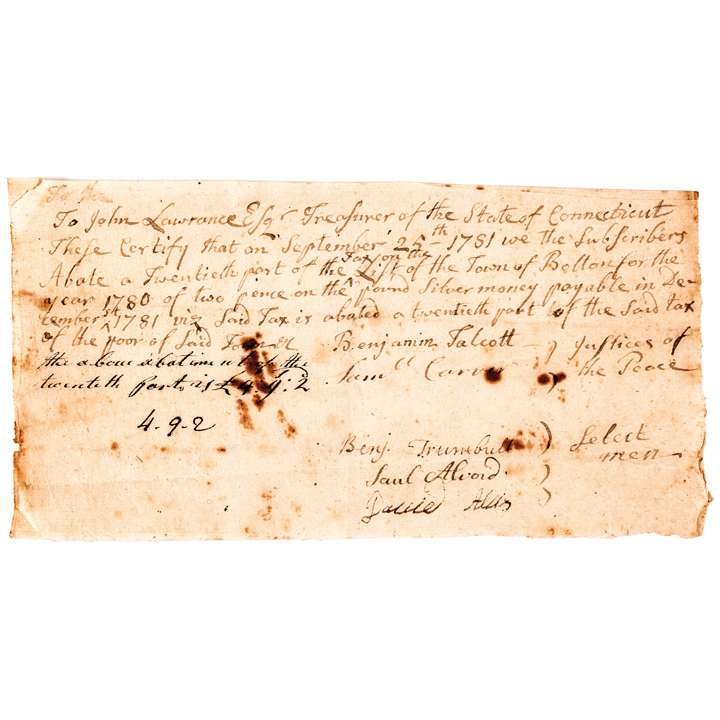
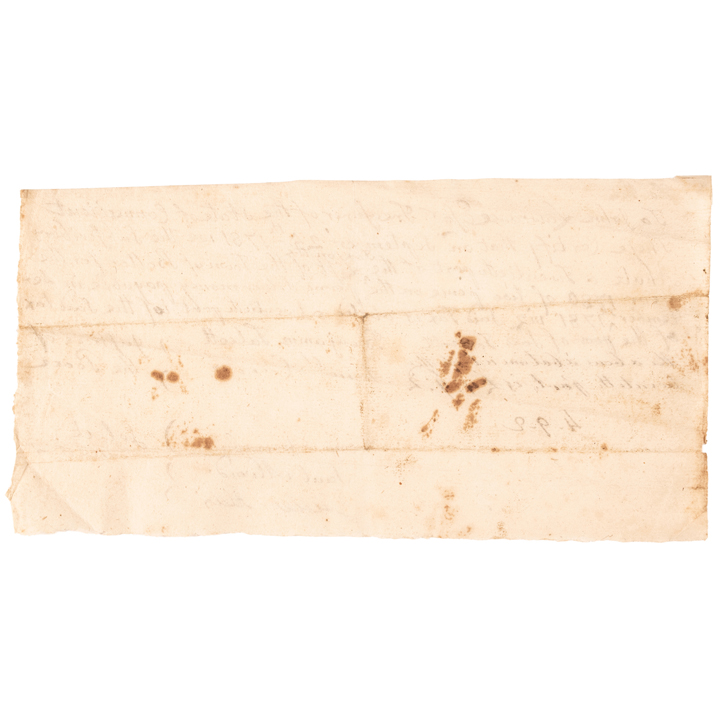
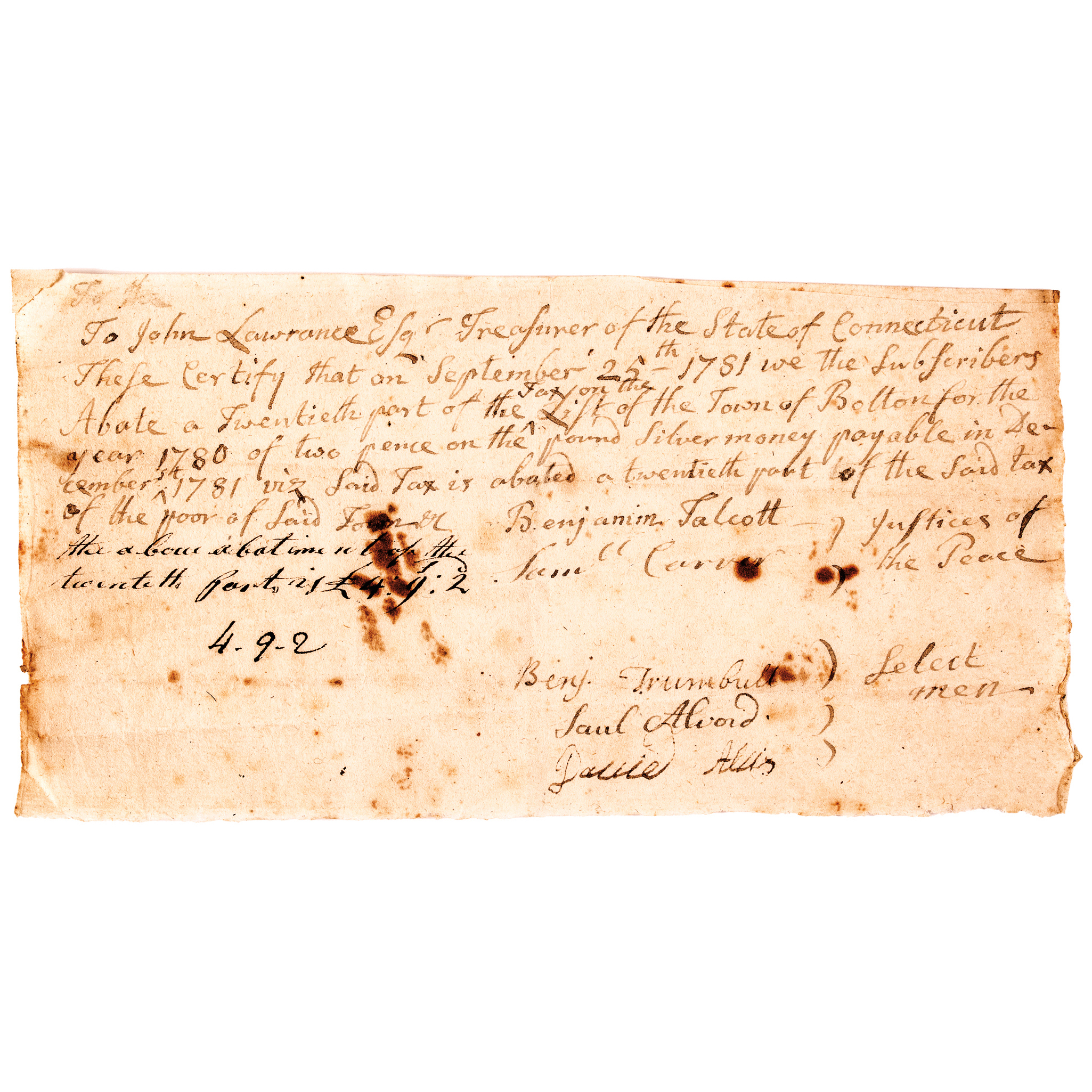
BENJAMIN TRUMBULL, (1735-1820). American Revolutionary War Period Patriot Chaplain, Preacher and Historian, who published “Twelve Discourses on the Divine Origin of the Holy Scriptures”, “A General History of the United States of America”, “A Complete History of Connecticut, Civil and Ecclesiastical, from the Emigration of Its First Planters from England, in 1630, to the Year 1764; and to the Close of the Indian Wars” and others. September 25, 1781-Dated Revolutionary War Period, Manuscript Document Signed, “Benj. Trumbull” as one of the Selectmen of Bolton, Connecticut, Fine. This original document measures about 4.25” x 8.25”, 1 page, that is easily readable written on laid period paper at Bolton, Connecticut (Incorporated in October 1720). On November 11th, 1723, Jonathan Edwards was Installed as the Pastor of Bolton. There are some scattered brown spots, one of which affects the right end of Trumbull’s signature, the reverse is blank. This Tax Abatement consists in the stated amount of, “... two pence on the Pound Silver Money ...”. Signed by two of the town’s Justices of the Peace, and three Town Select Men, including “Benj. Trumbull”. A rare “Benjamin Trumbull” signature. Benjamin Trumbull (December 1735-February 1820) was an early American historian and religious Preacher. Born in Hebron, Colony of Connecticut, Trumbull graduated from Yale in 1759, and received his theological education under Reverend Eleazer Wheelock, who delivered his ordination sermon in 1760, commending him to the people of North Haven as “not a sensual, sleepy, lazy, dumb dog, that could not bark back.” He continued in that charge for nearly sixty years, his preaching being interrupted only by the American Revolutionary War, in which he served both as a Volunteer and as Chaplain for the soldiers. After the war he published a pamphlet sustaining the claim of Connecticut to the Susquehanna purchase, which influenced the decision of Congress in her favor. Yale gave him the Degree of D.D. (Doctor of Divinity) in 1796. He published Twelve Discourses on the Divine Origin of the Holy Scriptures (Hartford: Hudson and Goodwin, 1790); A General History of the United States of America; from the Discovery, in 1492, to 1792, ... that was intended to be three volumes, but he lived only to complete the first, Vol. I: Exhibiting a General View of the Principal Events, from the Discovery of North America, to the Year 1765 (New York: Williams & Whiting, 1810); and A Complete History of Connecticut, Civil and Ecclesiastical, from the Emigration of Its First Planters from England, in MDCXXX, to MDCCXIII (Hartford: Hudson & Goodwin, 1797). Later, Trumbull expanded in a second edition to “A Complete History of Connecticut, Civil and Ecclesiastical, from the Emigration of Its First Planters from England” in 1630, to the Year 1764; and to the Close of the Indian Wars (New Haven, CT: Maltby, Goldsmith, & Co. and Samuel Wadsworth, 1818). The manuscript collections from which this history is compiled are in the Yale library. His grandson, Lyman Trumbull, was a U.S. Senator from Illinois. Trumbull was elected a Member of the American Antiquarian Society in 1814. AAS holds original copies of over 40 titles related to, or authored by Trumbull, as well as the manuscript of his General History of the United States. He died in North Haven, Connecticut. Originally part of the town of Hartford, the area was referred to as Hartford Mountains or Hanover, until incorporation in October 1720. On November 11th, 1723, Jonathan Edwards was installed as the Pastor of Bolton. Bolton was known for its high quality schist stone in the 18th century, and many tombstone carvers such as Gershom Bartlett and Jonathan Loomis sourced their stone from Bolton quarries. Bolton was removed from Hartford County when Tolland County was originally formed on October 13th, 1785. The northern half of Bolton was set aside in 1808 to form the town of Vernon. Quarries played a significant role in the area's developing economy, and Bolton Notch became the location of the small community of Quarryville. Prior to the railroad, granite was taken by oxcart to the Connecticut River where it was then shipped to major cities on the East Coast. The Bolton historical society has been actively purchasing sites throughout the town in their effort to preserve the town's history and rural character. The most recent of these purchases was Rose's Farm, a several hundred-acre site where the Comte de Rochambeau camped with his troops during the American Revolutionary War. |
|||||||||||
|
Auction Closing: Saturday, November 14th
at Noon Eastern Time • 9:00 AM Pacific Time |
|||||||||||