
|
Lot: 54 ♡
|
|||||||||||
|
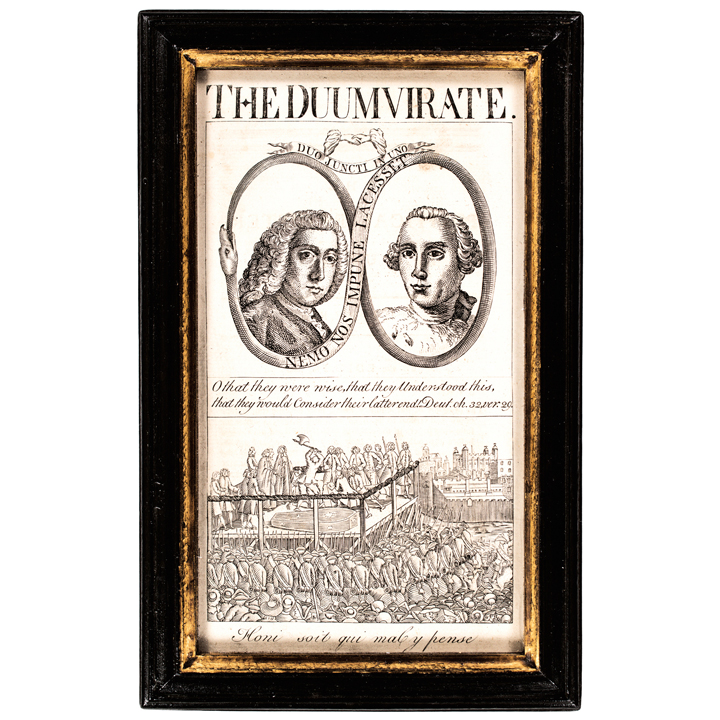
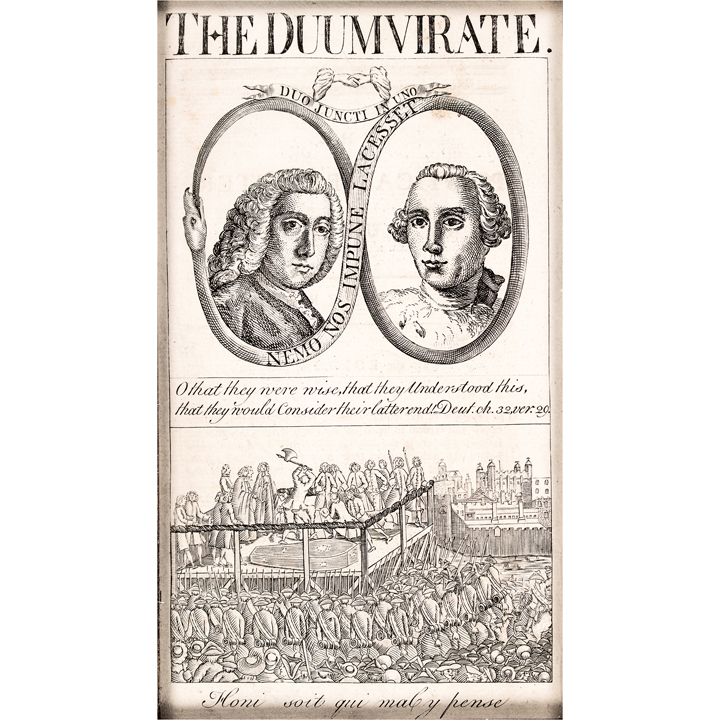
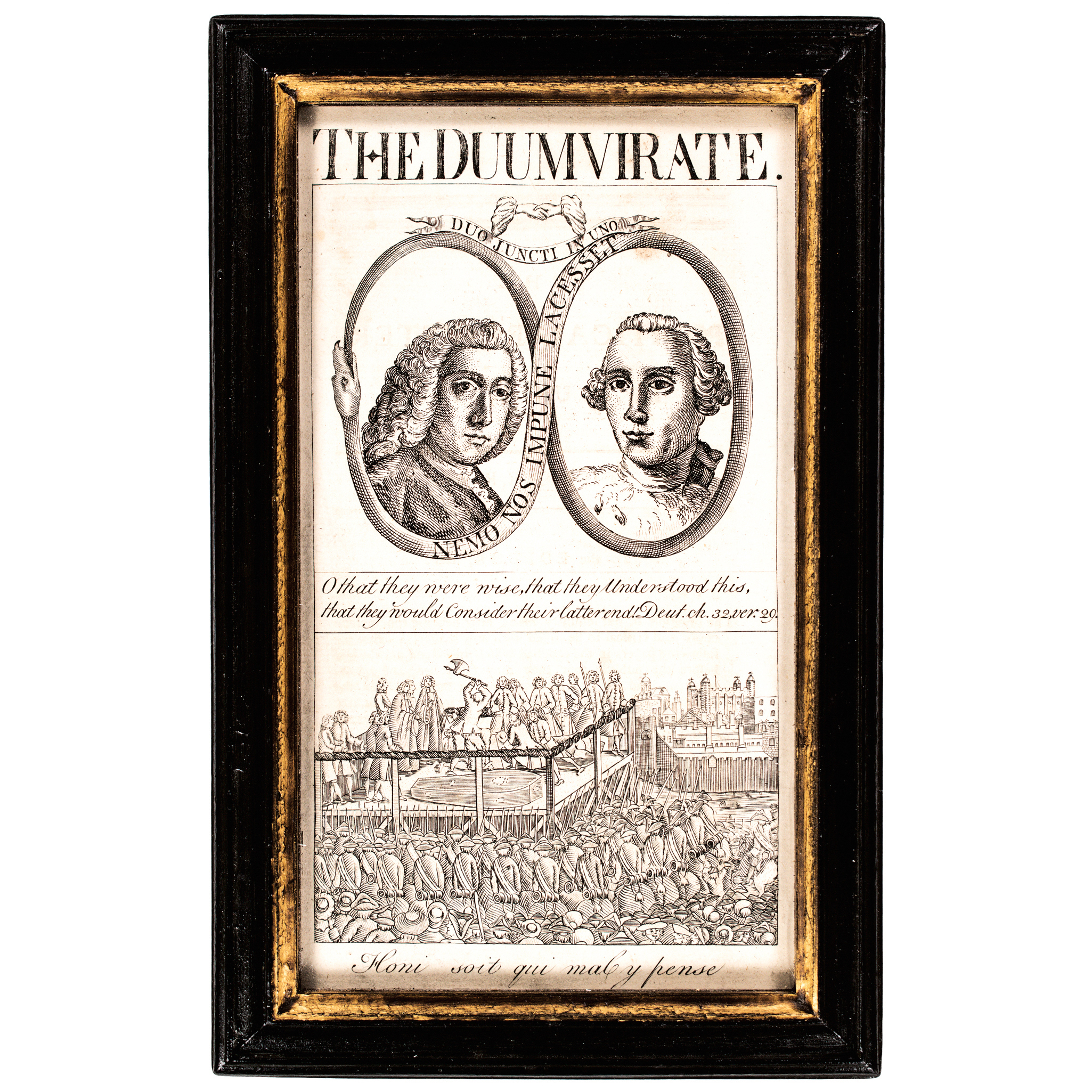
1766 British Beheading Satirical Engraving titled "The Duumvirate." William Pitt Earl of Chatham and Earl of Bute
|
|||||||||||
|
|||||||||||
 |
|
||||||||||
|
Lot 54:
1766 British Beheading Satirical Engraving titled "The Duumvirate." William Pitt Earl of Chatham and Earl of Bute
(1766) Copper-Plate Beheading Scene Engraving titled, "The Duumvirate." Depicting Head Portraits of William Pitt, Newly Created Earl of Chatham, and the Earl of Bute, within Intertwined Oval Frames Inscribed "Duo Juncti in Uno" and "Nemo Nos Impune Lacesset," England, Framed, Choice Very Fine. This rare graphic Beheading Scene engraving, measures 7.75 x 4.25 inches (by sight) and is “Perry Hopf” framed to 9.25 x 6 inches, published 1767 in “The Political Register” London. The large header is titled “THE DUUMVIRATE.” and depicts head-and-shoulders portraits of two men within a pair of intertwined oval frames formed like linked serpents, a clasped-hands device and banner reading DUO JUNCTI IN UNO ("two joined in one") above, and the motto NEMO NOS IMPUNE LACESSET encircling the ovals. Beneath the portraits, a biblical caption reads, "O that they were wise, that they understood this, that they would Consider their latter end! Deut. ch. 32, ver. 29." Below that, a second scene depicts a coffin borne on a platform through a crowd of onlookers and armed guards, a fortified building resembling the Tower of London visible in the background, captioned at the foot, "Honi soit qui mal y pense." (a French motto meaning roughly "Shame on him who thinks evil of it" or "evil be to him who thinks evil of it.") The print depicts William Pitt, newly created Earl of Chatham, and John Stuart, 3rd Earl of Bute, and is dated to August 1766 or shortly after. Pitt's elevation to the peerage in that year, forming a new ministry, was widely seen by contemporaries as a political decline, removing him from the House of Commons where his popularity and influence were strongest, and his ministry was dogged by suspicion that it remained secretly directed by Bute, George III's deeply unpopular former favorite and briefly prime minister in 1762-63. The "Duumvirate" of the title satirizes this perceived secret alliance between two men who had once been political rivals, while the funeral procession below likely alludes to the repeated public burnings of Bute in effigy that had become a recurring feature of British political protest earlier in the decade. The print is recorded in Frederic George Stephens's "Catalogue of Political and Personal Satires... in the British Museum" (vol. 4, no. 4155), the standard reference work for British satirical prints of this period, and an example is held in the collection of the Morgan Library & Museum, formerly in the collection of Sir Robert Peel. "Duumvirate" refers to a coalition or alliance of two people who share power or authority jointly, the term comes from Latin duumviri ("two men"), originally referring to pairs of magistrates who jointly held office in ancient Rome (there were various kinds, duumviri for administering justice, founding colonies, maintaining temples, etc.). As a heading over an engraving, "The Duumvirate" likely signals that the image depicts two figures who together hold or share some form of power, political, military, or otherwise. It's often used somewhat rhetorically or satirically to describe two individuals (real or allegorical) who dominate a situation jointly, similar to how "triumvirate" gets used for a ruling group of three. "Honi soit qui mal y pense" is a French motto meaning roughly "Shame on him who thinks evil of it" (or "evil be to him who thinks evil of it"). You still see that motto today encircling the royal coat of arms of the United Kingdom. William Pitt the Elder dominated British politics in the mid-eighteenth century and, though officially Prime Minister for only two years, effectively directed government policy during the earlier premierships of William Cavendish, 4th Duke of Devonshire and Thomas Pelham-Holles, Duke of Newcastle. A widely popular and influential statesman, Pitt understood the critical relationship between war and commercial prosperity. His strategic military campaigns, which expanded British influence in India, Canada, the West Indies, and West Africa, greatly enhanced national trade and laid foundations for what became the British Empire. His popularity with the public earned him the enduring nickname “The Great Commoner.” |
|||||||||||
|
Auction Closing: Saturday, November 14th
at Noon Eastern Time • 9:00 AM Pacific Time |
|||||||||||