
|
Lot: 7 ♡
|
|||||||||||
|
Historic ELISHA COOKE, JR. (1678-1737) Massachusetts Speaker of the House & Political Leader Signed Document
|
|||||||||||
|
|||||||||||
 |
|
||||||||||
|
Lot 7:
Historic ELISHA COOKE, JR. (1678-1737) Massachusetts Speaker of the House & Political Leader Signed Document
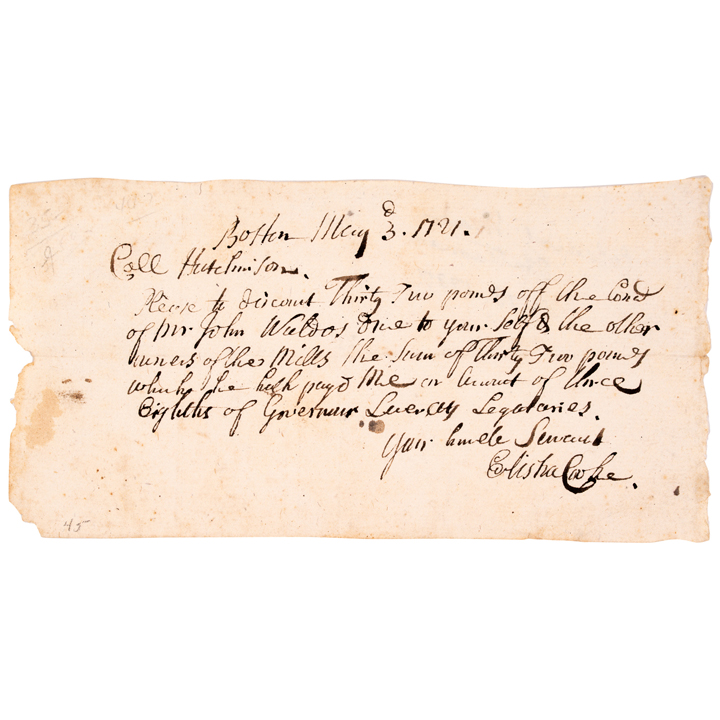
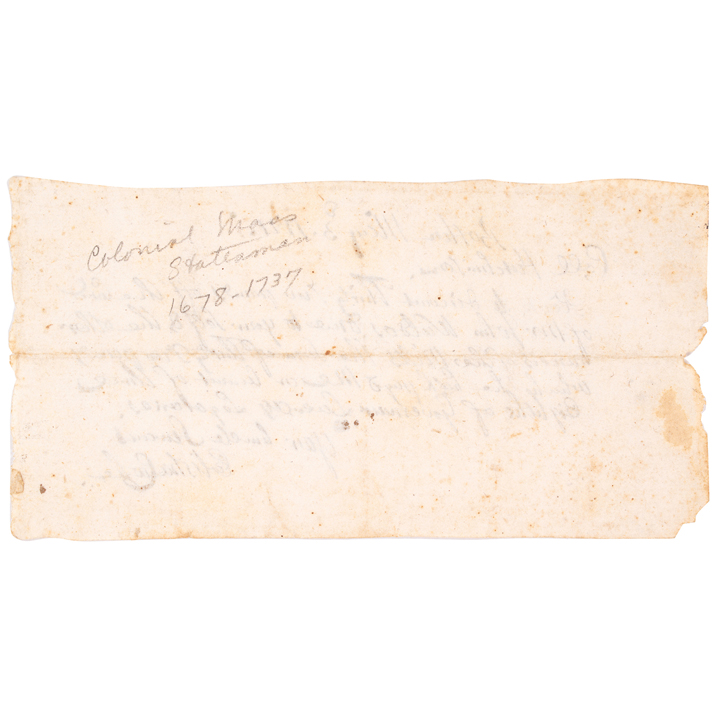
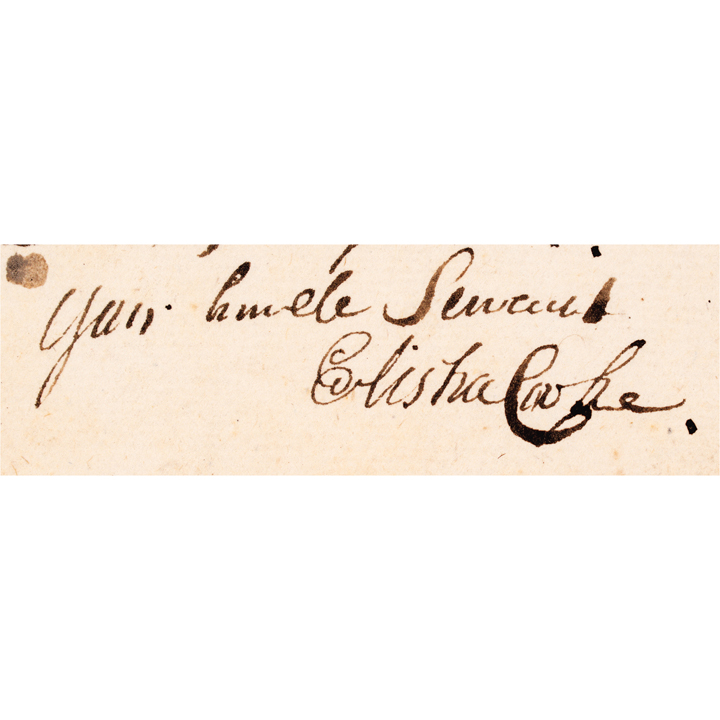
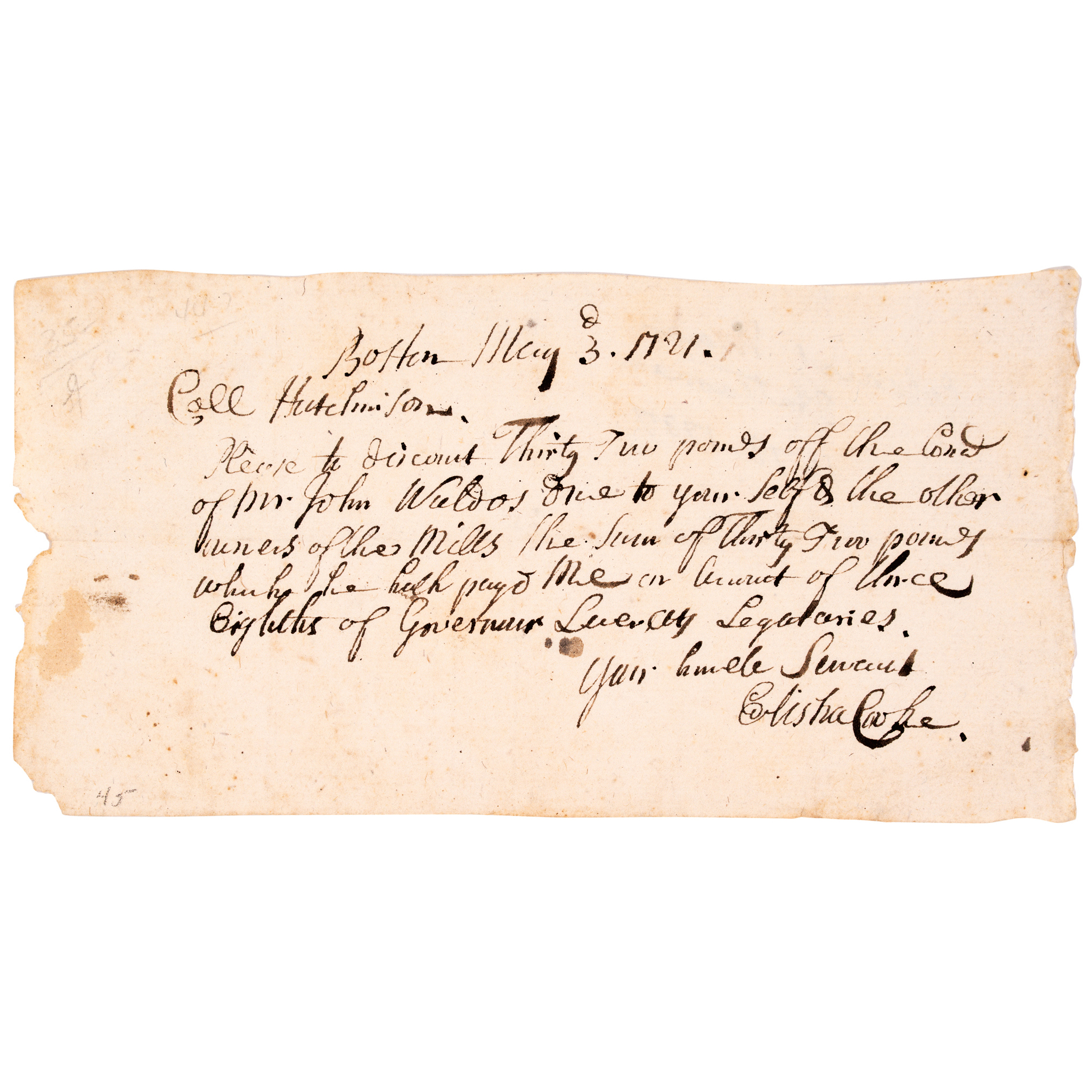
ELISHA COOKE, JR. (1678-1737). Physician and politician from Massachusetts, Speaker of the House, and the leader of the 'Popular Party', a faction in the Massachusetts House that resisted encroachment by Royal Officials on Colonial Rights, as embodied in the original Massachusetts Charter. Elisha Cooke Jr. was one of the most powerful and controversial political figures in early 18th-century Massachusetts. Born December 20, 1678, in Boston, he was the son of Elisha Cooke Sr., himself a wealthy physician and Speaker of the Massachusetts House, and the grandson (on his mother's side, Elizabeth Leverett) of Governor John Leverett, placing him at the center of Massachusetts's founding political families from birth. The Boston Caucus was established around 1719 by Cooke, and it later was instrumental in building the influence of Samuel Adams. May 3, 1721-Dated, rare historic Autograph Document Signed, “Elisha Cooke”, 1 page, Boston, to 'Coll. Hutchinson', Very Fine. Boldly handwritten in deep rich brown ink on clean laid period paper, measuring about 3” x 6” with some minor roughnesss to the left side outer margin edge, otherwise well centered with wide margins and easily readable having a blank reverse. It reads, in part: “Boston -- May 3rd, 1721 --- Pall Hutchinson, -- Please to discount Thirty Two pounds off the land of Mr. John Waldos due to your self & the other owners of the Mills the Sum of Thirty five pounds which he hath payd Me on Account of Three Eighths of Gouverneur Beverly Legalaries. --- Your humble Servant -- (Signed) Elisha Cooke.” A signed financial instruction from Elisha Cooke Jr. is significant on two levels: first, it's an autograph document from one of the most consequential (and fiercely Anti-Royalist) Massachusetts political leaders of the early 18th century, dated 1721, the very year following his explosive Speaker's-chair confrontation with Governor Shute, when he was at the peak of his political influence. Second, it offers a rare, concrete glimpse into the mundane financial afterlife of the “Bellingham” estate controversy, one of colonial Massachusetts's longest-running legal sagas, tying Cooke directly (via property/legacy interest) to that landmark case. This is a fascinating piece specifically because of the financial matter it records. Reading "Gouverneur Beverly Legalaries" as a period rendering of "Governor Bellingham's Legacies" makes excellent historical sense: Richard Bellingham, several-times Governor of the Massachusetts Bay Colony (d. 1672), left behind one of colonial New England's most famously contested wills. His son challenged the will, it was eventually set aside by the courts, and the resulting litigation over his Winnessimmett (Chelsea) landholdings dragged on for more than a century, not finally settled until 1785. A 1721 document referencing "three eighths of Governor [Bellingham]'s legacies" fits squarely within that long-running estate dispute, right in the thick of it, roughly halfway through its century-long life. Put together, this note reads as a piece of ordinary but historically rich estate bookkeeping: whereby Cooke, who apparently held (or was owed) a three-eighths interest in the Bellingham legacy, instructs a Hutchinson, a family deeply intertwined in Boston-area property and civic affairs, to credit £32 against what a John Waldo owed Hutchinson and his fellow mill-owning partners, since Waldo had separately just paid Cooke £35 against Cooke's own Bellingham inheritance claim. In effect, it's a short, informal instruction letter untangling three parties' overlapping accounts, Cooke, Hutchinson (and partners), and Waldo, all connected through the decades-long unwinding of a Colonial Governor's estate. The Bellingham Estate Controversy: Richard Bellingham (c. 1592-1672) was one of the most senior figures of the entire founding generation of the Massachusetts Bay Colony, an English-trained lawyer who emigrated in 1634 and went on to serve as governor three separate times (1641-42, 1654-55, and 1665 until his death in 1672), plus thirteen years as deputy governor. He was the last surviving signer of the original colonial charter, helped draft the Massachusetts Body of Liberties, and was a substantial landholder, he purchased the Winnessimmett ferry service and much of what is now Chelsea, Massachusetts, from Samuel Maverick, building a country house/hunting lodge there in 1659 in addition to his mansion in Boston. Bellingham was married twice. His second marriage, to a much younger woman, Penelope Pelham, contracted somewhat irregularly and without observing the customary legal formalities, was already controversial in his own lifetime and reportedly contributed to his political defeat in the 1641 election. That second marriage became the seed of the later estate fight: when Bellingham died in 1672, his will set aside a portion of his valuable Winnessimmett properties for religious/charitable uses (rather than passing cleanly to his bloodline), while other provisions favored Penelope, his surviving widow. His son Samuel Bellingham (from the first marriage) challenged the will almost immediately, objecting to the terms that diverted property away from direct inheritance. The contest dragged through the courts, and the will was ultimately declared invalid and set aside. But invalidating the will didn't end the dispute, it just opened the door to further fights over exactly who was entitled to what share of the underlying property, since Bellingham had named trustees and laid out specific bequests that now had no clear legal standing. As a contemporary observer (quoting the historian Governor Thomas Hutchinson, writing decades later) put it, Bellingham, despite being a trained lawyer himself, had made his will "in such a manner that after some years' dispute" it collapsed into confusion. |
|||||||||||
|
Auction Closing: Saturday, November 14th
at Noon Eastern Time • 9:00 AM Pacific Time |
|||||||||||