
|
Lot: 9 ♡
|
|||||||||||
|
Henry Dearborn Approves $5 Pay for an Express Rider to Mount Vernon - No Doubt Delivering a Letter from President Thomas Jefferson offering Tobias Lear the Position of Consul to Saint Dominque on March 26th, 1801 and then Returning with Tobias Lear’s Personal Response
|
|||||||||||
|
|||||||||||
 |
|
||||||||||
|
Lot 9:
Henry Dearborn Approves $5 Pay for an Express Rider to Mount Vernon - No Doubt Delivering a Letter from President Thomas Jefferson offering Tobias Lear the Position of Consul to Saint Dominque on March 26th, 1801 and then Returning with Tobias Lear’s Personal Response
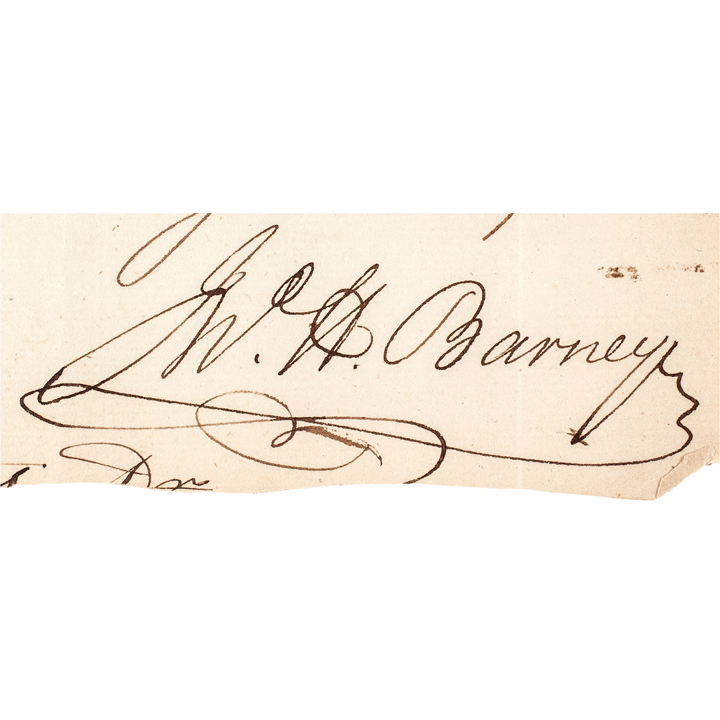
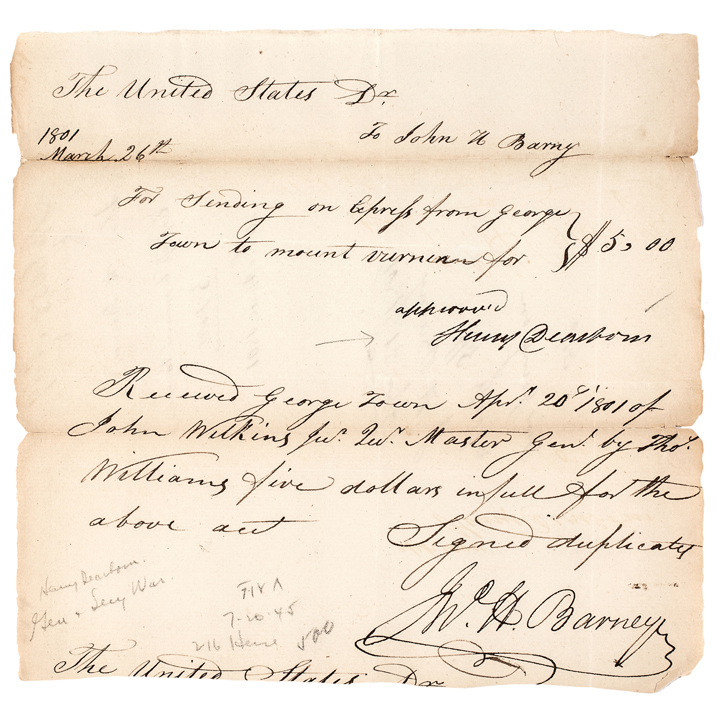
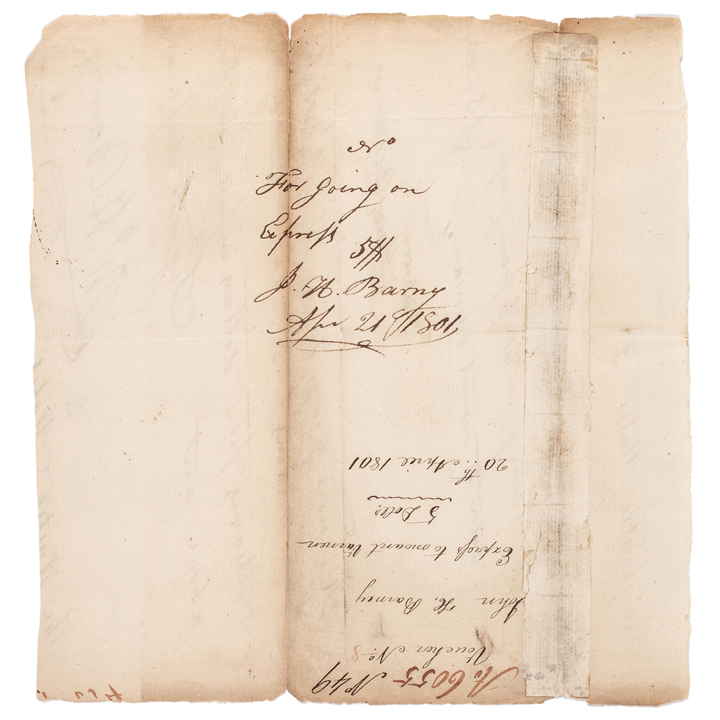
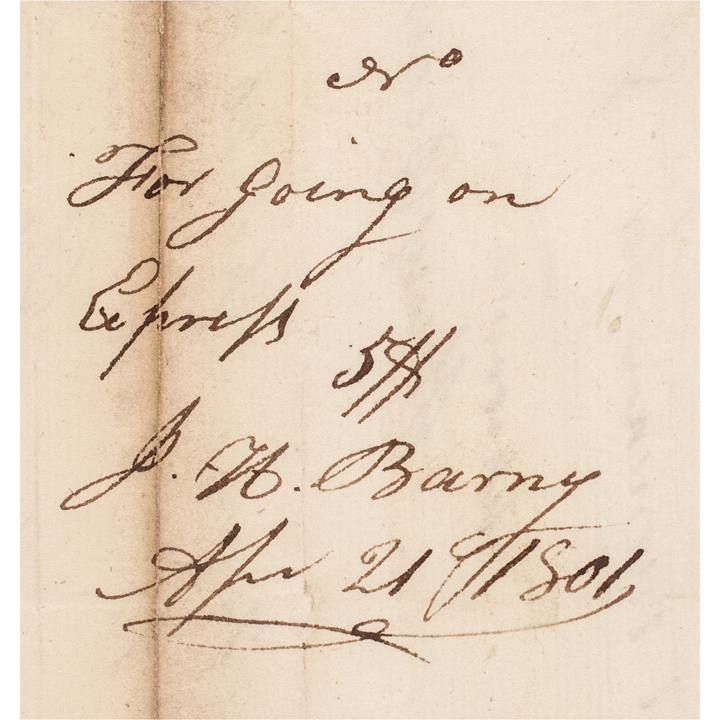
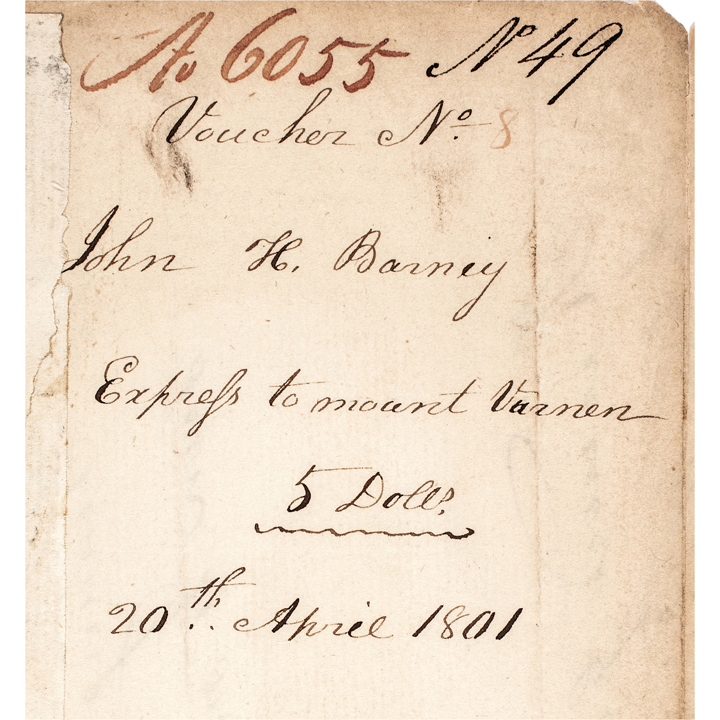
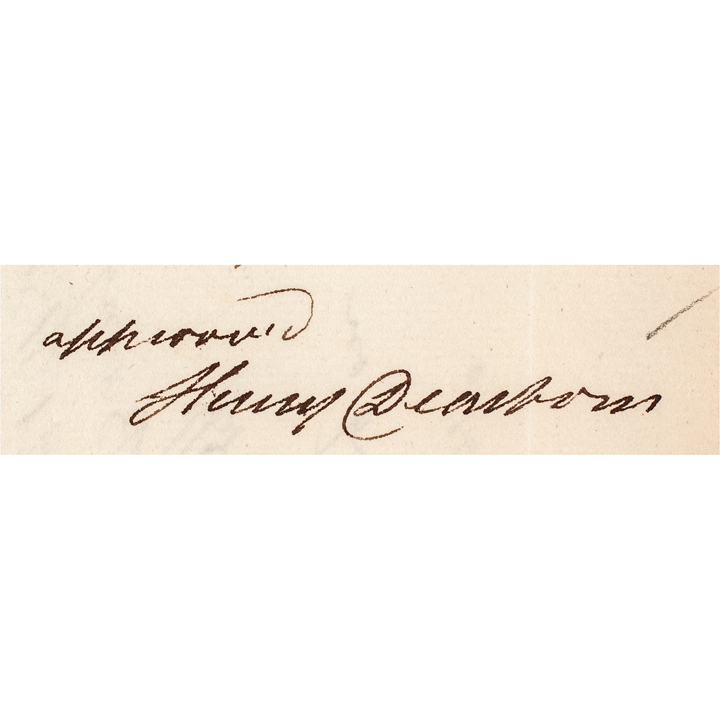
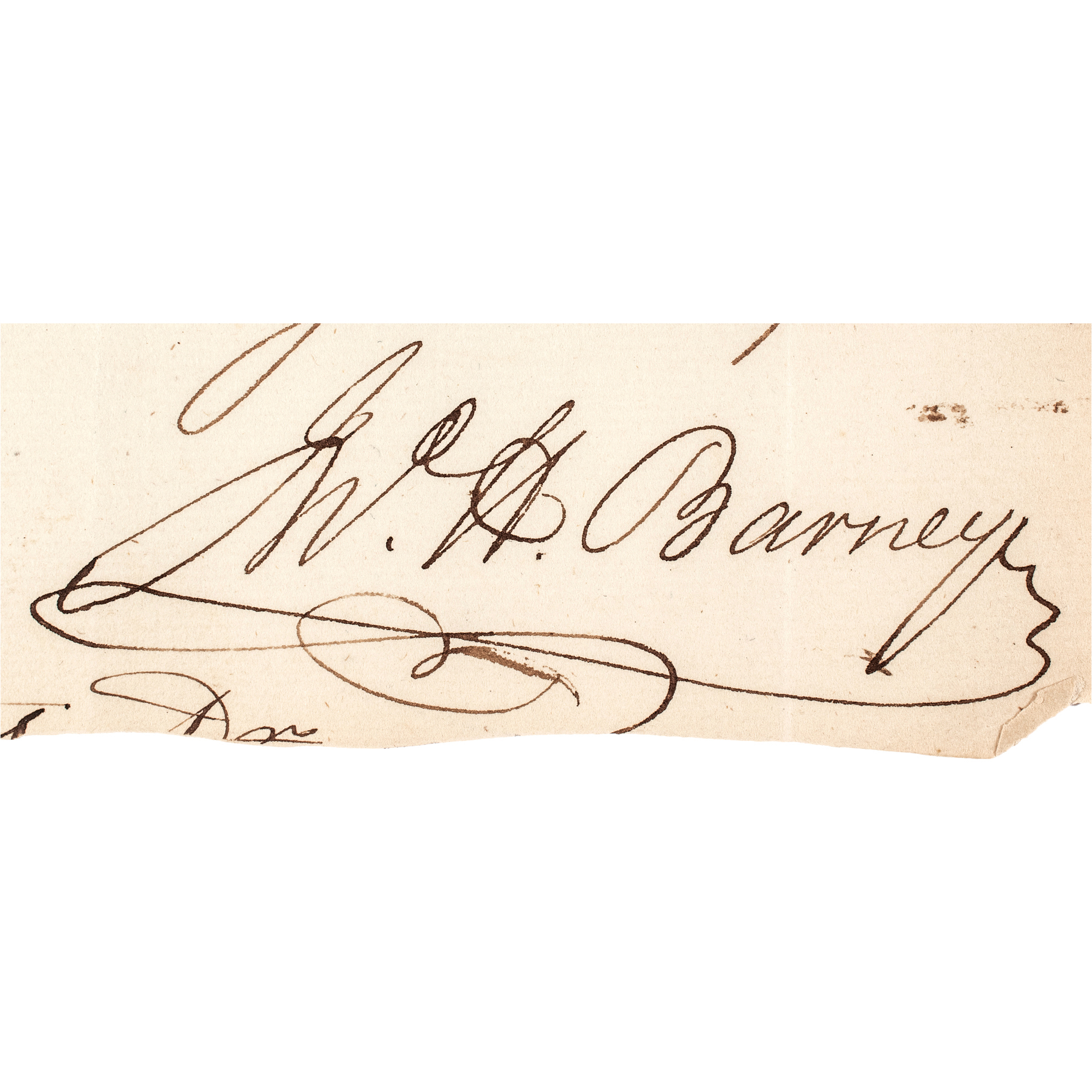
HENRY DEARBORN (1751-1829). Continental Army General; Member of General George Washington's staff; present at Valley Forge, and during the British Surrender at Yorktown; later was U.S. Secretary of War under President Thomas Jefferson. Together with: JOHN HOLLAND BARNEY (1752-1840). Brother of Commodore Joshua Barney, operated a tavern in Georgetown and on the west bank of the Susquehanna River at Havre de Grace, Baltimore County, Maryland here being the Express Rider. March 26, 1801-Dated Federal Period, Manuscript Autograph Endorsement Signed, “Henry Dearborn” for the payment of John H. Barney, 1 page, measuring 7.5” tall x 8” wide, well written in rich brown ink and easily readable on “F B” watermarked laid period paper, Very Fine. No doubt this Express Rider was delivering a Letter was meant for Tobias Lear with an offered appointment by President Thomas Jefferson (not present). Lear served as President George Washington’s Personal Secretary until his death in December 1799. Here, president Jefferson would be offering Lear a Diplomatic Post, an appointment as the United States Consul to Saint Domingue, issued the same day March 26th, 1801 (not present). The complete text for John H. Barney as the Express Rider’s pay, and his most likely returning with Lear’s personal letter in response (not present), as Endorsed by Henry Dearborn, reads in full: “The United States Dr. --- To John H. Barny ----- 1801 March 26th --- For Sending on Express from George-Town to mount Vernon (sic) (Mount Vernon) for - $5,00 --- approved ... (Signed) Henry Dearborn” “Received George Town Aprl 20th 1801 of John Wilkins Jur. Qur (Quarter) Master Genl. by Thos Williams five dollars in full for the above acct / Signed duplicate / (Signed) Jno H. Barney”. Overall, this is a full document slightly trimmed at bottom with old laid paper fold reinforcement on the reverse, fold tone and edge splits. The signatures of both Henry Dearborn and John Barney appear clearly written, as well as the text. Docket on the blank reverse reads, in full: “Voucher No 49 / John H. Barney / Express to mount Vernon / 5 Dolls. / 20th April 1801”. The opposite edge written by Barney reads, in full: “For going on / Express 5$ / (Signed) - J.H. Barney / April 21, 1801” (with his flourish below). The full text of Tobias Lear’s response to President Jefferson, dated March 26th, 1801 is provided in full online at: www.EarlyAmerican.com The Express rider, whether Barney or more likely someone sent by him, probably carried a letter from President Thomas Jefferson to Tobias Lear, former personal secretary to President George Washington who served in that position from (1786 to 1799). Tobias Lear was also present at Washington's death, and oversaw the funeral arrangements. From Washington, Lear inherited a lifetime interest in Walnut Tree Farm, one of the plantations of Mount Vernon, located on the Potomac River between the Mount Vernon estate and Georgetown. President Jefferson asked Lear to accept the appointment but required "a very early departure," and Jefferson would need to see Lear within two or three days before making a short trip to Monticello. The urgency of Jefferson's request may have required an express rider to deliver the letter. Later, on that same day, March 26th, 1801, Tobias Lear responded to President Thomas Jefferson... Tobias Lear to Thomas Jefferson, 26 March 1801, in full: “Dear Sir, ---- March 26th, 1801 -- I have been this moment honored with your favor of the present date, and feel grateful for the attention you have been so good as to pay me, by an offer of the Consulship in St. Domingo; and am highly flattered by the confidence which you repose in my prudence and discretion. - But, how ever desireable such an office may be to me, either in a pecuniary point of view; or from a wish to serve my Country, I must, at present, decline it, as the situation of my own Affairs will not permit me to leave the United States immediately; for although an attention to them would not occupy my whole time; yet some part of them are so circumstanced as not to allow of my committing them, at this time, to the charge of another person. - Although I have always avoided, as much as possible, giving recommendations for Office; yet I should do an injury to my own feelings, and perhaps injustice to my Country, not to call your attention, on this occasion, to Mr. Bartholomew Dandridge, who has lately been appointed Consul for some of the Southern Ports of St. Domingo, and in whose prudence and discretion I have as full a confidence as I have in my own. - This Gentleman, you will recollect, was in the Family of General Washington during his Presidency, and after I left him, acted as his private Secretary to the end of his Administration, when Mr. D. went to the Hague with Mr. Murry as his Secretary, and that Climate not agreeing with his health, he went to England, where he held the same place under Mr. King, ’till about 12 mos. ago, when he came to Alexandria and established himself in the mercantile line until his appointment. - He has not yet sail’d. - I recd. a letter from him dated the 15th inst. informing me that he should not sail till the middle of April. - But I will not take up more of your time at present, as I intend being in the City on Saturday, when I will have the honor of paying my respects to you. - And, if it is not really necessary to make this appointment before that time, you will do me a favour by delaying it; for I confess if it should be possible for me to receive it I should most readily embrace it. - Be assured, Dear Sir, of the Respect, Esteem & Attachment of Your Obliged Friend - (Signed) Tobias Lear.” Tobias Lear also recommended Bartholomew Dandridge for the post, as Dandridge had already been appointed as Consul from the Southern District of Santo Domingo. Bartholomew Dandridge had received the appointment as Consul for what was designated the Southern district of Santo Domingo, including the ports of Cayes and Jeremie, in December 1800. Lear continued, stating that he would be in Washington two days later and hoped to meet with the President, adding, in part: "... if it is not really necessary to make this appointment before that time, you will do me a favour by delaying it; for I confess if it should be possible for me to receive it I should most readily embrace it." Jefferson endorsed Lear's letter as received, a month later on April 26th. On March 31st, 1801, Jefferson signed a Commission for Lear as “Consul General” for the Island of Santo Domingo, but it was replaced by another dated May 11th, 1801. In January 1802, the Senate also approved Lear's Appointment. Henry Dearborn (1751-1829) was born in New Hampshire and studied medicine with a doctor in Portsmouth before opening his own practice in Nottingham, New Hampshire in 1772. In 1775, he fought at the Battle of Bunker Hill as a captain in the 1st New Hampshire Infantry. He was captured during the Battle of Quebec at the end of 1775 and was released on parole in May 1776 but not exchanged until March 1777. He fought at Ticonderoga and in the Saratoga campaign. Dearborn joined General George Washington's main Continental army at Valley Forge, Pennsylvania, as a lieutenant colonel. Dearborn joined Washington's staff in 1781 as deputy quartermaster general and commanded the 1st New Hampshire at the Battle of Yorktown with the rank of colonel. He was discharged from the Continental Army in June 1783 and settled in Maine. He served in the U.S. House of Representatives as a Democratic-Republican from the District of Maine (then part of Massachusetts) from 1793 to 1797. In 1801, President Thomas Jefferson appointed him Dearborn as Secretary of War, a post he held until March 1809. President James Madison appointed him as collector of the port of Boston, a position Dearborn held from March 1809 to January 1812, when he became the Commanding General of the U.S. Army. After mediocre service in the War on the northern frontier with Canada, Dearborn was discharged from the army in June 1815. In 1818, Dearborn ran for Governor of Massachusetts, but his article criticizing Israel Putnam's performance at the Battle of Bunker Hill sparked a long-lasting controversy that harmed his campaign in a largely Federalist state. The Senate rejected Madison's nomination of Dearborn for Secretary of War, and Dearborn served as minister to Portugal from May 1822 to June 1824. He then retired to his home in Massachusetts. Dearborn married three times-to Mary Bartlett in 1771, to Dorcas Marble in 1780, and to Sarah Bowdoin, widow of James Bowdoin, in 1813. John H. Barney (1752-1840) was a brother of Commodore Joshua Barney (1759-1818). He served as postmaster of Havre de Grace, Maryland, from 1789 to 1795, where he also operated a ferry. By 1797, he had invested in a stage line between Philadelphia and Baltimore. In 1800, he moved to Georgetown, and the firm of John H. Barney & Co. continued to operate stagecoaches on routes between Alexandria, Baltimore, Washington, and Philadelphia into the 1830s. Tobias Lear (1762-1816) was born in New Hampshire and graduated from Harvard College in 1783. He tutored Martha Washington's grandchildren and served as personal secretary to George Washington beginning in 1786. He remained as Washington's personal secretary, with some interruptions, until the former president's death in 1799. Lear started T. Lear & Company to work with Washington's Potomac Company to promote river traffic and to speculate in land. His business was largely a failure, and he returned to Washington's service. He married Mary Long in 1790, and they had one son before she died in the yellow fever epidemic in Philadelphia in 1793. Two years later, Lear married Frances Bassett Washington, the recent widow of the President's nephew George Augustine Washington. She died in 1796 of tuberculosis. In 1803, he married Frances Dandridge Henley, a niece of Martha Washington. Lear served as a diplomat during the administration of Thomas Jefferson to Saint-Domingue (Haiti) (1801-1802) and to North Africa during the First Barbary War (1803-1805). He and his third wife remained in Algiers until 1812, when he fell out of favor with the Dey. He apparently committed suicide by shooting himself with a pistol. |
|||||||||||
|
Auction Closing: Saturday, November 14th
at Noon Eastern Time • 9:00 AM Pacific Time |
|||||||||||