
|
Lot: 90 ♡
|
|||||||||||
|
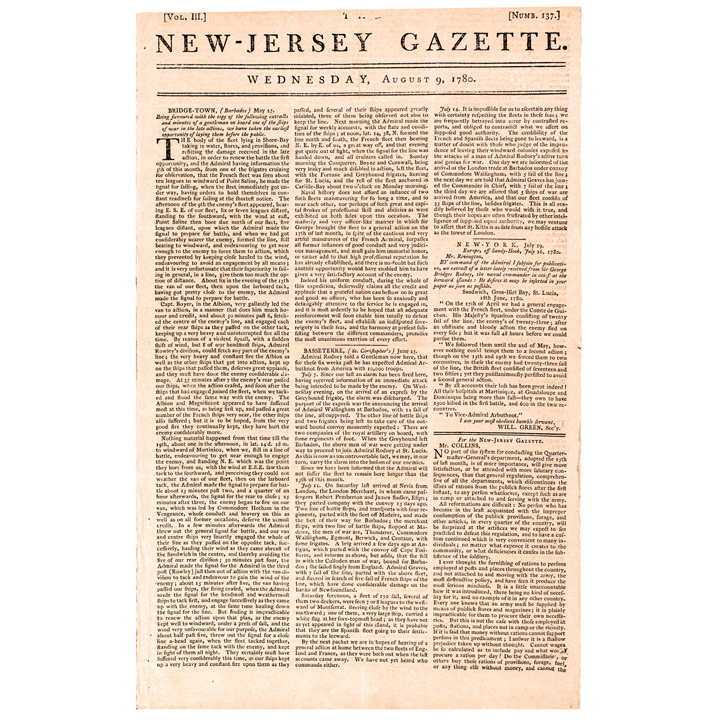
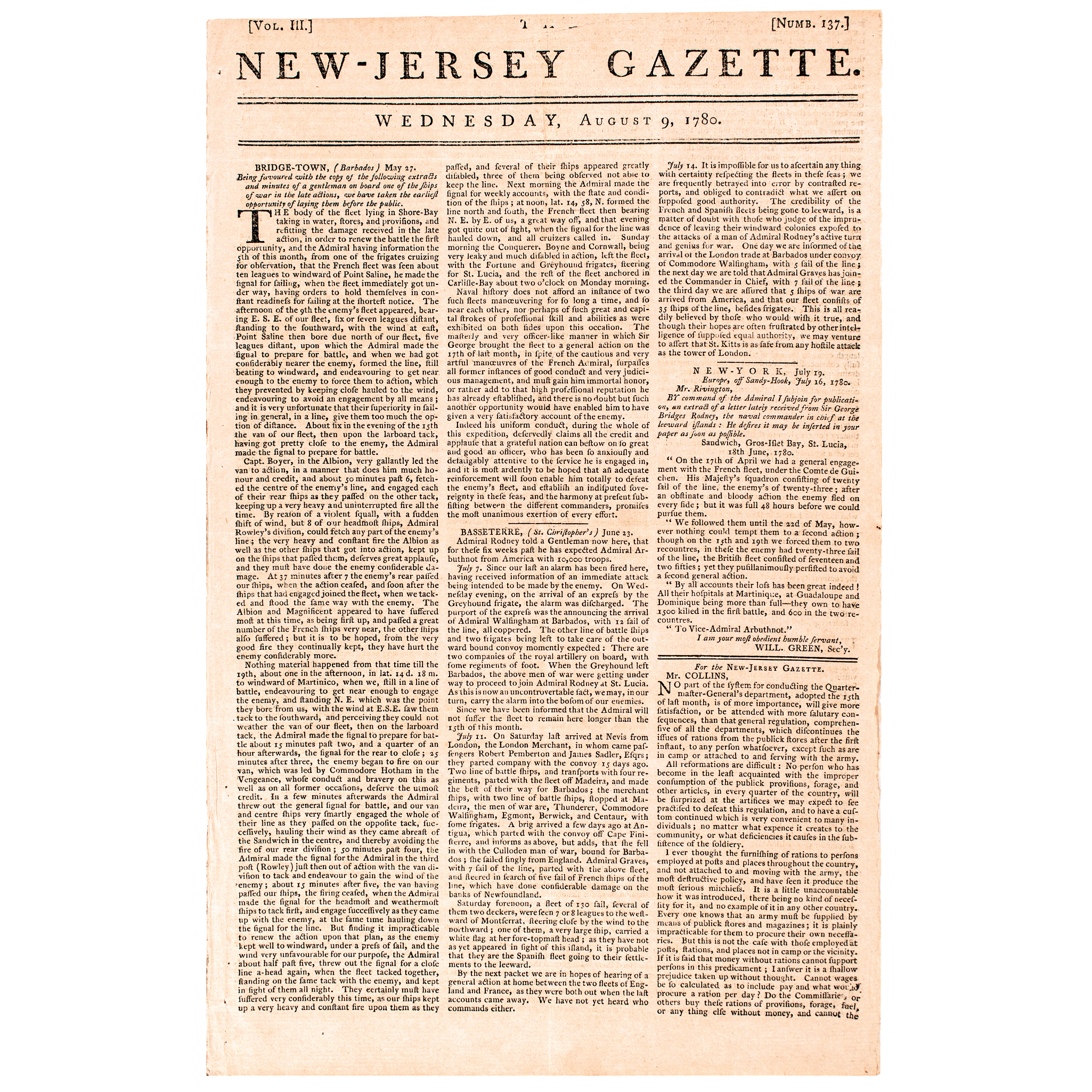
August 9, 1780 Issue of the New-Jersey Gazette, Printing an Official Letter of George Washington on the Battle of Bull's Ferry, Congressional Reward Resolve Anti-Counterfeiters !
|
|||||||||||
|
|||||||||||
 |
|
||||||||||
|
Lot 90:
August 9, 1780 Issue of the New-Jersey Gazette, Printing an Official Letter of George Washington on the Battle of Bull's Ferry, Congressional Reward Resolve Anti-Counterfeiters !
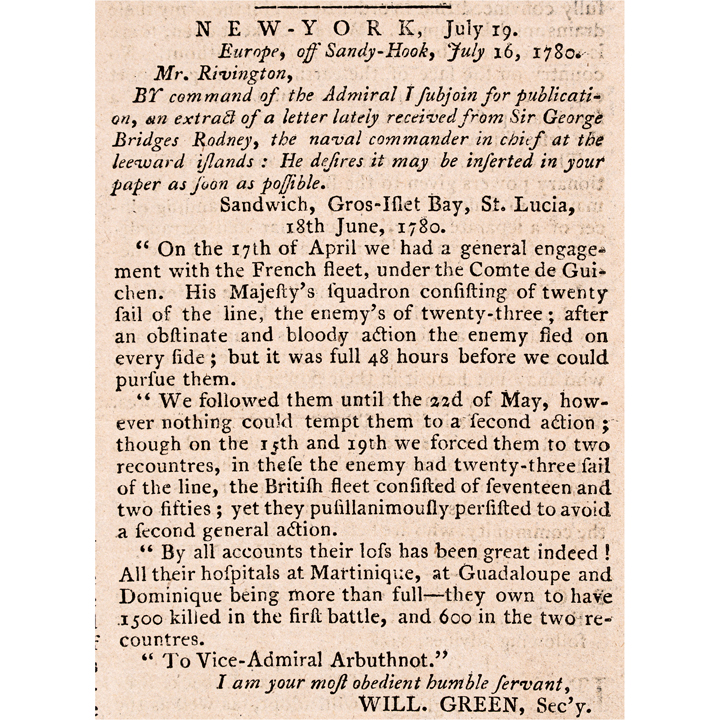
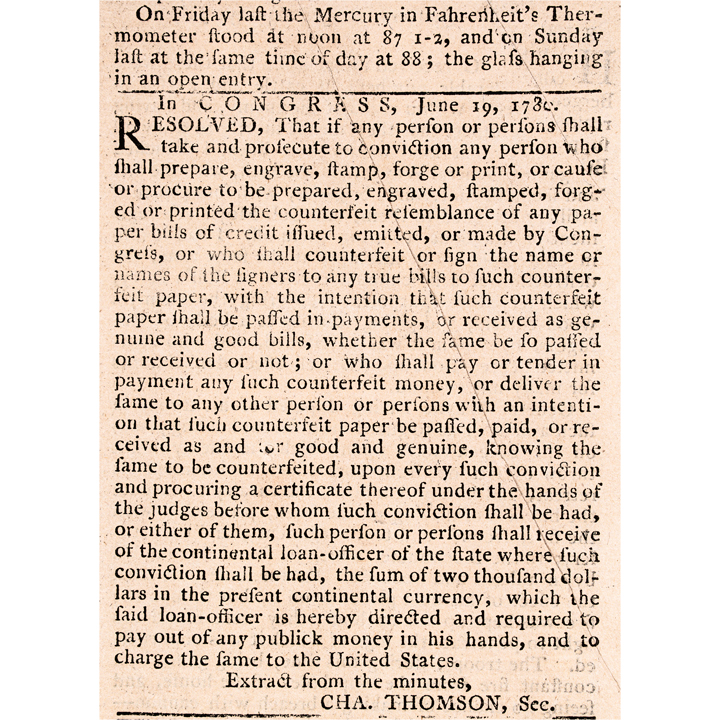
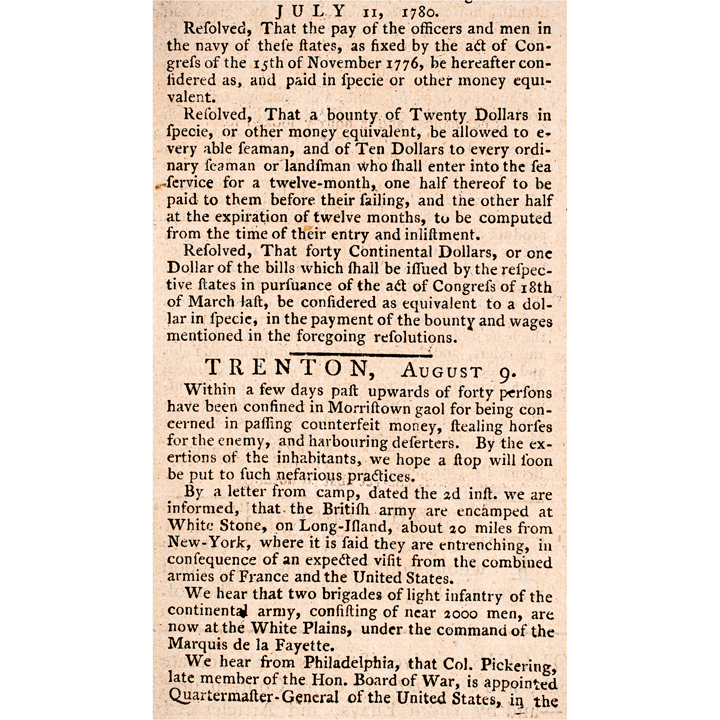
August 9, 1780-Dated Revolutionary War Complete Issue of the New-Jersey Gazette (Vol. III, No. 137), Trenton, Printed by Isaac Collins, by Order of Congress, George Washington's Official Letter to Samuel Huntington Describing General Anthony Wayne's Failed Assault on the British Blockhouse at Bull's Ferry, Congressional Reward & Anti-Counterfeiters Resolve, Choice Crisp Extremely Fine+. August 9, 1780, a superb complete superior quality four-page issue of the New-Jersey Gazette, measuring about 14 x 9 inches, printed by Isaac Collins at Trenton, and published on Wednesday, , as Volume III, Number 137. This newspaper's most significant content is a letter from General George Washington to Samuel Huntington, as President of the Continental Congress, printed "by order of Congress" over the signature of Secretary Charles Thomson, being dated from Headquarters in Bergen County, July 26, 1780. In it, George Washington reports his decision to send Brigadier General Anthony Wayne with the First and Second Pennsylvania Brigades, four pieces of artillery, and Colonel Moylan's dragoons to drive off livestock from Bergen Neck and destroy a blockhouse the British had erected at Bull's Ferry. It reads, in part: "I had it also in contemplation to attempt, at the same time, the destruction of a Blockhouse erected at Bull's Ferry, which served the purposes of covering the enemy's wood-cutters, and giving security to a body of Refugees." Washington goes on to describe the failed assault in frank terms, reporting that his troops, "galled by a constant fire from the loop holes of the house," rushed the position "with a view of forcing an entrance, which was found impracticable," at a cost of "three officers wounded, 15 non-commissioned and privates killed, and 46 non-commissioned and privates wounded." The newspaper's front page is given reporting almost entirely to a long, detailed firsthand account, dated from Bridge-Town, Barbados, of the Battle of Martinique, fought April 17, 1780 between Admiral Sir George Rodney's fleet and the French fleet under the Comte de Guichen, one of the largest and most closely fought naval engagements of the war's Caribbean theater. The correspondent, writing from aboard one of the ships of the line, praises Rodney's generalship in bringing the wary French admiral to action at all stating: "Naval history does not afford an instance of two such fleets maneuvering for so long a time, and so near each other, nor perhaps of such great and capital strokes of professional skill and abilities as were exhibited on both sides upon this occasion." Virtually the entire newspaper reports much more Revolutionary War and related news, with only a small number of local ads, including Resolve of Congress dated June 19, 1780, offering a Reward of Two Thousand Continental Dollars to anyone who successfully prosecuted a Counterfeiter of Continental paper currency! The action Washington describes is the Battle of Bull's Ferry, in which some seventy Loyalist irregulars under Thomas Ward held off nearly two thousand Continental troops from a stockaded blockhouse opposite New York City. The episode's chief legacy proved literary rather than military: British Major John Andre, aide to Sir Henry Clinton, mocked Wayne's costly failure in a long burlesque ballad, "The Cow Chace," whose final installment appeared in Rivington's Royal Gazette in New York on September 23, 1780, the very day Andre himself was captured behind American lines while returning from his meeting with Benedict Arnold, a mission that would send him to the gallows as a spy within a month. Domestic news reported from Trenton in this same issue notes that "upwards of forty persons have been confined in Morristown gaol for being concerned in passing counterfeit money, stealing horses for the enemy, and harbouring deserters." Indeed a fitting local pairing with the resolve of Congress printed elsewhere in the issue, dated June 19, 1780, offering a reward of two thousand Continental dollars to anyone who successfully prosecuted a counterfeiter of Continental paper currency. This is a sum whose real value, given the currency's rampant depreciation by the summer of 1780, was considerably more modest than its face amount suggests. The same column reports that two brigades of Continental light infantry, some two thousand men, were then encamped at White Plains under the Marquis de Lafayette, anticipating a combined Franco-American operation against New York. |
|||||||||||
|
Auction Closing: Saturday, November 14th
at Noon Eastern Time • 9:00 AM Pacific Time |
|||||||||||