
|
Lot: 91 ♡
|
|||||||||||
|
March 30, 1775 Royal Assent Historic “Restraining Act” of Great Britain Restricting Trade With Some of It’s American Colonies: New Jersey, Penn., Maryland, Virginia, and S. Carolina!
|
|||||||||||
|
|||||||||||
 |
|
||||||||||
|
Lot 91:
March 30, 1775 Royal Assent Historic “Restraining Act” of Great Britain Restricting Trade With Some of It’s American Colonies: New Jersey, Penn., Maryland, Virginia, and S. Carolina!
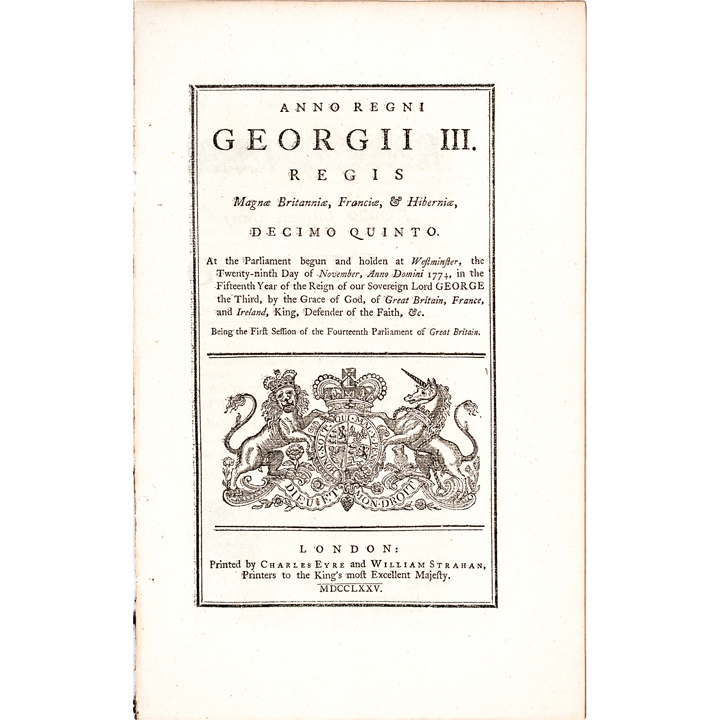
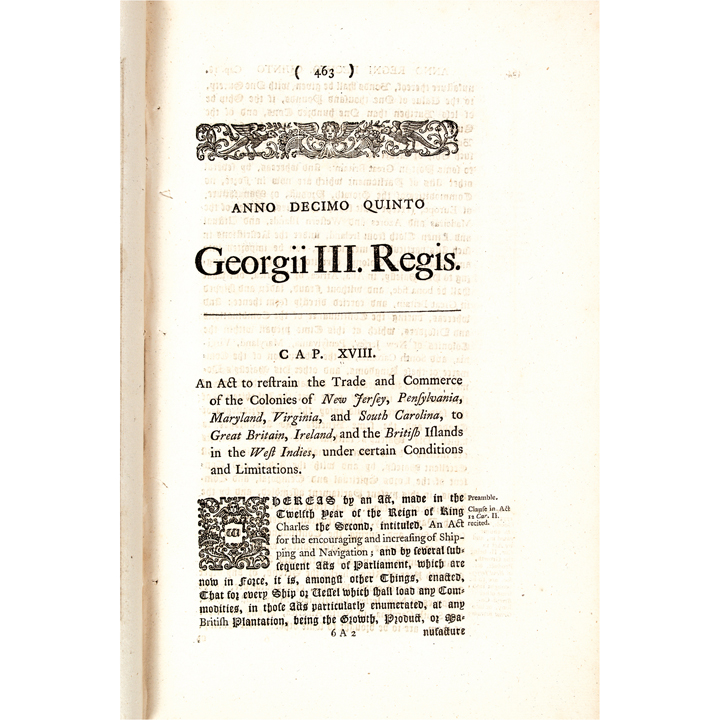
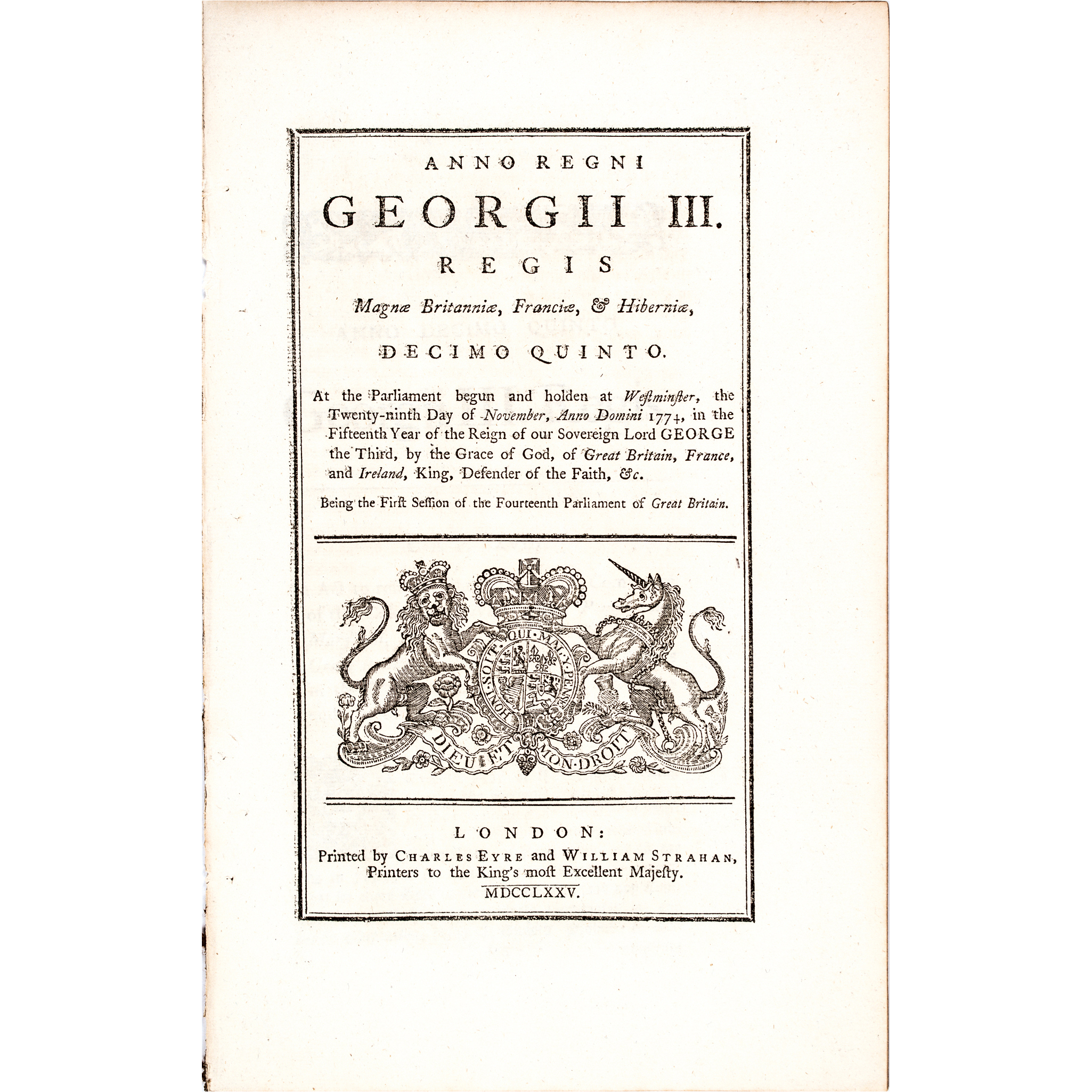
“Restraining Act” Approved March 30, 1775 the Revolutionary War Period Official Printed Act of the 1774 Fourteenth Parliament of Great Britain, titled: “An Act to restrain the Trade and Commerce of the Colonies of New Jersey, Pennsylvania, Maryland, Virginia, and South Carolina, to Great Britain, Ireland, and the British Islands of the West Indies, under certain Conditions and Limitations.”, Choice Crisp Mint. This is the Second of the Two March 1775 Revolutionary War Period "Restraining Acts" Approved by King George III, often called the Southern Colonies Restraining Act, or Trade (No. 2) Act 1775. Its the companion Act to the “the New England Restraining Act” (15 Geo. III, c. 10), that received Royal Assent (Approval) April 1775, which also cut off Massachusetts, New Hampshire, Rhode Island, and Connecticut from all foreign trade except with Britain, Ireland, and the British West Indies. It also barred them from the Newfoundland fisheries. Roughly two weeks later, on March 30, 1775, Parliament extended the same Trade Restrictions (though not the fisheries ban) to the five colonies named in this current document also under certain conditions and limitations. Benjamin Franklin, writing from London that same week, reported to Charles Thomson that a bill had passed the Commons stripping New England of its fishery and trade, and a new bill was being introduced extending the same trade restraints to those five colonies. This printed Act, has 9 pages, disbound, measuring 12.25” x 7.75” plus its ornate cover page from “Anno Regni Georgii III, Regis Magnae Britanniae, Franciae & Hiberniae, Decimo Quinto,” which simply means “The 15th Year of the Reign of George III, King of Great Britain, France and Ireland,” Printed in 1775 by Charles Eyre and William Strahan of London, the pages of this Act as an official government record. Therefore, the quality is expected to be high and the paper is bright, fresh and crisp with its full large margins and bold printing. The restrictions on trade to the West Indies, which was extremely important to the economy of the American Colonies, was another grievance leading to the Revolutionary War. A greatly important example in exceptional condition. Regarding this “Restraining Act” and the details that collectors and historians find most interesting is that New York, Georgia, North Carolina, and Delaware were deliberately left off the list. Benjamin Franklin explained why: Parliament had "great Hopes" of New York, and some hope for North Carolina, so those colonies were omitted as the ministry was gambling that dangling continued trade privileges might peel them away from the emerging colonial coalition, or at least sow division among the colonies. It was a “carrot-and-stick” strategy to punish the colonies that had committed to Boycotting Britain, while trying to keep the wavering ones inside the fold. The immediate trigger was the “Continental Association,” the coordinated Non-Importation/Non-Exportation Boycott of British Goods was adopted by the First Continental Congress in October 1774 in response to the Coercive (Intolerable) Acts. By early 1775, London had confirmed that New Jersey, Pennsylvania, Maryland, Virginia, and South Carolina had all thrown their weight behind that boycott. Parliament's answer was economic retaliation so that if those colonies wouldn't trade with Britain, Britain would make sure they couldn't trade with anyone else either. Dated “1774” on the title page is shown for the Session heading rather than showing 1775, and there's a straightforward explanation. This Act was passed during the first session of the newly-elected 14th Parliament of Great Britain, which convened in November 1774. However, the Parliamentary sessions and King's Printer Statute pamphlets were often headed by the year the session opened, even when individual Acts within that session received Royal Assent (approval) months later, in this case early 1775. So, "Fourteenth Parliament" + a title page reading "1774" is consistent with an Act that actually passed the Commons and received Royal Assent in March 30, 1775. It's simply dated to the session start, not the official “Assent” date. These were issued by the King's Printers, Charles Eyre and William Strahan. |
|||||||||||
|
Auction Closing: Saturday, November 14th
at Noon Eastern Time • 9:00 AM Pacific Time |
|||||||||||