
|
Lot: 92 ♡
|
|||||||||||
|
November 4, 1775-Dated Revolutionary War Period Printed Broadside Hampshire Provincial Congress Broadside Liquor Excise Tax Resolution
|
|||||||||||
|
|||||||||||
 |
|
||||||||||
|
Lot 92:
November 4, 1775-Dated Revolutionary War Period Printed Broadside Hampshire Provincial Congress Broadside Liquor Excise Tax Resolution
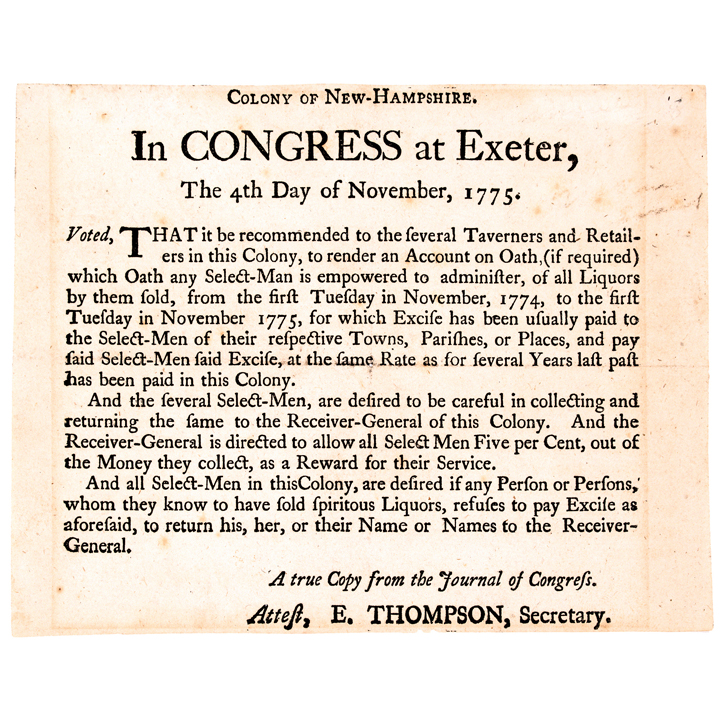
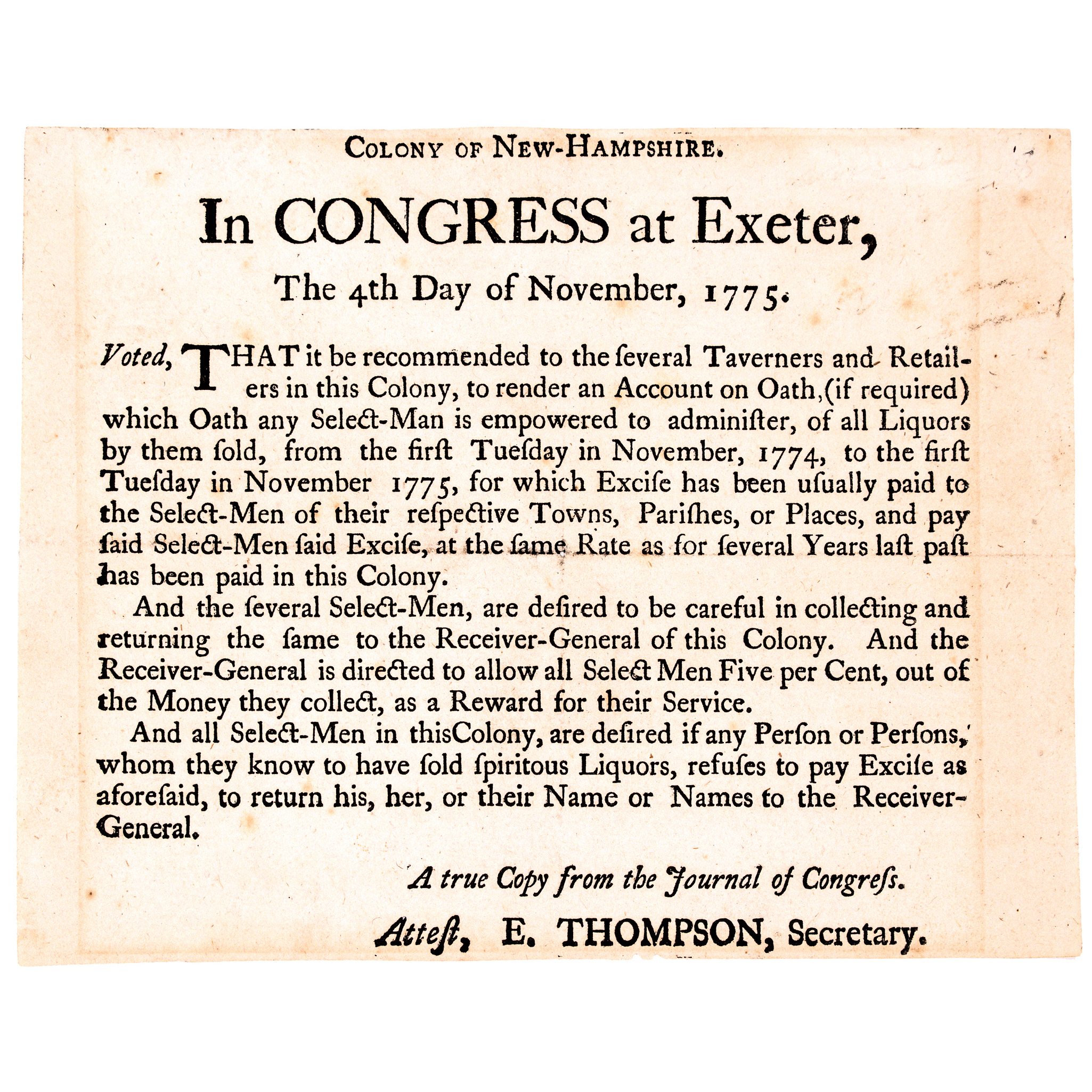
November 4, 1775-Dated Revolutionary War Period, New Hampshire Provincial Congress Broadside, issued at Exeter, headed: "Colony of New-Hampshire. / In CONGRESS at Exeter, / The 4th Day of November, 1775." Liquor Excise Tax Resolution, Attested by E. Thompson Secretary," Choice Very Fine. This rare Printed Broadside measures approximately 6.25" x 4.875" with the heading, "Colony of New-Hampshire. / In CONGRESS at Exeter, / The 4th Day of November, 1775." in progressively larger display type, followed by Liquor Excise Tax Resolution text in a smaller roman typeface. This boldly printed Broadside concludes with the attestation, "A true Copy from the Journal of Congress. / Attest, E. Thompson, Secretary." The sheet has been trimmed closely at the margins but all text remains fully intact and legible. A document of the first importance for the history of New Hampshire's Revolutionary period civil government, in a remarkably well-preserved state for a broadside of this fragility and age. This resolution is a model of Revolutionary War period Colonial administration: it votes to recommend to all taverners and retailers in the Colony of New Hampshire render an account on Oath, if required, of all liquors sold from the first Tuesday in November 1774 to the first Tuesday in November 1775. Whereby the excise tax on spirituous liquors had customarily been paid to the Select-Men of their respective towns, parishes, or places, directing that said excise be paid at the same rate as had been observed for several years past. The Select-Men are further directed to collect and return the excise money to the Receiver-General (Treasurer) of the Colony, who is authorized to allow the Select-Men five per cent of the money collected as a “reward” for their service. Any Select-Man knowing of a person who sold spirituous liquors but refused to pay the required excise is directed to report that person's name to the Receiver-General. Extremely rare, the first we such Broadside we have encounter in 50 years. The COLONY OF NEW HAMPSHIRE was among the most aggressive of the original Thirteen Colonies in organizing its own independent governmental apparatus well in advance of the formal Declaration of Independence. New Hampshire established a Provincial Congress at Exeter in 1775. It functioned as the de-facto governing body of the colony throughout the Revolutionary War period. Exeter, the colonial capital of New Hampshire, was the seat of this Congress. This present historic Broadside represents one of the practical legislative Acts of that body as it sought to maintain civil order, collect essential revenue, and regulate commerce during the extraordinarily disruptive opening months of the Revolutionary War with open conflict with Great Britain. This November 4, 1775 session of Congress at which this resolution was passed came less than seven months after the Battles of Lexington and Concord, during a period when the Continental Army was actively besieging Boston. The practical and timely concern with collecting liquor excise taxes reflects the Provincial Congress's determined effort to maintain the fiscal and administrative machinery of civil government, even as the colony was mobilized for war. |
|||||||||||
|
Auction Closing: Saturday, November 14th
at Noon Eastern Time • 9:00 AM Pacific Time |
|||||||||||